Cartesia
Low-latency voice AI platform behind the Sonic text-to-speech model, built for real-time agents
Cartesia is a developer-first voice AI platform built around Sonic, a text-to-speech model tuned for ultra-low latency — about 90ms time-to-first-audio on Sonic-3 and near 40ms on Sonic Turbo. A free tier gives 20,000 credits per month (~27 minutes of TTS); paid plans run $5 (Pro), $49 (Startup), and $299 (Scale), and voice agents cost $0.06 per minute. It clones a voice from ~3 seconds of audio and covers ~42 languages. Best for engineers building real-time voice agents rather than a consumer studio.
What is Cartesia?
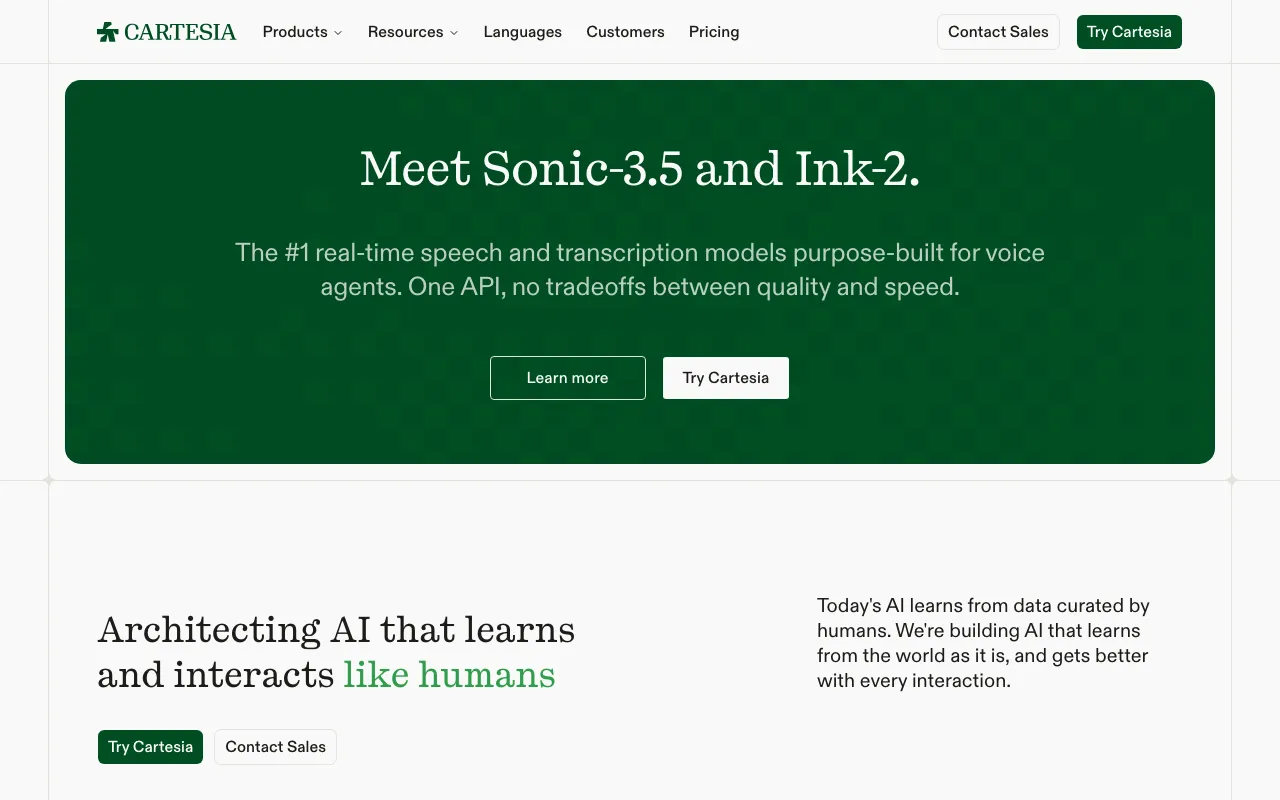
Cartesia is a voice AI platform built for developers, centered on Sonic — a text-to-speech model designed for ultra-low latency. Sonic-3 reaches roughly 90ms time-to-first-audio and the Sonic Turbo variant pushes toward 40ms, which is fast enough for live, synchronous conversations rather than pre-rendered clips. Around that model, Cartesia offers Ink for streaming speech-to-text and Line, an enterprise voice-agent platform, so a team can build a full real-time voice stack — listen, think, speak — from one vendor. Billing is credit-based: a free tier includes 20,000 credits per month, and paid plans scale credits up from there.
The company’s technical distinction is architectural. Cartesia spun out of Stanford’s AI lab in 2023, founded by researchers behind the state-space model line of work (the S4 and Mamba architectures), and Sonic is built on state-space models rather than conventional transformers. That underpins both its latency and its ability to run not just in the cloud but on-premise and on-device. Practically, it clones a usable voice from about 3 seconds of audio, covers roughly 42 languages in Sonic-3.5, and prices voice agents at $0.06 per minute of call time, with telephony at $0.014 per minute when using Cartesia phone numbers.
Who is it for?
Cartesia is aimed at engineers building voice features, not at creators who want a finished web studio. Its free tier and $5 Pro plan make prototyping cheap, and its latency advantage matters most when a human is waiting on the other end of the line — support bots, phone agents, and interactive characters — rather than for batch narration where a slower, more expressive model may be preferable.
- Teams building real-time voice agents — customer support, phone automation, and assistants — that need the lowest possible speech latency.
- Product engineers who want a single API for text-to-speech, streaming speech-to-text, and a managed agent platform.
- Developers with on-device or on-premise requirements who cannot rely on a cloud-only voice API for privacy or latency reasons.
- Creators of multilingual audio — audiobooks, podcasts, localized voiceovers — willing to work through an API rather than a polished consumer app.
How much does Cartesia cost?
Starting price: $0 · Free tier: yes · Model: usage-based
Price history tracked from June 2026
| Plan | Price | Includes |
|---|---|---|
| Free | Free | 20,000 credits/mo (~27 min TTS, ~1h51m STT) · 2 concurrent TTS / 8 concurrent STT streams · 1 agent slot, 8 concurrent calls |
| Pro | $5/mo | 100,000 credits/mo (~133 min TTS) · Commercial license included · Instant voice cloning from ~3 seconds of audio · 3 agent slots |
| Startup | $49/mo | 1.25M credits/mo (~1,667 min TTS) · Professional voice cloning and organizations · 5 agent slots |
| Scale | $299/mo | 8M credits/mo (~10,667 min TTS) · Priority support and high concurrency (60 calls) · 10 agent slots |
| Enterprise | Custom | Volume pricing and custom concurrency · DPAs/BAAs, SSO, security reviews · Dedicated support |
What are Cartesia's key features?
- Sonic-3 and Sonic Turbo text-to-speech models with ~40-90ms time-to-first-audio
- Ink streaming speech-to-text and the Line voice-agent platform on the same stack
- Instant voice cloning from ~3 seconds of audio, plus professional cloning on higher tiers
- Roughly 42-language coverage in Sonic-3.5
- State-space model architecture enabling cloud, on-premise, and on-device deployment
- Voice agents billed at $0.06/min and telephony at $0.014/min with Cartesia numbers
What people use Cartesia for
- 01 Powering real-time voice agents and phone systems that need sub-100ms speech synthesis
- 02 Cloning a brand or character voice from a few seconds of audio for consistent narration
- 03 Generating multilingual voiceovers across roughly 42 languages from one API
- 04 Adding streaming text-to-speech to apps, games, and assistants with low latency
Pros and cons
| Pros | Cons |
|---|---|
| Latency leader — Sonic Turbo near 40ms suits live, synchronous voice conversations | Developer- and TTS-focused: there is no polished consumer creator studio like ElevenLabs' web app |
| Free tier plus a $5 Pro plan make it cheap to prototype and go commercial | Smaller ecosystem and ~42 languages trail ElevenLabs' 70+ and its larger community voice library |
| State-space architecture enables on-device and on-premise deployment, not just cloud | Credit allotments run out faster than expected once real conversational turns are counted |
| Clones a usable voice from about 3 seconds of audio, less than many rivals require |
What are the best Cartesia alternatives?
Deepgram is the closest Cartesia alternative in our directory: it covers the same category (AI Audio & Music), starts at $0, has a free tier.
Ranked by category overlap with Cartesia, then free-tier availability, then lowest verified starting price — computed from our verified data, never from sponsorships.
| Alternative | What it is | Starting price | Free tier | Price verified |
|---|---|---|---|---|
| Deepgram | Developer-first voice AI API for speech-to-text, text-to-speech, and real-time voice agents | $0 | yes | Jul 5, 2026 |
| ElevenLabs | AI voice platform for text-to-speech, voice cloning, and conversational agents in 70+ languages | $6/mo | yes | Jul 3, 2026 |
| Murf AI | AI text-to-speech studio with 200+ voices across 35+ languages for voiceovers, dubbing, and voice agents | $19/mo | yes | Jun 11, 2026 |
| Resemble AI | AI voice platform for voice cloning, text-to-speech, and real-time voice agents, plus deepfake detection and audio watermarking | $0.0005/sec | no | Jun 30, 2026 |
How people make money with Cartesia
- Build low-latency voice agents or interactive characters for clients on Cartesia's streaming API — its per-minute agent pricing lets a studio charge a recurring platform fee while keeping synthesis costs low
- Produce narrated audiobooks, podcasts, and localized voiceovers using Sonic's cloned voices and multilingual output, billing per finished minute of audio through a freelance marketplace
Frequently asked questions
Is Cartesia free?
Yes, Cartesia has a free tier with 20,000 credits per month, roughly 27 minutes of text-to-speech. The $5 Pro plan raises that to 100,000 credits and adds a commercial license plus instant voice cloning. Paid usage is credit-based, so cost scales with how much audio you generate.
What is Cartesia's Sonic model?
Sonic is Cartesia's text-to-speech model, marketed as one of the fastest and most realistic available. Sonic-3 reaches about 90ms time-to-first-audio and Sonic Turbo about 40ms, making it a latency leader for real-time voice agents. It is built on a state-space model architecture for efficiency.
How much does Cartesia cost?
Cartesia's paid plans are Pro at $5 per month, Startup at $49, and Scale at $299, each with progressively larger monthly credit allotments (100K, 1.25M, and 8M credits). A free tier and a custom Enterprise plan also exist. Voice agents are billed at $0.06 per minute of call duration.
How does Cartesia compare to ElevenLabs?
Cartesia positions itself as the low-latency, developer-first option for real-time voice agents, while ElevenLabs is the benchmark for voice realism with a broader library and more languages (70+ versus about 42). Cartesia also clones a voice from roughly 3 seconds of audio, faster than ElevenLabs' usual sample length.
Can Cartesia clone voices?
Yes. Cartesia offers instant voice cloning from about 3 seconds of audio on the Pro plan and up, plus professional voice cloning on higher tiers. Cloned and custom voices work across its supported languages and can be deployed through the streaming API in real-time voice applications.
What languages does Cartesia support?
Cartesia's Sonic-3.5 model supports roughly 42 languages as of 2026, up from about 15 in earlier versions. That is narrower than some rivals covering 70 or more languages, but it spans the major world languages used in most voice-agent and narration deployments.