Poe
Quora's multi-model AI aggregator — chat with GPT, Claude, Gemini, and thousands of bots under one subscription
Poe is Quora's aggregator that puts GPT-5.5, Claude Opus 4.7, Gemini, image and video models, and thousands of community bots behind a single login and a shared compute-points budget. There is a free tier with limited daily points; paid plans run from roughly $4.99/month (10,000 points/day) through $19.99/month (660,000 points/month) up to $249.99/month (8.25M points/month). Annual billing saves about 17%. Best for people who want to switch between frontier models without juggling five separate subscriptions.
What is Poe?
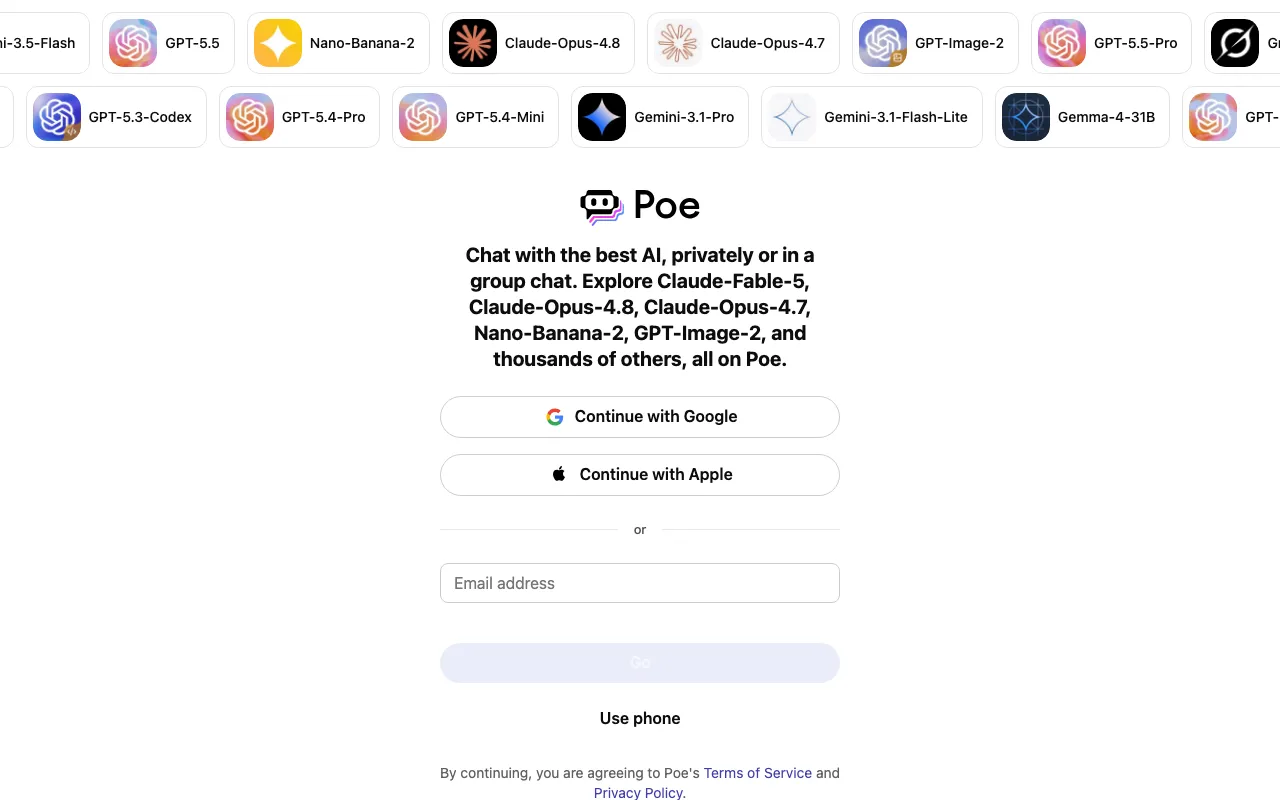
Poe is Quora’s AI aggregator: instead of buying separate subscriptions to ChatGPT, Claude, and Gemini, you get one login that reaches all of them, plus image, video, and audio models and thousands of community-built bots. Everything runs on a single compute-points budget — each model charges a different number of points per message, so a quick reply from a lightweight model costs little while a long answer from a frontier model like GPT-5.5 or Claude Opus 4.7 costs more. The appeal is breadth: you can send the same prompt to several models, compare the responses side by side, and pick the strongest one for the task without leaving the app.
Beyond chat, Poe lets anyone build a custom bot by wrapping a model in a saved system prompt and publishing it, and creators can earn a share when others use their bots. Poe has moved to transparent USD pricing on models — which it says runs 10-30% below native provider rates — and ships a developer API with tool calling across OpenAI, Anthropic, and Google models, so it plugs into automation tools like n8n and Cline. Apps cover web, iOS, Android, and desktop with synced history. The trade-off for all this convenience is the points system: budgets are easy to burn through on frontier models, and predicting how far a plan will stretch takes some trial and error.
Who is it for?
Poe is for people who want access to many AI models without managing many accounts. If you switch between Claude, GPT, and Gemini depending on the task — or only reach for each one occasionally — one points budget is simpler and often cheaper than stacking subscriptions. The free tier is enough to evaluate the lineup, but real multi-model work needs at least the $4.99 or $19.99 paid tiers.
- Model-hoppers and power users who want to A/B the same prompt across frontier models and pick the best answer, with Claude Opus 4.7 as one of the top options on the platform.
- Casual multi-tool users who would rather pay one bill than maintain separate ChatGPT, Claude, and Gemini plans they each use lightly.
- Bot builders and creators who want to package prompts into shareable bots and earn from a marketplace.
- Developers who need one API to route tool-calling requests across OpenAI, Anthropic, and Google models from automation tools.
How much does Poe cost?
Starting price: $4.99/mo · Free tier: yes · Model: freemium
Price history tracked from June 2026
| Plan | Price | Includes |
|---|---|---|
| Free | Free | Limited daily compute points · Access to lower-cost and community models · Custom bot creation · No credit card required |
| Starter | $4.99/mo | Up to 10,000 compute points per day · $49.99/year on annual billing (~$4.17/mo) · Access to premium models within the daily budget · Faster responses than free tier |
| Subscriber | $19.99/mo | 660,000 compute points per month · $199.99/year on annual billing (~$16.67/mo) · Full access to GPT, Claude, Gemini, and image/video models · Bot creation and sharing |
| Pro | $49.99/mo | 1.65M compute points per month · $499.99/year on annual billing (~$41.67/mo) · Headroom for frontier and reasoning models · Image, video, and audio generation |
| Pro+ | $99.99/mo | 3.3M compute points per month · $999.99/year on annual billing (~$83.33/mo) · Heavy multi-model and media generation use · All available models |
| Max / Teams | $249.99/mo | 8.25M compute points per month · $2,499.99/year on annual billing (~$208.33/mo) · For expensive frontier models and high-volume teams · Purchase additional credits as needed |
What are Poe's key features?
- Single account access to frontier models from OpenAI, Anthropic, Google, and others, plus thousands of community bots
- Compute-points budget shared across every model, so heavier models simply cost more points per message
- Custom bot builder — wrap any model in saved system prompts and publish it
- Image, video, and audio generation models (Nano-Banana-Pro, Veo, Sora-2 and others) alongside text chat
- Transparent USD pricing on models, which Poe says runs 10-30% below native provider rates
- Developer API with tool calling across OpenAI, Anthropic, and Google models, managed via an API key
- Apps for web, iOS, Android, and desktop with synced chat history
- Optional credit top-ups when the monthly points budget runs out
What people use Poe for
- 01 Comparing the same prompt across GPT-5.5, Claude Opus 4.7, and Gemini side by side to pick the best answer per task
- 02 Replacing several separate AI subscriptions with one bill when you only use each model occasionally
- 03 Generating text, images, and video from one interface without switching providers
- 04 Building and sharing custom prompt bots with preset instructions for repeatable workflows
- 05 Calling Poe's API from automation tools like n8n or Cline to route requests across multiple model providers
Pros and cons
| Pros | Cons |
|---|---|
| One subscription replaces separate GPT, Claude, and Gemini plans for users who switch between models | The compute-points system is opaque — point costs vary per model and per message, so it is hard to predict how far a budget will stretch |
| Free tier needs no credit card and is enough to evaluate the model lineup | Heavy use of frontier models like GPT-5.5 or Claude Opus 4.7 drains points fast, and you may need a higher tier or paid top-ups sooner than expected |
| Side-by-side model access makes it easy to compare answers and pick the strongest model — Claude Opus 4.7 is one of the top options available inside Poe | You sit one step removed from each model's native interface, so newer provider-specific features can lag or be missing on Poe |
| Annual billing saves roughly 17% across every paid tier | At $249.99/month the top tier is expensive, and dedicated single-model subscriptions can be cheaper for someone who only uses one model |
What are the best Poe alternatives?
Gemini is the closest Poe alternative in our directory: it covers the same category (AI Chatbots), starts at $7.99/mo, has a free tier.
Ranked by category overlap with Poe, then free-tier availability, then lowest verified starting price — computed from our verified data, never from sponsorships.
| Alternative | What it is | Starting price | Free tier | Price verified |
|---|---|---|---|---|
| Gemini | Google's multimodal AI assistant with real-time Search access and deep Workspace integration | $7.99/mo | yes | Jun 11, 2026 |
| ChatGPT | Conversational AI assistant by OpenAI with multimodal reasoning, voice, and agent capabilities | $8/mo | yes | Jun 11, 2026 |
| Grok | xAI's truth-seeking chatbot with real-time X/web access and extended reasoning | $10/mo | yes | Jun 11, 2026 |
| Claude | Anthropic's AI assistant built for long-context analysis, coding, and safe reasoning | $20/mo | yes | Jul 3, 2026 |
| Perplexity | AI-powered answer engine that searches the live web and cites every source | $20/mo | yes | Jun 11, 2026 |
How people make money with Poe
- Build and publish custom prompt bots on Poe's marketplace — creators earn a revenue share when other users spend points or subscriptions on their bots
- Offer multi-model prompt-engineering consulting — Poe's side-by-side model access lets you benchmark Claude, GPT, and Gemini for a client on one screen instead of three accounts
Frequently asked questions
Is Poe free?
Yes. Poe has a free tier with a limited daily allowance of compute points and no credit card required. It is enough to try the model lineup, but heavier use of frontier models needs a paid plan starting around $4.99/month.
How does Poe's points system work?
Poe runs on compute points. Every message, image, or video consumes points, and each model has its own cost per message — cheaper models cost few points while frontier models like GPT-5.5 or Claude Opus 4.7 cost many. Plans give you a daily or monthly points budget, and you can buy more credits if you run out.
How much does Poe cost?
Poe's paid plans range from about $4.99/month (10,000 points/day) and $19.99/month (660,000 points/month) up to $249.99/month (8.25M points/month), with intermediate tiers in between. Annual billing saves roughly 17%, so the $19.99 plan is about $199.99/year.
Which AI models are available on Poe?
Poe aggregates models from multiple providers, including OpenAI's GPT, Anthropic's Claude (Opus 4.7 and Sonnet 4.5), Google's Gemini, plus image and video models like Nano-Banana-Pro, Veo, and Sora-2 — alongside thousands of community bots.
Is Claude available on Poe, and is it any good?
Yes. Claude Opus 4.7 and Claude Sonnet 4.5 are both available on Poe and are among the strongest options on the platform, especially for long-context reasoning, writing, and coding. Because Poe lets you run the same prompt across models, Claude is easy to compare head-to-head against GPT and Gemini.
Does Poe have an API?
Yes. Poe offers a developer API with tool calling across OpenAI, Anthropic, and Google models, managed through an API key. It integrates with automation tools like n8n and Cline, and API usage draws on your Poe subscription and credits.
Should I use Poe or a single-model subscription?
Poe makes sense if you switch between several models or use each one occasionally, since it replaces multiple bills with one points budget. If you live in a single model all day, a dedicated subscription to that provider is often cheaper and gives you its newest native features first.