OpenRouter
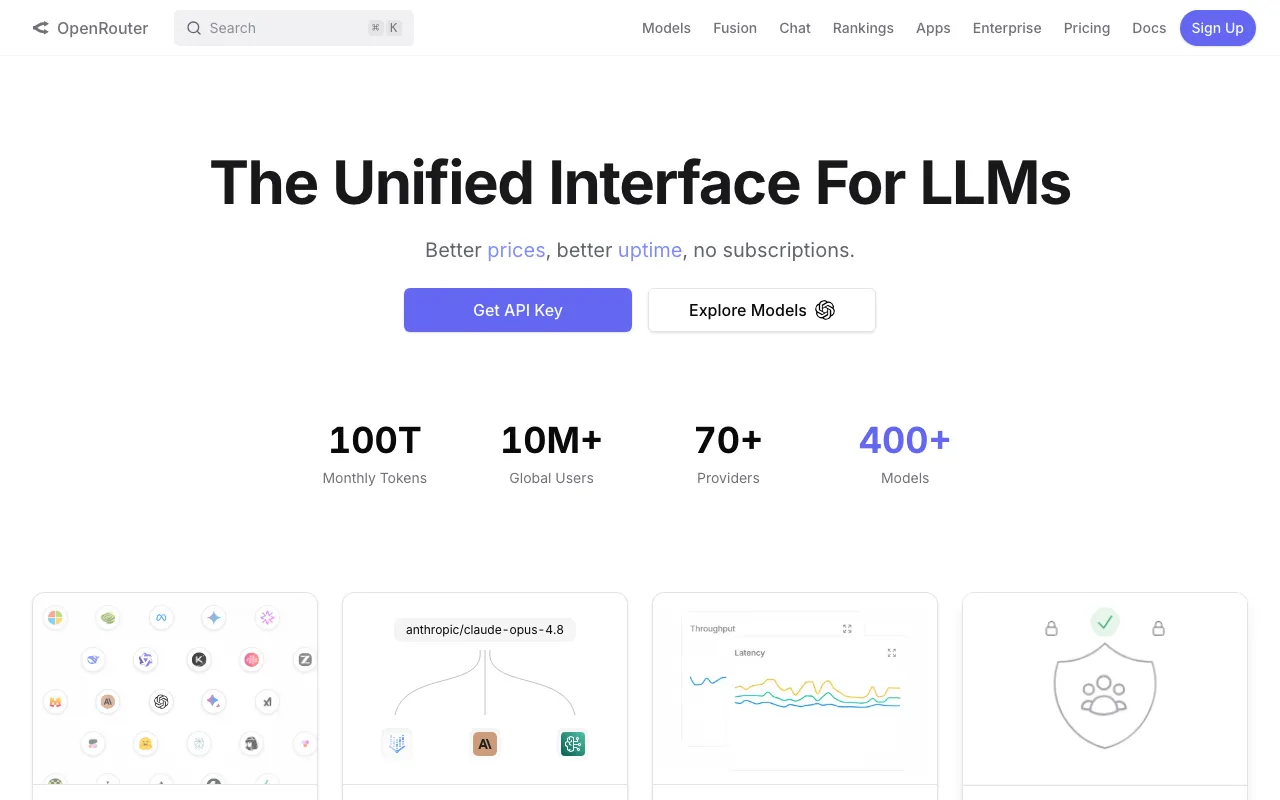
Unified API to 400+ LLMs from 70+ providers through one OpenAI-compatible endpoint, with automatic failover and pass-through token pricing
USAGE-BASED Verified JUN 23, 2026
5 tools ranked · last updated Jul 8, 2026 · how we picked
The best LLM API platform in 2026 is OpenRouter, one OpenAI-compatible endpoint to 400+ models with no token markup and just a 5.5% fee on credits. The strongest pick for running and fine-tuning open models is Together AI, where Llama 3.3 70B inference runs around $0.88 per 1M tokens and on-demand H100 clusters start near $2.99/hour.
Prices last verified Jul 3, 2026 against official pricing pages.
OpenRouter is a single OpenAI-compatible endpoint that routes requests to 400+ large language models from 70+ providers — you integrate once, switch models by name, and get automatic failover when a provider is down or rate-limited. Its pricing is unusually clean: token usage passes through at each provider’s posted rate with no markup, and OpenRouter instead charges a 5.5% fee on card credit purchases (a flat 5% for crypto), with an $0.80 minimum. A genuine free tier exposes 25+ models at 50 requests per day with no credit card, and buying $10 or more in credits raises that to 1,000 requests per day; failed and fallback attempts are never billed. It is the best fit for developers who want maximum model choice behind one interface. The caveat: the $0.80 minimum fee makes small top-ups an effective 10–20%, and free models are too rate-limited for production.
Together AI is an AI-native cloud for open-weight models — Llama, DeepSeek, Qwen, Mistral, and 200+ others — spanning the full stack from serverless inference to raw GPU clusters. Serverless inference is billed per token with no monthly minimum: Llama 3.3 70B runs around $0.88 per 1M tokens, with cached-token discounts. For steady traffic, dedicated single-model endpoints start at $6.49/hour, and on-demand GPU clusters (H100, H200, B200) start near $2.99/hour on reserved terms, scaling to thousands of GPUs for training. It also offers LoRA and full fine-tuning priced per training token, with free signup credits to evaluate first. It is the best choice for teams that have committed to open models and need to run or customize them in production without operating hardware. The caveat: per-token rates vary widely by model and change often, so cost forecasting is harder than with a single fixed-price provider.
Groq runs open models — Llama 3.1, 3.3, and 4, GPT-OSS, and Qwen3 — on its custom LPU inference chip, generating hundreds to over 1,000 tokens per second, fast enough to make real-time chat and voice feel instant. (Note the spelling: this is Groq, not xAI’s Grok.) Access is through an OpenAI-compatible API, so existing code migrates with a roughly two-line change. GroqCloud has a genuine free tier that needs no credit card, gated by rate limits around 30 requests per minute, and a pay-as-you-go Developer tier: Llama 3.1 8B is about $0.05 per 1M input tokens at ~840 tokens/second, with a Batch API and prompt caching each 50% off. It is the best pick when latency and per-token cost matter more than access to closed frontier models. The caveat: the lineup is limited to open and hosted models — no GPT-4 or Claude-class frontier models — and free-tier limits are tight for production.
Replicate runs thousands of open-source models — language, image, video, and audio — through one API call, handling the GPU provisioning, scaling, and serving for you. Billing is usage-based and granular. Public models charge for active processing time, often per output or per token: FLUX 1.1 Pro is $0.04 per image, and hosted LLMs bill per million tokens. When you deploy your own model, you pay for hardware by the second across tiers, from CPU at $0.000025/sec up to an Nvidia H100 at $0.001525/sec (about $5.49/hour), with multi-GPU options for heavier work. Custom models are packaged and fine-tuned with Cog, Replicate’s open-source tool. It is the best fit for developers who want a vast, mixed catalog behind one interface without managing infrastructure. The caveat: there is no permanent free tier, and private deployments bill for setup and idle time as well as inference, so costs accumulate even between requests.
Cohere is an enterprise LLM platform built around data sovereignty — organizations can run its Command generative models, plus Embed and Rerank search models, on their own cloud or on-premise rather than a shared SaaS endpoint. A free trial API key is created at sign-up, but it is rate-limited and non-commercial; production moves to pay-as-you-go token billing. Published rates cover the legacy Command family: Command-light starts at $0.30 per 1M input tokens, and Command R+ 08-2024 is $2.50 input and $10.00 output per 1M. Teams needing isolation use Model Vault, a fully managed dedicated deployment from $2,500/month. It is the best pick for regulated industries — finance, healthcare, government — where data cannot leave a controlled environment. The caveat: current-generation Command A pricing is not published on the public page, and the dedicated Model Vault minimum puts private deployment out of reach for small teams.
We ranked platforms that give developers API access to run, aggregate, fine-tune, or host models — unified gateways, inference clouds, fast-inference chips, and model-hosting services — judged on breadth of models, transparent value-for-money pricing, speed, and developer fit. These are usage-based products, so we cite per-token, per-second, and per-hour rates exactly as each vendor lists them rather than reducing them to a single monthly figure. OpenRouter leads for sheer model choice through one endpoint; the rest specialize by open-model production (Together AI), raw inference speed (Groq), mixed-modality hosting (Replicate), and private enterprise deployment (Cohere). Pricing was verified on July 8 2026 against each product’s official pricing page; no tool paid or provided incentives to appear in this list.
Unified API to 400+ LLMs from 70+ providers through one OpenAI-compatible endpoint, with automatic failover and pass-through token pricing
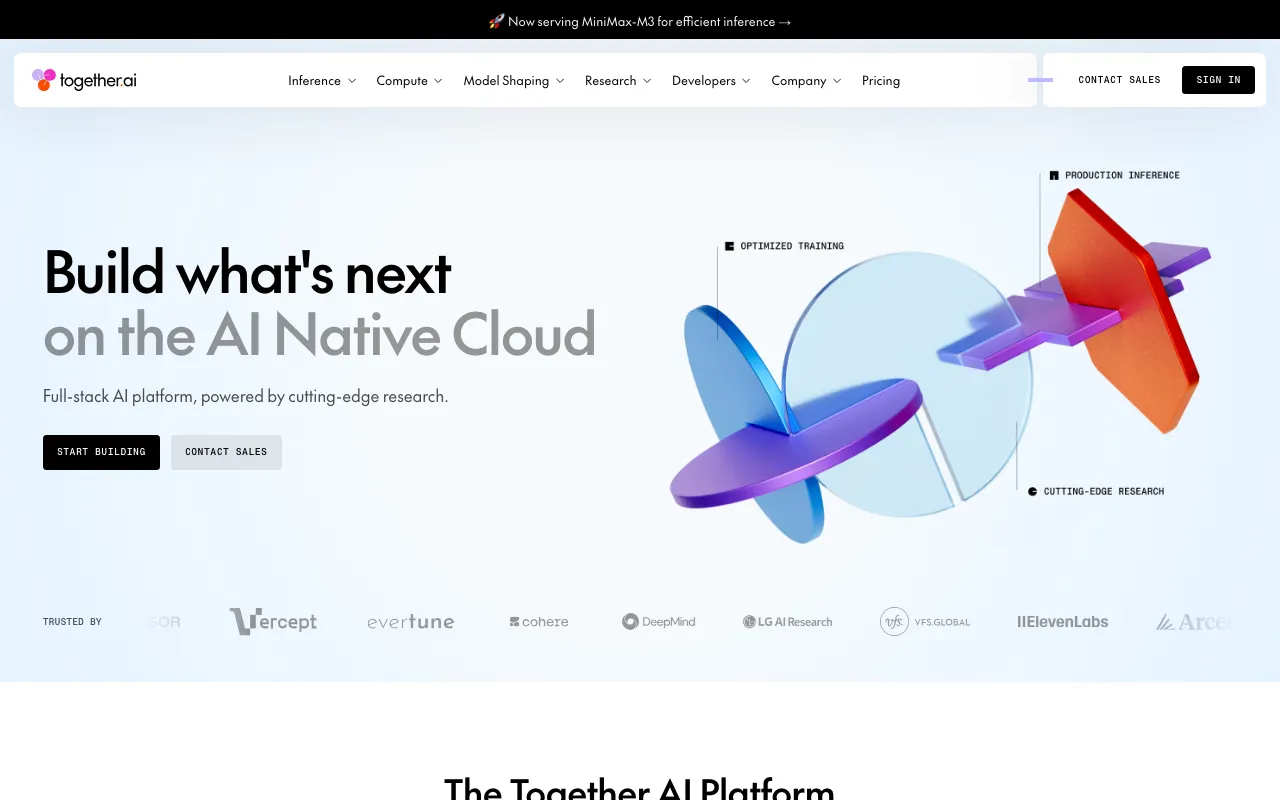
AI cloud for running, fine-tuning, and deploying open-source models via serverless inference and on-demand GPU clusters
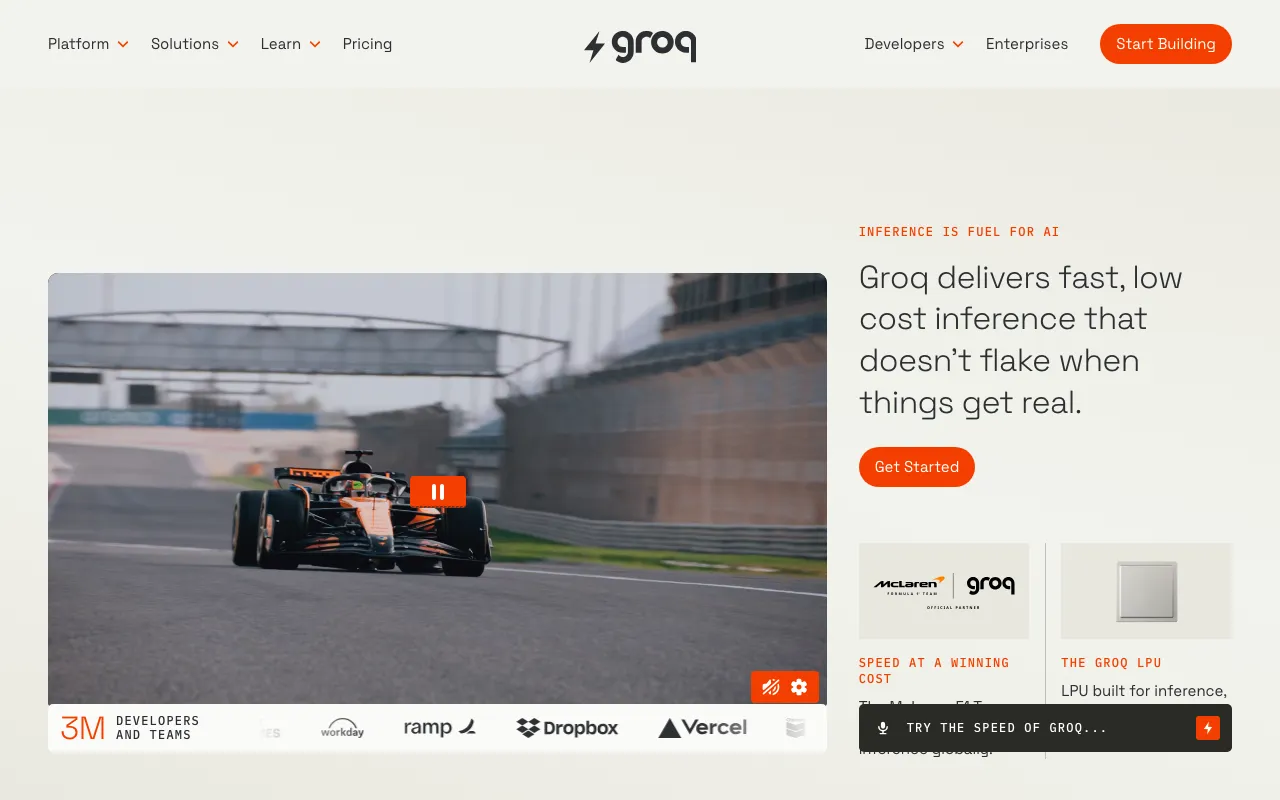
Ultra-fast, low-cost inference for open models on custom LPU chips (groq.com — not xAI's Grok)
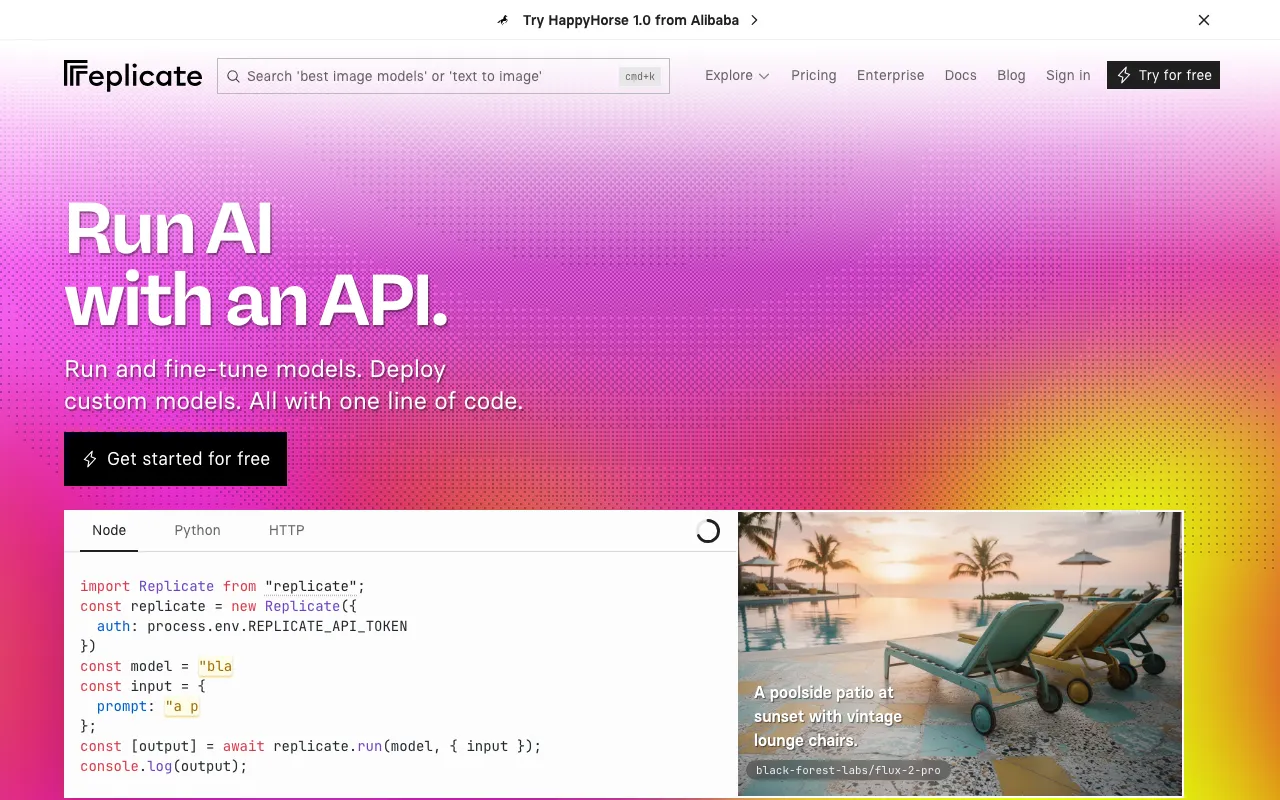
Run and fine-tune thousands of open-source AI models with one line of code via a cloud API, billed per second of GPU or CPU compute
Enterprise AI platform for private, secure LLM deployment with search and agentic models
Every tool in this list has a full profile in our directory with pricing verified against its official pricing page on the date shown on its stamp. Ranking reflects verified pricing, free-tier generosity, platform coverage, and documented capabilities — not sponsorships. Nobody can pay to appear here. Read the full methodology.
Yes — 4 of the 5 tools here have a free tier: OpenRouter, Together AI, Groq, Cohere. Pricing verified Jul 8, 2026.
5 of the 5 tools list an API: OpenRouter, Together AI, Groq, Replicate, Cohere.