OpenRouter
Unified API to 400+ LLMs from 70+ providers through one OpenAI-compatible endpoint, with automatic failover and pass-through token pricing
OpenRouter is a unified API that routes requests to 400+ LLMs from 70+ providers through one OpenAI-compatible endpoint. Token usage passes through at each provider's posted rate with no markup; OpenRouter instead charges a 5.5% fee on credit purchases (5% for crypto). A free tier covers 25+ models at 50 requests/day. Best for developers who want one integration plus automatic failover across models.
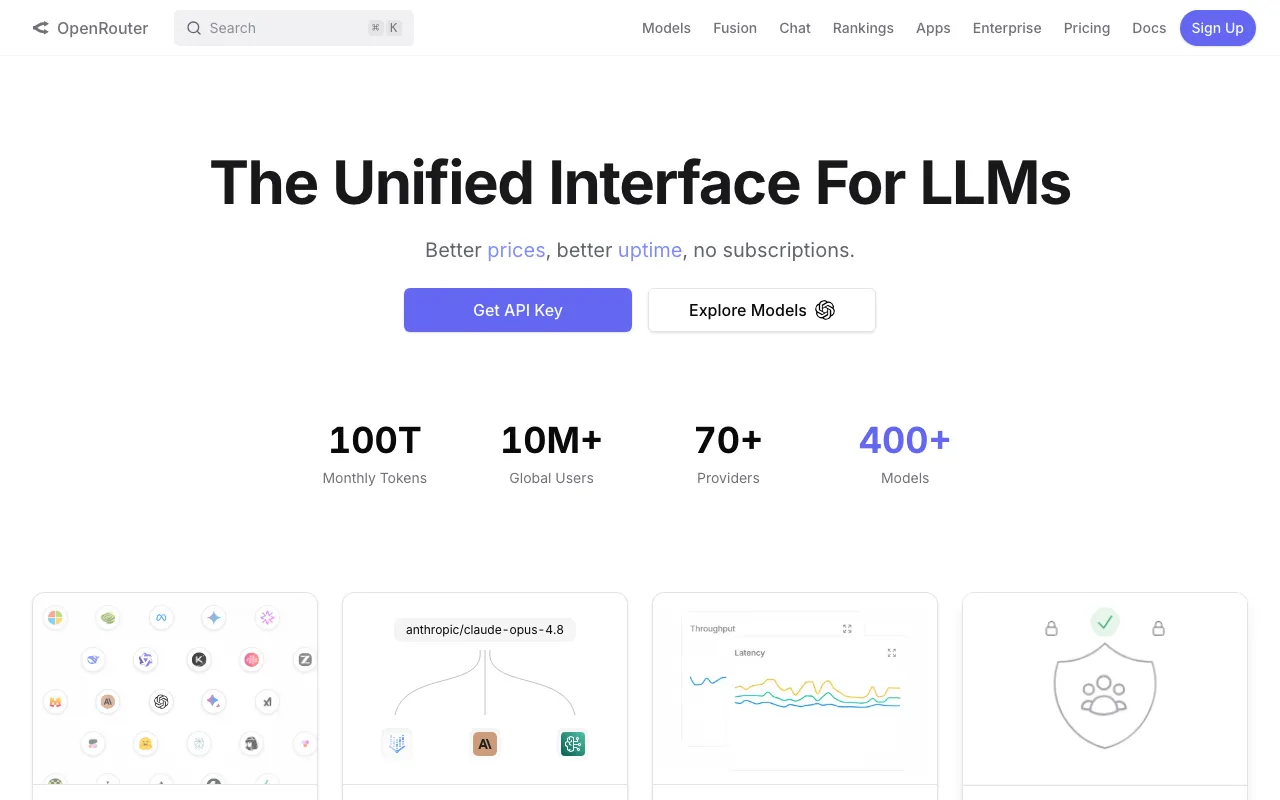
What is OpenRouter?
OpenRouter is a single API gateway that sits in front of hundreds of large language models. Instead of integrating OpenAI, Anthropic, Google, Meta, DeepSeek, and dozens of other providers separately, you point one OpenAI-compatible endpoint at OpenRouter and choose a model by name. It routes the request to a provider that hosts that model, and if the provider is down or rate-limited, it automatically falls back to another — so your app keeps working through individual outages.
The pricing model is deliberately simple: token usage is passed through at each provider’s posted rate with no markup. OpenRouter makes money on a platform fee charged when you buy credits — 5.5% on card purchases (with an $0.80 minimum) or a flat 5% for crypto. A free tier exposes 25+ models at 50 requests per day with no credit card, and adding $10 or more in credits lifts that to 1000 requests per day. Bring Your Own Key routing is free for the first million requests a month, then 5% of the equivalent model cost.
Who is it for?
OpenRouter is built for developers and teams who want model flexibility without rebuilding their integration every time a better or cheaper model appears. It is an API-first product, so the value is in code, not a consumer chat window.
- App and agent developers who want to swap models — or route by price and latency — behind one stable, OpenAI-compatible interface.
- Teams that need reliability, using automatic provider failover so a single vendor outage does not take their product down.
- Cost-conscious builders who route each request to the cheapest capable provider and centralize spend tracking under one credit balance.
- Prototypers testing many models quickly, including the free model pool, before committing to one for production.
How much does OpenRouter cost?
Starting price: $0 · Free tier: yes · Model: usage-based
Price history tracked from June 2026
| Plan | Price | Includes |
|---|---|---|
| Free | Free | Access to 25+ free models · 50 free-model requests/day (20/min), no credit card · No platform fee on free models |
| Pay-as-you-go | Token rates + 5.5% credit fee | Token usage billed at provider posted rates with no markup · 5.5% fee on card credit purchases ($0.80 minimum); 5% flat for crypto · Buying $10+ in credits raises free-model limit to 1000 requests/day · Failed and fallback attempts are not billed |
| Enterprise | Custom | Platform-fee discounts · Custom BYOK pricing · Fine-grained data governance policies |
What are OpenRouter's key features?
- Single OpenAI-compatible endpoint that routes to 400+ models from 70+ providers
- Automatic provider fallback when one is down or rate-limited
- Pass-through token pricing with no markup on underlying provider rates
- Bring Your Own Key (BYOK) routing using your own provider API keys
- Provider routing controls — prefer lowest price, lowest latency, or specific providers
- Fine-grained data governance over which models and providers receive prompts
- Unified credit balance billed per token across all providers
What people use OpenRouter for
- 01 Building apps that swap between LLMs (OpenAI, Anthropic, Google, Meta, DeepSeek) without rewriting integration code
- 02 Adding automatic failover so an app stays up when a single provider has an outage
- 03 Cost optimization by routing requests to the cheapest provider for a given model
- 04 Prototyping cheaply across many models, including 25+ free models
- 05 Centralizing billing and spend tracking for multi-model usage under one account
Pros and cons
| Pros | Cons |
|---|---|
| One integration unlocks 400+ models from 70+ providers via an OpenAI-compatible SDK | The 5.5% credit fee has a $0.80 minimum, so small top-ups pay an effective 10-20% rate |
| No markup on token pricing — you pay the same per-token rates as going direct | Free models are heavily rate-limited (50 requests/day, 20/min) and unsuitable for production |
| Built-in automatic failover improves uptime versus calling a single provider | BYOK is not free at scale — a 5% fee applies after the first 1M requests/month |
| Generous free tier (25+ free models, no credit card) for testing and light use | Adds a routing layer that can introduce extra latency and a dependency on OpenRouter's uptime |
| Only successful completions are billed; failed and fallback attempts are free | No flat subscription — costs are purely usage-based and can be hard to predict |
What are the best OpenRouter alternatives?
Ollama is the closest OpenRouter alternative in our directory: it covers the same category (AI Coding), starts at $0, has a free tier.
Ranked by category overlap with OpenRouter, then free-tier availability, then lowest verified starting price — computed from our verified data, never from sponsorships.
| Alternative | What it is | Starting price | Free tier | Price verified |
|---|---|---|---|---|
| Ollama vs OpenRouter → | Free, open-source tool to run open-weight LLMs locally via CLI, desktop, or API — with an optional paid cloud for larger models | $0 | yes | Jun 23, 2026 |
| Claude | Anthropic's AI assistant built for long-context analysis, coding, and safe reasoning | $20/mo | yes | Jul 3, 2026 |
| Replicate vs OpenRouter → | Run and fine-tune thousands of open-source AI models with one line of code via a cloud API, billed per second of GPU or CPU compute | $0.000025/sec | no | Jun 23, 2026 |
| Poe | Quora's multi-model AI aggregator — chat with GPT, Claude, Gemini, and thousands of bots under one subscription | $4.99/mo | yes | Jun 20, 2026 |
| ChatGPT | Conversational AI assistant by OpenAI with multimodal reasoning, voice, and agent capabilities | $8/mo | yes | Jun 11, 2026 |
How people make money with OpenRouter
- Ship a multi-model app or chatbot on one OpenRouter integration, routing each request to the cheapest capable provider to protect inference margins as model prices shift
- Offer LLM-cost-optimization consulting — audit a team's model usage and set up OpenRouter routing rules and failover to cut spend and downtime
Frequently asked questions
What is OpenRouter?
OpenRouter is a unified API and marketplace that routes requests to 400+ large language models from 70+ providers (OpenAI, Anthropic, Google, Meta, DeepSeek and more) through a single OpenAI-compatible endpoint, with automatic failover and pass-through token pricing.
How much does OpenRouter cost?
OpenRouter is usage-based. You buy credits and pay per token at each model's posted provider rate with no markup. A 5.5% platform fee (with an $0.80 minimum) is charged when you purchase credits by card, or a flat 5% for crypto.
Does OpenRouter mark up model prices?
No. OpenRouter does not mark up provider pricing — input and output tokens are billed at the underlying provider's posted rates. Its revenue comes from the platform fee on credit purchases.
Is there a free tier?
Yes. You can use 25+ free models with no credit card, limited to 50 requests per day and 20 per minute. Purchasing at least $10 in credits raises the free-model limit to 1000 requests per day.
What is BYOK and does it cost extra?
Bring Your Own Key lets you route requests through OpenRouter using your own provider API keys. The first 1 million BYOK requests per month are free; beyond that a 5% fee of the equivalent OpenRouter model cost applies.
Does OpenRouter have an API?
Yes. OpenRouter is fundamentally an API product with an OpenAI-compatible endpoint, so existing OpenAI SDK code works by changing the base URL and key. There is no standalone desktop or mobile app.
Public signals
- "OpenRouter raises $113M Series B" — 460 points on Hacker News, May 30, 2026