Argil
AI avatar video generator that clones you from a short recording to make talking-head social videos from a script
Argil turns one short recording into a personal AI clone, then generates talking-head videos from a script for TikTok, Reels, and Shorts, with automatic captions, B-rolls, and gesture styles. There is no permanent free tier — only a 5-day trial — then Classic is $39/month for about 25 minutes of video and Pro is $149/month for roughly 100 minutes. Best for creators scaling short-form and faceless brand content.
What is Argil?
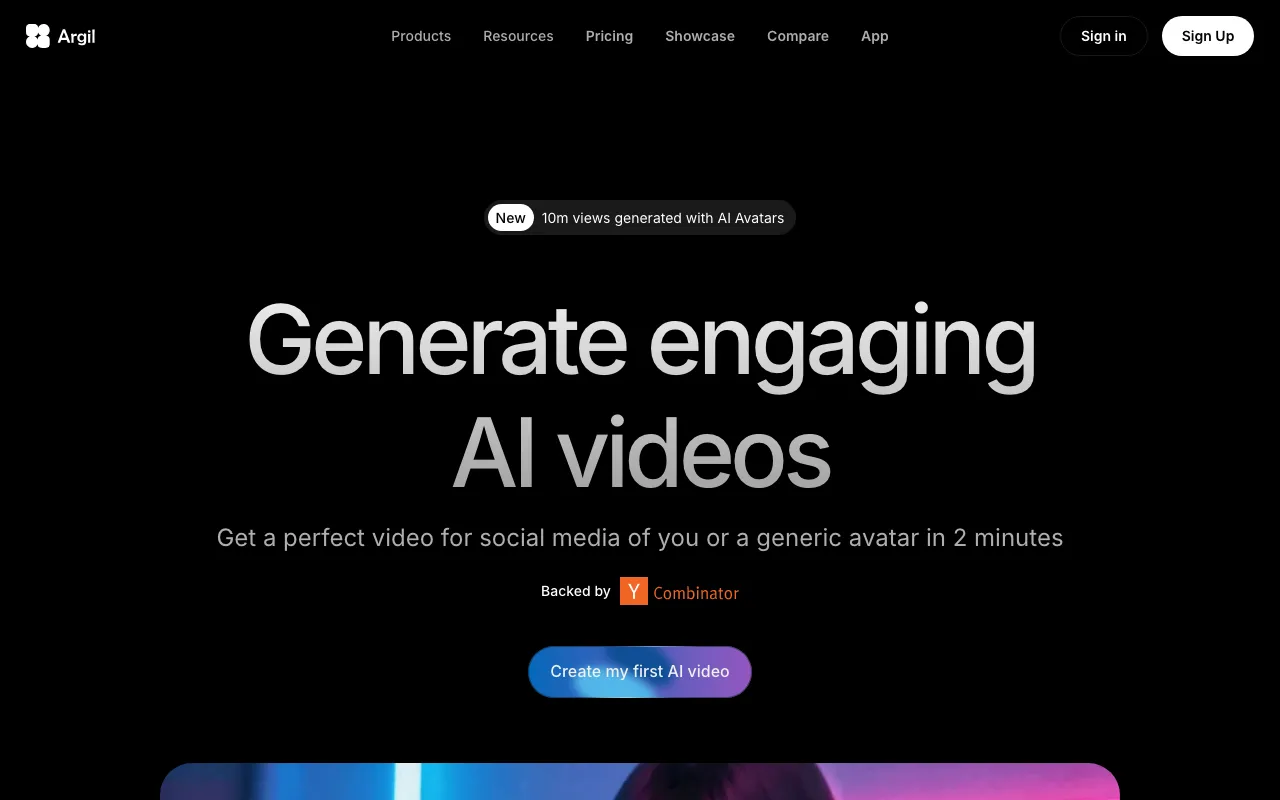
Argil is a web-based AI avatar video generator built for short-form social content. You clone yourself from a short recording — a roughly two-minute training video plus a consent video — and Argil turns that into a reusable digital avatar that speaks any script you type in your own appearance and voice. If you would rather stay faceless, it also ships with more than 100 ready-made stock avatars across education, promotion, and entertainment styles. From a written script, the platform assembles a finished vertical video with automatic captions, B-rolls, backgrounds, and transitions, so a talking-head clip for TikTok, Reels, or YouTube Shorts comes together in minutes rather than through filming and manual editing.
Argil runs on a credit system rather than a flat per-video price. An avatar minute costs 160 credits, voice costs 20 credits per minute, and B-roll elements are billed individually, so the effective minutes per plan depend on how each video is composed. The Classic plan includes 1,600 credits per month for up to about 25 minutes of video, Pro includes 6,000 credits for roughly 100 minutes and unlocks unlimited avatar styles plus an AI Influencer builder, and Scale adds more credits and workspace seats. API access is available from the Classic tier upward for teams that want to generate videos programmatically, and pay-as-you-go credit top-ups never expire.
Who is it for?
Argil fits creators and small teams who publish talking-head or faceless short-form video frequently and want to skip filming and editing. There is no permanent free tier, only a 5-day trial, so it suits people ready to commit to a paid content workflow rather than casual one-off experimenters. The credit-based caps mean the entry plan works for a modest posting cadence, while daily publishers or agencies will need Pro or Scale.
- Personal-brand creators who want a clone of themselves delivering scripts consistently without setting up a camera each time.
- Faceless channel operators producing high-volume short-form content using stock avatars instead of their own likeness.
- E-commerce and UGC marketers generating avatar-led product ads at scale without hiring on-camera talent.
- Developers and agencies who need API access to automate video production pipelines from the entry Classic plan upward.
How much does Argil cost?
Starting price: $39/mo · Free tier: no · Model: paid
Price history tracked from June 2026
| Plan | Price | Includes |
|---|---|---|
| Classic | $39/mo | 1,600 credits/month (up to ~25 minutes of video) · Clone one avatar plus 10 avatar styles · 100+ ready-made Argil avatars · Magic video editing and Fictions playground · API access included · $27/mo when billed yearly (30% off) |
| Pro | $149/mo | 6,000 credits/month (up to ~100 minutes of video) · Unlimited avatar styles · AI Influencer builder · Seedance 2.0 videos and style editing · Priority support · $104/mo when billed yearly (30% off) |
| Scale | $499/mo | 18,000 credits/month · Unlimited avatar styles · 3 workspace seats included · Everything in Pro · $349/mo when billed yearly (30% off) |
| Enterprise | Custom | Custom monthly credits and unlimited avatar styles · Custom branded assets and white-label options · Dedicated account manager and early access · SLA and priority support |
What are Argil's key features?
- AI clone creation from a short two-minute training video plus a consent recording
- 100+ ready-made stock avatars across education, promotion, and entertainment styles
- Script-to-video generation with automatic captions, B-rolls, backgrounds, and transitions
- Gesture and style control across three avatar delivery styles
- API access for programmatic, scaled video production from the Classic tier upward
- Credit-based billing with pay-as-you-go top-ups that never expire
- Fictions playground integrating third-party generative video models (VEO3, Hailuo, Seedance)
What people use Argil for
- 01 Generating daily talking-head TikTok, Reels, and YouTube Shorts from a written script without filming
- 02 Cloning yourself once, then producing personal-brand videos in your own likeness and voice at scale
- 03 Producing faceless UGC-style ad creatives for e-commerce products using stock avatars
- 04 Repurposing blog posts or newsletters into short avatar-narrated social clips
- 05 Localizing educational or training content across multiple avatar styles for different audiences
Pros and cons
| Pros | Cons |
|---|---|
| One short recording is enough to build a usable personal AI clone | No permanent free plan — only a 5-day trial, then paid plans start at $39/month |
| Automatic captions, B-rolls, and transitions cut manual editing time for short-form | Video minutes are capped: Classic covers roughly 25 minutes and Pro about 100 minutes per month, and the credit system charges differently for avatar, voice, and B-roll usage |
| API access is available from the entry $39/month Classic plan, not gated to enterprise | AI-avatar output can still look uncanny on complex gestures or emotional delivery versus real footage |
| Annual billing cuts every paid plan by 30% | Custom clone creation requires recording a training video and a separate consent video before you can generate |
What are the best Argil alternatives?
Captions is the closest Argil alternative in our directory: it covers the same category (AI Video), starts at $9.99/mo, has a free tier.
Ranked by category overlap with Argil, then free-tier availability, then lowest verified starting price — computed from our verified data, never from sponsorships.
| Alternative | What it is | Starting price | Free tier | Price verified |
|---|---|---|---|---|
| Captions | AI video creation app for talking-head and social content, with AI avatars (Mirage) and a chat-based editor | $9.99/mo | yes | Jun 20, 2026 |
| Hedra | AI video platform whose Character-3 model turns an image plus audio or text into lip-synced talking-character videos in 140+ languages | $15/mo | yes | Jun 30, 2026 |
| Synthesia | AI video platform that generates studio-quality videos from text using AI avatars | $18/mo | yes | Jun 11, 2026 |
| HeyGen | AI video platform that generates avatar-based videos from text scripts with lip-sync in 175+ languages | $29/mo | yes | Jul 3, 2026 |
| Colossyan | AI avatar video platform that turns documents and scripts into workplace training videos in 120+ languages | $59/mo | yes | Jul 8, 2026 |
How people make money with Argil
- Offer faceless short-form video production as a service for coaches and personal brands, delivering daily TikTok and Reels clips from a single client recording
- Run a UGC-ad micro-agency for e-commerce brands, producing avatar-led product videos at volume without hiring on-camera talent or booking studio time
Frequently asked questions
Is Argil free?
Argil has no permanent free plan. New users get a 5-day free trial with access to paid features, after which the entry Classic plan costs $39 per month, or $27 per month billed annually. Pay-as-you-go credit top-ups are also available and never expire.
How many videos can I make on the Classic plan?
The Classic plan includes 1,600 credits per month, enough for up to about 25 minutes of finished video — roughly 50 clips at 30 seconds each. Actual output depends on how many avatar minutes, voice minutes, and B-roll elements each video uses, since credits are charged per component.
How does Argil create an AI clone of me?
You record a short training video of about two minutes plus a separate consent video confirming the likeness is yours. Argil processes these into a reusable avatar that speaks your scripts in your own appearance. Stock avatars are available immediately if you would rather not clone yourself first.
Does Argil have an API?
Yes. API access is included from the Classic plan upward, so you can generate avatar videos programmatically rather than only through the web app. Argil publishes developer documentation, and higher tiers add more monthly credits for scaled, automated production pipelines.
What is the difference between Classic and Pro?
Classic is $39 per month with 1,600 credits (about 25 minutes) and 10 avatar styles. Pro is $149 per month with 6,000 credits (about 100 minutes), unlimited avatar styles, the AI Influencer builder, Seedance 2.0 videos, and priority support. Pro suits creators publishing short-form daily.
What are good alternatives to Argil?
Popular alternatives include HeyGen and Synthesia for enterprise avatar and training videos, Captions for AI-assisted short-form editing, Hedra for expressive character video, and Colossyan for workplace learning content. The best choice depends on whether you prioritize personal cloning, template libraries, or team collaboration.