Fireworks AI
High-speed inference and fine-tuning cloud for open-weight LLMs, image, and audio models via a usage-based API
Fireworks AI is a high-speed inference and fine-tuning cloud for open-weight models like DeepSeek, Llama, and Qwen, processing over 30 trillion tokens a day. Serverless inference is usage-based — roughly $0.20 per 1M tokens for 4-16B models and $0.90 for larger ones — while dedicated H100/H200 GPUs run $8.00/hour. New accounts get $1 in free credits. Best for developers serving open models in production without managing GPUs.
What is Fireworks AI?
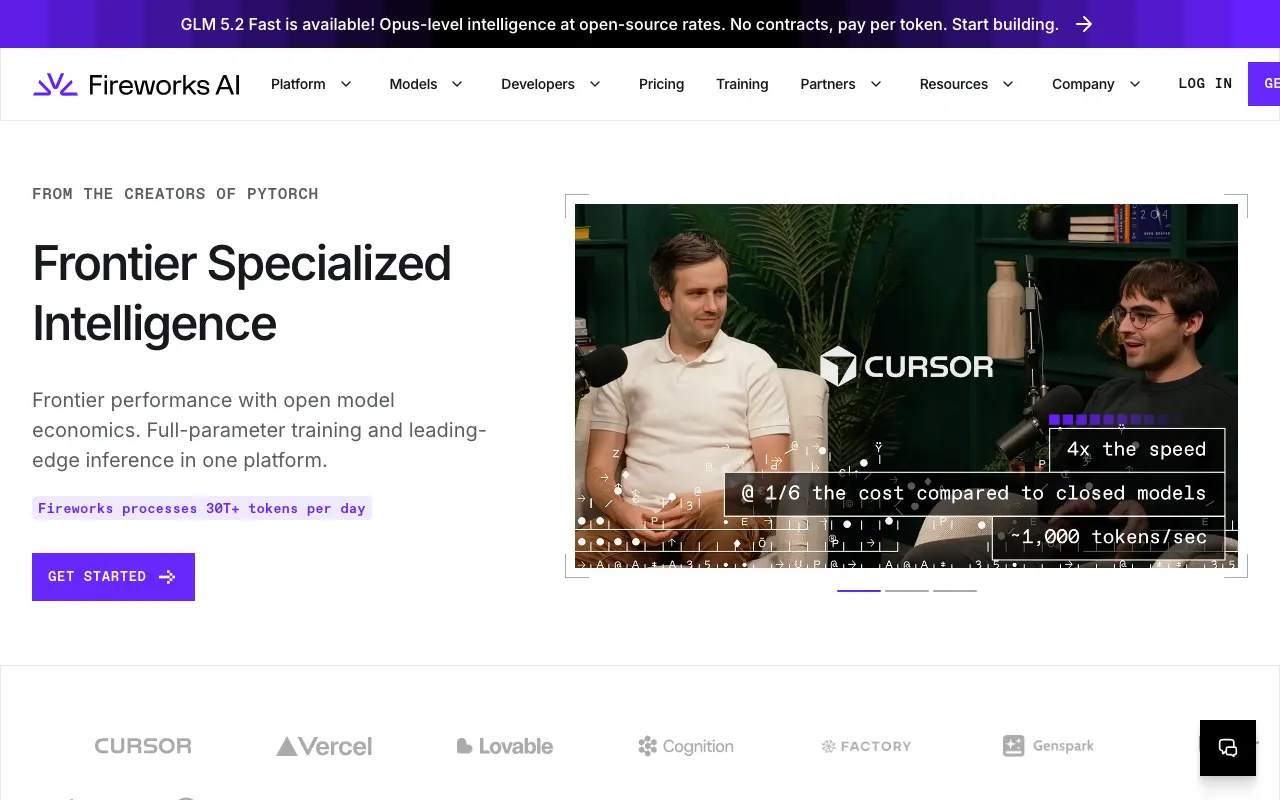
Fireworks AI is an inference and training cloud built for open-weight generative models. Instead of locking you into one vendor’s proprietary model, it lets you serve, fine-tune, and scale open weights — DeepSeek, Llama, Qwen, Mistral, and others — through a single usage-based API. The platform spans serverless per-token inference (you call a model with no servers to manage), dedicated on-demand GPU deployments for steady traffic, and reserved capacity for large workloads. It runs at production scale, processing more than 30 trillion tokens per day for customers including Cursor, Vercel, and Notion.
Pricing is usage-based with no monthly minimum. Serverless text and vision inference is billed per token by model size — roughly $0.10 per 1M tokens under 4B parameters, $0.20 for 4-16B, and $0.90 for models over 16B — with batch inference discounted to 50% of the standard rate. Dedicated deployments are billed per GPU-hour, with H100 80GB and H200 141GB at $8.00/hour and B200 at $13.00/hour. Fine-tuning (LoRA, full-parameter, SFT, and DPO) is priced per million training tokens starting at $0.50. Beyond text, Fireworks serves image models like FLUX.1 and audio models like Whisper V3, and its OpenAI- and Anthropic-compatible APIs make migrating existing code straightforward.
Who is it for?
Fireworks AI is a developer and team platform, not a consumer app. It fits builders who have chosen open models — for speed, cost, control, or data-residency reasons — and need a fast, low-latency place to run them in production without operating their own GPUs. Teams comparing options often weigh it against Together AI and Groq.
- Developers and startups shipping AI features who want open-model inference via API with predictable per-token billing.
- ML teams fine-tuning open models on proprietary data and deploying the result to a serverless or dedicated endpoint.
- Latency-sensitive product teams building chatbots, coding assistants, and agents where response speed directly affects the user experience.
- Companies running large workloads that need dedicated H100/H200/B200 capacity billed per GPU-hour for sustained, high-volume traffic.
How much does Fireworks AI cost?
Starting price: $0.10/1M tokens · Free tier: yes · Model: usage-based
Price history tracked from June 2026
| Plan | Price | Includes |
|---|---|---|
| Serverless Inference | Pay per token | Under 4B models ~$0.10 per 1M tokens · 4B-16B models ~$0.20 per 1M tokens · Over 16B models ~$0.90 per 1M tokens · Batch inference at 50% of serverless price |
| Dedicated Deployments | From $8.00/hr | H100 80GB and H200 141GB at $8.00/hr · B200 180GB at $13.00/hr · B300 288GB at $15.00/hr · Reserved single-model GPU capacity |
| Fine-Tuning | From $0.50/1M tokens | LoRA SFT from $0.50 per 1M training tokens (up to 16B) · 16.1B-80B models from $3.00 per 1M tokens · Full-parameter and DPO training supported · Deploy the tuned model to serverless or dedicated |
| Free Credits | $1 | $1 in free credits for new accounts · OpenAI- and Anthropic-compatible APIs · No monthly minimum or seat fee |
What are Fireworks AI's key features?
- Serverless per-token inference with Priority and Fast tiers across open LLMs, vision, image, and audio models
- Dedicated on-demand GPU deployments on H100, H200, B200, and B300 hardware
- Fine-tuning stack supporting LoRA, full-parameter, SFT, and DPO training
- OpenAI- and Anthropic-compatible APIs for drop-in migration
- Prompt caching at 50% of input price and batch inference at 50% of serverless pricing
- Multi-modal support including FLUX.1 image generation and Whisper V3 audio transcription
- Production scale — the platform processes 30T+ tokens per day
What people use Fireworks AI for
- 01 Serving open-weight LLMs like DeepSeek, Llama, and Qwen in production through a pay-per-token API
- 02 Fine-tuning open models with LoRA or full-parameter training, then deploying the result in seconds
- 03 Running low-latency inference for chatbots, agents, and RAG where response speed matters
- 04 Renting dedicated H100/H200/B200 GPUs for reserved capacity and steady high-volume traffic
- 05 Generating images with FLUX.1 or transcribing audio with Whisper V3 through the same API
Pros and cons
| Pros | Cons |
|---|---|
| Fast, cost-efficient inference — customers like Notion report latency dropping from about 2 seconds to 350 milliseconds | Only $1 in free credits, so there is little room to evaluate at scale before paying |
| Simple size-based usage pricing (around $0.20 per 1M tokens for 4-16B models) with no monthly minimum | Per-token rates vary by model and headline models carry separate premium pricing, making cost forecasting harder |
| Covers the full stack — serverless inference, dedicated GPUs, and fine-tuning — in one platform | Developer- and API-focused with no consumer desktop or mobile app |
| OpenAI- and Anthropic-compatible APIs make switching from proprietary providers low-effort | Dedicated GPU hours at $8.00/hr and up add up quickly for sustained workloads |
What are the best Fireworks AI alternatives?
Groq is the closest Fireworks AI alternative in our directory: it covers the same category (AI Coding), starts at $0, has a free tier.
Ranked by category overlap with Fireworks AI, then free-tier availability, then lowest verified starting price — computed from our verified data, never from sponsorships.
| Alternative | What it is | Starting price | Free tier | Price verified |
|---|---|---|---|---|
| Groq | Ultra-fast, low-cost inference for open models on custom LPU chips (groq.com — not xAI's Grok) | $0 | yes | Jun 24, 2026 |
| OpenRouter | Unified API to 400+ LLMs from 70+ providers through one OpenAI-compatible endpoint, with automatic failover and pass-through token pricing | $0 | yes | Jun 23, 2026 |
| Together AI | AI cloud for running, fine-tuning, and deploying open-source models via serverless inference and on-demand GPU clusters | $0 | yes | Jun 24, 2026 |
| Replicate | Run and fine-tune thousands of open-source AI models with one line of code via a cloud API, billed per second of GPU or CPU compute | $0.000025/sec | no | Jun 23, 2026 |
| fal | Usage-based inference cloud for generative media — 1,000+ image, video, and audio model APIs (FLUX, Kling, Veo) plus serverless GPUs from $1.89/hour | $0.02/megapixel | no | Jul 6, 2026 |
How people make money with Fireworks AI
- Build and sell an AI product — a chatbot, coding assistant, or summarizer — on top of Fireworks' per-token open-model inference and charge a subscription that keeps the margin above your token cost
- Offer fine-tuning-as-a-service: train open models on a client's proprietary data using Fireworks' tuning stack and deliver a private hosted endpoint billed as a project fee plus monthly hosting
Frequently asked questions
What is Fireworks AI used for?
Fireworks AI is a cloud platform for running, fine-tuning, and deploying open-weight models such as DeepSeek, Llama, and Qwen. Developers use it to serve LLMs, image, and audio models via API, fine-tune them on custom data, and rent dedicated GPUs — without managing hardware. The platform processes over 30 trillion tokens per day.
How does Fireworks AI pricing work?
Inference is usage-based and billed per token by model size: roughly $0.10 per 1M tokens under 4B, $0.20 for 4-16B, and $0.90 for models over 16B. Dedicated deployments are billed per GPU-hour — H100 80GB and H200 141GB at $8.00/hour, B200 at $13.00/hour. Batch inference is billed at 50% of the standard rate.
Is there a free tier on Fireworks AI?
Fireworks AI gives new accounts $1 in free credits to start building. There is no ongoing free tier beyond that credit and no monthly minimum, so after the credit you pay only for the tokens and GPU hours you use.
Can I fine-tune models on Fireworks AI?
Yes. Fireworks supports LoRA, full-parameter, SFT, and DPO fine-tuning priced per million training tokens — LoRA SFT starts at $0.50 per 1M tokens for models up to 16B and $3.00 for 16.1B-80B models. The tuned model can then be deployed to serverless or a dedicated endpoint.
How is Fireworks AI different from Together AI?
Both are inference clouds for open models with per-token and per-GPU-hour billing. Fireworks emphasizes low-latency serving and its FireAttention-style optimizations, with customers like Cursor, Vercel, and Notion citing large speedups. Together AI leans on a very broad 200+ model catalog. Pricing and available models differ, so compare the specific model you need.
Does Fireworks AI support image and audio models?
Yes. Beyond text LLMs, Fireworks serves image models like FLUX.1 and audio models like Whisper V3 Large through the same usage-based API, so a single account can cover text, vision, image generation, and transcription.
Is the Fireworks AI API compatible with OpenAI?
Yes. Fireworks exposes OpenAI- and Anthropic-compatible APIs, so applications built against those SDKs can often switch to Fireworks with minimal code changes by pointing at the Fireworks endpoint.