Gladia
Speech-to-text API with real-time and async transcription across 100+ languages, with audio intelligence bundled into the per-hour rate
Gladia is a Paris-based speech-to-text API built on its Solaria models, sold by the hour of audio rather than by seat. The Starter plan is pay-as-you-go at $0.61 per hour for async transcription and $0.75 per hour for real-time, with 10 hours free every month and no card required. Growth drops to as low as $0.20 per hour async but needs an upfront commitment and a sales conversation. The per-hour rate sits above several rivals, but diarization, language detection, and 100+ languages are included rather than billed as add-ons.
What is Gladia?
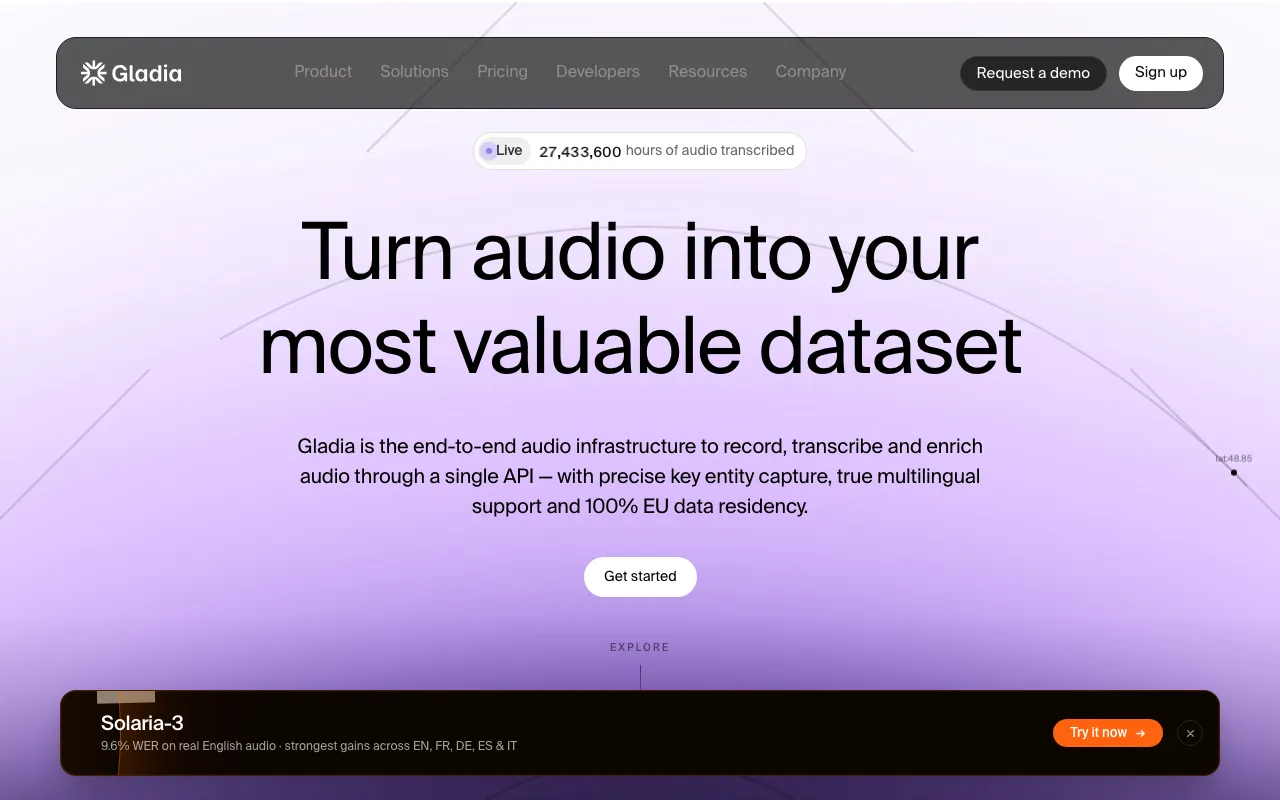
Gladia is a French speech-to-text company, founded in Paris in 2022, that sells transcription as a metered API rather than as a finished app. Two endpoints cover the workload: async transcription for recordings and long-form audio, and real-time streaming that returns output in under 300 milliseconds, with partial transcripts arriving in under 100 milliseconds. Behind both sits the Solaria model family. Solaria-1 is the universal option, covering more than 100 languages and handling speakers who switch language mid-sentence. Solaria-3, released in June 2026, trades that breadth for accuracy on real production audio in English and core European languages, and is aimed at noisy, fast-paced business recordings such as customer calls.
The pricing shape is the interesting part. Where several competitors meter each intelligence feature separately, Gladia folds automatic language detection, speaker diarization, word-level timestamps, and the full language set into a single per-hour rate. The self-serve Starter plan bills $0.61 per hour for async and $0.75 per hour for real-time, with 10 hours free every month, 30 concurrent real-time requests, and 25 concurrent async requests. Growth advertises rates as low as $0.20 per hour but gates them behind an upfront commitment and a sales conversation. Beyond raw transcription, the platform adds PII redaction, sentiment analysis, summarization, and an Audio to LLM path that runs custom prompts over a transcript in the same API call. Billing is moving to a prepaid credit wallet as of July 2026, with per-hour rates stated as unchanged.
Who is it for?
Gladia is built for engineering teams embedding transcription into their own product, not for individuals who want a meeting-notes app. The headline rate is higher than several rivals, so the honest test is whether you need the bundled audio intelligence: if you only want raw English transcripts at volume, cheaper per-hour options exist. If you need diarized, multilingual output with sentiment or entity extraction attached, the bundled rate closes most of that gap. One caveat worth weighing before committing: OVH Groupe entered exclusive negotiations to acquire Gladia in June 2026, and that deal had not been announced as closed at the time of writing.
- Meeting assistant and note-taker builders who need diarized transcripts with per-speaker attribution and a direct path from audio into a language model.
- Contact centre and CCaaS platforms running quality assurance, compliance review, or live agent-assist over large volumes of recorded and streaming calls.
- Voice agent developers who need sub-300ms streaming transcription and can source text-to-speech from a separate vendor.
- Products handling genuinely multilingual audio where speakers switch language mid-conversation and a single-language model fails outright.
- European teams with data sovereignty requirements who want a French provider carrying GDPR, ISO 27001, HIPAA, and SOC 2 Type II coverage, with training opt-out on paid plans.
How much does Gladia cost?
Starting price: $0 · Free tier: yes · Model: usage-based
Price history tracked from June 2026
| Plan | Price | Includes |
|---|---|---|
| Starter | $0.61/hr async, $0.75/hr real-time | 10 hours of transcription free every month, renewing · Async transcription $0.61/hr, real-time streaming $0.75/hr · Pay-as-you-go with immediate self-serve signup, no sales call · 30 concurrent real-time requests, 25 concurrent async requests · Automatic language detection and switching, speaker diarization, 100+ languages · GDPR, HIPAA, and AICPA SOC 2 Type 2 coverage · Support via help center and Discord |
| Growth | from $0.20/hr async, $0.25/hr real-time | Roughly 67% below Starter rates, per the vendor's own pricing page · Requires an upfront volume commitment negotiated with sales · Flexible concurrent request limits and custom volume discounts · Automatic opt-out from model training · 99.9% uptime SLA and priority processing queue |
| Enterprise | Custom | Custom models, fine-tuning, and debundled per-feature pricing · Unlimited concurrent requests and dedicated infrastructure · Zero data retention and model training opt-out by default · Custom hosting options and 99.9% uptime SLA · Dedicated Slack channel, account manager, and premium support |
What are Gladia's key features?
- Solaria-1 universal model covering more than 100 languages, including mid-conversation language switching
- Solaria-3, released June 2026, tuned for noisy production audio in English and core European languages
- Real-time streaming transcription under 300ms, with partial transcripts returned in under 100ms
- Async batch transcription for long-form recordings with word-level timestamps
- Speaker diarization, automatic language detection, PII redaction, sentiment analysis, and summarization
- Audio to LLM, generally available since April 2026, running custom prompts over a transcript in the same API call
- Official Python and TypeScript SDKs that wrap the upload, poll, and retrieve cycle
- GDPR, HIPAA, ISO 27001, and SOC 2 Type II compliance, with training opt-out on paid plans
What people use Gladia for
- 01 Transcribing recorded meetings, interviews, and sales calls with speaker diarization for downstream summaries
- 02 Powering real-time voice agents and live agent-assist with sub-300ms streaming transcription
- 03 Contact-centre quality assurance and compliance review over large archives of recorded calls
- 04 Generating time-stamped transcripts and subtitles for media editing and post-production
- 05 Feeding call audio straight into a language model for action items, red flags, or CRM-ready notes without building a separate pipeline
Pros and cons
| Pros | Cons |
|---|---|
| Core capabilities are bundled into the per-hour rate rather than sold as separate line items — diarization, language detection, and all 100+ languages are included on the entry plan | Starter async at $0.61 per hour is meaningfully above rivals' entry rates — Deepgram's pre-recorded Nova-3 works out near $0.46 per hour and Speechmatics lists batch Melia 1 at $0.24 per hour — so the bundling only pays off if you actually use diarization, sentiment, or entity extraction |
| The 10-hour monthly free allowance renews rather than expiring as a one-off trial, and needs no credit card | The headline $0.20 per hour Growth rate is not self-serve: it requires an upfront volume commitment and a sales conversation, so the published number is unreachable for small teams |
| Starter is genuinely self-serve at 30 concurrent real-time and 25 concurrent async requests, which is enough concurrency to run a small production workload without talking to sales | OVH Groupe entered exclusive negotiations to acquire Gladia on 11 June 2026 and the transaction had not been announced as closed as of 20 July 2026, leaving roadmap and pricing continuity unresolved |
| Two distinct models let you pick breadth (Solaria-1, 100+ languages) or accuracy on business audio (Solaria-3, English and core European languages) | Gladia sells speech-to-text only — there is no text-to-speech, so a full voice agent still needs a second synthesis vendor |
| Audio to LLM removes the glue code between transcription and a language model for summaries and extraction | The uptime SLA and priority processing queue start at Growth; Starter customers get no contractual availability guarantee |
| Custom hosting, fine-tuning, and zero data retention are Enterprise-only with no published price |
What are the best Gladia alternatives?
Cartesia is the closest Gladia alternative in our directory: it covers the same category (AI Audio & Music), starts at $0, has a free tier.
Ranked by category overlap with Gladia, then free-tier availability, then lowest verified starting price — computed from our verified data, never from sponsorships.
| Alternative | What it is | Starting price | Free tier | Price verified |
|---|---|---|---|---|
| Cartesia | Low-latency voice AI platform behind the Sonic text-to-speech model, built for real-time agents | $0 | yes | Jul 5, 2026 |
| Deepgram | Developer-first voice AI API for speech-to-text, text-to-speech, and real-time voice agents | $0 | yes | Jul 5, 2026 |
| Speechmatics | Speech-to-text API with real-time and batch transcription across 56+ languages, plus text-to-speech and voice agent endpoints | $0.129/hr | yes | Jul 18, 2026 |
| AssemblyAI | Voice AI API for developers: speech-to-text, speaker diarization, audio intelligence, and LLM-over-audio with per-hour usage billing | $0.15/hr | yes | Jun 23, 2026 |
| ElevenLabs | AI voice platform for text-to-speech, voice cloning, and conversational agents in 70+ languages | $6/mo | yes | Jul 3, 2026 |
How people make money with Gladia
- Build a meeting-notes or call-summary product for a single vertical and bill a flat monthly platform fee, with metered transcription hours as your only variable cost
- Offer multilingual subtitle and caption delivery to media agencies on a per-project fee, using async transcription with word-level timestamps as the production backend
- Sell contact-centre quality assurance dashboards on a per-seat retainer, letting bundled diarization and sentiment analysis replace a separate audio-intelligence vendor
- Package a compliance call-archive search tool for regulated firms on an annual licence that covers a committed block of transcription hours purchased upfront
Frequently asked questions
Is Gladia free to use?
Gladia has a free allowance rather than a free product. Signing up gives you up to 10 hours of transcription each month at no charge, renewing monthly, with no credit card required. Beyond that allowance the Starter plan meters usage at $0.61 per hour for async transcription and $0.75 per hour for real-time streaming.
How much does Gladia cost per hour?
On the self-serve Starter plan, async transcription costs $0.61 per hour of audio and real-time streaming costs $0.75 per hour. The Growth plan advertises rates as low as $0.20 per hour async and $0.25 per hour real-time, roughly 67% below Starter, but requires an upfront commitment negotiated with sales. Enterprise pricing is custom.
What is the difference between Solaria-1 and Solaria-3?
Solaria-1 is the universal model, covering more than 100 languages and handling speakers who switch language mid-conversation. Solaria-3, released in June 2026, is narrower but more accurate on real production audio in English and core European languages such as French, Italian, Spanish, and German. Pick Solaria-1 for breadth and Solaria-3 for business call accuracy.
Is Gladia being acquired by OVHcloud?
OVH Groupe announced on 11 June 2026 that it had entered exclusive negotiations to acquire Gladia, citing sovereign voice AI ambitions for OVHcloud and OVHai. As of 20 July 2026 no completion had been announced. Gladia continues to sell its own plans, publish its own pricing, and ship product updates independently.
Does Gladia offer text-to-speech?
No. Gladia is a speech-to-text and audio intelligence provider only. It covers async and real-time transcription plus features like diarization, sentiment analysis, PII redaction, and summarization, but it does not synthesize speech. Teams building a full voice agent will need to pair Gladia with a separate text-to-speech vendor.
How does Gladia billing work?
Gladia announced in July 2026 that it is moving from end-of-month invoicing to a prepaid credit wallet. You buy credits upfront, watch the balance in the developer console, and top up manually or automatically when it drops below a threshold. Per-hour rates were stated as unchanged by the switch, and payments run through Stripe.
How many languages does Gladia support?
More than 100 languages are supported on every paid plan, including automatic language detection and switching within a single recording. Language coverage is not tiered, so an entry-level Starter account gets the same language set as Enterprise. Solaria-3 narrows to English and core European languages in exchange for higher accuracy on noisy business audio.
Is Gladia cheaper than Deepgram?
Not on the headline rate. Gladia's self-serve async rate is $0.61 per hour, while Deepgram's pre-recorded Nova-3 model works out to roughly $0.46 per hour. Gladia becomes competitive when you need diarization, sentiment, or entity extraction, since those are bundled into its per-hour price rather than billed as separate add-ons.