Harvey
Domain-specific generative AI for legal and professional-services work at law firms and enterprise legal teams
Harvey is a domain-specific AI platform for legal and professional-services work — contract analysis, legal research, drafting, and agentic workflows built for law firms and in-house teams. In March 2026 it raised $200 million at an $11 billion valuation and serves 1,300+ organizations across 60+ countries, including a majority of the AmLaw 100. Pricing is enterprise contact-sales only with no public tiers, so budget for a procurement cycle.
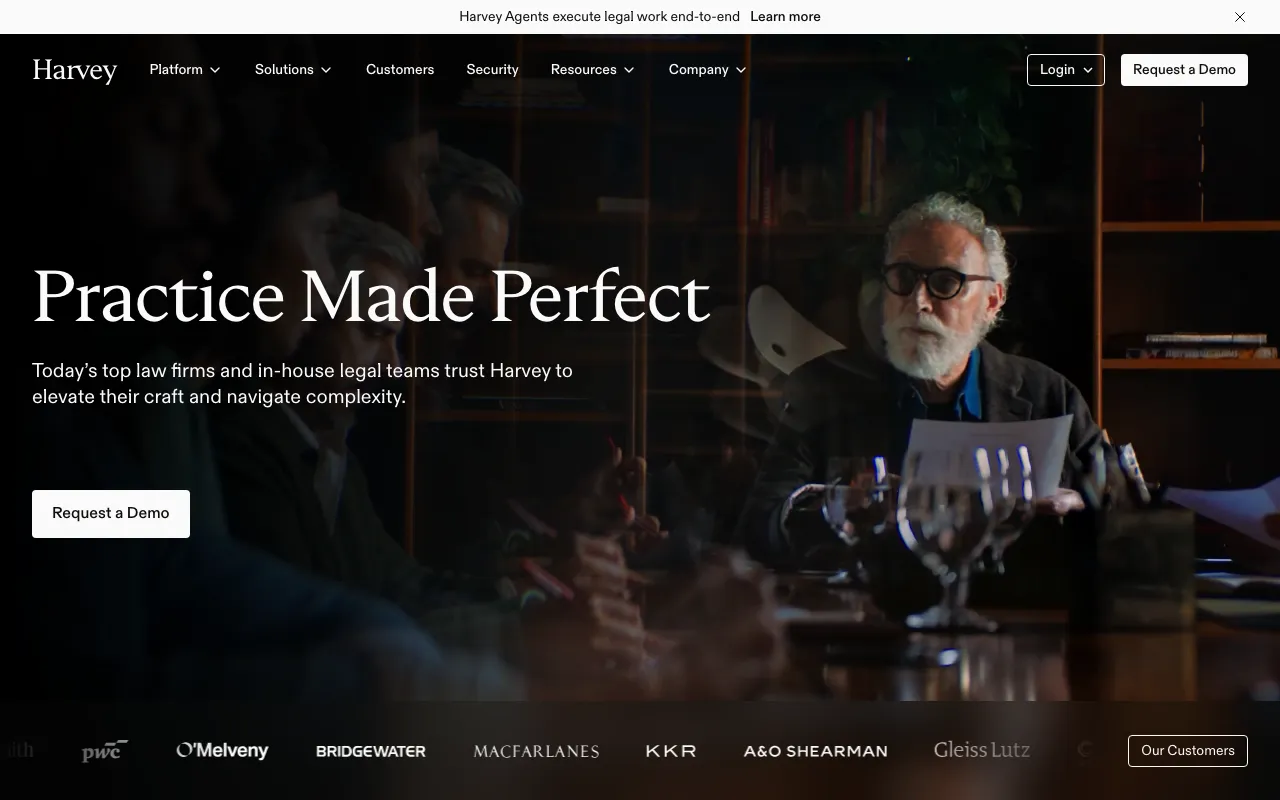
What is Harvey?
Harvey is a generative AI platform built specifically for legal and professional-services work rather than adapted from a general-purpose chatbot. It gives lawyers and legal teams tools to automate the repetitive, document-heavy parts of their practice — contract analysis and negotiation, legal, regulatory, and tax research, due diligence, and drafting — while keeping attorneys in control of strategy and final judgment. The platform combines purpose-built AI agents that execute multi-step legal tasks end-to-end with a secure document vault for storing, organizing, and bulk-analyzing large sets of files.
Beyond individual tasks, Harvey is designed to operate at firm scale. Shared Spaces enable secure collaboration across organizations, the Knowledge module grounds research in legal and regulatory sources, and a Command Center gives leaders analytics on how AI is being adopted across the firm. Security and compliance are central to the pitch, with SOC 2 Type II, GDPR, and ISO 27001 certifications aimed at the regulated data that legal teams handle. The company has grown quickly: in March 2026 it raised $200 million at an $11 billion valuation, and it reports use by more than 1,300 organizations and over 100,000 lawyers, including a majority of the AmLaw 100.
Who is it for?
Harvey is aimed at legal organizations that handle enough volume to justify an enterprise AI deployment, and it is sold through custom contracts rather than self-serve signup. There is no free tier or per-seat public price, so evaluation happens through a demo and a negotiated pilot. The value shows up when repeatable legal work — contract review, research, diligence — can be standardized across many practitioners.
- Large law firms (including AmLaw 100 firms) that want firm-wide AI agents and workflow automation across practice areas.
- In-house legal departments looking to accelerate contract review, research, and drafting without adding headcount.
- Professional-services and asset-management firms with recurring legal, regulatory, and compliance workloads that benefit from secure bulk document analysis.
- Legal operations leaders who need adoption analytics, admin controls, and enterprise security to roll AI out across a regulated organization.
How much does Harvey cost?
Starting price: Custom · Free tier: no · Model: contact
Price history tracked from June 2026
| Plan | Price | Includes |
|---|---|---|
| Enterprise | Custom | Seat-based enterprise licensing, quoted per organization · Typical annual contracts with seat minimums and multi-year terms · SOC 2 Type II, GDPR, and ISO 27001 security posture · Dedicated onboarding, admin controls, and account management · No public pricing — request a demo through sales |
What are Harvey's key features?
- Harvey Agents that execute multi-step legal work end-to-end for professional review
- Vault for secure document storage, organization, and bulk analysis
- Knowledge module for research across legal, regulatory, and tax domains
- Contract Intelligence for accelerated contract analysis and negotiation
- Shared Spaces for secure cross-organization collaboration
- Command Center analytics for tracking AI adoption across the organization
- Harvey Mobile for access to matters and workflows on the go
- Enterprise security certifications (SOC 2 Type II, GDPR, ISO 27001)
What people use Harvey for
- 01 Automating first-pass contract review, redlining, and negotiation support across large deal volumes
- 02 Running legal, regulatory, and tax research with source-grounded answers for outside and in-house counsel
- 03 Bulk-analyzing document sets in a secure vault for due diligence and M&A workflows
- 04 Drafting and revising legal memos, agreements, and client deliverables end-to-end with attorney review
- 05 Standardizing repeatable legal workflows across a firm with purpose-built AI agents
Pros and cons
| Pros | Cons |
|---|---|
| Purpose-built for legal work rather than a general chatbot repurposed for law | Opaque contact-sales pricing with no public tiers — cost is only visible after a demo and quote |
| Deep enterprise adoption — 1,300+ organizations and a majority of the AmLaw 100 as of 2026 | Enterprise-only motion with seat minimums and long procurement cycles; not accessible to solo practitioners on a self-serve basis |
| Strong security and compliance posture (SOC 2 Type II, GDPR, ISO 27001) suited to regulated legal data | Third-party estimates put seat costs anywhere from roughly $100 to $2,000 per user per month (unverified estimate — treat as directional, not a quote) |
| Agentic workflows and a document vault handle firm-scale volumes, not just single prompts | Outputs still require attorney review; generative legal AI can hallucinate citations or misstate law |
What are the best Harvey alternatives?
ChatGPT is the closest Harvey alternative in our directory: it starts at $8/mo, has a free tier.
Ranked by category overlap with Harvey, then free-tier availability, then lowest verified starting price — computed from our verified data, never from sponsorships.
| Alternative | What it is | Starting price | Free tier | Price verified |
|---|---|---|---|---|
| ChatGPT | Conversational AI assistant by OpenAI with multimodal reasoning, voice, and agent capabilities | $8/mo | yes | Jun 11, 2026 |
| Consensus | AI search engine for peer-reviewed research across 200M+ scientific papers | $10/mo | yes | Jun 11, 2026 |
| Claude | Anthropic's AI assistant built for long-context analysis, coding, and safe reasoning | $20/mo | yes | Jul 3, 2026 |
| Perplexity | AI-powered answer engine that searches the live web and cites every source | $20/mo | yes | Jun 11, 2026 |
| Glean | Enterprise Work AI platform unifying AI search, an assistant, and agents over a permission-aware company knowledge graph | Custom | no | Jul 12, 2026 |
Frequently asked questions
How much does Harvey cost?
Harvey does not publish pricing. It sells through custom enterprise contracts with seat-based licensing, seat minimums, and annual terms. You must request a demo to receive a quote. Third-party reports estimate a wide per-seat range, but these are unverified estimates rather than official figures.
Is Harvey a legal-specific AI tool?
Yes. Harvey is a domain-specific generative AI platform built for legal and professional-services work, including contract analysis, legal research, drafting, due diligence, and workflow automation for law firms and in-house legal teams. It is not a general-purpose coding or consumer chatbot.
Who uses Harvey?
Harvey is used by law firms, in-house legal departments, and professional-services organizations. As of 2026 the company reports over 1,300 customer organizations across 60+ countries and more than 100,000 lawyers, including a majority of the AmLaw 100 and hundreds of in-house teams.
How much funding has Harvey raised?
In March 2026 Harvey raised $200 million at an $11 billion valuation in a round co-led by GIC and Sequoia. The company states it has raised more than $1 billion in total funding from investors including Andreessen Horowitz, Coatue, Kleiner Perkins, and Elad Gil.
Does Harvey have a free tier?
No. Harvey has no free tier and no self-serve signup. Access is provisioned through enterprise sales after a demo, with contracts negotiated per organization. Evaluation typically happens through a guided pilot rather than an open free trial.
Can Harvey's output be trusted without review?
No. Like all generative legal AI, Harvey can produce errors, including inaccurate citations or misstatements of law. It is designed to accelerate legal work, not replace attorney judgment. Qualified professionals must review outputs before they are relied upon or filed.
What are good alternatives to Harvey?
For general legal research and drafting, teams often compare Harvey with Claude and ChatGPT, or enterprise search tools like Glean. Perplexity and Consensus can support research workflows. Dedicated legal platforms such as CoCounsel also compete directly, though pricing and legal-specific features vary widely.