Consensus
AI search engine for peer-reviewed research across 200M+ scientific papers
Consensus is an AI academic search engine that queries 200M+ peer-reviewed papers and synthesizes findings via a "Consensus Meter" showing yes/no/possibly across analyzed studies. The free tier includes unlimited paper searches plus 3 Deep Searches per month; Pro costs $10/mo (billed annually) or $15/mo monthly. Best for researchers, students, and clinicians who need evidence-backed answers fast without manual literature review.
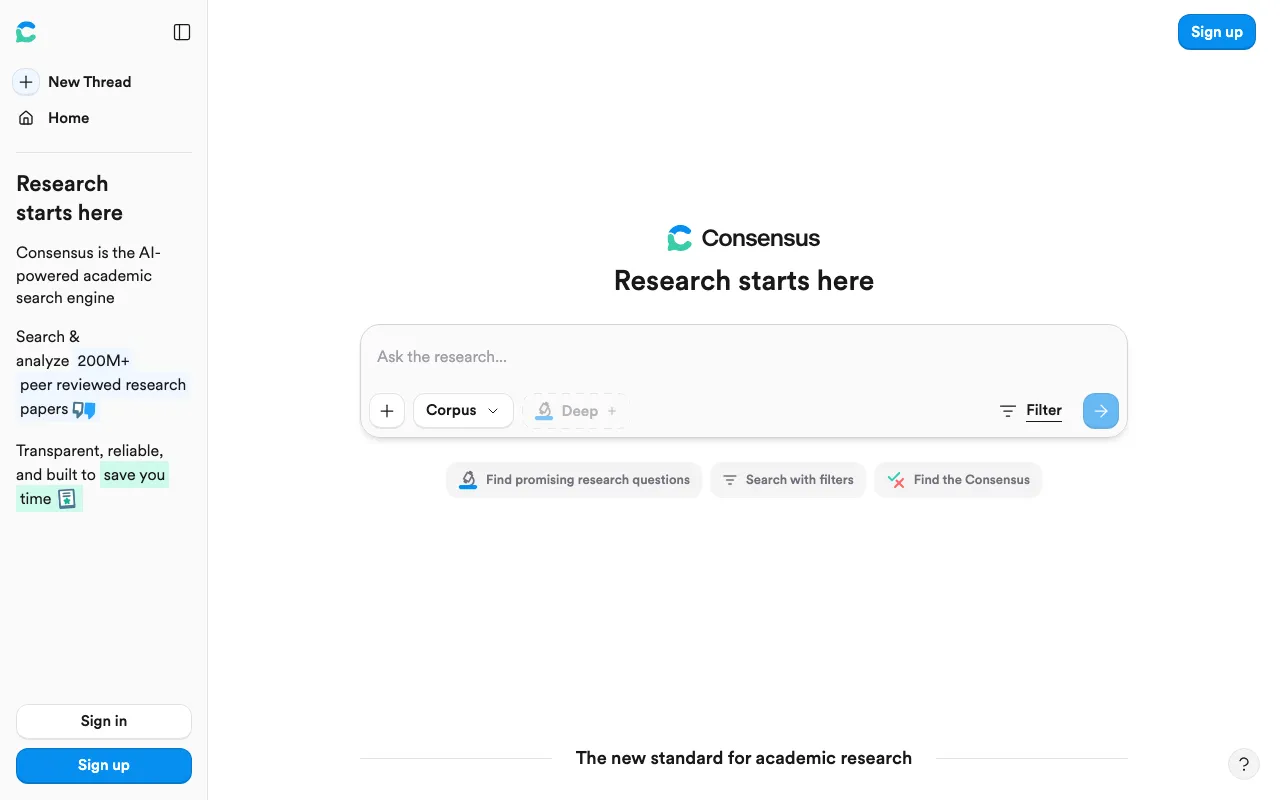
What is Consensus?
Consensus is an AI-powered academic search engine built on a corpus of over 220 million peer-reviewed scientific papers. Unlike general-purpose AI chatbots that synthesize from training data, Consensus runs every query directly against its indexed literature using a hybrid of semantic search (vector embeddings) and keyword search (BM25), then surfaces the papers most relevant to your specific research question. Every claim it returns is tied to a citable source paper, not generated text.
The platform’s signature feature is the Consensus Meter: a visual indicator that aggregates findings from analyzed studies and shows a yes/no/possibly breakdown in seconds, reranked by citation count, study design quality, and journal reputation. Deeper features include Deep Search, which automates full search strategy execution across up to 1,000 papers per query, and Study Snapshots, which extract structured data — methods, outcomes, populations, sample sizes — from individual papers. Medical Mode (launched October 2025) restricts results to clinical guidelines and high-impact medical journals, while Scholar Agent coordinates multi-agent workflows for complex research tasks requiring planning, retrieval, reading, and synthesis in sequence.
Who is it for?
Consensus targets anyone who needs evidence-backed answers faster than manual literature search allows. The free tier is genuinely usable for occasional research needs without a subscription, while Pro suits regular users doing ongoing literature work. The Deep tier is designed for power users who run frequent systematic reviews or need Medical Mode access.
Specific user profiles:
- Academic researchers and PhD students running literature reviews for papers, theses, or grant applications — Deep Search reduces initial screening from days to minutes.
- Clinicians and healthcare professionals who need quick access to clinical evidence; Medical Mode filters to guideline-level sources, and a 25% NPI-verified discount reduces cost.
- Science journalists and fact-checkers who need to verify whether a claimed finding reflects broader scientific consensus, not a single outlier study.
- Instructors and librarians teaching evidence-based research skills — the Consensus Meter makes the aggregation of evidence legible to students unfamiliar with meta-analysis.
How much does Consensus cost?
Starting price: $10/mo · Free tier: yes · Model: freemium
Price history tracked from June 2026
| Plan | Price | Includes |
|---|---|---|
| Free | Free | Unlimited paper searches across 200M+ papers · 3 Deep Searches/month · 10 Study Snapshots/month · 15 Pro AI messages/month |
| Pro | $15/mo | $10/mo billed annually ($120/yr) · Unlimited Pro Search · 15 Deep Searches/month · Unlimited Study Snapshots · 40% student discount available |
| Deep | $65/mo | $45/mo billed annually ($540/yr) · 200 Deep Searches/month · Medical Mode access · Scholar Agent access · Priority support |
| Enterprise | Contact | 200+ users · Centralized billing · University library integrations · Custom SLA |
What are Consensus's key features?
- Searches 200M+ peer-reviewed papers with semantic + keyword hybrid retrieval
- Consensus Meter visualizes yes/no/possibly breakdown across analyzed studies
- Deep Search automates search strategy across up to 1,000 papers per query
- Study Snapshots extract structured methods, outcomes, populations, and sample sizes
- Medical Mode filters to 50,000+ clinical guidelines and top 1,000 medical journals
- Scholar Agent orchestrates multi-agent workflows for complex research tasks
- Every claim links directly to the source paper with full citation
- 170+ university library partnerships for expanded access
What people use Consensus for
- 01 Rapid literature review for academic papers and grant writing
- 02 Evidence-based fact-checking on medical or scientific claims
- 03 Systematic review screening across hundreds of studies
- 04 Teaching research methodology with live paper evidence
- 05 Competitive intelligence on scientific consensus in a niche
Pros and cons
| Pros | Cons |
|---|---|
| Free tier includes unlimited paper searches — no hard search cap | Coverage is limited to indexed academic papers — no grey literature or preprints by default |
| Consensus Meter reduces hundreds of papers to a visual signal in seconds | Large price jump from Pro ($15/mo) to Deep ($65/mo) for moderate power users |
| Medical Mode and Scholar Agent meaningfully differentiate the Deep tier | No API access, limiting programmatic integration into research pipelines |
| 40% student discount and 25% clinician discount reduce effective cost | Deep Search credits reset monthly with no rollover |
What are the best Consensus alternatives?
You.com is the closest Consensus alternative in our directory: it covers the same category (AI Search & Research), starts at $5 per 1,000 calls, has a free tier.
Ranked by category overlap with Consensus, then free-tier availability, then lowest verified starting price — computed from our verified data, never from sponsorships.
| Alternative | What it is | Starting price | Free tier | Price verified |
|---|---|---|---|---|
| You.com vs Consensus → | Real-time web search and research APIs for AI agents and LLM pipelines | $5 per 1,000 calls | yes | Jun 11, 2026 |
| NotebookLM vs Consensus → | Google's AI research assistant that answers questions grounded in your own uploaded sources | $7.99/mo | yes | Jun 11, 2026 |
| Felo AI vs Consensus → | Multilingual AI search and creation platform combining research, summarization and content generation | $14.99/mo | yes | Jul 3, 2026 |
| Perplexity | AI-powered answer engine that searches the live web and cites every source | $20/mo | yes | Jun 11, 2026 |
| Elicit vs Consensus → | AI research assistant that searches, summarizes and extracts data from 138 million academic papers | $49/mo | yes | Jul 3, 2026 |
Frequently asked questions
Is Consensus free to use?
Yes. The free tier includes unlimited paper searches across 200M+ peer-reviewed articles, plus 3 Deep Searches per month, 10 Study Snapshots, and 15 Pro AI messages. No credit card is required.
How much does Consensus Pro cost?
Consensus Pro costs $15/month on a monthly billing cycle, or $10/month when billed annually ($120/year). A 40% student discount is available with a verified academic email, bringing the annual rate to approximately $6/month.
What is the Consensus Meter?
The Consensus Meter is a visual indicator that aggregates findings from analyzed papers and shows a yes/no/possibly breakdown for a given research question. Papers are reranked by citation count, study design, and journal reputation before the calculation.
What is Deep Search?
Deep Search is an automated literature review feature that expands a query across up to 1,000 papers, extracts structured data, and synthesizes findings. Free users get 3 Deep Searches per month; Pro users get 15; Deep plan users get 200.
Does Consensus cover medical research?
Yes. Medical Mode, available on the Deep plan, filters results to approximately 50,000 clinical guidelines and 8 million articles from the top 1,000 medical journals. A 25% clinician discount is available with verified NPI.
What is the Scholar Agent?
Scholar Agent is a multi-agent system introduced in 2025 that automates complex scientific research workflows. Specialized sub-agents handle planning, searching, reading, and analysis tasks in sequence.
How many papers does Consensus index?
As of 2026, Consensus indexes over 220 million scientific papers from peer-reviewed sources, with partnerships across 170+ university libraries.