Kagi
Paid, ad-free search engine with an AI assistant, universal summarizer, and translator layered on top of independent search results
Kagi is a paid, ad-free search engine that adds AI features — Kagi Assistant, Universal Summarizer, and Kagi Translate — on top of independent, non-tracking search results. There is no permanent free tier, only a 100-search trial; Starter costs $5/month for 300 searches, Professional is $10/month for unlimited search, and Ultimate is $25/month for unlimited search plus premium AI models like Claude and GPT. Best for people who want search without ads or tracking and are willing to pay directly instead of being the product.
What is Kagi?
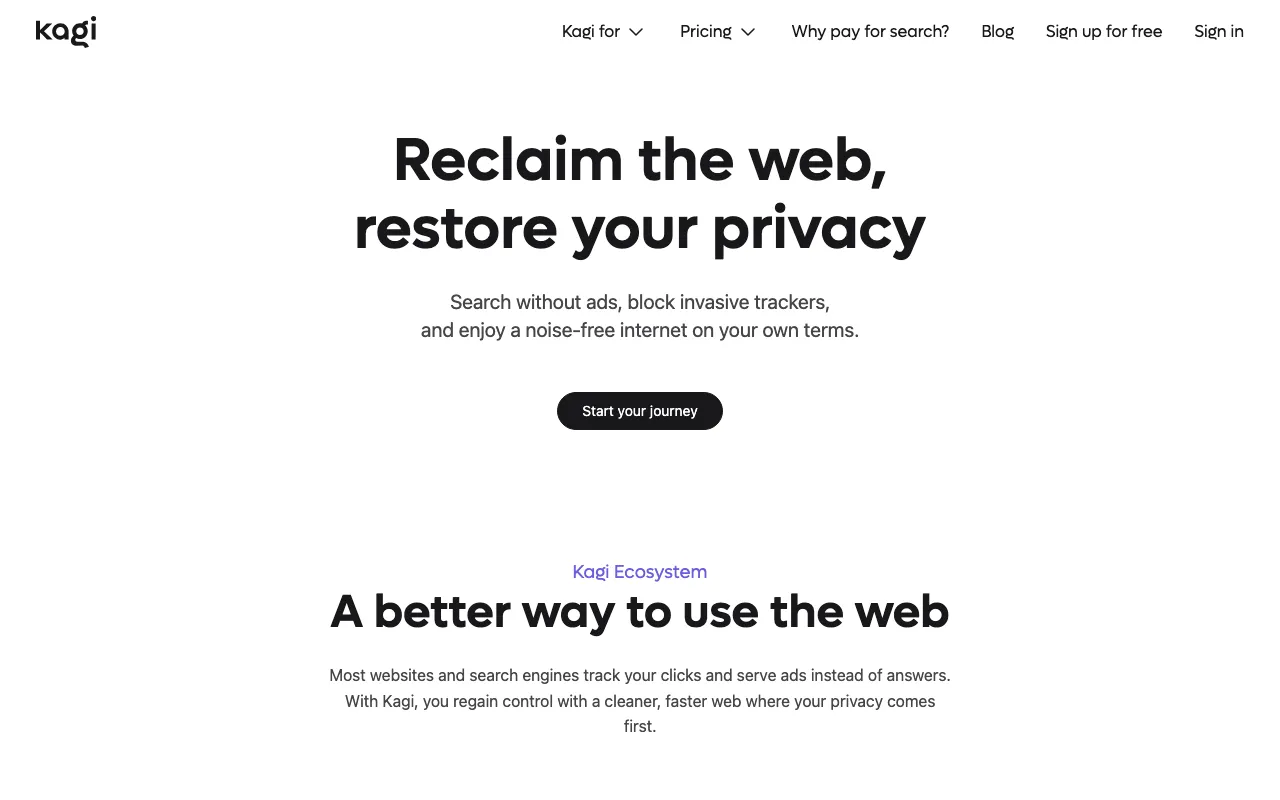
Kagi is a subscription-funded search engine built as an alternative to ad-supported search. Instead of monetizing queries through advertising and tracking, Kagi charges directly for search access, which lets it ship features ad-funded engines generally avoid — user-controlled result ranking, the ability to permanently boost or block specific domains, and a results page with no sponsored listings. Kagi Search is the core product; a one-time trial of 100 searches lets a new user evaluate it before any plan is required.
Layered on top of search, Kagi has expanded into a small suite of AI features: Kagi Assistant is a chat interface that queries multiple AI models and grounds its answers in live Kagi Search results rather than relying solely on a model’s static training data. Universal Summarizer condenses articles, PDFs, and videos into short digests, and Kagi Translate handles text, page, and voice translation across 240+ languages, with mobile apps and a browser extension for on-the-go use. The premium Ultimate tier adds a Research mode and access to flagship models including Claude, GPT, and Gemini.
Who is it for?
Kagi is aimed at people who have decided the trade-offs of free, ad-funded search — tracking, sponsored results, algorithmic ranking they can’t control — are worse than paying a monthly fee for a cleaner result set. It is a harder sell for casual users who are used to search costing nothing, but a natural fit for anyone already paying for privacy tools or professional research software.
- Privacy-conscious individuals who want to stop being tracked across search queries and are willing to pay $5-10/month instead of trading data for free results.
- Researchers and knowledge workers who lean on Universal Summarizer and Kagi Assistant to condense long documents and get answers grounded in live search rather than a static AI knowledge cutoff.
- Power searchers who want to customize result ranking — boosting trusted sites and blocking low-quality ones — a feature not available in mainstream engines like Perplexity or standard web search.
- Multilingual users and travelers who use Kagi Translate’s 240+ language support across mobile and browser extension for text, page, and voice translation.
- Families and small teams who want to split the cost of ad-free search and AI access across up to 6 people on the Family plan.
How much does Kagi cost?
Starting price: $5/mo · Free tier: no · Model: paid
Price history tracked from June 2026
| Plan | Price | Includes |
|---|---|---|
| Trial | Free | 100 searches to try Kagi Search · 100 Kagi Assistant AI interactions · No credit card required to start · Not an ongoing free tier — searches run out |
| Starter | $5/mo | 300 searches per month · 300 Kagi Assistant interactions with standard models · 10% off with annual billing |
| Professional | $10/mo | Unlimited searches · Unlimited Universal Summarizer use · Kagi Assistant with standard AI models and a larger usage allowance · 10% off with annual billing |
| Ultimate | $25/mo | Unlimited searches · Kagi Assistant Research mode with premium models (Claude, GPT, Gemini) · Unlimited Kagi Translate across 240+ languages · Highest tier of support · 10% off with annual billing |
| Family | $20/mo | Shared plan for up to 6 members · Each member can add Ultimate for +$15/month · Team plans available separately for organizations |
What are Kagi's key features?
- Kagi Search — an independent, ad-free search index with no tracking and user-controlled result ranking
- Kagi Assistant — a chat interface that queries multiple AI models and grounds answers in Kagi Search results
- Universal Summarizer — condenses articles, PDFs, and videos into a short summary in a chosen language
- Kagi Translate — translates text, full pages, and voice across 240+ languages, with mobile apps and a browser extension
- Kagi News — a private, ad-free news briefing without algorithmic clickbait feeds
- Browser extensions for Chrome and Firefox, plus a Search API in preview for developers
What people use Kagi for
- 01 Everyday web search for people who want to stop seeing ads and being tracked across queries
- 02 Summarizing long articles, PDFs, or web pages into a short digest via Universal Summarizer
- 03 Asking Kagi Assistant questions that are grounded in live Kagi Search results instead of a model's static training data
- 04 Translating text, pages, or conversations across 240+ languages through Kagi Translate
- 05 Customizing and re-ranking search results — boosting or blocking specific domains per user preference
Pros and cons
| Pros | Cons |
|---|---|
| No ads and no tracking by design — the business model is subscriptions, not advertising, so incentives are aligned with the searcher | No lasting free tier — only a one-time 100-search trial, so paying for search is a hard sell against Google or Bing, which are free |
| Users can customize and permanently boost or block specific domains from their own results, which ad-funded engines don't offer | Starter plan caps out at 300 searches and 300 AI interactions per month, which heavy users will exhaust quickly |
| Kagi Assistant grounds answers in real Kagi Search results rather than relying purely on a model's training data | No native shopping, maps, or local-business search parity with the largest ad-funded engines |
| Ultimate plan bundles unlimited search with access to multiple premium AI models (Claude, GPT, Gemini) under one subscription | Premium AI models and Research mode are locked behind the $25/month Ultimate tier, not available on cheaper plans |
What are the best Kagi alternatives?
Exa is the closest Kagi alternative in our directory: it covers the same category (AI Search & Research), starts at $0, has a free tier.
Ranked by category overlap with Kagi, then free-tier availability, then lowest verified starting price — computed from our verified data, never from sponsorships.
| Alternative | What it is | Starting price | Free tier | Price verified |
|---|---|---|---|---|
| Exa | AI-native web search engine and API built for agents, with semantic search and content extraction | $0 | yes | Oct 12, 2026 |
| You.com | Real-time web search and research APIs for AI agents and LLM pipelines | $5 per 1,000 calls | yes | Jun 11, 2026 |
| Perplexity | AI-powered answer engine that searches the live web and cites every source | $20/mo | yes | Jun 11, 2026 |
Frequently asked questions
Is Kagi free?
No. Kagi offers a one-time trial of 100 searches and 100 AI interactions to test the product, but there is no ongoing free tier. Paid plans start at $5/month for the Starter tier.
How much does Kagi cost?
Starter is $5/month for 300 searches and 300 AI interactions. Professional is $10/month for unlimited searches. Ultimate is $25/month for unlimited searches plus premium AI models like Claude and GPT. Annual billing on any plan saves 10%.
What is Kagi Assistant?
Kagi Assistant is an AI chat feature that lets users query multiple AI models while keeping prompts private. On the Professional plan it uses standard models; the Ultimate plan unlocks a Research mode with premium flagship models including Claude, GPT, and Gemini.
Does Kagi have a search API for developers?
Yes, in preview. Kagi offers programmatic access to search results, enrichment data, its summarizer, and FastGPT through a commercial, credit-based API for developers building on top of Kagi's index.
How many searches do Kagi's plans include?
The Starter plan includes 300 searches per month. Professional and Ultimate both include unlimited searches. Bangs and search suggestions typed while searching don't count against the limit.
Does Kagi have a family plan?
Yes. The Family plan starts at $20/month for up to 6 members sharing one subscription, and any member can individually add Ultimate-tier AI access for an additional $15/month.
Is Kagi's AI grounded in search results, or does it just chat like ChatGPT?
Kagi Assistant is designed to ground its answers in live Kagi Search results rather than answering purely from a model's training data, which is meant to reduce outdated or fabricated answers compared to a standalone chatbot.