Exa
AI-native web search engine and API built for agents, with semantic search and content extraction
Exa is an AI-native web search engine and API built for agents and retrieval-augmented generation, with semantic search, page-content extraction, and a no-code Websets product for building structured result collections. The API has a free tier of 20,000 requests a month and bills search from $7 per 1,000 requests; Websets runs free, $49/month, or $449/month. Best for developers grounding AI apps in live, citable web data.
What is Exa?
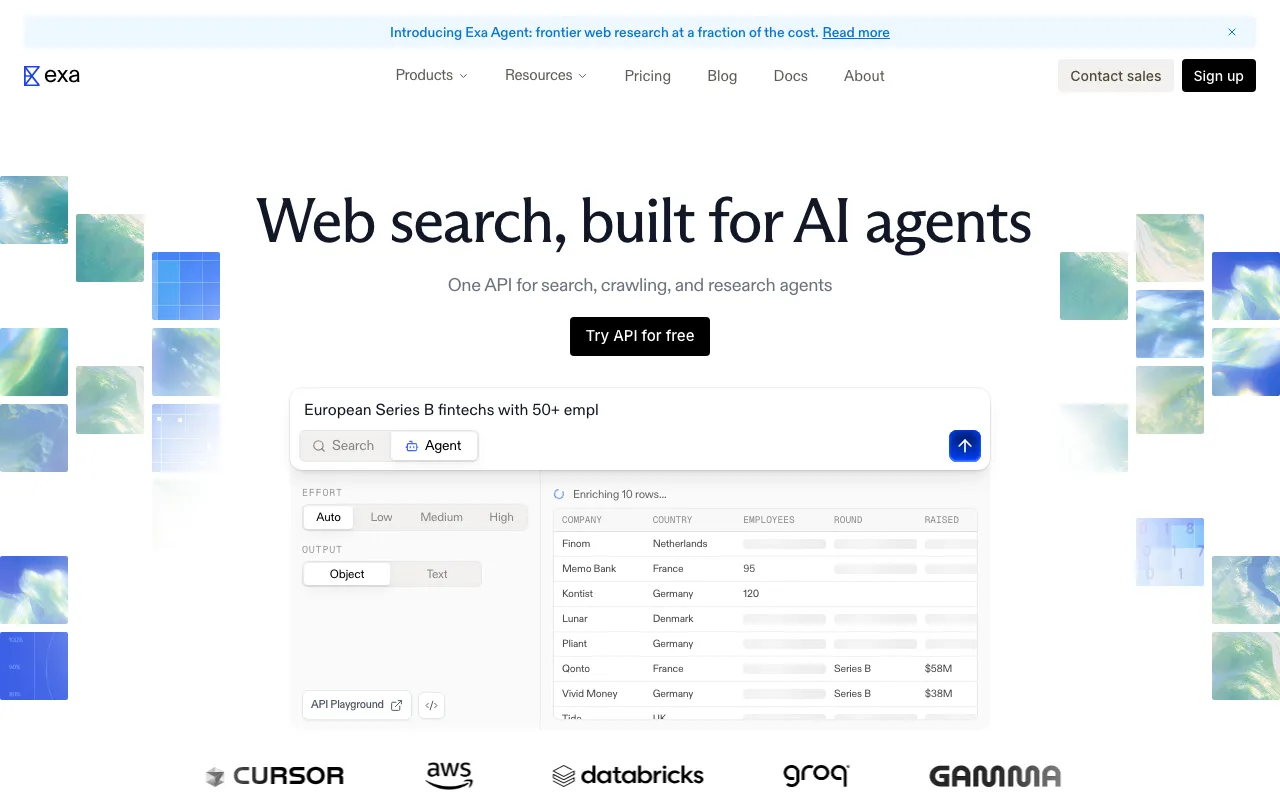
Exa is a web search engine and API built specifically for AI systems rather than human browsing. Where a consumer search engine returns a page of links for a person to read, Exa returns structured, citable results designed to be consumed by agents, chatbots, and retrieval-augmented-generation pipelines. Its neural (semantic) search matches on meaning, and its content and highlight extraction pulls just the relevant passages from a page — which can sharply reduce the token cost of feeding web data into a model.
The API is usage-based with a sizable free tier of 20,000 requests a month. Standard search is $7 per 1,000 requests, with cheaper and more advanced options — an Answer endpoint, Deep Search, content extraction, and a Monitors API for tracking web changes. On top of the raw API, Exa offers Websets, a no-code product for building curated, enriched collections of results (such as lists of companies or people with custom columns), sold as a subscription: free, Core at $49/month, and Pro at $449/month. Enterprise adds SOC 2 Type II compliance, Zero Data Retention, SSO, and custom limits.
Who is it for?
Exa is aimed squarely at builders. If you are putting live web knowledge into an AI product and need it structured, grounded, and citable, Exa is designed for exactly that. The free tier is generous enough to prototype; the usage-based pricing scales with real traffic, and Websets adds a no-code path for non-engineers.
- AI developers grounding agents and chatbots in current web data with citations.
- RAG engineers who want highlight extraction to cut token usage and improve relevance.
- Growth and research teams building enriched lead or company lists through Websets without code.
- Enterprises that need compliant, low-latency search with Zero Data Retention and SSO.
How much does Exa cost?
Starting price: $0 · Free tier: yes · Model: usage-based
Price history tracked from June 2026
| Plan | Price | Includes |
|---|---|---|
| Free | Free | Up to 20,000 API requests per month · Full API access including search and content extraction · $1,000 in credits for eligible startups and education |
| Search (API) | $7/1k | $7 per 1,000 search requests (10 results with text + highlights) · Deep Search at $12 per 1,000 requests · Answer endpoint at $5 per 1,000 requests · Contents extraction at $1 per 1,000 pages |
| Websets Core | $49/mo | 8,000 credits per month · Up to 100 results per webset · 2 team seats |
| Websets Pro | $449/mo | 100,000 credits per month · Up to 1,000 results per webset · 10 team seats |
| Enterprise | Custom | Custom credits and rate limits · Zero Data Retention and SSO · Volume discounts and higher concurrency |
What are Exa's key features?
- Neural / semantic web search optimized for AI agents and RAG
- Content and highlight extraction that cuts token usage substantially
- Structured JSON outputs across a large company and people index
- Exa Instant for low-latency results (under roughly 180 ms)
- Websets for building curated, enriched collections of results
- Monitors API to track and re-run searches for new web events
- Exa Agent for autonomous web research with tunable effort
- Enterprise security: SOC 2 Type II, Zero Data Retention, and SSO
What people use Exa for
- 01 Grounding an AI agent or chatbot in live web results with citations
- 02 Extracting just the relevant highlights from pages to cut token usage in RAG pipelines
- 03 Building structured, enriched collections of companies or people with Websets
- 04 Running low-latency semantic search inside an application
- 05 Monitoring the web for new events and re-running searches on a schedule
Pros and cons
| Pros | Cons |
|---|---|
| Transparent, granular usage-based pricing with a large free tier (20,000 requests/month) | Pricing rose in early 2026 (standard search went from $5 to $7 per 1,000), and add-on charges can stack unpredictably |
| Purpose-built for AI and agent workflows — highlights, structured JSON, and grounded citations | Websets jumps steeply from $49 to $449/month with a large gap between tiers |
| Very low-latency option and both API and no-code (Websets) paths | The per-request and credit model requires usage modeling to forecast spend |
| Enterprise-grade compliance plus startup and education credits | Quality depends on neural relevance, and large 1,000-result jobs can take a long time |
What are the best Exa alternatives?
You.com is the closest Exa alternative in our directory: it covers the same category (AI Search & Research), starts at $5 per 1,000 calls, has a free tier.
Ranked by category overlap with Exa, then free-tier availability, then lowest verified starting price — computed from our verified data, never from sponsorships.
| Alternative | What it is | Starting price | Free tier | Price verified |
|---|---|---|---|---|
| You.com | Real-time web search and research APIs for AI agents and LLM pipelines | $5 per 1,000 calls | yes | Jun 11, 2026 |
| Consensus | AI search engine for peer-reviewed research across 200M+ scientific papers | $10/mo | yes | Jun 11, 2026 |
| Felo AI | Multilingual AI search and creation platform combining research, summarization and content generation | $14.99/mo | yes | Jul 3, 2026 |
| Perplexity | AI-powered answer engine that searches the live web and cites every source | $20/mo | yes | Jun 11, 2026 |
| Elicit | AI research assistant that searches, summarizes and extracts data from 138 million academic papers | $49/mo | yes | Jul 3, 2026 |
How people make money with Exa
- Build and sell research or lead-generation products on top of the Websets and search API, billed as a SaaS subscription or per delivered list
- Offer RAG and agent integration consulting for companies that need their AI grounded in live, citable web data
Frequently asked questions
Is Exa free?
Exa has a free tier of up to 20,000 API requests per month with full access to search and content extraction. Beyond that it is usage-based — for example, $7 per 1,000 search requests. Eligible startups and education users can also get $1,000 in credits.
What is Exa used for?
Exa is a search engine and API built for AI. Developers use it to ground agents and chatbots in live web results with citations, to extract relevant page highlights for RAG, and to build structured, enriched data collections with its Websets product.
How much does the Exa API cost?
Standard search is $7 per 1,000 requests (returning 10 results with text and highlights). Deep Search is $12 per 1,000, the Answer endpoint is $5 per 1,000, and content extraction is $1 per 1,000 pages. The first 20,000 requests a month are free.
What is Exa Websets?
Websets is a no-code product for building curated, enriched collections of web results — for example, lists of companies or people with custom data columns. It is sold as a subscription: free, Core at $49/month, and Pro at $449/month, plus Enterprise.
How is Exa different from Google or Perplexity?
Exa is a neural search engine designed to be called by AI systems rather than browsed by people. It returns structured, citable results and page highlights optimized for agents and RAG, where Perplexity is an answer engine for end users and Google is a general consumer search.
Does Exa support enterprise security?
Yes. Exa offers SOC 2 Type II compliance, an optional Zero Data Retention mode, and SSO on its Enterprise tier, along with custom rate limits, volume discounts, and higher concurrency.
Public signals
- "Rumors of my death are slightly exaggerated" — 1676 points on Hacker News, May 6, 2026