MarketMuse
AI content planning and optimization platform with topic modeling, content briefs, and Personalized Difficulty scoring for SEO teams
MarketMuse is an AI content strategy platform that models topics from your own site inventory and scores Personalized Difficulty so you target pages you can realistically rank. A permanent Free tier gives 10 queries per month; paid Optimize, Research, and Strategy tiers add briefs, tracked topics, and strategy docs but are quote-based — MarketMuse no longer publishes prices, so budget via a demo.
What is MarketMuse?
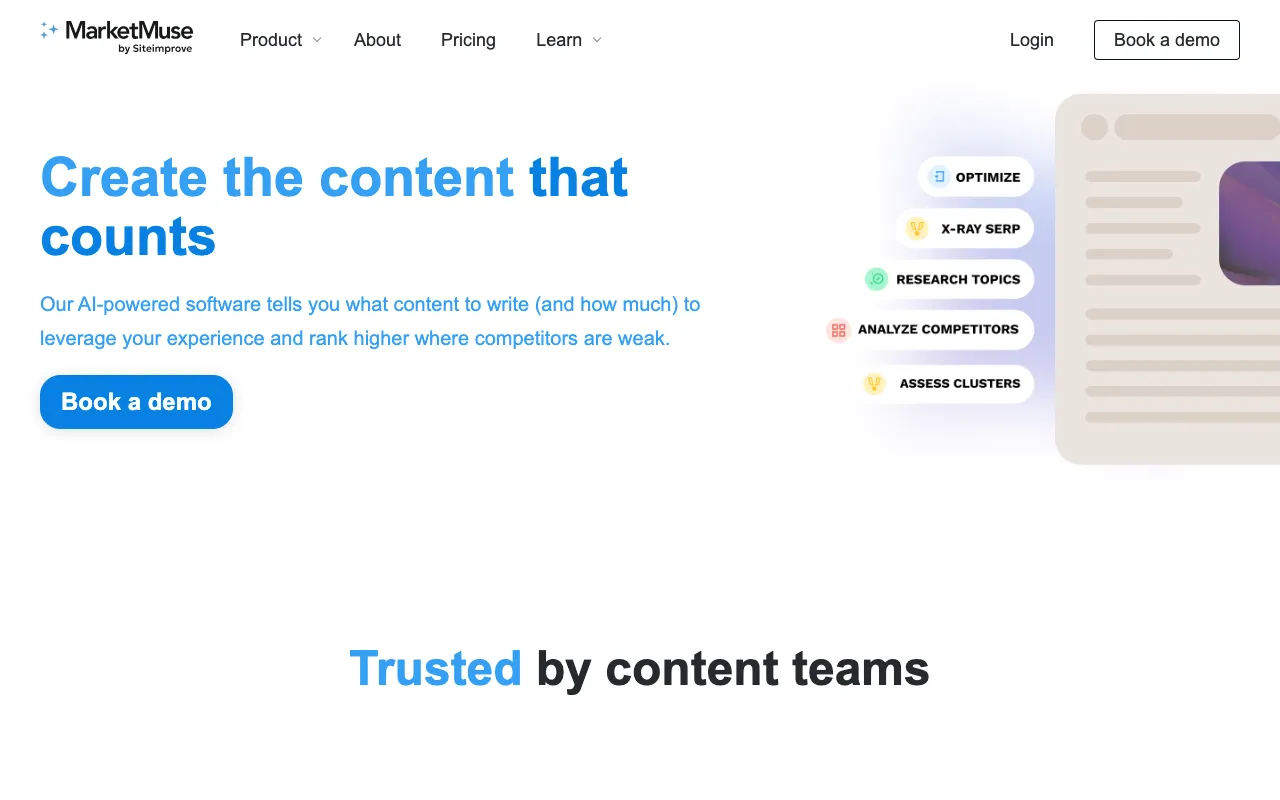
MarketMuse is an AI content planning and optimization platform built for SEO and content teams. Instead of only scoring a single draft against the current top-ranking pages, it models the topics your site already covers, maps the subtopics and related terms a page needs to demonstrate depth, and produces a Personalized Difficulty score that estimates how hard it is for your specific site to rank — based on your existing authority rather than a generic, site-agnostic keyword-difficulty number.
The platform combines a competitive content inventory, topic-cluster analysis, AI-generated content briefs, and planning roadmaps that recommend what to create or update. The Free plan includes one user and 10 queries per month with no tracked topics; the paid Optimize, Research, and Strategy plans add tracked topics from 100 up to 10,000, more briefs, strategy documents, and, on Strategy, all nine brief types. Following an acquisition completed in October 2024, MarketMuse now operates as part of Siteimprove, though it is still sold and branded under the MarketMuse name. Prices for the paid plans are no longer published — each is quote-based through a demo.
Who is it for?
MarketMuse fits teams that treat content as a long-term SEO strategy rather than a one-off optimization task. Its topic-modeling and inventory approach rewards sites with enough existing content to analyze, and its value grows with publishing volume — which is also why the meaningful capabilities sit on the paid Research and Strategy tiers. The Free plan is best for evaluation and light use.
- SEO and content strategists who plan topic clusters and need to prioritize what to create or update across a whole site, not just optimize one draft.
- In-house content teams at brands and publishers that publish regularly and want briefs, difficulty scoring, and inventory analysis in one platform.
- Agencies managing multiple clients that need more tracked topics, multiple seats, and all nine brief types on the Strategy tier.
- Editors and writers who want structured briefs specifying subtopics, questions, and depth before drafting.
How much does MarketMuse cost?
Starting price: $0 · Free tier: yes · Model: freemium
Price history tracked from June 2026
| Plan | Price | Includes |
|---|---|---|
| Free | Free | 1 user · 10 queries per month · No tracked topics or content briefs · Limited application access · Best for evaluation and low content volume |
| Optimize | Custom | Quote-based — book a demo (price not published) · 1 user · 100 tracked topics · 100 queries per month · 5 content briefs per month, 1 strategy document · 1 site inventory |
| Research | Custom | Quote-based — book a demo (price not published) · 3 users · 1,000 tracked topics · Unlimited queries per month · 10 content briefs per month, 3 strategy documents · 1 site inventory |
| Strategy | Custom | Quote-based — book a demo (price not published) · 5 users · 10,000 tracked topics · Unlimited queries per month · 20 content briefs per month, all 9 brief types · 5 strategy documents, 1 site inventory |
What are MarketMuse's key features?
- Topic modeling that maps the subtopics and related terms a page needs to demonstrate depth
- Personalized Difficulty scoring that rates ranking difficulty against your own site's authority, not a generic keyword-difficulty metric
- AI-generated content briefs with structure, questions, and coverage recommendations (nine brief types on the Strategy tier)
- Competitive content inventory and gap analysis across your site and rivals'
- Content planning roadmaps that recommend what to create or update
- Internal link recommendations to build topic clusters
What people use MarketMuse for
- 01 Building a data-driven content plan that prioritizes topics you can realistically rank for based on your existing site authority
- 02 Generating structured content briefs so writers know the subtopics, questions, and depth needed to compete
- 03 Auditing an existing content inventory to find gaps, cannibalization, and pages worth updating
- 04 Running competitive content analysis to spot topics where rivals are weak
- 05 Planning internal linking to connect related pages into topic clusters
Pros and cons
| Pros | Cons |
|---|---|
| Personalized Difficulty ties recommendations to your own site's authority rather than a one-size-fits-all keyword score | MarketMuse no longer publishes paid-tier prices — Optimize, Research, and Strategy are all quote-based via a demo, making budgeting harder than with transparent rivals like Surfer SEO or Clearscope |
| Permanent free tier lets you test topic models and optimization with 10 queries per month at no cost | Lower tiers cap usage hard: Free has no tracked topics, and Optimize limits you to 100 queries, 100 topics, and 5 briefs per month |
| Content briefs give writers concrete, structured guidance that reduces editorial back-and-forth | Steep jump from Optimize (1 user, 5 briefs) to Strategy (5 users, 20 briefs, all 9 brief types), with limited middle ground |
| Strong for topic-cluster and content-inventory strategy, not just single-page optimization | Learning curve — the topic-modeling and inventory workflow is more involved than simpler real-time optimizers |
What are the best MarketMuse alternatives?
Frase is the closest MarketMuse alternative in our directory: it covers the same category (AI Writing & Marketing), starts at $49/mo, has no free tier.
Ranked by category overlap with MarketMuse, then free-tier availability, then lowest verified starting price — computed from our verified data, never from sponsorships.
| Alternative | What it is | Starting price | Free tier | Price verified |
|---|---|---|---|---|
| Frase | AI SEO content platform for SERP research, briefs, and optimizing content to rank on Google and get cited by AI search | $49/mo | no | Jul 12, 2026 |
| Surfer SEO | AI SEO platform that scores content in real time and tracks brand visibility across AI search engines | $49/mo | no | Jun 11, 2026 |
| Scalenut | AI SEO and content platform that turns a keyword into a SERP-optimized draft in minutes and tracks brand visibility across AI search engines | $59/mo | no | Jul 14, 2026 |
| Semrush | All-in-one digital marketing platform for SEO, content, ads, and AI brand visibility | $117.33/mo | no | Jun 11, 2026 |
| Clearscope | Content optimization platform that grades drafts against SERP competitors and tracks brand visibility in ChatGPT and Gemini | $129/mo | no | Jul 16, 2026 |
Frequently asked questions
Is MarketMuse free?
MarketMuse has a permanent Free plan with one user, 10 content queries per month, and limited application access, but no tracked topics or content briefs. It is enough to test topic models and try optimization on a few pages. Regular publishing needs a paid tier such as Optimize, Research, or Strategy.
How much does MarketMuse cost?
MarketMuse no longer publishes dollar prices for its paid plans. Optimize, Research, and Strategy are all quote-based, and the only way to get current pricing is to book a demo. Third-party sites cite varying figures, but MarketMuse itself shows only plan features and limits, not prices, as of July 2026.
What is Personalized Difficulty?
Personalized Difficulty is MarketMuse's scoring that estimates how hard it is for your specific site to rank for a topic, based on your existing content authority rather than a generic, site-agnostic keyword-difficulty number. Two sites can get different scores for the same keyword, which helps you prioritize topics you can realistically win.
What are MarketMuse content briefs?
Content briefs are AI-generated outlines that tell a writer the subtopics, related questions, structure, and depth a page needs to compete for a topic. Brief allowances are capped per plan — 5 per month on Optimize, 10 on Research, and 20 on Strategy, which also unlocks all nine brief types like Guide, Listicle, and Comparison.
How is MarketMuse different from Surfer SEO or Clearscope?
Surfer SEO and Clearscope focus on real-time, single-page optimization by comparing your draft to top-ranking results. MarketMuse leans toward strategy: modeling entire topic clusters, scoring difficulty against your own site, and planning what to create or update across a whole inventory. Many teams pair one optimizer with MarketMuse for planning.
Is MarketMuse still an independent company?
No. MarketMuse was acquired by Siteimprove, with the deal completed in October 2024, and now operates as part of Siteimprove's content and SEO suite. The MarketMuse product, website, and plan lineup remain available and are still sold under the MarketMuse name as of July 2026.