RunPod
GPU cloud for renting Nvidia GPUs by the second — Pods for persistent workloads, Serverless for autoscaling inference
RunPod is a GPU cloud for renting Nvidia GPUs by the second with no monthly subscription. Secure Cloud on-demand pods run from about $0.27/hour for an RTX A5000 up to $7.39/hour for a B300, while Community Cloud spot pods cost roughly half as much but can be interrupted with only a 5-second warning. Serverless autoscaling inference starts around $0.58/hour and scales to zero when idle. Best for developers self-hosting LLMs or Stable Diffusion without buying GPU hardware.
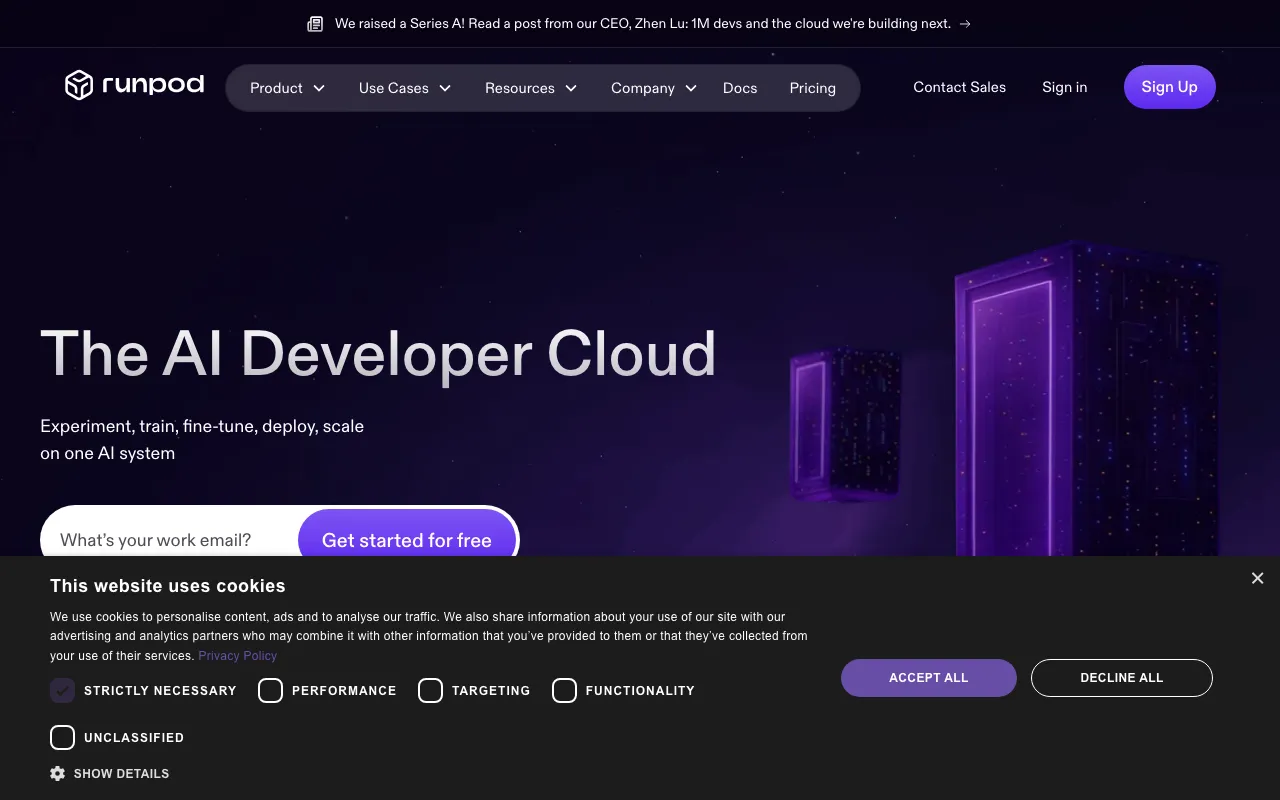
What is RunPod?
RunPod is a GPU cloud built for AI workloads: renting Nvidia GPUs by the second to run, train, or fine-tune models without owning hardware. It offers three deployment modes — Pods for persistent GPU instances you SSH into and control directly, Serverless for autoscaling inference endpoints that scale to zero when idle, and Instant Clusters for multi-node jobs spanning 200+ simultaneous GPUs. The GPU catalog spans more than 30 SKUs, from consumer cards like the RTX 3090 and RTX 4090 up to datacenter chips like the H100, H200, B200, and B300, so the same platform covers a cheap personal Stable Diffusion box and a multi-GPU training cluster.
Pricing splits between Secure Cloud, which runs in vetted, datacenter-grade facilities with a 99.99% uptime SLA, and Community Cloud, a distributed pool of third-party hosts that costs roughly half as much but can interrupt a running pod with only a five-second warning. Billing is prepaid and usage-based with no monthly subscription or minimum commitment. Developers manage deployments through the web console, a REST API, a Python SDK, or the runpodctl command-line tool, and RunPod says it serves more than a million developers, including teams at Hugging Face, Replit, and Perplexity.
Who is it for?
RunPod fits developers and small teams who need GPU compute for AI workloads but don’t want to buy hardware or commit to a cloud provider’s long-term reserved instances. The tradeoff is operational: you’re managing containers and, on Community Cloud, tolerating possible interruptions, rather than calling a fully managed per-token API.
- Developers self-hosting open-weight LLMs (Llama, DeepSeek, Qwen) who want to avoid per-token API costs at high volume and are comfortable running their own inference server.
- Stable Diffusion and image-generation users who need dedicated GPU time for batch rendering, fine-tuning, or running community models that hosted APIs don’t offer.
- ML engineers fine-tuning or training custom models who need multi-GPU capacity through Instant Clusters without provisioning their own data center.
- Startups and indie developers on a budget who use Community Cloud’s cheaper spot pricing for fault-tolerant batch jobs, saving Secure Cloud’s guaranteed uptime for production inference.
- Teams already using Modal or Replicate who want lower-level pod access with root control instead of a fully managed serverless abstraction.
How much does RunPod cost?
Starting price: $0.27/hr · Free tier: no · Model: usage-based
Price history tracked from June 2026
| Plan | Price | Includes |
|---|---|---|
| Secure Cloud Pods (On-Demand) | $0.27–$7.39/hr | RTX A5000 24GB from $0.27/hr; RTX 4090 24GB $0.69/hr · A100 80GB SXM $1.49/hr; H100 SXM 80GB $2.99/hr; H100 NVL $3.19/hr · H200 141GB $4.39/hr; B200 180GB $5.89/hr; B300 288GB $7.39/hr · Datacenter-grade infrastructure with a 99.99% uptime SLA and SOC 2 Type II |
| Community Cloud Pods (Spot) | From about $0.22/hr | Distributed pool of vetted third-party hosts, roughly half the price of Secure Cloud for the same GPU · RTX 4090 around $0.34/hr versus $0.69/hr on Secure Cloud · Spot instances can be interrupted anytime with only a 5-second SIGTERM warning before SIGKILL · Best for fault-tolerant batch jobs, not for uninterruptible training runs |
| Serverless | $0.58–$9.98/hr | Autoscaling inference workers billed by the second, scaling to zero when idle · Sub-200ms cold starts via FlashBoot; scales from 0 to thousands of workers in under 250ms · Rates span A4000-class GPUs at $0.58/hr up to B300 at $9.98/hr |
| Storage | $0.05–$0.20/GB/mo | Container and volume disk $0.10/GB/mo while running, $0.20/GB/mo idle · Network storage $0.07/GB/mo under 1TB, $0.05/GB/mo over 1TB, with no egress fees · High-performance network storage $0.14/GB/mo |
| Reserved / Enterprise | Custom | 1, 3, 6, 12, and 12+ month commitments cut costs 30-45% versus on-demand · Reserved Instant Clusters for multi-node distributed training across 200+ GPUs · Contact sales for discounted rates and enterprise SLAs |
What are RunPod's key features?
- Pods — persistent GPU instances in Secure Cloud (datacenter-grade) or Community Cloud (distributed, cheaper) with root SSH access
- Serverless — autoscaling inference endpoints with sub-200ms cold starts via FlashBoot and scale-to-zero billing
- Instant Clusters — multi-node deployments of 200+ simultaneous GPUs for distributed training and large-batch inference
- 30+ GPU SKUs spanning consumer RTX cards to datacenter H100, H200, B200, and B300 chips
- runpodctl CLI and Python SDK/API for scripting pod, serverless endpoint, and volume management
- Persistent network storage volumes shared across pods, with no egress fees
- RunPod Hub of prebuilt container templates for common ML workloads
What people use RunPod for
- 01 Self-hosting open-weight LLMs like Llama, DeepSeek, or Qwen on rented GPUs instead of paying per-token API fees
- 02 Running Stable Diffusion, Flux, or other image-generation models on demand for personal projects or production pipelines
- 03 Fine-tuning or training custom models across multi-GPU Instant Clusters
- 04 Deploying autoscaling inference APIs for production apps via Serverless endpoints
- 05 Spinning up a temporary GPU-backed development environment for ML experimentation without buying hardware
Pros and cons
| Pros | Cons |
|---|---|
| Per-second billing with no monthly subscription or minimum commitment across pods, serverless, and storage | Community Cloud spot pods can be interrupted anytime with only a 5-second SIGTERM warning — unsaved work is lost without volumes or checkpoints |
| Community Cloud spot pricing runs roughly half of Secure Cloud on-demand rates for the same GPU | No standing free tier on the official pricing page; only referral-driven signup bonus credits, unlike competitors such as Modal's ongoing monthly free compute allowance |
| Wide GPU catalog spans budget RTX cards from about $0.27/hr up to datacenter B300s at $7.39/hr, matching hardware to budget | Reserved/committed discounts of 30-45% require contacting sales rather than a self-serve toggle |
| runpodctl CLI and REST API make it straightforward to script GPU provisioning into existing ML pipelines | Pricing spans many GPU SKUs across two cloud tiers, making true cost comparison against flat per-token API providers harder |
What are the best RunPod alternatives?
Modal is the closest RunPod alternative in our directory: it covers the same category (AI Coding), starts at Free + usage, has a free tier.
Ranked by category overlap with RunPod, then free-tier availability, then lowest verified starting price — computed from our verified data, never from sponsorships.
| Alternative | What it is | Starting price | Free tier | Price verified |
|---|---|---|---|---|
| Modal | Python-first serverless platform for running, deploying, and fine-tuning AI models on GPUs, billed per second with scale-to-zero and no idle charges | Free + usage | yes | Oct 19, 2026 |
| Together AI | AI cloud for running, fine-tuning, and deploying open-source models via serverless inference and on-demand GPU clusters | $0 | yes | Jun 24, 2026 |
| Fireworks AI | High-speed inference and fine-tuning cloud for open-weight LLMs, image, and audio models via a usage-based API | $0.10/1M tokens | yes | Oct 19, 2026 |
| Replicate | Run and fine-tune thousands of open-source AI models with one line of code via a cloud API, billed per second of GPU or CPU compute | $0.000025/sec | no | Jun 23, 2026 |
How people make money with RunPod
- Rent out idle Nvidia GPU hardware as a vetted RunPod Community Cloud host — renters pay an hourly rate per GPU that scales with the model, with hosting income paid for the capacity you contribute
Frequently asked questions
Is RunPod free?
RunPod has no standing free tier on its official pricing page. It uses prepaid, usage-based billing by the second across Pods, Serverless, and storage. Referral signups can earn bonus credits, but there is no permanent free monthly allowance like some competitors offer.
What is the difference between Secure Cloud and Community Cloud?
Secure Cloud runs in vetted, datacenter-grade facilities with a 99.99% uptime SLA and SOC 2 Type II compliance. Community Cloud draws on a distributed pool of vetted third-party hosts at roughly half the price, but without the same redundancy guarantees, and spot instances can be interrupted.
How much does an H100 cost on RunPod?
On Secure Cloud, H100 pricing depends on the variant: H100 PCIe runs about $2.89/hr, H100 SXM about $2.99/hr, and H100 NVL about $3.19/hr. Community Cloud spot pricing for comparable GPUs runs lower but can be interrupted.
What happens if a Community Cloud spot pod is interrupted?
RunPod sends a 5-second SIGTERM warning before force-terminating a spot pod with SIGKILL. Any work not saved to a persistent volume or checkpoint at that point is lost, so spot pods suit fault-tolerant batch jobs rather than uninterruptible training runs.
Does RunPod have a CLI or API?
Yes. The runpodctl CLI manages pods, serverless endpoints, templates, and network volumes from the command line, and RunPod also offers a REST API and a Python SDK for scripting deployments.
What is RunPod Serverless?
RunPod Serverless is an autoscaling inference platform for GPU workloads. Workers scale to zero when idle and back up to thousands of workers in under 250ms, with sub-200ms cold starts powered by RunPod's FlashBoot technology.
Can I train models across multiple GPUs on RunPod?
Yes. RunPod's Instant Clusters support multi-node deployments of 200+ simultaneous GPUs for distributed training and large-batch inference, with reserved cluster commitments available for extended jobs.