Writesonic
AI writing and GEO platform that tracks brand visibility across ChatGPT, Gemini and 8 other AI engines
Writesonic is an AI writing and Generative Engine Optimization (GEO) platform. It combines an AI article writer and 80+ copy templates with brand-visibility tracking across 10 AI search engines. No free tier — only a 7-day trial (no credit card). Paid plans start at $79/month. Best for marketing teams that need both content production and AI-search presence monitoring in one tool.
What is Writesonic?
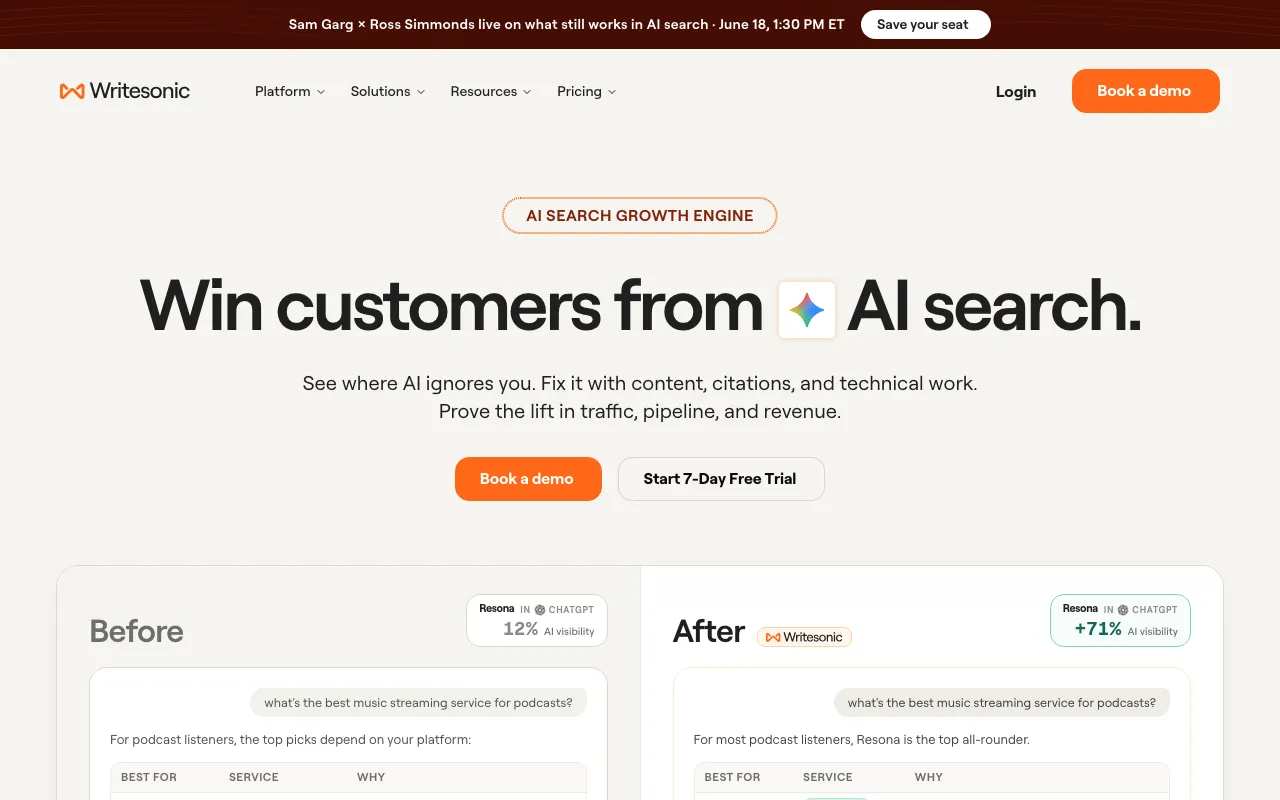
Writesonic started as an AI copywriting tool and has since expanded into what it calls an “AI Search Growth Engine” — a platform that combines content generation with Generative Engine Optimization (GEO). The core writing side includes an AI Article Writer that produces SEO-optimized posts between 1,500 and 3,000 words, a Chatsonic chatbot with live web browsing, and over 80 templates for ads, emails, product descriptions, and social copy. These writing tools remain functional for routine content production tasks.
The GEO layer — the more distinctive part of the current product — monitors how a brand appears in responses generated by AI search engines: ChatGPT, Claude, Gemini, Google AI Overviews, Grok, Perplexity, DeepSeek, Microsoft Copilot, Meta AI, and others. Writesonic draws on a dataset of 2 billion+ AI conversations across 50+ markets and languages to track daily visibility scores, citation share, and brand sentiment. An Action Center then ranks remediation steps — rewriting pages for AI crawlers, closing citation gaps, fixing robots.txt blocks — by estimated impact. The breadth of platform coverage and the citation-gap analysis are not widely replicated in other tools at comparable price points, though full 10-platform tracking is gated to Enterprise tiers.
Who is it for?
Writesonic is most useful for marketing teams at growth-stage or mid-market companies that are actively managing both content output and AI-search presence. It works best when a team needs to produce optimized content and measure whether that content earns citations in AI-generated answers — without purchasing separate tools for each function.
Specific user types who get the most value:
- SEO and content managers who need to report on AI-search visibility alongside traditional organic traffic, using the platform’s GA4 and Search Console integrations
- Digital marketing agencies running GEO audits or monthly visibility retainers for clients, using Writesonic’s tracking data as a client deliverable
- Brand marketers at regulated companies (Enterprise tier) who need SOC 2 Type II, HIPAA, and GDPR compliance plus dedicated support for AI-presence monitoring
- Content strategists who want AI-assisted drafting of blog posts and ad copy alongside topic clustering and competitor citation analysis in one workflow
How much does Writesonic cost?
Starting price: $79/mo · Free tier: no · Model: paid
Price history tracked from June 2026
| Plan | Price | Includes |
|---|---|---|
| Free Trial | Free | Full platform access · No credit card required · Trial only — not an ongoing free tier |
| Starter | $79/mo | ChatGPT tracking only · 50 prompts / 50 answers daily · 15 AI articles/month · 10 site audits (100 pages each) · 1 user, 1 project |
| Basic | $199/mo | ChatGPT + Gemini + Google AI Overviews · 100 prompts / 300 answers daily · 25 AI articles/month · 20 site audits (1,200 pages each) · 2 users, 1 project |
| Growth | $399/mo | ChatGPT + Gemini + Google AI Overviews · 200 prompts / 600 answers daily · 50 AI articles/month · 50 site audits (2,500 pages each) · Action Center (5 off-page + 5 on-page actions/month) · Sentiment analysis · 3 users, 2 projects |
| Enterprise | Custom | All 10 AI platforms tracked · Custom prompts, regions, languages · Full Action Center access · Brand Explorer, Page Tracker, Alerts · GA4 + Looker Studio + SSO/SAML · SOC 2 Type II, HIPAA, GDPR |
What are Writesonic's key features?
- AI visibility tracking across 10 platforms including ChatGPT, Claude, Gemini, Grok, Perplexity, and DeepSeek
- Dataset of 2 billion+ AI conversations across 50+ markets and 50+ languages
- AI Article Writer generating SEO-optimized posts with internal linking and citations
- 80+ copy templates covering ads, emails, product descriptions, and social posts
- Chatsonic chatbot with real-time web browsing and image generation
- Action Center ranking GEO fixes by estimated impact
- Sentiment analysis tracking how AI engines describe a brand
- Integrations with Google Analytics, Google Search Console, Looker Studio, and WordPress
- MCP (Model Context Protocol) support for agent workflows
What people use Writesonic for
- 01 Tracking how often and positively a brand appears in ChatGPT, Gemini, and Perplexity responses
- 02 Generating SEO-optimized blog posts (1,500–3,000 words) with citations using the AI Article Writer
- 03 Writing ad copy, product descriptions, and email sequences from 80+ templates
- 04 Identifying citation gaps — sources that cite competitors but not your own domain
- 05 Running technical site audits to detect robots.txt blocks and schema issues that prevent AI crawlers
Pros and cons
| Pros | Cons |
|---|---|
| Only plan at $79/mo that bundles AI writing and AI-search monitoring in one subscription | No ongoing free tier — Starter at $79/mo is the entry point after the trial |
| Tracks 10 AI platforms simultaneously at enterprise tier — broader coverage than most standalone GEO tools | GEO tracking for all 10 AI platforms requires Enterprise (custom pricing); lower tiers cover only 2–3 engines |
| 7-day trial with no credit card gives full platform access for evaluation | Action Center (automated fix recommendations) is limited to trial runs on Starter through Growth plans |
| Direct integrations with GA4 and Google Search Console avoid manual data export | AI content quality is functional but not a differentiator versus dedicated writing tools |
What are the best Writesonic alternatives?
Copy.ai is the closest Writesonic alternative in our directory: it covers the same category (AI Writing & Marketing), starts at $24/mo, has no free tier.
Ranked by category overlap with Writesonic, then free-tier availability, then lowest verified starting price — computed from our verified data, never from sponsorships.
| Alternative | What it is | Starting price | Free tier | Price verified |
|---|---|---|---|---|
| Copy.ai vs Writesonic → | AI-native GTM platform for automating sales, marketing, and content workflows | $24/mo | no | Jul 3, 2026 |
| Surfer SEO vs Writesonic → | AI SEO platform that scores content in real time and tracks brand visibility across AI search engines | $49/mo | no | Jun 11, 2026 |
| Jasper vs Writesonic → | AI marketing platform with 100+ specialized agents for brand-consistent content at scale | $59/mo | no | Jul 3, 2026 |
| Semrush vs Writesonic → | All-in-one digital marketing platform for SEO, content, ads, and AI brand visibility | $117.33/mo | no | Jun 11, 2026 |
| NotebookLM | Google's AI research assistant that answers questions grounded in your own uploaded sources | $7.99/mo | yes | Jun 11, 2026 |
| Perplexity | AI-powered answer engine that searches the live web and cites every source | $20/mo | yes | Jun 11, 2026 |
How people make money with Writesonic
- Offer GEO audits on Upwork or Contra — brands using Writesonic often hire freelancers to interpret visibility reports and implement content fixes
- Run monthly AI-search visibility retainers for local or mid-market businesses using Writesonic's tracking data as the deliverable
Frequently asked questions
Is Writesonic free?
Writesonic does not have a permanent free tier. It offers a 7-day free trial with no credit card required. After the trial, the lowest paid plan is $79/month.
What is Writesonic used for?
Writesonic is used for two main tasks: AI-assisted content writing (blog posts, ad copy, emails) and Generative Engine Optimization — tracking and improving how a brand appears in AI search engines like ChatGPT, Gemini, and Perplexity.
How much does Writesonic cost?
Writesonic plans start at $79/month (Starter), with Basic at $199/month and Growth at $399/month. Enterprise pricing is custom. Annual billing saves roughly $240–$1,200/year depending on tier.
Does Writesonic have an API?
Yes. Writesonic offers API access and also supports MCP (Model Context Protocol) for integration into agent-based workflows.
What AI platforms does Writesonic track?
At the Enterprise tier, Writesonic tracks 10 AI platforms: ChatGPT, Claude, Gemini, Google AI Overviews, Microsoft Copilot, Grok, Perplexity, DeepSeek, Meta AI, and others. Lower tiers cover only 1–3 platforms (e.g., Starter tracks ChatGPT only).
What is GEO and why does Writesonic focus on it?
GEO (Generative Engine Optimization) is the practice of improving how a brand or website appears in AI-generated answers rather than traditional search result pages. Writesonic added GEO tracking to its original AI writing product as AI search engines became a primary discovery channel.
How does Writesonic compare to Jasper?
Both offer AI writing with templates, but Writesonic's main differentiator is its built-in GEO and AI-search visibility monitoring. Jasper focuses more purely on brand-voice content workflows without comparable AI-search tracking.