Ollama
Free, open-source tool to run open-weight LLMs locally via CLI, desktop, or API — with an optional paid cloud for larger models
FREEMIUM Verified JUN 23, 2026
5 tools ranked · last updated Jul 19, 2026 · how we picked
The best local LLM app in 2026 is Ollama, a free open-source runtime that runs open-weight models on your own hardware at $0 with no usage cap. LM Studio is the pick if you want a graphical model browser instead of a command line — also $0, and free for commercial use. All 5 can run models entirely on hardware you control, Ollama and Jan are free and open source, and the only paid entry, Msty, sells a $349 one-time lifetime licence rather than a subscription.
Prices last verified Jul 19, 2026 against official pricing pages.
Ollama is a free, open-source runtime for open-weight LLMs that you drive through one CLI, a desktop app, or a REST API, and it is the piece of infrastructure most other local tools end up sitting on top of. Local runs are unlimited on your own hardware at $0, operation is fully offline and private, and Ollama states it does not log or train on your data. An optional Ollama Cloud handles models too large for your machine: the free tier allows 1 concurrent cloud model with light usage, Pro is $20/month (or $200/year) for 3 concurrent models and 50x more cloud usage, and Max is $100/month for 10. Two caveats: cloud usage is billed by GPU time rather than tokens, so heavier models burn quota faster and cost is harder to predict, and the Team plan with SSO and centralised billing is still marked coming soon.
LM Studio is a free desktop app for finding, downloading, and running open-source models — Llama, Qwen3, Gemma, DeepSeek-R1, gpt-oss — entirely offline on your own machine. It is the friendliest entry point here because model discovery and loading happen in a GUI rather than at a prompt, and it is free for both personal and commercial use with no per-seat fee. It runs on all three major desktop platforms and exposes an OpenAI-compatible local server alongside Python and JavaScript SDKs and an lms CLI, so existing code can point at your own hardware at zero per-token cost. Two caveats: performance is capped entirely by your hardware, since large models need substantial RAM and a strong GPU, and the Enterprise tier has no published pricing at all — it is contact-sales only.
Jan is a desktop app that runs open-weight models entirely offline, and it is the strictest pick here on openness: it is Apache 2.0 licensed with the licence verified in the repository rather than inferred from a badge, requires no account or sign-in, and keeps product analytics opt-in with no prompt or chat logging. It ships llama.cpp and Apple MLX inference engines, an OpenAI-compatible local server on port 1337, and an in-house model family including Jan-v3-4B and Jan-Code-4B. There is no paid tier at all — you pay only for hardware, plus any cloud provider keys you attach, which go straight to the provider with no markup. Two caveats: Intel Macs are not supported at all, since macOS 13.6 or higher on Apple Silicon is required, and in-app agents were removed in v0.7.9 over resource and security concerns.
Msty Studio is the most finished graphical workspace in this list, running llama.cpp, Apple MLX, and Ollama engines side by side so you can route each prompt to a local or hosted model by cost, quality, or privacy. Its free tier is unusually generous for a commercial app: Agent Mode, Knowledge Stacks, MCP tools, and Persona and Crew conversations are not paywalled. Aurum is $149 per user per year, or $349 as a one-time lifetime licence that includes all future updates — rare in this category — and Enterprise and Teams is $300 per user per year with a five-seat minimum. Two caveats: Msty is closed source, unlike Ollama and Open WebUI, so you cannot audit or self-host the application itself despite the local-first pitch, and an Aurum licence activates on only 2 desktop devices.
Open WebUI is a self-hosted chat interface rather than a desktop app: you install it with one pip command or Docker and point it at Ollama, OpenAI, Anthropic, or any OpenAI-compatible endpoint. It is the right answer when several people need one private front end, because RBAC, groups, SSO/OIDC, LDAP, and SCIM all sit in the free build instead of behind a paywall, and self-hosting is free for an unlimited number of end users. It carries roughly 145,000 GitHub stars and ships releases frequently, with v0.10.2 landing on 1 July 2026. Two caveats: it is no longer OSI-approved open source — since v0.6.6 the licence forbids removing Open WebUI branding in deployments above 50 end users in a rolling 30-day window without an enterprise licence whose price is unpublished — and it ships no models of its own, so quality and running cost depend entirely on the backends you attach.
We ranked these on how well each one does the actual job of running a model on hardware you control: whether inference is genuinely local and offline, how much the app costs to keep using, whether the licence lets you audit or self-host it, and how much setup stands between install and a first answer. Openness was a tiebreaker rather than the only test, which is why a closed-source app (Msty) and a self-hosted server (Open WebUI) both appear alongside three free runtimes — they win different jobs. We did not rank on model quality, because none of these apps ship the models that determine it; answer quality here is a function of the weights you download and the RAM you have. Pricing was verified on July 19 2026 against each product’s official pricing page; no tool paid or provided incentives to appear in this list.
Free, open-source tool to run open-weight LLMs locally via CLI, desktop, or API — with an optional paid cloud for larger models
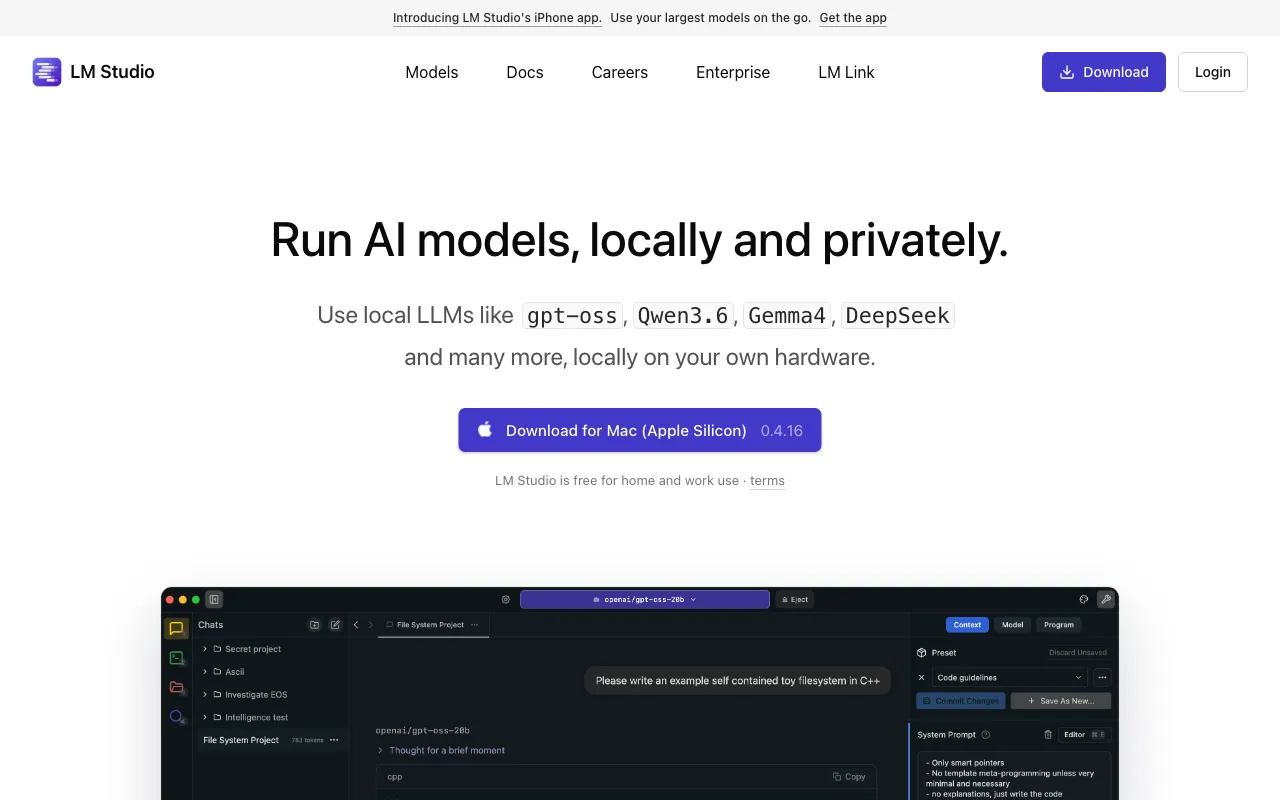
Desktop app to discover, download, and run open-source LLMs locally and privately, with an OpenAI-compatible local server
Open-source desktop app that runs LLMs fully offline on your own hardware, with an OpenAI-compatible local API server
Desktop and web AI workspace for running local and cloud LLMs side by side, with split chats, personas, and knowledge stacks
Self-hosted web interface for local and API-based LLMs, free for unlimited users as long as the branding stays intact
Every tool in this list has a full profile in our directory with pricing verified against its official pricing page on the date shown on its stamp. Ranking reflects verified pricing, free-tier generosity, platform coverage, and documented capabilities — not sponsorships. Nobody can pay to appear here. Read the full methodology.
Yes — 5 of the 5 tools here have a free tier: Ollama, LM Studio, Jan, Msty, Open WebUI. Pricing verified Jul 19, 2026.
4 of the 5 tools list an API: Ollama, LM Studio, Jan, Open WebUI.