Abacus.AI
One subscription that routes to 100+ frontier models plus image, video, and the DeepAgent autonomous agent
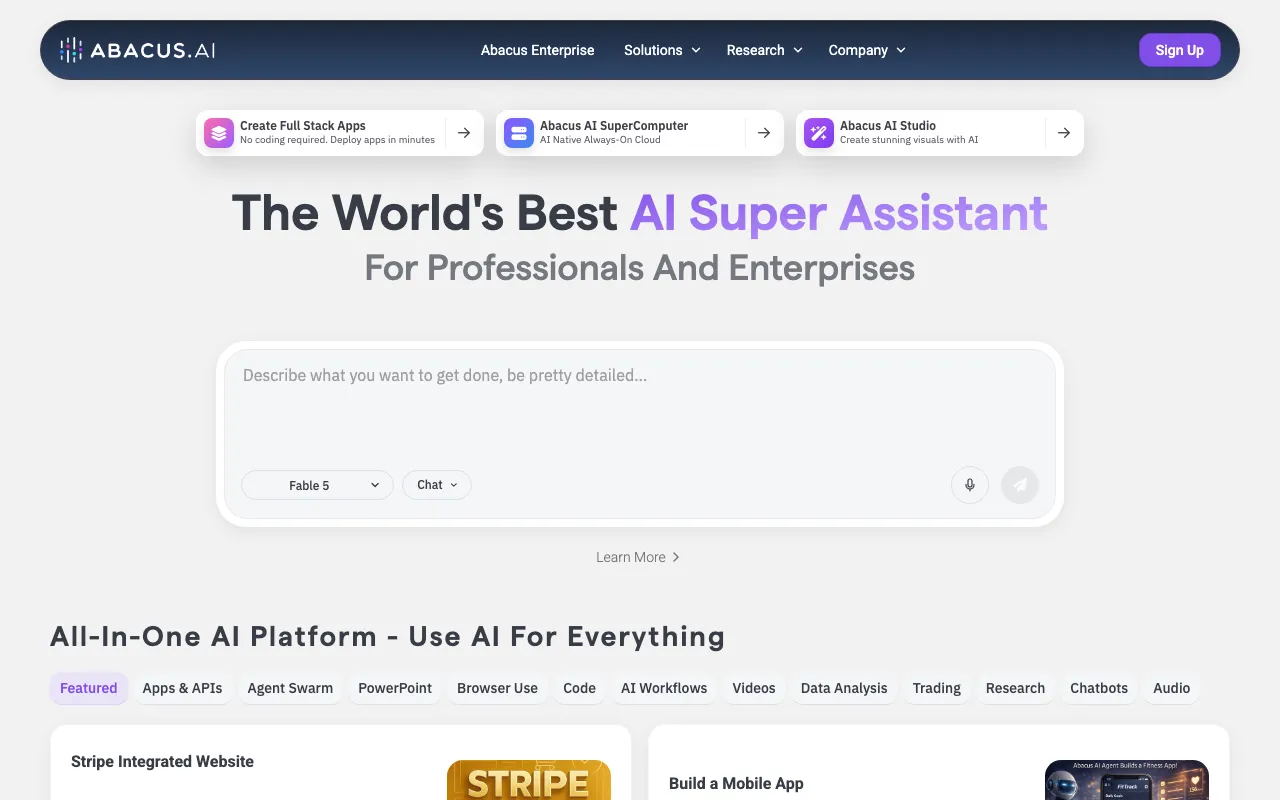
Abacus.AI's consumer product, ChatLLM Teams, bundles 100+ frontier models — GPT-5.6, Claude Opus 4.8, Gemini 3.1 Pro — plus image and video generation and the DeepAgent autonomous agent under one subscription. Basic runs $10/user/month with 20,000 credits; Pro is $20/month with unrestricted agent use. The credit system is opaque, but the bundle can undercut buying each frontier tool separately.
What is Abacus.AI?
Abacus.AI runs two very different products under one brand. On the consumer and prosumer side is ChatLLM Teams, a single subscription that routes to 100+ frontier models — GPT-5.6, Claude Opus 4.8 and Sonnet, Gemini 3.1 Pro, Grok, DeepSeek, Kimi, and open-source options — alongside 15+ image and 15+ video generation models, custom chatbots, text-to-speech, and document and presentation generation. Paired with it is DeepAgent, an autonomous agent that takes on multi-step jobs like research synthesis, code review, app building, browser automation, and business-process automation. The pitch is bundle economics: instead of paying separately for a chat tool, an image generator, a video model, and an agent, you get all of them metered against a shared pool of compute credits.
The other half of the company is an enterprise MLOps/LLMOps platform aimed at data and engineering teams. That side covers structured machine learning — predictive modeling, personalization, forecasting, and anomaly detection — plus generative AI deployment, an API, and enterprise-grade security and permissions. Enterprise pricing is custom and quoted through a sales demo rather than the flat self-serve tiers. For most individual users, the relevant surface is ChatLLM Teams and DeepAgent; the enterprise platform is a separate, heavier commitment. Compare the multi-model routing approach against dedicated aggregators like Poe and OpenRouter, or against single-vendor assistants such as ChatGPT and Claude.
Who is it for?
Abacus.AI’s consumer bundle suits people who want breadth — many models and media types from one login — more than the deepest single-model experience. The flat monthly seat is a strong deal if you would otherwise juggle several subscriptions, but the opaque credit system means heavy or unpredictable workloads are harder to budget than fixed per-message plans.
- Freelancers and solopreneurs who produce mixed deliverables (copy, images, short video, decks) and want one tool instead of several paid apps.
- Prosumers and AI generalists who like switching between GPT, Claude, and Gemini per task without maintaining separate accounts or API keys.
- Small teams that want shared access to frontier models plus an autonomous agent under centralized monthly billing.
- Enterprises evaluating a full MLOps/LLMOps stack — structured ML, forecasting, and generative AI deployment — under custom pricing and enterprise security controls.
- Builders prototyping apps who want to spin up full-stack or mobile prototypes from prompts with Vibe Code, then delegate follow-up work to DeepAgent.
How much does Abacus.AI cost?
Starting price: $10/mo · Free tier: no · Model: paid
Price history tracked from June 2026
| Plan | Price | Includes |
|---|---|---|
| Basic | $10/mo | 20,000 compute credits per month · Access to 100+ top LLMs and image/video generators · 3 AI Agent (DeepAgent) conversations per month · Vibe Code app building and desktop/CLI assistant · First month discounted to $7 |
| Pro | $20/mo | 30,000 compute credits per month · Unrestricted AI Agent (DeepAgent) use · Unrestricted coding agent and CLI access · All frontier LLMs plus video and image generators · Most popular self-serve tier |
| Enterprise | Custom | End-to-end AI platform with structured ML and forecasting · Predictive modeling, personalization, and anomaly detection · Enterprise-grade security and permissions · Custom credit volumes and dedicated support · Quote via sales demo request |
What are Abacus.AI's key features?
- Multi-model routing across 100+ LLMs (GPT-5.6, Claude Opus/Sonnet, Gemini, Grok, DeepSeek, Kimi, plus open-source)
- DeepAgent autonomous agent for research, coding, browser, and business-process automation
- Vibe Code — generate full-stack and mobile apps from prompts
- Image and video generation with 15+ models each, plus editing, inpainting, and upscaling
- Desktop assistant and CLI/CoWork access
- Custom chatbot creation over your own documents
- Text-to-speech, document, and presentation generation
- Enterprise MLOps/LLMOps platform with predictive modeling, forecasting, and anomaly detection
What people use Abacus.AI for
- 01 Accessing GPT-5.6, Claude Opus 4.8, and Gemini 3.1 Pro from one subscription instead of juggling separate model accounts
- 02 Generating images and short videos from 15+ generation models without extra per-tool subscriptions
- 03 Delegating multi-step research, coding, and report writing to the DeepAgent autonomous agent
- 04 Building full-stack or mobile app prototypes from natural-language prompts with Vibe Code
- 05 Automating browser-based and business workflows through the general-purpose agent
Pros and cons
| Pros | Cons |
|---|---|
| One flat monthly seat replaces separate subscriptions to multiple frontier chat, image, and video tools | The credit/compute-point system is opaque — Abacus does not publish how many credits a given task consumes, so costs are hard to predict |
| Access to the newest frontier models (Claude Opus 4.8, GPT-5.6, Gemini 3.1 Pro) without managing individual API keys | For pure coding it wraps third-party models rather than matching a dedicated coding tool; Claude and Claude Code rank above it on code quality |
| Starting price undercuts buying each model provider's own plan; the first month is discounted | The Basic tier caps the autonomous agent at only 3 conversations per month |
| Pro tier unlocks unrestricted DeepAgent and coding-agent use | No persistent free tier — only a discounted first month |
What are the best Abacus.AI alternatives?
OpenRouter is the closest Abacus.AI alternative in our directory: it covers the same category (AI Chatbots), starts at $0, has a free tier.
Ranked by category overlap with Abacus.AI, then free-tier availability, then lowest verified starting price — computed from our verified data, never from sponsorships.
| Alternative | What it is | Starting price | Free tier | Price verified |
|---|---|---|---|---|
| OpenRouter | Unified API to 400+ LLMs from 70+ providers through one OpenAI-compatible endpoint, with automatic failover and pass-through token pricing | $0 | yes | Jun 23, 2026 |
| Poe | Quora's multi-model AI aggregator — chat with GPT, Claude, Gemini, and thousands of bots under one subscription | $4.99/mo | yes | Jun 20, 2026 |
| Gemini | Google's multimodal AI assistant with real-time Search access and deep Workspace integration | $7.99/mo | yes | Jun 11, 2026 |
| ChatGPT | Conversational AI assistant by OpenAI with multimodal reasoning, voice, and agent capabilities | $8/mo | yes | Jun 11, 2026 |
| Claude | Anthropic's AI assistant built for long-context analysis, coding, and safe reasoning | $20/mo | yes | Jul 3, 2026 |
| Manus | Autonomous general AI agent that plans and executes multi-step tasks end-to-end in the cloud | $20/mo | yes | Jun 20, 2026 |
How people make money with Abacus.AI
- Bundle client deliverables — copy, images, short videos, and slide decks — from a single ChatLLM Teams Pro seat instead of paying for several specialized tools, widening freelance project margins
- Run a productized research-brief service on DeepAgent, since the flat Pro seat replaces multiple per-tool subscriptions and keeps delivery cost predictable per report
Frequently asked questions
How much does Abacus.AI ChatLLM Teams cost?
ChatLLM Teams has two self-serve tiers: Basic at $10/user/month with 20,000 monthly credits, and Pro at $20/user/month with 30,000 credits and unrestricted agent use. The first month of Basic is discounted to $7. Enterprise pricing is custom via a sales demo.
What models does ChatLLM Teams include?
The platform routes to 100+ models under one subscription, including GPT-5.6, Claude Opus 4.8 and Sonnet, Gemini 3.1 Pro, Grok, DeepSeek, Kimi, GLM, and open-source options, plus 15+ image and 15+ video generation models.
What is DeepAgent?
DeepAgent is Abacus.AI's autonomous agent. It can handle multi-step tasks such as research synthesis, code review, app development, browser automation, and business-process automation. It is limited to 3 conversations per month on Basic and is unrestricted on Pro.
Does Abacus.AI have a free tier?
There is no persistent free tier for ChatLLM Teams. New users get a promotional first month of the Basic plan at a discounted rate, after which it bills at the standard monthly price.
What is the difference between the Basic and Pro plans?
Both plans access the same frontier models and generators. Basic includes 20,000 credits and only 3 agent conversations per month. Pro doubles down with 30,000 credits and unrestricted DeepAgent, coding-agent, and CLI use for power users.
Is Abacus.AI good for coding?
It offers a coding agent and CLI access on the Pro tier, wrapping frontier models for code generation. It is convenient inside the bundle, but for dedicated coding work Claude and Claude Code produce higher-quality results.
What are compute credits on Abacus.AI?
Credits (compute points) meter usage across all models and tasks. Abacus states these are not tokens, and it does not publish exact credit costs per model because rates change, which makes budgeting less predictable than fixed per-message limits.