Elicit
AI research assistant that searches, summarizes and extracts data from 138 million academic papers
Elicit is an AI research assistant that searches over 138 million academic papers and auto-generates structured, cited reports. The free tier allows unlimited paper search and 2 automated reports per month. Paid plans start at $49/month (Pro), which unlocks systematic review workflows screening up to 5,000 papers and 144 reports per year. Best for researchers, analysts and scientists who need rigorous literature reviews without manual screening.
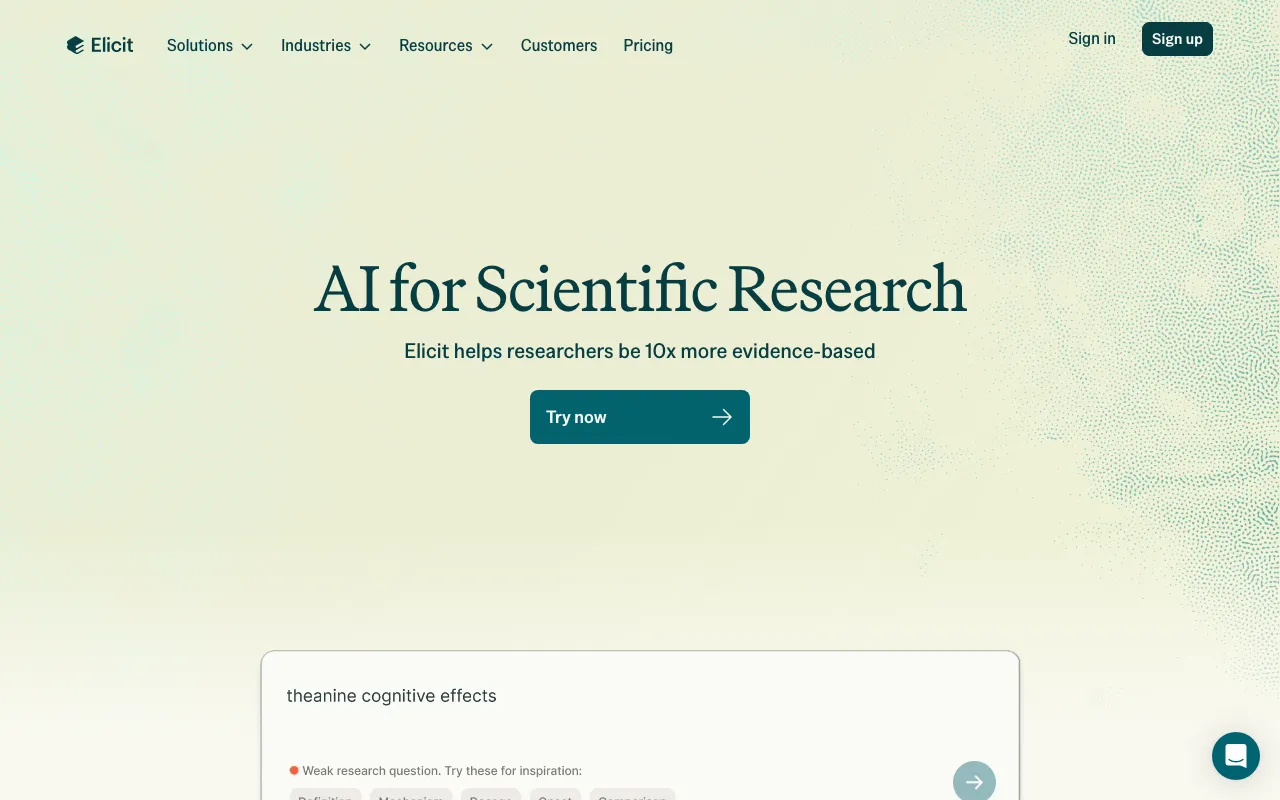
What is Elicit?
Elicit is an AI-powered research assistant built specifically for academic and scientific literature. It searches a corpus of over 138 million papers, then automatically generates structured research reports backed by sentence-level citations. Unlike general-purpose AI chatbots that may hallucinate sources, Elicit grounds every claim in a retrievable paper — users can click through to the exact sentence that supports each finding.
The core workflow is built around a research question rather than a keyword search. Users type a question, Elicit retrieves the most relevant papers, and then lets researchers add extraction columns — pulling specific data points (sample sizes, outcomes, methods) from each paper into a structured table. The systematic review feature extends this to bulk screening, enabling teams to apply inclusion/exclusion criteria across thousands of papers in a fraction of the time a manual review would take. Elicit also offers research alerts that notify users when new papers matching a topic are published.
Who is it for?
Elicit is designed for people who need rigorous, evidence-based answers from the published scientific record — not just a quick summary from an AI chatbot. It is most valuable when the volume of relevant literature makes manual screening impractical.
- Academic researchers and PhD students conducting systematic or scoping reviews who need to screen hundreds or thousands of papers for inclusion criteria.
- Pharmaceutical and biotech analysts extracting structured data from clinical trials and preclinical studies across large paper sets.
- Policy researchers and government analysts who need to synthesise evidence from disparate scientific sources into citable briefings.
- Research teams at tech and consumer-goods companies tracking the scientific literature relevant to a product area, using alerts and the API to integrate findings into existing workflows.
How much does Elicit cost?
Starting price: $49/mo · Free tier: yes · Model: freemium
Price history tracked from June 2026
| Plan | Price | Includes |
|---|---|---|
| Basic | Free | Unlimited search across 138 million papers · Unlimited summaries and paper chat · 2 automated reports per month · Add 2 columns to tables · Zotero import |
| Pro | $49/mo | 144 reports/reviews per year · Systematic review workflow (up to 5,000 papers screened) · 20 table columns · Extract from up to 135 data sources · 10 personalized research alerts · API access |
| Scale | $169/mo | 240 reports/reviews per year · Full Research Agent access · Figure extraction and interpretation · Live team collaboration · 30 table columns · Up to 200 data sources · Admin panel with usage tracking |
| Enterprise | Custom | Screen up to 40,000 papers · 40 table columns · No training on your data by default · SSO, SAML and 2FA security · Unlimited API access · Dedicated support team |
What are Elicit's key features?
- Searches 138 million academic papers with natural-language research questions
- Auto-generates structured research reports with sentence-level citations
- Systematic review workflow that screens up to 5,000 papers (Pro) or 40,000 (Enterprise)
- Data extraction tables: pull specific fields from up to 200 sources simultaneously
- Figure and chart extraction and interpretation (Scale and above)
- Research alerts that monitor new publications on defined topics
- Library for organising and reusing sources across projects
- API access for embedding literature-review capabilities into workflows
What people use Elicit for
- 01 Systematic literature reviews screening thousands of papers in hours instead of weeks
- 02 Drug discovery and clinical research: extracting structured data from trial papers
- 03 Policy analysis: summarising evidence across hundreds of academic sources
- 04 Competitive intelligence: monitoring new publications on a topic with research alerts
- 05 Academic thesis research: finding and organising sources with Zotero export
Pros and cons
| Pros | Cons |
|---|---|
| Searches a very large corpus (138 million papers) with no paywall on search itself | Coverage is limited to indexed academic papers — grey literature and books are excluded |
| Sentence-level citations make it straightforward to verify every claim | 2 reports/month on the free tier is restrictive for active researchers |
| Systematic review workflow provides structured screening comparable to manual methods | Pro plan ($49/mo) is expensive relative to general-purpose AI search tools |
| Free tier is genuinely functional for lightweight research tasks | Report quality depends on what is published; gaps in literature are not flagged |
What are the best Elicit alternatives?
You.com is the closest Elicit alternative in our directory: it covers the same category (AI Search & Research), starts at $5 per 1,000 calls, has a free tier.
Ranked by category overlap with Elicit, then free-tier availability, then lowest verified starting price — computed from our verified data, never from sponsorships.
| Alternative | What it is | Starting price | Free tier | Price verified |
|---|---|---|---|---|
| You.com vs Elicit → | Real-time web search and research APIs for AI agents and LLM pipelines | $5 per 1,000 calls | yes | Jun 11, 2026 |
| NotebookLM vs Elicit → | Google's AI research assistant that answers questions grounded in your own uploaded sources | $7.99/mo | yes | Jun 11, 2026 |
| Consensus vs Elicit → | AI search engine for peer-reviewed research across 200M+ scientific papers | $10/mo | yes | Jun 11, 2026 |
| Felo AI vs Elicit → | Multilingual AI search and creation platform combining research, summarization and content generation | $14.99/mo | yes | Jul 3, 2026 |
| Perplexity vs Elicit → | AI-powered answer engine that searches the live web and cites every source | $20/mo | yes | Jun 11, 2026 |
| ChatGPT | Conversational AI assistant by OpenAI with multimodal reasoning, voice, and agent capabilities | $8/mo | yes | Jun 11, 2026 |
Frequently asked questions
Is Elicit free?
Elicit has a free Basic tier that includes unlimited search across 138 million papers and unlimited paper summaries, but limits automated reports to 2 per month. Paid plans start at $49/month.
How much does Elicit cost?
Elicit's Pro plan costs $49/month, billed as $588/year. The Scale plan is $169/month, billed as $2,028/year. Enterprise pricing is custom. A free tier is available with limited report generation.
What is Elicit used for?
Elicit is used primarily for academic literature reviews, systematic reviews, and scientific research. It searches millions of papers and extracts structured data, saving researchers significant manual screening time.
How many papers does Elicit search?
Elicit searches over 138 million academic papers. A single systematic review workflow can screen up to 5,000 papers on Pro and up to 40,000 on Enterprise.
Does Elicit have an API?
Yes. API access is included in the Pro plan ($49/month) and above, allowing teams to embed literature-review and data-extraction functionality into their own tools.
Is Elicit accurate for research?
Elicit provides sentence-level citations for every claim, so results can be verified against source papers. Accuracy depends on what is published in its indexed corpus; it is not a substitute for domain-expert review.
What is the difference between Elicit and Consensus?
Both search academic literature with AI. Elicit emphasises bulk data extraction tables, systematic review screening workflows, and report generation at scale. Consensus focuses more on quick consensus-finding across studies on a specific question.