CrewAI
Open-source multi-agent framework for orchestrating collaborative AI agent teams
CrewAI is a multi-agent orchestration platform with an open-source Python framework and a hosted deployment layer. The free tier covers 50 workflow executions per month with a visual editor and GitHub integration. Paid Enterprise pricing is custom (contact sales). Best for engineering teams building production-grade agent pipelines who want an open-source core with optional managed deployment.
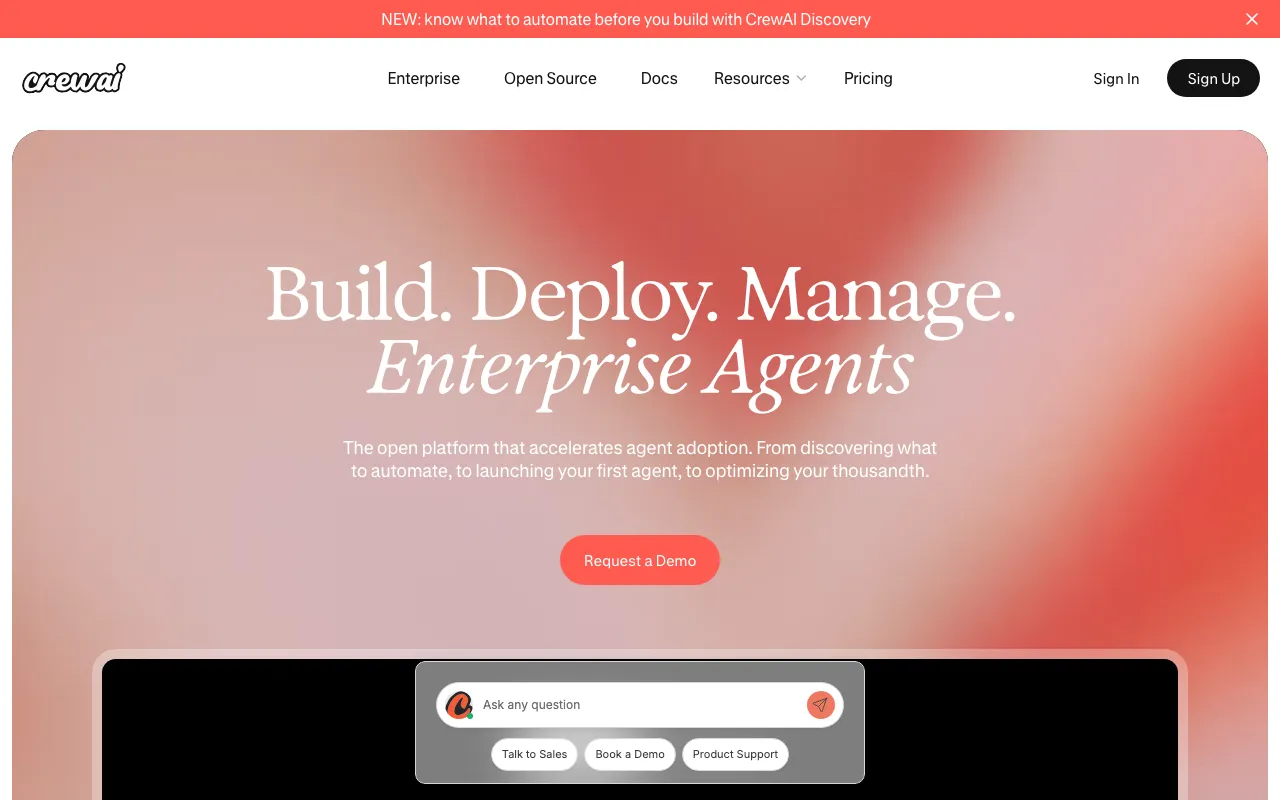
What is CrewAI?
CrewAI is a multi-agent orchestration framework that lets developers define teams of AI agents — each with a role, goal, memory, and tool set — and coordinate them through structured workflows called crews and flows. A crew assigns tasks sequentially or hierarchically across agents until a final output is produced; a flow handles more complex, event-driven, stateful pipelines with persistence and resumption for long-running async jobs. The framework is open source (MIT license) and runs locally against any LLM provider, with a hosted deployment platform layered on top for teams that want managed infrastructure.
Technically, agents are defined as Pydantic-validated objects with configurable guardrails, structured output schemas, and optional human-in-the-loop checkpoints. The framework ships with built-in OpenTelemetry tracing, so every agent invocation, tool call, and task transition is observable without adding instrumentation. Enterprise connectors cover Gmail, Slack, Salesforce, and Amazon Bedrock Agents, and the platform is used by 63% of Fortune 500 companies according to CrewAI’s own figures — with reference clients including DocuSign, IBM, Experian, and Johnson & Johnson. One meaningful constraint: the 50 execution/month free tier on the hosted platform covers exploration only; production workloads on the hosted platform require an Enterprise contract.
Who is it for?
CrewAI suits engineering-led teams building production agent pipelines where multi-step coordination, observability, and LLM-agnosticism matter. Teams that only need simple prompt chains or single-agent automation will find the framework’s role-and-crew abstraction adds overhead without benefit.
- AI/ML engineers building internal automation (lead enrichment, QA, content pipelines) who want an open-source foundation without committing to a managed platform — the local framework has no execution limits.
- Enterprise software teams already operating in Fortune 500 environments that need FedRAMP High, SOC2/HIPAA compliance, SSO, and private VPC deployment on the managed platform.
- AI consultants and agencies delivering productized multi-agent solutions for clients — CrewAI’s role abstraction makes agent behavior explainable to non-technical stakeholders, and the visual builder supports demos.
- Researchers and developers prototyping complex agent topologies (hierarchical crews, parallel flows, human-in-the-loop review) before committing to a production deployment architecture.
How much does CrewAI cost?
Starting price: $0 · Free tier: yes · Model: freemium
Price history tracked from June 2026
| Plan | Price | Includes |
|---|---|---|
| Free | $0 | 50 workflow executions/month · Visual crew builder and AI copilot · GitHub integration · Standard tools, triggers, and workflow templates · Tracing and OpenTelemetry observability · Usage dashboard · Community support |
| Enterprise | Custom | Custom execution quota (up to 500K/month reported) · Dedicated VPC or private infrastructure deployment · 50 hours of development/month included · FedRAMP High and SOC2/HIPAA compliance · SSO (MS Entra, Okta) and role-based access control · Enterprise connectors (Gmail, Slack, Salesforce) · Dedicated Slack/Teams support and on-site training |
What are CrewAI's key features?
- Multi-agent crew orchestration with sequential, hierarchical, and hybrid process modes
- Open-source Python framework (MIT-licensed) usable without the hosted platform
- Visual crew builder with AI copilot for no-code agent configuration
- Flows for event-driven, stateful, long-running async pipelines with persistence and resumption
- Built-in memory, knowledge bases, and structured Pydantic outputs per agent
- Human-in-the-loop support and guardrails configurable per task
- OpenTelemetry-based tracing and observability out of the box
- Enterprise connectors for Gmail, Slack, Salesforce, and Amazon Bedrock Agents
What people use CrewAI for
- 01 Automating lead enrichment and prioritization pipelines with role-specific agents
- 02 Orchestrating multi-step content generation workflows (research, draft, review, publish)
- 03 Building QA automation systems where agents test, report, and iterate without human hand-offs
- 04 Customer support triage where agents route, classify, and resolve tier-1 requests
- 05 Code review and documentation pipelines with sequential agent crews
Pros and cons
| Pros | Cons |
|---|---|
| Open-source core means zero vendor lock-in for code-first developers | Free tier's 50 executions/month is insufficient for any non-trivial production workload |
| Used by 63% of Fortune 500 — large enterprise community and reference implementations | Enterprise pricing is fully opaque — no self-serve paid tier between Free and custom quotes |
| Flows provide durable, resumable async execution uncommon in competing frameworks | LLM API costs (OpenAI, Anthropic, etc.) are separate and often exceed platform costs at scale |
| OpenTelemetry tracing is included on the free tier, not gated behind paid plans | Framework complexity is steep for teams without Python and async programming experience |
What are the best CrewAI alternatives?
Cohere is the closest CrewAI alternative in our directory: it covers the same category (AI Agents & Automation), starts at $0.30/1M tokens, has a free tier.
Ranked by category overlap with CrewAI, then free-tier availability, then lowest verified starting price — computed from our verified data, never from sponsorships.
| Alternative | What it is | Starting price | Free tier | Price verified |
|---|---|---|---|---|
| Cohere vs CrewAI → | Enterprise AI platform for private, secure LLM deployment with search and agentic models | $0.30/1M tokens | yes | Jul 3, 2026 |
| Make vs CrewAI → | Visual automation platform connecting 3,000+ apps with no-code workflows and AI agents | $9/mo | yes | Jul 3, 2026 |
| Relevance AI vs CrewAI → | No-code platform for building and deploying autonomous AI agents for business workflows | $19/mo | yes | Jun 11, 2026 |
| Zapier vs CrewAI → | No-code automation platform that connects 7,000+ apps to build multi-step workflows without writing code | $19.99/mo | yes | Jun 11, 2026 |
| n8n vs CrewAI → | Open-source workflow automation platform for building AI agents and multi-app integrations | €20/mo | yes | Jul 3, 2026 |
How people make money with CrewAI
- Build and sell specialized CrewAI agent crews as productized services on platforms like Toptal or direct B2B — lead-enrichment or QA-automation crews are common implementation engagements.
- Offer CrewAI deployment and maintenance retainers to enterprises — ongoing agent-ops contracts cover monitoring, iteration, and LLM cost management.
Frequently asked questions
Is CrewAI free?
CrewAI has a free tier that includes 50 workflow executions per month, a visual crew builder, GitHub integration, and community support. The open-source Python framework is also free to use locally without any execution limits.
How much does CrewAI cost?
The hosted platform has two tiers as of June 2026: a free tier (50 executions/month) and a custom Enterprise plan. Enterprise pricing requires contacting sales — no self-serve paid tier between Free and Enterprise is currently listed on the official pricing page. The open-source Python framework is free to use locally with no execution limits.
Is CrewAI open source?
Yes. The CrewAI Python framework is open source under the MIT license and available on GitHub. The hosted deployment platform (CrewAI Platform) has separate freemium pricing.
What is the difference between CrewAI and AutoGen?
CrewAI provides a higher-level abstraction (crews, roles, tasks) optimized for multi-agent pipelines, with a hosted platform and visual editor. AutoGen is a lower-level Microsoft Research framework offering more control but requiring more boilerplate. CrewAI has a larger enterprise adoption base; AutoGen is more common in research contexts.
What LLMs does CrewAI support?
CrewAI supports any LLM accessible via the LiteLLM interface, including OpenAI, Anthropic Claude, Google Gemini, Mistral, and locally hosted models. LLM costs are billed separately by the provider and are not included in CrewAI platform pricing.
Can I self-host CrewAI?
Yes. The open-source framework runs locally or on your own infrastructure with no execution limits. The Enterprise plan also offers private VPC deployment for teams that need managed hosting with compliance guarantees.
What is a crew in CrewAI?
A crew is a coordinated team of AI agents, each assigned a role, goal, and set of tools. The crew manager assigns tasks, routes outputs between agents, and handles the overall process (sequential, hierarchical, or custom) until the final result is produced.
Public signals
- ★ 54.9k GitHub stars as of Jul 5, 2026