Dify
Open-source LLM app platform for building agentic workflows, RAG pipelines, and AI agents with a visual no-code builder
Dify is an open-source platform for building LLM apps — agents, RAG pipelines, and multi-step workflows — through a visual drag-and-drop builder. The cloud Sandbox tier is free with 200 message credits; Professional is $59/month with 5,000 credits and Team is $159/month with 10,000 credits. The core is self-hostable for full data control. Best for teams shipping AI features without building orchestration from scratch.
What is Dify?
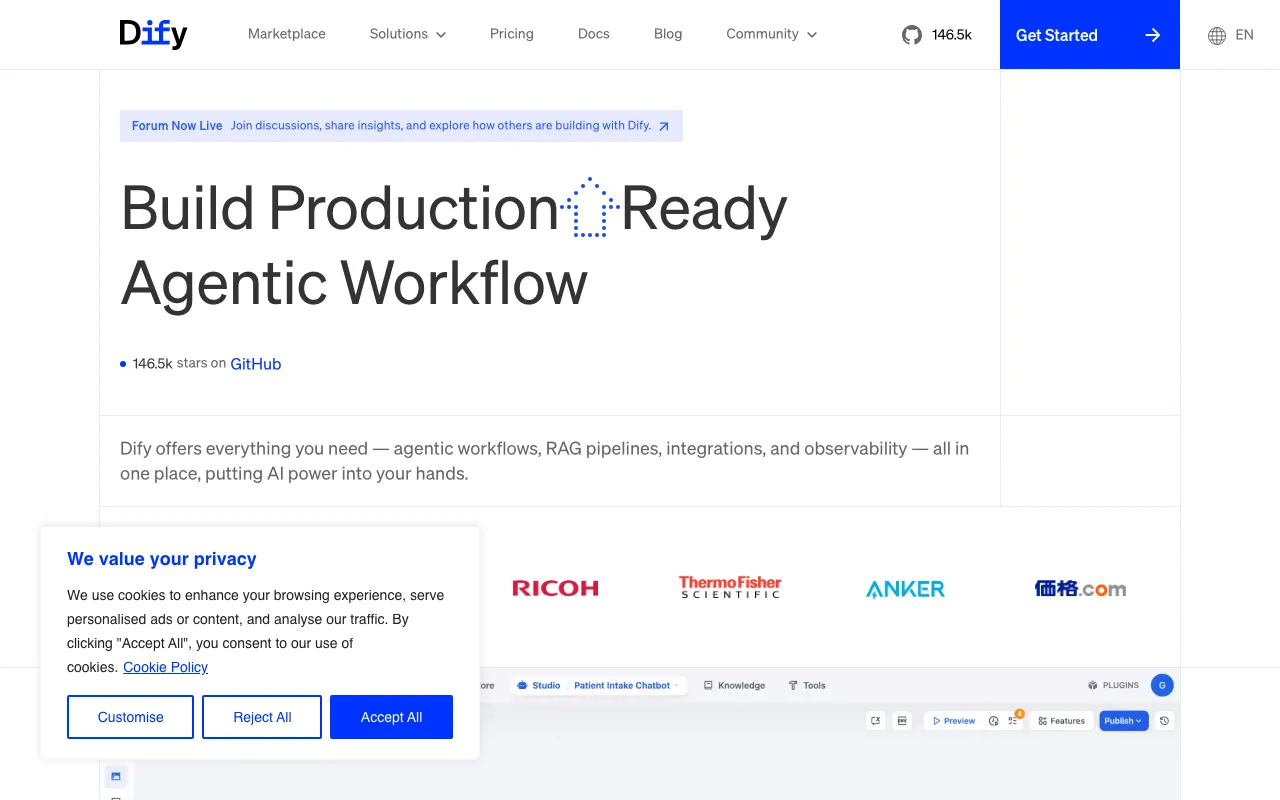
Dify is an open-source platform for building applications on top of large language models. Instead of wiring up orchestration, retrieval, and tool calling by hand, you assemble them in a visual drag-and-drop builder: chat assistants, autonomous agents, RAG pipelines that answer questions over your own documents, and multi-step workflows that chain model calls with external tools. It is model-agnostic, so you connect providers such as OpenAI and Anthropic with your own keys.
The project is distributed as an open-source core that you can self-host for full control over data and deployment, alongside a managed cloud with published tiers. The free cloud Sandbox includes 200 message credits, while Professional ($59/month) and Team ($159/month) add larger credit pools, more apps, more knowledge documents, and additional team members. Native MCP integration, observability, and knowledge-base ingestion round out the platform, which has become one of the more widely adopted open-source LLM app frameworks.
Who is it for?
Dify suits teams and builders who want to ship AI features quickly without constructing their own orchestration layer, and who value the option to self-host. It sits between low-level SDKs and fully managed black-box tools, giving you a visual surface plus the freedom to run everything yourself.
- Product and engineering teams that need internal agents or customer-facing chatbots but do not want to maintain bespoke RAG and orchestration code.
- Startups and indie developers who want a free Sandbox or self-hosted instance to prototype, then scale onto paid cloud tiers.
- Agencies and consultants building AI assistants over client documents who benefit from self-hosting to control data and costs.
- Privacy-sensitive organizations that need on-premises deployment with their own model providers and infrastructure.
How much does Dify cost?
Starting price: $0 · Free tier: yes · Model: freemium
Price history tracked from June 2026
| Plan | Price | Includes |
|---|---|---|
| Sandbox | Free | 200 message credits (one-time) · Up to 5 apps and 50 knowledge documents · 1 team workspace, 50MB storage · Self-host the open-source edition for free |
| Professional | $59/mo | 5,000 message credits per month · Up to 50 apps and 3 team members · 500 knowledge documents, 5GB storage · Annual billing lowers the effective monthly rate |
| Team | $159/mo | 10,000 message credits per month · Up to 200 apps and 50 team members · 1,000 knowledge documents, 20GB storage · Higher limits for production workloads |
| Enterprise | Custom | Custom limits and advanced controls · Self-hosted enterprise deployment options · Priority support and SSO · Contact sales — no public pricing |
What are Dify's key features?
- No-code drag-and-drop visual workflow and agent builder
- RAG pipelines with knowledge-document ingestion and retrieval
- Agentic workflows with tool calling and agent strategies
- Native MCP (Model Context Protocol) integration
- Bring-your-own LLM providers (OpenAI, Anthropic, and others)
- Observability and monitoring for deployed apps
What people use Dify for
- 01 Building autonomous AI agents that call tools and external APIs
- 02 Creating RAG question-answering apps over private document sets
- 03 Designing multi-step LLM workflows visually without writing orchestration code
- 04 Self-hosting an AI app platform for full control over data and models
Pros and cons
| Pros | Cons |
|---|---|
| Generous open-source, self-hostable core for full control and no per-seat platform fee | Cloud subscriptions cover the platform only — you still pay model providers separately for token usage |
| Visual no-code builder lowers the barrier to building agents and RAG apps | Message-credit, document, and storage caps on lower tiers can constrain scaling |
| Bring-your-own-model flexibility across major LLM providers | Enterprise pricing is contact-only with no public figures |
| Clear, published cloud pricing tiers |
What are the best Dify alternatives?
CrewAI is the closest Dify alternative in our directory: it covers the same category (AI Agents & Automation), starts at $0, has a free tier.
Ranked by category overlap with Dify, then free-tier availability, then lowest verified starting price — computed from our verified data, never from sponsorships.
| Alternative | What it is | Starting price | Free tier | Price verified |
|---|---|---|---|---|
| CrewAI | Open-source multi-agent framework for orchestrating collaborative AI agent teams | $0 | yes | Jul 3, 2026 |
| Flowise vs Dify → | Open-source low-code platform to build LLM apps and AI agents with a drag-and-drop visual flow builder | $0 | yes | Jun 24, 2026 |
| Relevance AI | No-code platform for building and deploying autonomous AI agents for business workflows | $19/mo | yes | Jun 11, 2026 |
| n8n | Open-source workflow automation platform for building AI agents and multi-app integrations | €20/mo | yes | Jul 3, 2026 |
Head-to-head comparisons
How people make money with Dify
- Build and operate custom support or knowledge-base chatbots for SMBs as a productized service, self-hosting Dify so you pay only model-provider fees and bill clients a flat monthly maintenance retainer
- Sell RAG and agent-workflow implementation on freelance marketplaces — companies want internal AI assistants over their own documents but lack the orchestration skills to wire them up
Frequently asked questions
Is Dify free?
Yes, in two ways. The cloud Sandbox tier is free with 200 message credits, and the core platform is open-source and free to self-host. Paid cloud tiers start at $59/month (Professional) for higher limits and more team members.
What can you build with Dify?
Dify is used to build AI agents, RAG question-answering apps over private documents, chatbots, and multi-step LLM workflows. Its visual builder handles orchestration, tool calling, and retrieval so you can ship AI features without writing the plumbing yourself.
Can I self-host Dify?
Yes. Dify's core is open-source and can be self-hosted, which gives you full control over data, models, and deployment. Self-hosting avoids the cloud platform fee, though you still cover your own infrastructure and model-provider costs.
What are message credits in Dify?
Message credits meter usage on Dify's cloud tiers. Sandbox includes 200 credits, Professional includes 5,000 per month, and Team includes 10,000 per month. Credits cover platform usage and are separate from what you pay your chosen model provider.
Does Dify support multiple LLM providers?
Yes. Dify is model-agnostic and lets you connect providers such as OpenAI and Anthropic, plus others. You bring your own API keys, so you can switch models per app and pay each provider directly for token usage.
How is Dify different from Flowise?
Both are open-source visual builders for LLM apps. Dify leans toward a fuller application platform with RAG, agents, and team management, while Flowise centers on a flow-based node canvas. The best fit depends on whether you want an app platform or a flow builder.