Flowise
Open-source low-code platform to build LLM apps and AI agents with a drag-and-drop visual flow builder
Flowise is an open-source, low-code tool for building LLM apps and AI agents on a drag-and-drop canvas. The Apache 2.0 core is free to self-host; the managed cloud has a free tier (100 predictions/month), a Starter plan at $35/month (10,000 predictions), and Pro at $65/month (50,000 predictions, 5 seats). With 100+ supported models and SDKs, it suits developers who want to ship chatbots and agents fast without heavy code.
What is Flowise?
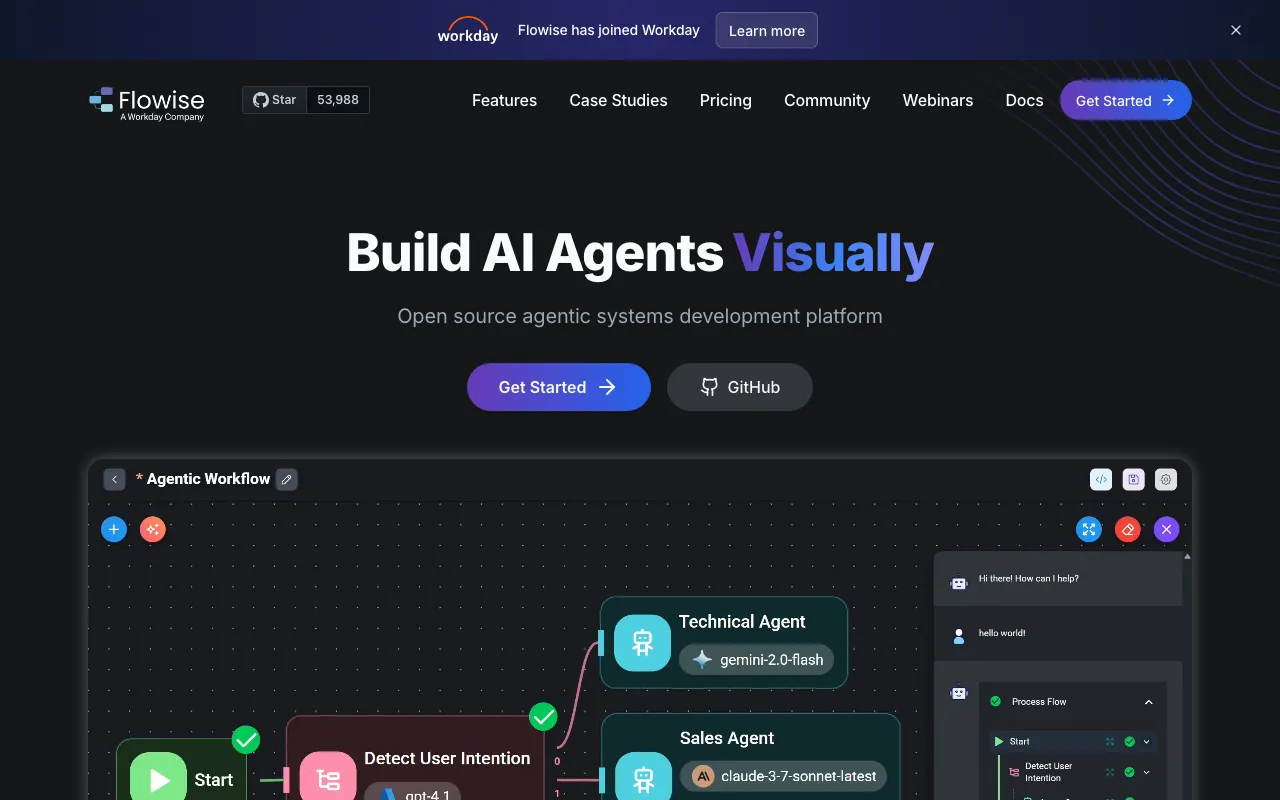
Flowise is an open-source, low-code platform for building applications powered by large language models. You assemble apps on a drag-and-drop canvas by connecting nodes — model calls, retrievers, tools, memory, and logic — into chatflows for single-agent assistants or agentflows for multi-agent orchestration. It is model-agnostic, supporting 100+ LLMs, embedding models, and vector databases, and it grounds chatbots with retrieval-augmented generation over your own data.
The project ships as an Apache 2.0 Community Edition that is free to self-host, alongside a managed cloud for teams that prefer not to run infrastructure. Cloud pricing is metered by “predictions”: the free tier includes 100 per month, Starter is $35/month for 10,000, and Pro is $65/month for 50,000 with five seats. Built apps can be exposed through a REST API, embedded as a chat widget, or called from the TypeScript and Python SDKs, with execution traces and human-in-the-loop steps available for production use.
Who is it for?
Flowise is aimed at developers and small teams who want to build LLM apps quickly on a visual canvas while keeping the option to self-host for free. It trades some of the depth of code-first frameworks for speed and a gentler learning curve.
- Developers who want to prototype chatbots and agents on a node canvas and then expose them via API or SDK.
- Agencies and freelancers building client chatbots who can self-host to control data and keep recurring costs low.
- Startups that need an embeddable AI widget or internal assistant without committing engineering time to orchestration.
- Teams with data-control requirements that prefer running the open-source edition on their own infrastructure.
How much does Flowise cost?
Starting price: $0 · Free tier: yes · Model: open-source
Price history tracked from June 2026
| Plan | Price | Includes |
|---|---|---|
| Free (Cloud) | Free | 2 flows, 100 predictions per month · 5MB storage · Managed hosting, no setup · Good for evaluation and small demos |
| Starter | $35/mo | Unlimited flows · 10,000 predictions per month · 1GB storage · Managed cloud hosting |
| Pro | $65/mo | 50,000 predictions per month · 5 user seats (extra seats $15/user/mo) · Unlimited workspaces and user management · Higher limits for production |
| Self-Hosted | Free | Apache 2.0 open-source Community Edition · Free to run on your own infrastructure · Full control over data and deployment · Pay only for servers and model usage |
What are Flowise's key features?
- Visual drag-and-drop builder for chatflows and multi-agent agentflows
- Tool calling and RAG for grounded chatbots
- REST API, TypeScript and Python SDKs, and an embeddable chat widget
- Human-in-the-loop review steps in agent workflows
- Execution traces and observability support
- Support for 100+ LLMs, embeddings, and vector databases
What people use Flowise for
- 01 Building customer-facing chatbots with RAG over private documents
- 02 Prototyping and deploying multi-agent workflows visually
- 03 Embedding an AI chat widget into a website or app
- 04 Self-hosting a private, open-source LLM app platform for data control
Pros and cons
| Pros | Cons |
|---|---|
| Genuinely open-source (Apache 2.0) and free to self-host, with managed cloud as an option | Cloud free and Starter prediction quotas are low (100–10,000/month), so heavy use scales cost quickly |
| Low-code visual canvas lowers the barrier to building LLM apps and agents | Enterprise pricing is not publicly disclosed (contact sales) |
| Broad integrations (100+ models, embeddings, vector DBs) plus REST API and SDKs | Self-hosting means running your own infrastructure and absorbing server plus model-usage costs |
What are the best Flowise alternatives?
CrewAI is the closest Flowise alternative in our directory: it covers the same category (AI Agents & Automation), starts at $0, has a free tier.
Ranked by category overlap with Flowise, then free-tier availability, then lowest verified starting price — computed from our verified data, never from sponsorships.
| Alternative | What it is | Starting price | Free tier | Price verified |
|---|---|---|---|---|
| CrewAI | Open-source multi-agent framework for orchestrating collaborative AI agent teams | $0 | yes | Jul 3, 2026 |
| Dify vs Flowise → | Open-source LLM app platform for building agentic workflows, RAG pipelines, and AI agents with a visual no-code builder | $0 | yes | Jun 24, 2026 |
| Relevance AI | No-code platform for building and deploying autonomous AI agents for business workflows | $19/mo | yes | Jun 11, 2026 |
| n8n | Open-source workflow automation platform for building AI agents and multi-app integrations | €20/mo | yes | Jul 3, 2026 |
Head-to-head comparisons
How people make money with Flowise
- Run a chatbot-building agency: self-host Flowise to deliver branded RAG chatbots and agent assistants to local businesses, charging a setup fee plus a recurring maintenance retainer per client
- Productize embeddable AI widgets for niche sites (real estate, clinics, e-commerce) built on Flowise flows, selling access on a per-seat or per-site subscription you host and manage
Frequently asked questions
Is Flowise free?
Yes. Flowise is open-source under Apache 2.0 and free to self-host. The managed cloud also has a free tier with 2 flows and 100 predictions per month. Paid cloud plans start at $35/month (Starter) for higher limits.
What is the difference between self-hosting and Flowise Cloud?
Self-hosting runs the free open-source Community Edition on your own servers, so you control data and pay only infrastructure and model costs. Flowise Cloud is the managed, hosted version with tiered prediction quotas and no setup, starting free and scaling to paid plans.
What can you build with Flowise?
Flowise builds chatbots, RAG question-answering apps, and multi-agent workflows on a visual canvas. You can expose them via REST API, embed a chat widget, or call them from your own app using the TypeScript or Python SDK.
How many models does Flowise support?
Flowise supports 100+ LLMs, embedding models, and vector databases through its node library. Because it is model-agnostic, you connect your own provider keys and can mix models within a single flow for different steps.
What are predictions in Flowise pricing?
Predictions meter usage on Flowise Cloud. The free tier includes 100 per month, Starter includes 10,000, and Pro includes 50,000. They count platform runs and are separate from the token costs you pay your model provider.
How is Flowise different from Dify?
Both are open-source visual builders for LLM apps. Flowise centers on a flow-based node canvas favored by developers, while Dify leans toward a fuller application platform with built-in RAG and team management. Many teams evaluate both before choosing.
Public signals
- "Workday Acquires Flowise" — 10 points on Hacker News, Aug 14, 2025