GPTZero
AI-writing detector for educators that flags ChatGPT, Claude, and Gemini text, plus plagiarism checks and authorship writing reports
GPTZero is the most widely used AI-writing detector in education, claiming 99% accuracy across ChatGPT, Claude, and Gemini text with over 10 million users. The free tier covers a reported 10,000 words/month; paid plans run from a reported $8.33/month (annual) for 150,000 words to $24.99/month for 500,000. Accuracy is contested — independent studies document false positives on human writing, especially from non-native English speakers — so treat results as a signal to start a conversation, not proof.
What is GPTZero?
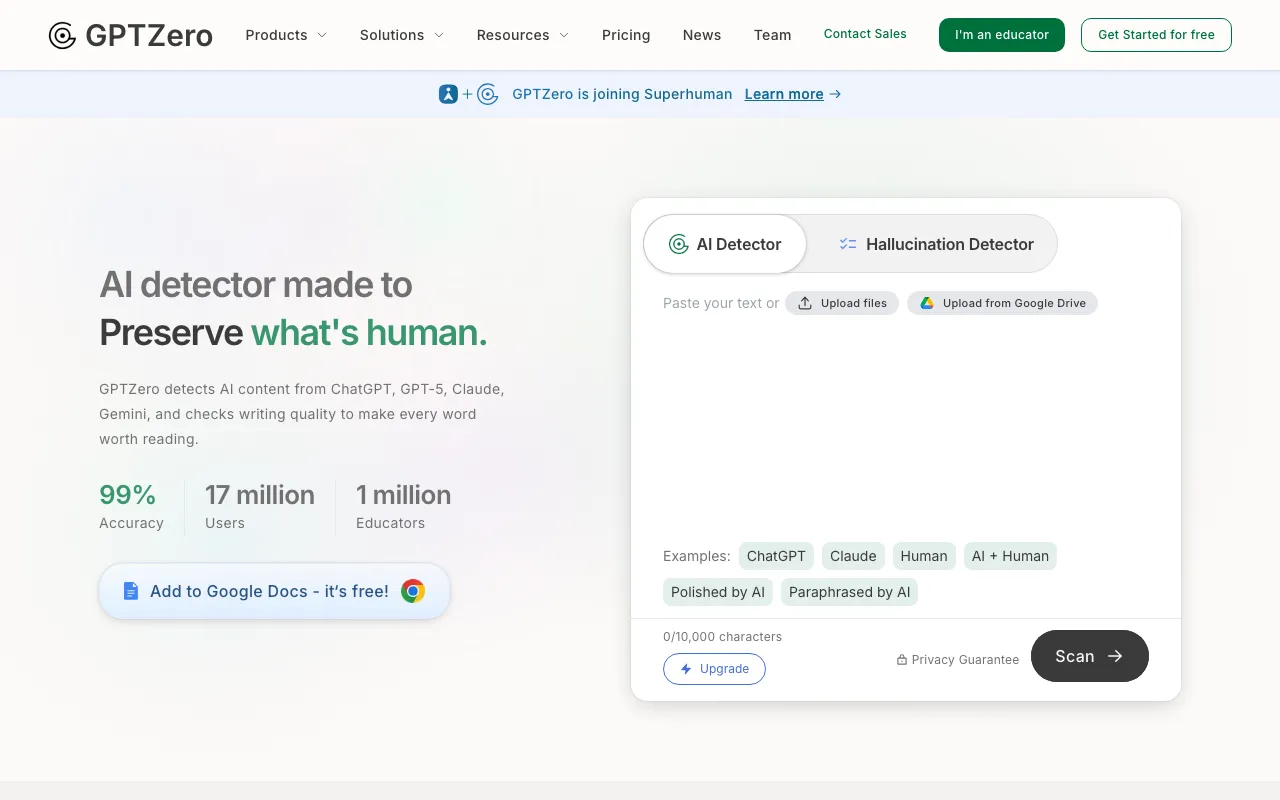
GPTZero is an AI-writing detector launched in January 2023 that estimates whether a piece of text was written by a human or generated by models like ChatGPT, Claude, Gemini, Llama, or DeepSeek. It claims over 10 million users — including a claimed 1 million educators — and has become the default detection tool in schools and universities. Beyond the basic scan, it ships an advanced sentence-by-sentence probability view, a plagiarism checker, a hallucination detector that flags fabricated citations, and authorship writing reports that replay how a document was drafted so a writer can demonstrate the work is their own. A quick scan of up to 10,000 characters works on the website without an account.
The honest caveat: detection is probabilistic, and the accuracy numbers are contested. GPTZero markets 99% accuracy and cites independent benchmarking at 95.7% detection with roughly 1% of human texts misclassified, but real-world tests have reported human-text false-positive rates of 11-15%, and a Stanford study found AI detectors disproportionately flag non-native English speakers’ writing as AI-generated. GPTZero’s own product direction — writing reports, drafting replay, integrations with Canvas and Google Classroom — reflects that a raw score is a conversation starter, not a verdict. Paid plans reportedly range from $8.33/month (annual billing) for 150,000 words to $24.99/month for 500,000 words, with a free tier at a reported 10,000 words/month.
Who is it for?
GPTZero fits people who need to screen writing at volume and can treat the output as one signal among several rather than a definitive ruling. Educators are the core audience, but the plagiarism and fake-citation checks make it useful anywhere written submissions arrive from strangers. Writers on the other side of the table use it defensively — checking their own work before submission or generating an authorship report as evidence. Tools like /tools/quillbot ship their own free detector, and /tools/grammarly offers authorship tracking, but neither is as education-focused.
- Teachers and professors screening essays through Canvas or Google Classroom integrations, using sentence-level highlights to ground a conversation with the student rather than an automatic accusation.
- Editors, publishers, and content managers checking freelance submissions for AI generation, plagiarism, and fabricated citations before paying for them.
- Students and freelance writers who scan their own work pre-submission and use writing reports with drafting replay to prove authorship if challenged.
- Hiring and admissions teams triaging cover letters, essays, and take-home writing samples at volume.
- Developers and platforms embedding detection into moderation or review pipelines via the API.
How much does GPTZero cost?
Starting price: $8.33/mo · Free tier: yes · Model: freemium
Price history tracked from June 2026
| Plan | Price | Includes |
|---|---|---|
| Free | Free | Reported 10,000 words per month · Basic and advanced AI scans · Multilingual detection (English, German, Portuguese, French, Spanish) · Writing feedback, no credit card required |
| Essential | $14.99/mo | Reported $8.33/mo billed annually (45% off) · Reported 150,000 words per month · Plagiarism check and grammar check · AI vocabulary check and Chrome extension |
| Premium | $23.99/mo | Reported $12.99/mo billed annually · Reported 300,000 words per month · Advanced sentence-level scans · Unlimited batch file uploads · Add team members |
| Professional | $45.99/mo | Reported $24.99/mo billed annually · Reported 500,000 words per month · Bulk scanning up to 250 files at once · Page-by-page scanning and team collaboration · Enterprise-grade security |
| API / Enterprise | Custom | Developer API with usage-based pricing via sales · Team and enterprise multi-seat plans · LMS integrations for institutions |
What are GPTZero's key features?
- AI detection across ChatGPT, GPT-5, Claude, Gemini, Llama, and DeepSeek outputs, updated for new model releases
- Advanced scan with sentence-by-sentence AI probability breakdown
- Authorship writing reports with drafting replay to verify human writing
- Plagiarism checker and hallucination detector for fake or fabricated citations
- Grammar check and AI vocabulary check that flags characteristic AI phrasing
- Batch scanning — up to 250 files at once on the Professional plan
- Chrome extension, Google Docs, Canvas, Google Classroom, and Zapier integrations
- Multilingual detection in English, German, Portuguese, French, and Spanish
What people use GPTZero for
- 01 Teachers screening essay submissions for AI-generated text with sentence-level highlights before talking to the student
- 02 Editors and publishers checking freelance submissions for AI writing, plagiarism, and fabricated citations before acceptance
- 03 Students and writers generating authorship writing reports (with replay of the drafting process) to preemptively prove their work is human
- 04 Hiring teams screening cover letters and take-home writing samples at volume
- 05 Developers integrating AI detection into moderation or review pipelines via the API
Pros and cons
| Pros | Cons |
|---|---|
| Free tier with a reported 10,000 words/month and a 10,000-character quick scan that needs no account | False positives on human text are documented: a Stanford study (Liang et al.) found GPT detectors disproportionately flag non-native English speakers' writing as AI, and independent real-world tests report human-text false-positive rates well above GPTZero's marketed ~1% |
| Goes beyond a yes/no verdict: plagiarism checks, fake-citation detection, and authorship reports with drafting replay | The headline 99% accuracy figure comes from GPTZero's own benchmarks; independent tests report lower real-world accuracy, and paraphrasing tools can evade detection |
| Deep education integrations (Canvas, Google Classroom) plus a Chrome extension and developer API | No verdict is proof — results are probabilistic, so institutions still need process (drafts, version history, conversations) around any flag |
| Publishes its own benchmark methodology and supports five languages, used by a claimed 10M+ users and 1M educators | Word caps are hard monthly limits; heavy users can burn through the reported 150,000-word Essential allowance quickly when scanning long documents |
What are the best GPTZero alternatives?
Grammarly is the closest GPTZero alternative in our directory: it covers the same category (AI Writing & Marketing), starts at $0, has a free tier.
Ranked by category overlap with GPTZero, then free-tier availability, then lowest verified starting price — computed from our verified data, never from sponsorships.
| Alternative | What it is | Starting price | Free tier | Price verified |
|---|---|---|---|---|
| Grammarly | AI writing assistant that checks grammar, tone, and clarity and generates text across apps and browsers | $0 | yes | Jun 22, 2026 |
| QuillBot | AI writing suite built around paraphrasing, with grammar checking, summarizing, and AI detection | $0 | yes | Jun 22, 2026 |
| Wordtune | AI writing and rewriting assistant from AI21 Labs that paraphrases, summarizes, and adjusts tone inline | $6.99/mo | yes | Jun 28, 2026 |
| Jasper | AI marketing platform with 100+ specialized agents for brand-consistent content at scale | $59/mo | no | Jul 3, 2026 |
Frequently asked questions
Is GPTZero free?
Yes. The free plan reportedly covers 10,000 words per month with basic and advanced AI scans, and you can scan up to 10,000 characters on the website without creating an account. Paid plans start at a reported $8.33/month on annual billing.
How accurate is GPTZero?
GPTZero claims 99% accuracy and cites independent benchmarking at 95.7% AI-text detection with about 1% of human texts misclassified. Independent real-world tests are less favorable, with some reporting 11-15% of human essays flagged as AI. A Stanford study found AI detectors disproportionately misclassify non-native English speakers' writing. Treat any result as probabilistic, not proof.
Can GPTZero falsely accuse a human writer?
Yes, and it is documented. Polished academic prose, formal styles, and non-native English writing share statistical patterns with AI text and can trigger false positives. GPTZero's own authorship writing reports (drafting replay) exist partly because a detection score alone should never be the sole basis for an academic-integrity decision.
Which AI models can GPTZero detect?
GPTZero detects text from ChatGPT (including GPT-5 and GPT-4.1-class models), Claude, Gemini (including 2.5 Pro and Flash), Llama, and DeepSeek, plus services built on those models. Detection works in English, German, Portuguese, French, and Spanish.
How much does GPTZero Premium cost?
Premium is reported at $23.99/month, or $12.99/month billed annually, for 300,000 words per month plus advanced scans and unlimited batch file uploads. Essential is reported at $14.99/month ($8.33/month annual) for 150,000 words; Professional at $45.99/month ($24.99/month annual) for 500,000 words.
Does GPTZero have an API?
Yes. GPTZero offers a developer API for integrating AI detection into other products, alongside Zapier automation and LMS integrations for Canvas and Google Classroom. API pricing is not published on the public pricing page — it is quoted via sales.
Should schools rely on GPTZero to punish students?
No detector output should be the sole evidence in a disciplinary case. Given documented false positives — especially against non-native English speakers — best practice is to combine a flag with drafts, version history, or GPTZero's writing reports, and to talk with the student before drawing conclusions.