Midjourney
AI image generator that creates high-quality art and photos from text prompts via web and Discord
PAID Verified JUN 11, 2026
All-in-one AI image and video studio running 100+ models with consistent characters, style training, and a template app library
OpenArt is an all-in-one AI image and video studio that runs 100+ models — Flux, GPT Image, Seedream, Kling, Veo — alongside consistent-character and style-training tools. A free tier offers starter credits; Essential is $14/month for 4,000 credits, Advanced $34/month, Infinite $56/month, and Wonder $240/month. Commercial-use rights unlock only from the Advanced tier upward, which matters for anyone selling output.
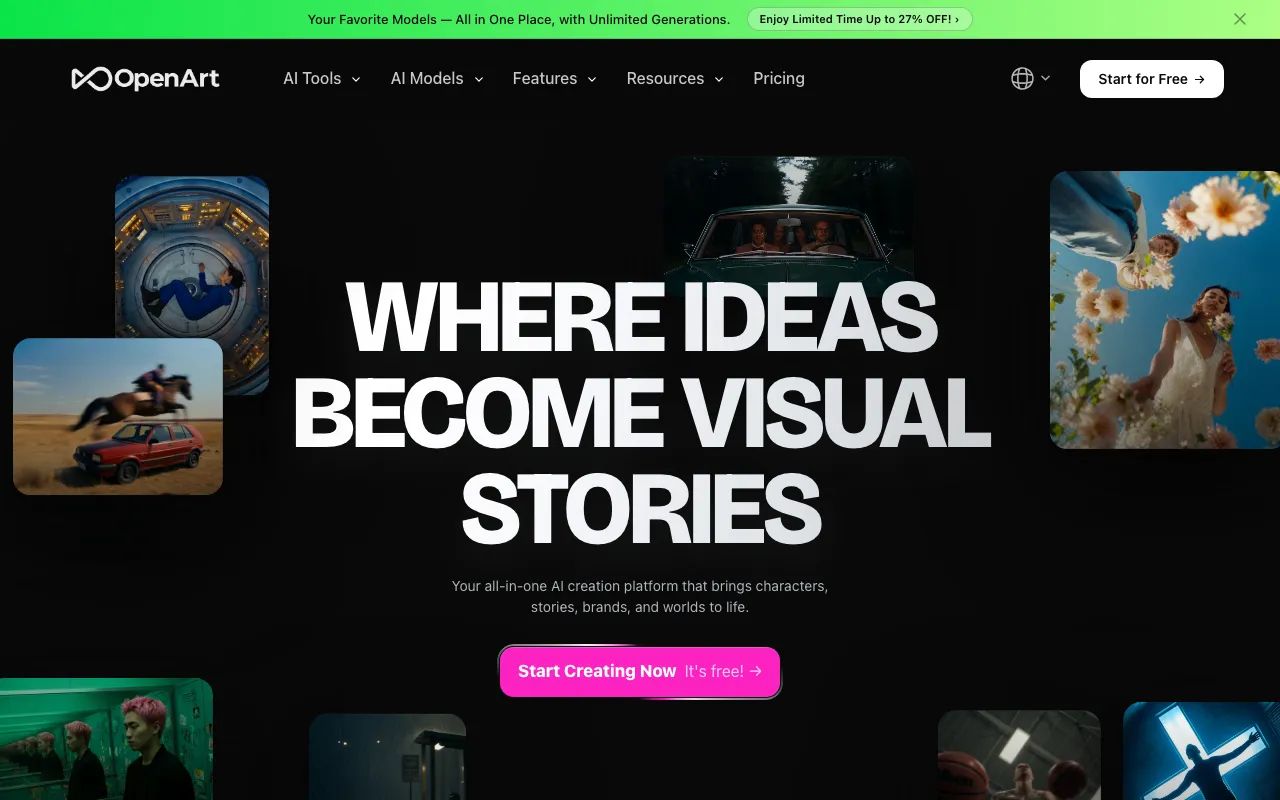
OpenArt is an all-in-one AI creation studio for images and video that bundles more than 100 underlying models — including Flux, GPT Image, Seedream, Kling, and Veo — behind a single interface. Rather than picking one generator, you choose the best model for each job and generate with credits from your monthly plan. On top of raw generation, OpenArt layers creative tools: consistent characters that stay recognizable across scenes, personalized style and character training from your own reference images, inpainting and outpainting, and a template app library that turns repeatable workflows into one-click actions.
The platform is built around a credit system tied to subscription tiers. A free plan offers starter credits with watermarked output, while paid plans from Essential up scale monthly credits, parallel generation slots, and the number of characters and personalized models you can maintain. Commercial-use rights are a deliberate gate: they are excluded from the Free and Essential tiers and only unlock from the Advanced plan upward. OpenArt positions itself as a mainstream, brand-friendly tool and enforces a content policy that blocks explicit material and certain copyrighted or celebrity prompts.
OpenArt suits creators who want the breadth of many AI models without juggling separate subscriptions, and who value narrative tools like consistent characters and style training over a single opinionated generator. Casual users can start free, but the tool’s real strengths — watermark-free output, commercial rights, and higher credit ceilings — surface on the paid tiers, so the right plan depends on how much you generate and whether you sell the results.
Starting price: $14/mo · Free tier: yes · Model: freemium
Price history tracked from June 2026
| Plan | Price | Includes |
|---|---|---|
| Free | Free | Starter credits to try image and video generation · Access to a limited set of models · Outputs are watermarked · No commercial-use rights |
| Essential | $14/mo | 4,000 credits per month (~4,000 images or ~50 videos) · 100+ premium image, video, and audio models · Consistent characters and personalized model training · Watermark-free, 8 parallel generations · Commercial use NOT included |
| Advanced | $34/mo | 12,000 credits per month plus optional add-on credits · Commercial-use rights included · 16 parallel generations · More consistent characters and personalized models |
| Infinite | $56/mo | 24,000 credits per month (marked Most Popular) · Commercial-use rights included · 32 parallel generations and priority support · Up to ~80 consistent characters and personalized models |
| Wonder | $240/mo | 106,000 credits per month (marked Best Value) · Unlimited creation for the heaviest workloads · Commercial-use rights included · Up to ~353 consistent characters and personalized models |
| Pros | Cons |
|---|---|
| One subscription covers 100+ leading image and video models instead of many separate tools | Commercial-use rights are gated to Advanced ($34/mo) and above — the cheapest paid tier cannot be used for resale |
| Free tier lets you test image and video generation before paying | Credit-based billing means heavy video generation can exhaust a month's allotment quickly |
| Consistent-character and style-training tools are strong for brand and narrative work | Content policy blocks explicit and certain copyrighted or celebrity prompts, so some generations get flagged |
| Annual billing cuts up to roughly 27% off every paid plan | No public generation API for developers; automation is limited to the app and MCP |
AI image generator that creates high-quality art and photos from text prompts via web and Discord
AI image generator with custom model training, canvas editor, and token-based generation
AI image generator specializing in accurate text rendering and layout-aware design output
AI image and vector generator with custom styles, mockups, and design-ready output
API-first AI image generator from Black Forest Labs with per-image pay-as-you-go pricing
OpenArt has a free tier that gives you starter credits to try image and video generation. Free outputs are watermarked and carry no commercial-use rights. Paid plans start at Essential for $14 per month, which removes watermarks and adds 4,000 monthly credits.
Paid plans are Essential at $14/month, Advanced at $34/month, Infinite at $56/month, and Wonder at $240/month. Each tier grants monthly credits (4,000 up to 106,000). Annual billing discounts each plan by up to roughly 27 percent.
Commercial-use rights are not included on the Free or Essential tiers. They unlock starting at the Advanced plan ($34/month) and apply to Infinite and Wonder as well. If you plan to sell or publish output commercially, choose Advanced or higher.
OpenArt runs 100+ models in one place, including image models like Flux, GPT Image, Seedream, and Nano Banana, plus video models such as Kling, Google Veo, Sora, and Seedance. You can switch models per generation without leaving the studio.
Generation is credit-based: each image or video consumes credits, with video costing far more than a still image. Your plan grants a monthly credit allotment (from 4,000 to 106,000), and Advanced and higher tiers let you buy add-on credits when you run out.
OpenArt is primarily a web studio and also ships an official iOS app for on-the-go generation. It does not offer a public developer API for generation, though it exposes an MCP integration for use inside AI agent workflows.