
Zep
Context and memory layer for AI agents built on temporal knowledge graphs, with credit-based cloud plans and the open-source Graphiti framework
Zep gives AI agents long-term memory and governed company context by turning chat messages, documents and business data into temporal knowledge graphs. Its open-source Graphiti framework (Apache-2.0, over 32,000 GitHub stars) is free; the managed cloud is credit-based, with a free tier of 10,000 credits a month, Flex at $125/month and Flex Plus at $375/month. Strong on memory that tracks how facts change over time; the jump from free to the first paid plan is steep.
Free tier
What is Zep?
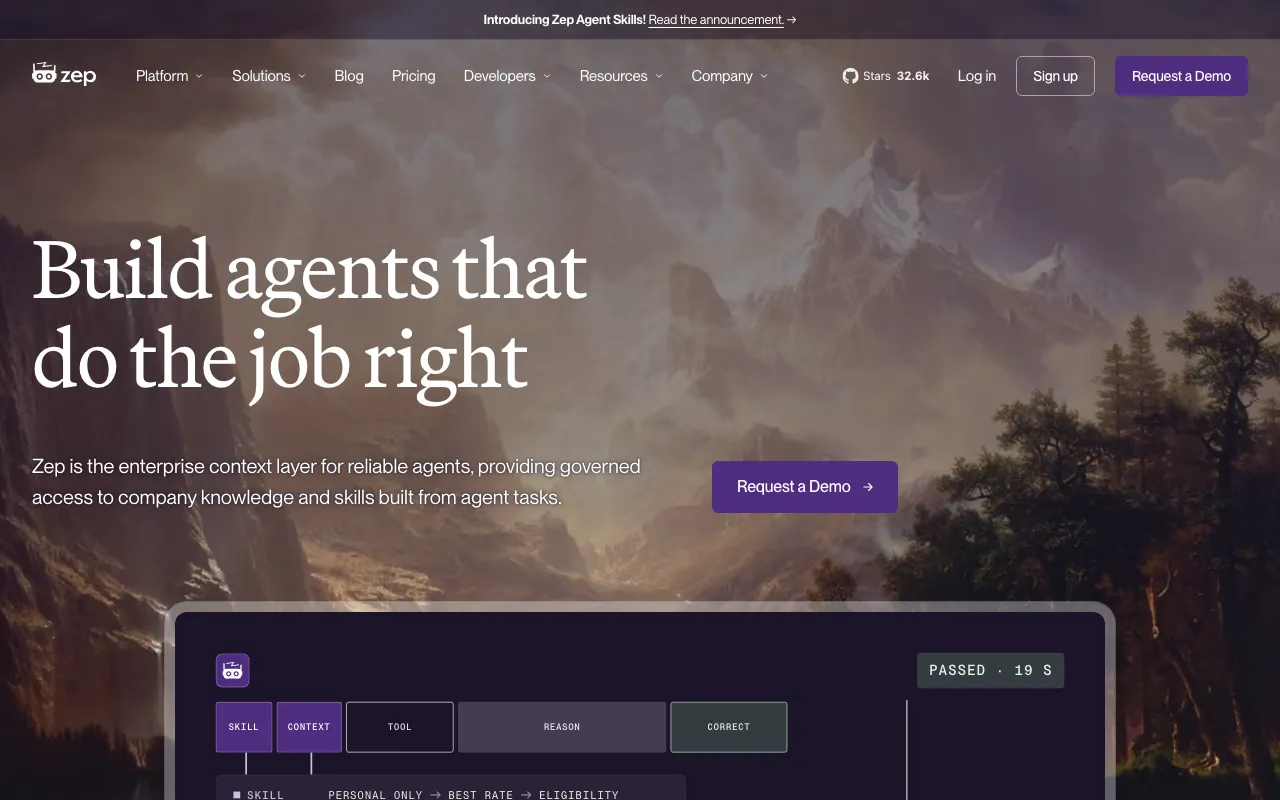
Zep is a context and memory layer for AI agents. An application sends Zep its raw material — chat messages, JSON payloads, documents and synced business data — and Zep turns it into temporal context graphs: knowledge graphs that record entities, the relationships between them, and when each fact became true or stopped being true. When an agent needs context, it retrieves the relevant slice of that graph through Zep’s Python, TypeScript or Go SDKs or through an MCP server, instead of replaying whole transcripts into the prompt. The time dimension is the distinguishing idea: if a customer switches plans or changes their billing currency, the graph keeps the history and marks the newer fact as current.
Zep now positions itself as an enterprise context layer rather than only a memory API. The Context Lake unifies business data, documents and conversations into governed graphs, connectors pull in Slack, Google Drive, Notion, Gmail and Granola (with Microsoft Teams, SharePoint, Snowflake, Databricks and BigQuery on Enterprise), and attribute-based access control decides what each agent can read, with every request logged. A newer feature, Agent Skills, builds reusable skills from the traces of an agent’s past runs and is free on every plan until January 4, 2027. The graph engine underneath is published separately as Graphiti, an Apache-2.0 framework with over 32,000 GitHub stars. The managed service bills by credits: 1 credit per 350 bytes of ingested data, with storage not charged and unlimited retrieval on the paid plans, from a free tier of 10,000 credits a month to Flex at $125/month and Flex Plus at $375/month.
Who is it for?
Zep fits engineering teams that have an agent in production, or close to it, and need it to remember users and know current company facts without stuffing ever-longer histories into each prompt. It is a developer product with no no-code path. The free tier is enough to test whether graph memory improves an agent’s answers, but the first paid plan is $125/month, so it suits funded products and internal enterprise projects more than hobby builds. Teams that want a cheaper start, or a fully self-hostable memory library, should compare Mem0, whose free plan runs on your own LLM key, and Letta.
- Support and success teams’ developers building agents that must recall each customer’s history, plan and preferences across channels.
- Enterprise platform teams assembling a governed company brain that internal agents can query with per-user access rules.
- Regulated-industry builders in legal, finance or healthcare who need retention policies, audit logs and a VPC deployment option.
- Framework users already on LangGraph, LangChain or Mastra who want a dedicated memory and context store rather than a raw vector index.
- Researchers and prototypers who want to start with the open-source Graphiti framework before paying for the managed platform.
How much does Zep cost?
Starting price: $125/mo · Free tier: yes · Model: freemium
Price history tracked from June 2026
| Plan | Price | Includes |
|---|---|---|
| Free | $0 | 10,000 credits per month, no rollover or auto top-up · 2 projects and 1 Context MCP Server seat · 5 custom entity and edge types · Variable rate limits and lower-priority processing |
| Flex | $125/mo | 50,000 credits per month, then $25 per 10,000 credits · Auto top-up at 20% balance, 30-day credit rollover · 600 requests per minute, 5 projects, 5 Context MCP Server seats · Connectors for Google Drive, Slack, Notion, Gmail and Granola · $1,250/year billed annually (about $104/mo) |
| Flex Plus | $375/mo | 200,000 credits per month, then $75 per 40,000 credits · 60-day credit rollover, 1,000 requests per minute · 10 projects and 15 Context MCP Server seats · Observations, webhooks, analytics and custom extraction instructions · $3,750/year billed annually (about $312/mo) |
| Enterprise | Custom | Custom credits with negotiated rates and SLA-backed rate limits · Zep Cloud, cloud with your own encryption keys, or deployment in your VPC · HIPAA BAA, audit and API logs kept for 1 year · Adds Microsoft Teams, SharePoint, Snowflake, Databricks and BigQuery connectors |
Paying for more than one AI tool? Add Zep to the stack cost calculator and see the monthly total.
What are Zep's key features?
- Temporal context graphs that record when facts became true and when they changed
- Context Lake that unifies business data, documents and conversations into governed graphs
- Python, TypeScript and Go SDKs plus an MCP server for agent access
- Agent Skills that turn traces of past agent runs into reusable skills
- Attribute-based access control, retention policies and legal hold
- Connectors for Slack, Google Drive, Notion, Gmail and Granola, with warehouse connectors on Enterprise
- Integrations with LangGraph, Google ADK, Microsoft Agent Framework and Mastra
- SOC 2 Type II certification, with HIPAA BAAs on Enterprise
What people use Zep for
- 01 Giving a support or sales agent memory of each customer that stays current as facts change
- 02 Building a governed company brain that internal agents query for up-to-date business context
- 03 Feeding coding agents and assistants such as Claude Code or Cursor shared project context through an MCP server
- 04 Grounding legal, finance or healthcare agents in isolated per-customer data with access controls and retention rules
- 05 Prototyping temporal knowledge graphs locally with the open-source Graphiti framework
Pros and cons
| Pros | Cons |
|---|---|
| Graph memory that tracks how facts change over time, not just a flat list of stored snippets | No low-cost paid tier: the step from the free plan to Flex is $125/month, with nothing in between |
| Unlimited memories, retrieval and end users on the paid self-serve plans; you pay for ingestion, not storage | Credits scale with the byte size of each message or document, so long payloads cost several credits and monthly spend is harder to forecast |
| Apache-2.0 Graphiti framework with over 32,000 GitHub stars lets you study or prototype the core approach for free | The free plan has variable rate limits and lower-priority processing, and Zep says its features may change over time |
| Enterprise deployment options include your own encryption keys or a deployment inside your VPC | Running the full platform in your own VPC requires an Enterprise contract; only the Graphiti framework is open source |
| Agent Skills is free only until January 4, 2027, and Zep has not published what it will cost after that date |
What are the best Zep alternatives?
LlamaIndex is the closest Zep alternative in our directory: it covers the same category (AI Agents & Automation), starts at $0, has a free tier.
Ranked by category overlap with Zep, then free-tier availability, then lowest verified starting price — computed from our verified data, never from sponsorships.
| Alternative | What it is | Starting price | Free tier | Price verified |
|---|---|---|---|---|
 LlamaIndex | Open-source data framework for LLM apps, plus the commercial LlamaCloud platform for parsing, extracting, and indexing complex documents | $0 | yes | Nov 15, 2026 |
 Mem0 | Memory layer for AI agents that stores and retrieves user context across sessions, open source with a hosted platform | $0 | yes | Nov 16, 2026 |
 Letta | Platform for stateful AI agents with persistent memory that survives across sessions | $20/mo | yes | Nov 15, 2026 |
| Pinecone | Managed serverless vector database for semantic search, RAG, and recommendation systems | $20/mo | yes | Nov 17, 2026 |
 LangChain | Open-source frameworks for building LLM agents, plus the commercial LangSmith platform for tracing, evaluation, and deployment | $39/seat/mo | yes | Nov 16, 2026 |
How people make money with Zep
- Build customer-support or account-management agents for clients that remember each customer's history across tickets and channels, charging a setup fee plus a monthly retainer that covers the credit-based platform plan
- Offer a company-brain integration service that connects a client's Slack, Google Drive and Notion into Zep so internal agents answer from current company knowledge, priced per connected source plus ongoing maintenance
Frequently asked questions
Is Zep free?
Partly. Zep Cloud has a free plan with 10,000 credits a month, 2 projects and variable rate limits, and credits do not roll over. Separately, Zep's Graphiti framework for temporal knowledge graphs is open source under Apache-2.0 and free to run yourself, though you supply your own graph database and model calls.
How much does Zep cost?
Zep's self-serve plans are credit based. Flex costs $125/month with 50,000 credits, or $1,250/year billed annually. Flex Plus costs $375/month with 200,000 credits, or $3,750/year. Extra credits cost $25 per 10,000 on Flex and $75 per 40,000 on Flex Plus. Enterprise pricing is negotiated.
How do Zep credits work?
Zep charges credits for ingesting Episodes, meaning any single chat message, JSON payload or block of text you send. An Episode up to 350 bytes uses 1 credit, and each additional 350 bytes uses another, so a 1,200-byte Episode costs 4 credits. Storage is not charged, paid plans include unlimited retrieval, and webhook calls cost an eighth of a credit.
What is Graphiti?
Graphiti is Zep's open-source framework for building real-time temporal knowledge graphs for AI agents. It is Apache-2.0 licensed with over 32,000 GitHub stars. It contains the graph-building approach behind Zep's memory, while the hosted platform adds the Context Lake, governance, connectors, Agent Skills and managed infrastructure.
How is Zep different from Mem0?
Both give agents memory across sessions. Mem0 offers a free plan that runs on your own LLM key, custom plans through sales, and an Apache-2.0 library, with graph memory on its Custom plan. Zep builds temporal knowledge graphs on every plan, bills by credits from $125/month, and leans toward enterprise context with connectors, access controls and VPC deployment.
Can Zep be deployed in my own cloud?
Yes, on Enterprise. Zep lists three deployment options: its managed Zep Cloud, Zep Cloud with your own encryption keys, and a deployment inside your own VPC. The self-serve Free, Flex and Flex Plus plans run only on Zep's managed cloud.
Which languages and agent tools does Zep support?
Zep ships official SDKs for Python, TypeScript and Go, and agents can also connect through MCP. Its site lists framework support for LangGraph, Google ADK, Microsoft Agent Framework and Mastra, and coding agents such as Claude Code, Codex and Cursor among the clients that can reach Zep context.