LangChain
Open-source frameworks for building LLM agents, plus the commercial LangSmith platform for tracing, evaluation, and deployment
LangChain ships free, MIT-licensed open-source frameworks — LangChain and LangGraph — for building LLM agents, plus the commercial LangSmith platform for observability, evaluation, and deployment. LangSmith's Developer tier is free (1 seat, 5k traces/month); Plus runs $39/seat/month with 10k traces; Enterprise is custom. Best for teams shipping and monitoring production agents.
What is LangChain?
LangChain is the company behind one of the most widely used stacks for building applications on top of large language models. Its open-source, MIT-licensed frameworks — LangChain for rapidly assembling agents and chains across any model provider, and LangGraph for low-level, stateful orchestration with explicit graph-based control — together see over 100 million monthly downloads. A newer Deep Agents project targets long-running, highly autonomous systems. Because the frameworks expose a unified interface across OpenAI, Anthropic, Google, and hundreds of tools and vector stores, developers can prototype quickly and swap models without rewriting application logic.
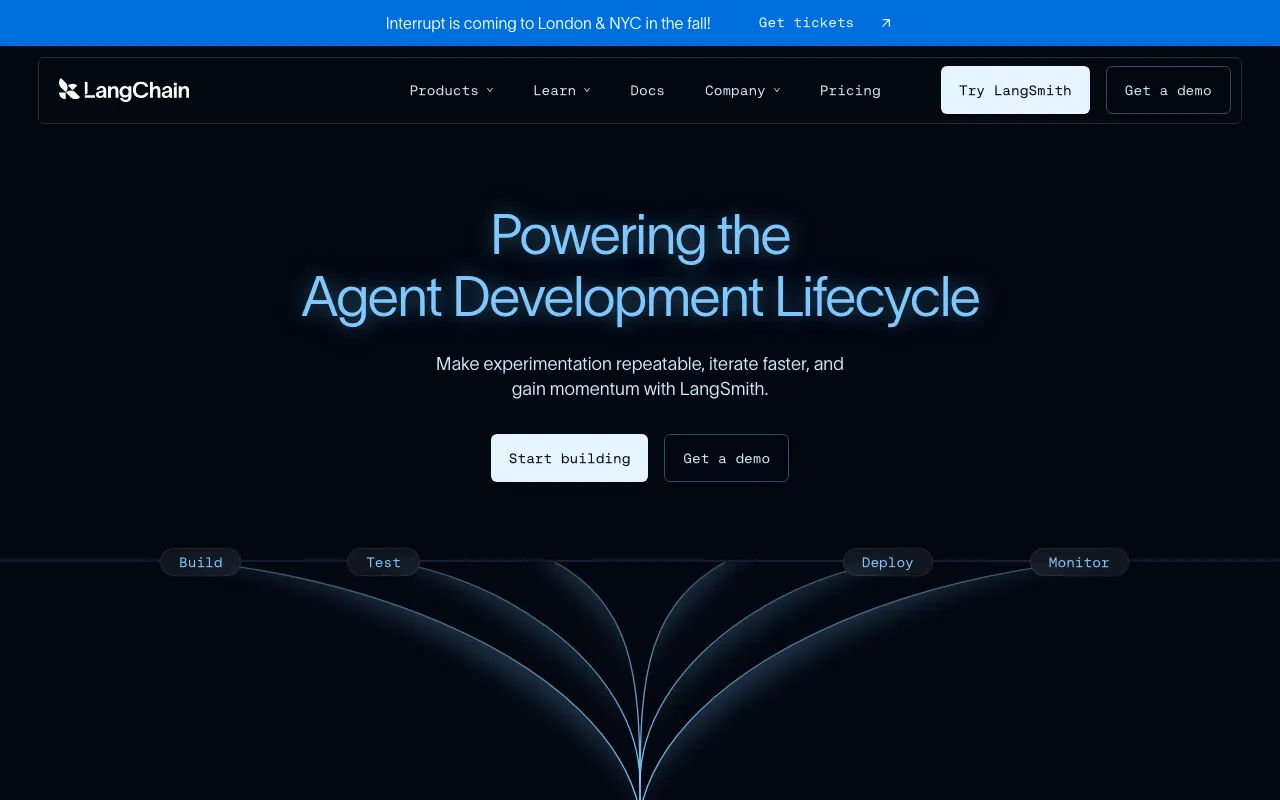
The commercial side is LangSmith, an agent-engineering platform that layers observability, evaluation, and deployment on top of whatever you build. Its tracing surfaces every step, token, and tool call in an agent run; the evaluation suite blends automated scorers with human review to catch regressions; and LangGraph Platform handles managed deployment with fault tolerance and asynchronous runs. LangSmith is framework-agnostic — it can instrument apps built with raw SDK calls, not only LangChain — and a no-code Fleet product lets non-technical users describe tasks in plain language. Pricing runs from a free Developer tier through a $39/seat/month Plus tier to custom Enterprise, with usage billed by trace volume.
Who is it for?
LangChain fits developers and teams building LLM-powered agents who want a flexible open-source foundation plus a managed layer for monitoring and shipping to production. The free frameworks and Developer tier make it easy to start, while the paid LangSmith tiers become worthwhile once agents move into production and trace volume, evaluation, and team collaboration matter.
- AI application developers building agents and chains who want a unified interface across model providers rather than hand-rolling integrations.
- Platform and ML engineering teams that need production observability, tracing, and evaluation to debug and de-risk agent behavior at scale.
- Startups and solo builders who want to prototype for free on the open-source core before committing to any paid platform.
- Enterprises requiring hybrid or self-hosted deployment, SSO, audit controls, and dedicated support under a custom Enterprise agreement.
How much does LangChain cost?
Starting price: $39/seat/mo · Free tier: yes · Model: freemium
Price history tracked from June 2026
| Plan | Price | Includes |
|---|---|---|
| Developer | Free | 1 seat maximum · Up to 5k base traces/month, then pay-as-you-go · Full open-source LangChain + LangGraph frameworks · Community support |
| Plus | $39/seat/mo | Unlimited seats at $39 each · Up to 10k base traces/month included · One free dev-sized LangGraph deployment · Higher rate limits and email support |
| Enterprise | Custom | Custom trace volumes and support SLA · Hybrid (VPC) or fully self-hosted deployment · SSO, RBAC, and audit controls · Dedicated engineers, trainings, Fleet and Engine access |
What are LangChain's key features?
- Open-source LangChain framework with a unified interface across LLM providers and tools
- LangGraph for low-level, stateful agent orchestration with graph-based control
- LangSmith tracing that visualizes every step, token, and tool call of an agent run
- Evaluation suite combining automated scorers with human review of LLM outputs
- LangGraph Platform for managed agent deployment with fault tolerance and async runs
- Prompt versioning, dataset management, and a shared prompt hub
- Fleet no-code agent builder for non-technical users
- Hundreds of integrations across model providers, vector stores, and external tools
What people use LangChain for
- 01 Building stateful, multi-step LLM agents with LangGraph's graph-based control flow
- 02 Tracing and debugging agent runs step-by-step in LangSmith observability
- 03 Running automated and human-in-the-loop evaluations to catch output regressions before release
- 04 Deploying long-running agents to managed cloud infrastructure via LangGraph Platform
- 05 Prototyping across model providers (OpenAI, Anthropic, Google) through one unified interface
Pros and cons
| Pros | Cons |
|---|---|
| Core frameworks are free and MIT-licensed, with a huge ecosystem (100M+ monthly open-source downloads) | LangChain's abstractions have a reputation for churn — frequent breaking changes across versions can force rewrites |
| LangSmith is framework-agnostic — it traces apps built with any framework or raw SDK calls, not just LangChain | Trace-based billing adds up at scale: overage is charged per 1,000 traces beyond the included allotment |
| Free Developer tier and open-source core let you start building at no cost | The layered stack (LangChain, LangGraph, LangSmith, LangGraph Platform) has a steep learning curve |
| Extensive integration library spanning model providers, vector databases, and tooling | Some developers find the abstraction overhead heavier than calling model APIs directly for simple apps |
What are the best LangChain alternatives?
CrewAI is the closest LangChain alternative in our directory: it covers the same category (AI Agents & Automation), starts at $0, has a free tier.
Ranked by category overlap with LangChain, then free-tier availability, then lowest verified starting price — computed from our verified data, never from sponsorships.
| Alternative | What it is | Starting price | Free tier | Price verified |
|---|---|---|---|---|
| CrewAI | Open-source multi-agent framework for orchestrating collaborative AI agent teams | $0 | yes | Jul 3, 2026 |
| Dify | Open-source LLM app platform for building agentic workflows, RAG pipelines, and AI agents with a visual no-code builder | $0 | yes | Jun 24, 2026 |
| Flowise | Open-source low-code platform to build LLM apps and AI agents with a drag-and-drop visual flow builder | $0 | yes | Jun 24, 2026 |
| OpenRouter | Unified API to 400+ LLMs from 70+ providers through one OpenAI-compatible endpoint, with automatic failover and pass-through token pricing | $0 | yes | Jun 23, 2026 |
| Relevance AI | No-code platform for building and deploying autonomous AI agents for business workflows | $19/mo | yes | Jun 11, 2026 |
| n8n | Open-source workflow automation platform for building AI agents and multi-app integrations | €20/mo | yes | Jul 3, 2026 |
How people make money with LangChain
- Build and sell production AI agents as a service — develop on the free open-source frameworks, then use the LangSmith Plus tier to trace, evaluate, and debug them for paying clients
- Offer LangSmith observability and evaluation setup as a consulting service — the Enterprise tier's hybrid and self-hosted deployment is a natural upsell for regulated or security-sensitive clients
Frequently asked questions
Is LangChain free?
Yes. The LangChain and LangGraph frameworks are open-source and MIT-licensed, so the core is free to use. The commercial LangSmith platform also has a free Developer tier with 1 seat and up to 5,000 base traces per month before pay-as-you-go pricing applies.
What is the difference between LangChain, LangGraph, and LangSmith?
LangChain is the higher-level framework for building LLM applications and agents. LangGraph is a lower-level library for stateful, graph-based agent orchestration with fine-grained control. LangSmith is the commercial platform that adds tracing, evaluation, and deployment on top of whatever you build.
How much does LangSmith cost?
The Developer tier is free (1 seat, up to 5,000 base traces/month). Plus is $39 per seat per month with up to 10,000 base traces included, and Enterprise is custom. Base trace overage is $2.50 per 1,000 (14-day retention); extended 400-day-retention traces cost $5.00 per 1,000.
What does LangGraph Platform pricing look like?
The Developer tier supports self-hosted deployment free for up to roughly 100,000 node executions per month. The Plus tier offers managed cloud deployment starting around $39 per user per month with node-execution overage billed per run, and Enterprise adds hybrid or self-hosted options at custom pricing.
Do I need to use LangChain to use LangSmith?
No. LangSmith is framework-agnostic and can trace and evaluate applications built with any framework — or with direct model SDK calls — not only LangChain or LangGraph.
Is LangChain suitable for production agents?
Yes, though teams typically pair the open-source frameworks with LangSmith for observability and LangGraph for reliable state management. LangChain reports 6,000+ customers, including several Fortune 10 companies, using the platform in production.