Mem0
Memory layer for AI agents that stores and retrieves user context across sessions, open source with a hosted platform
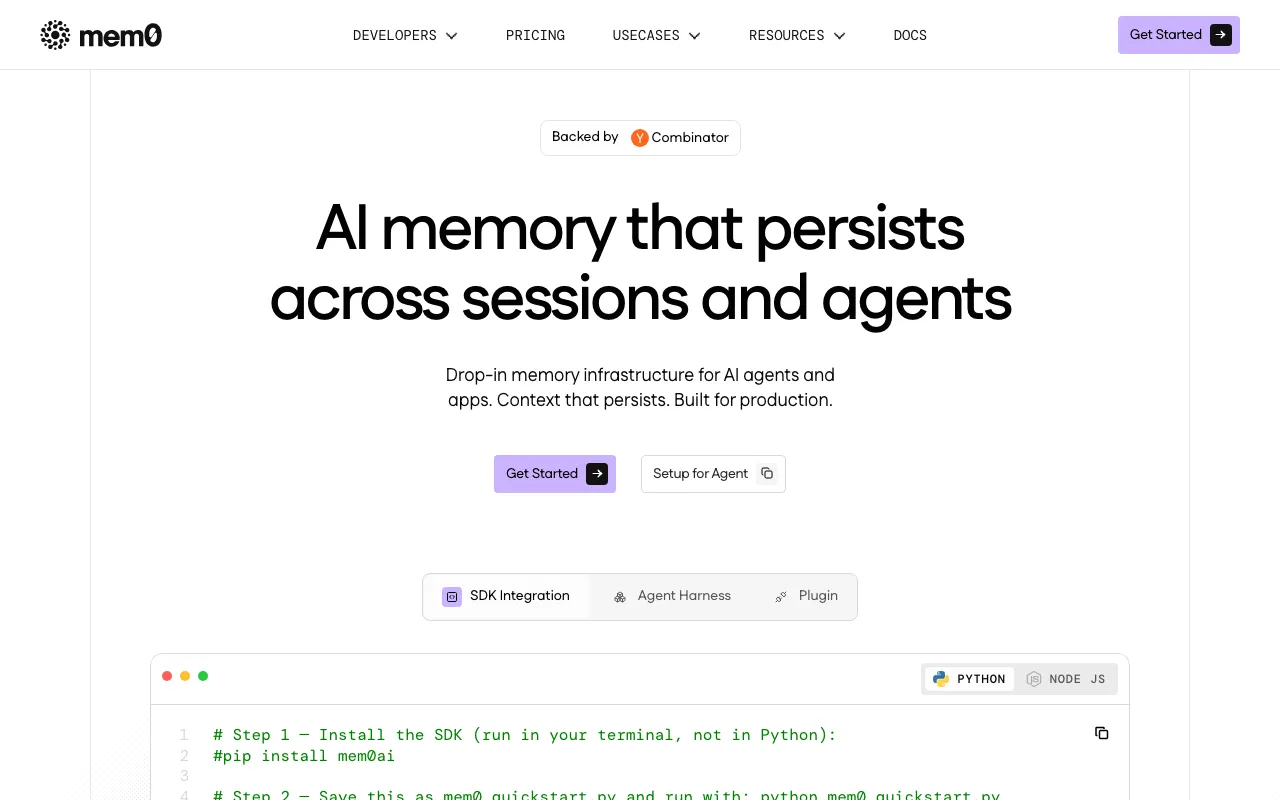
Mem0 is a memory layer that lets AI agents remember user context across sessions instead of restarting cold every conversation. The open-source core is Apache-2.0 with over 61,000 GitHub stars; the hosted platform adds a managed API and dashboard. Free Hobby tier covers 10,000 add requests and 1,000 retrieval requests per month, Starter is $19/month, Growth is $79/month, and Pro is $249/month. Graph memory is gated to Pro and Enterprise only.
What is Mem0?
Mem0 is a memory layer for AI agents and assistants. Instead of replaying an entire conversation history into the prompt on every turn, an application sends new interactions to Mem0, which extracts the durable facts — a user’s plan, preferences, past issues, stated constraints — and stores them as compact records. On the next turn the agent queries Mem0 for the memories relevant to the current message and injects only those. The practical effect is that context survives across sessions and devices, and prompt size stops growing linearly with conversation length.
The project exists in two forms. The open-source package is Apache-2.0 licensed, has passed 61,000 GitHub stars, and works with 20+ vector databases and 15+ LLM providers — you provide the infrastructure and pay only for your own vector store and model calls. The hosted platform wraps the same core in a managed API with a web dashboard, per-project separation, usage analytics, webhooks, and memory export, billed on flat monthly tiers from a free Hobby plan up to $249/month for Pro. Graph memory, which links entities rather than storing flat records, is available only on Pro and Enterprise. Memory scoping is per user, per agent, or per session, which is what makes the managed version usable for multi-tenant products. The company behind it raised a reported $24 million across seed and Series A rounds announced in late 2025.
Who is it for?
Mem0 fits developers who have already built an agent or chatbot and hit the point where statelessness became the product’s biggest weakness. It is not a no-code tool; every path in requires writing code against an SDK. The free Hobby tier’s 10,000 monthly add requests are enough to validate whether memory actually improves your outputs, but production traffic moves you to a paid tier quickly — and if entity relationships matter to your use case, budget for Pro rather than Growth, because graph memory skips the middle tier entirely. Teams that would rather run their own storage can take the Apache-2.0 package and pair it with a vector database such as Pinecone.
- Developers building stateful assistants in support, healthcare, education, or CRM contexts, where forgetting a user’s history between sessions is an obvious product defect.
- Teams optimizing token spend who want to replace long raw transcripts with distilled memories and cut both cost and latency per call.
- Multi-tenant SaaS builders who need memory partitioned cleanly per end user, with unlimited end users on every tier including the free one.
- Engineers already using orchestration frameworks like LangChain or LlamaIndex who want a dedicated memory store rather than rolling one out of a raw vector index.
- Privacy-sensitive or regulated teams who want the self-hosted Apache-2.0 route now and the option of an on-prem Enterprise agreement later.
How much does Mem0 cost?
Starting price: $19/mo · Free tier: yes · Model: freemium
Price history tracked from June 2026
| Plan | Price | Includes |
|---|---|---|
| Hobby | Free | 10,000 add requests per month · 1,000 retrieval requests per month · Unlimited end users, 1 project · Community support · No graph memory or analytics |
| Starter | $19/mo | 50,000 add requests per month · 5,000 retrieval requests per month · Unlimited end users, 1 project · Community support |
| Growth | $79/mo | 200,000 add requests per month · 20,000 retrieval requests per month · 3 projects · Email support and basic analytics · Still no graph memory |
| Pro | $249/mo | 500,000 add requests per month · 50,000 retrieval requests per month · Unlimited projects · Graph memory (entity linking) · Advanced analytics and private Slack support |
| Enterprise | Custom | Unlimited add and retrieval requests · On-prem deployment · SSO, audit logs, custom integrations · Usage-based pricing available · Private Slack channel with SLA |
What are Mem0's key features?
- Automatic extraction of durable facts from conversation history into compact memory records
- Memory search and retrieval API scoped by user, agent, session, or metadata filters
- Python and Node.js SDKs plus a REST API
- Graph memory with entity linking on Pro and Enterprise tiers
- Web dashboard with usage analytics and multi-project separation
- Apache-2.0 open-source package supporting 20+ vector stores and 15+ LLM providers
- Webhooks and memory export on the hosted platform
- SOC 2 Type 1 and HIPAA compliance claimed for enterprise deployments
What people use Mem0 for
- 01 Giving a customer support bot recall of a user's past tickets, plan, and stated preferences without resending full transcripts
- 02 Cutting prompt token spend by replacing raw chat history with distilled memories on every turn
- 03 Persisting user preferences across an agent's separate sessions, devices, and tools
- 04 Scoping memory per user, per agent, or per session in a multi-tenant application
- 05 Prototyping on the self-hosted open-source package, then switching to the managed API before launch
Pros and cons
| Pros | Cons |
|---|---|
| Genuine free tier with 10,000 monthly add requests and no credit card gate, enough to prototype a real agent | Graph memory (entity linking) is locked behind the $249/month Pro tier — a steep jump from the $79/month Growth plan for what is arguably a core capability |
| Apache-2.0 open-source core means you can self-host and avoid vendor lock-in entirely | Retrieval quotas are roughly ten times smaller than add quotas at every tier, so read-heavy agents hit the retrieval ceiling long before the write ceiling |
| API-first design with the same core methods in the self-hosted and managed versions, so migration is mostly a client swap | Self-hosting is free in licence terms only; you still pay for a vector database, LLM API calls, and the operational work of running both |
| Large, actively maintained repository with over 61,000 stars and commits landing daily | Memory extraction is LLM-driven and lossy — what gets stored is a judgement call you do not fully control, which can silently drop details that mattered |
| No annual discount is advertised on the pricing page, and the Pro tier price is displayed inconsistently across the page layouts |
What are the best Mem0 alternatives?
Composio is the closest Mem0 alternative in our directory: it covers the same category (AI Agents & Automation), starts at $0, has a free tier.
Ranked by category overlap with Mem0, then free-tier availability, then lowest verified starting price — computed from our verified data, never from sponsorships.
| Alternative | What it is | Starting price | Free tier | Price verified |
|---|---|---|---|---|
| Composio | Integration and tool-calling infrastructure that gives AI agents authenticated access to 1,000+ apps like Gmail, Slack, GitHub, and Notion | $0 | yes | Jul 17, 2026 |
| Langfuse | Open-source LLM engineering platform for tracing, observability, evals, and prompt management — self-host free or run on Langfuse Cloud | Free | yes | Jul 15, 2026 |
| Pinecone | Managed serverless vector database for semantic search, RAG, and recommendation systems | $20/mo | yes | Jul 12, 2026 |
| LangChain | Open-source frameworks for building LLM agents, plus the commercial LangSmith platform for tracing, evaluation, and deployment | $39/seat/mo | yes | Jul 12, 2026 |
| LlamaIndex | Open-source data framework for LLM apps, plus the commercial LlamaCloud platform for parsing, extracting, and indexing complex documents | $50/mo | yes | Jul 16, 2026 |
How people make money with Mem0
- Build and sell personalized AI assistants where retained user context is the differentiator, charging clients a monthly retainer and passing the platform tier through as a line item
- Offer memory-layer integration as a fixed-scope consulting engagement for teams whose chatbots lose context between sessions, priced per integration plus an ongoing maintenance fee
Frequently asked questions
Is Mem0 free?
Yes, in two ways. The open-source Mem0 package is Apache-2.0 licensed and free to self-host, though you supply your own vector database and LLM API keys. The hosted platform also has a permanent free Hobby tier with 10,000 add requests and 1,000 retrieval requests per month, one project, and community support.
How much does Mem0 cost?
The hosted platform lists four published tiers billed monthly: Hobby is free, Starter is $19/month, Growth is $79/month, and Pro is $249/month. Enterprise is custom-quoted with usage-based pricing available. Tiers differ mainly by monthly add and retrieval request quotas, project count, analytics depth, and support level. No annual discount is advertised.
What is the difference between open-source Mem0 and the hosted platform?
The Apache-2.0 package gives you the core memory extraction and retrieval logic plus a choice of 20+ vector stores and 15+ LLM providers, but you run and scale that infrastructure yourself. The hosted platform adds a managed API, a web dashboard with analytics, graph memory on higher tiers, webhooks, memory export, and auto-scaling.
Which plan includes graph memory?
Graph memory, shown on the pricing page as entity linking, appears on the Pro tier at $249/month and on Enterprise. The Hobby, Starter, and Growth tiers all list it as unavailable. If you need entity relationships rather than flat memory records, that is a large jump from the $79/month Growth plan.
What counts against the monthly quota?
Two separate counters. Add requests write new information into memory; retrieval requests search stored memories. Hobby allows 10,000 adds and 1,000 retrievals per month, while Pro allows 500,000 and 50,000. Because retrieval limits are roughly ten times smaller than add limits at every tier, read-heavy agents usually hit the retrieval ceiling first.
Does Mem0 have an API?
Yes. The hosted platform is API-first, with official Python and Node.js SDKs and a REST interface for adding, searching, updating, and deleting memories scoped to a user, agent, or session. The open-source package exposes the same core methods locally, so you can prototype self-hosted and later switch to the managed API by changing the client.
Is Mem0 a product or just a library?
Both. The GitHub project is an Apache-2.0 library with over 61,000 stars, but Mem0 also sells a managed platform with its own dashboard, project management, analytics, and paid monthly tiers up to $249/month plus a custom Enterprise plan. The company raised a reported $24 million across seed and Series A rounds announced in late 2025.