Amp
Sourcegraph's agentic coding tool — autonomous agents across CLI, editors, and web with zero-markup usage billing
Amp is Sourcegraph's agentic coding tool — it runs autonomous agents across a CLI, editors, and the web to plan, edit, and verify code using frontier models like Claude Opus 4.8. Billing is usage-based with zero markup: you buy credits from a $5 minimum and pay the raw model token cost, with no subscription. A volatile free daily allowance exists, and Enterprise is a one-time $1,000 purchase at 50% higher usage rates. Best for developers who want frontier-model agents without a fixed monthly fee.
What is Amp?
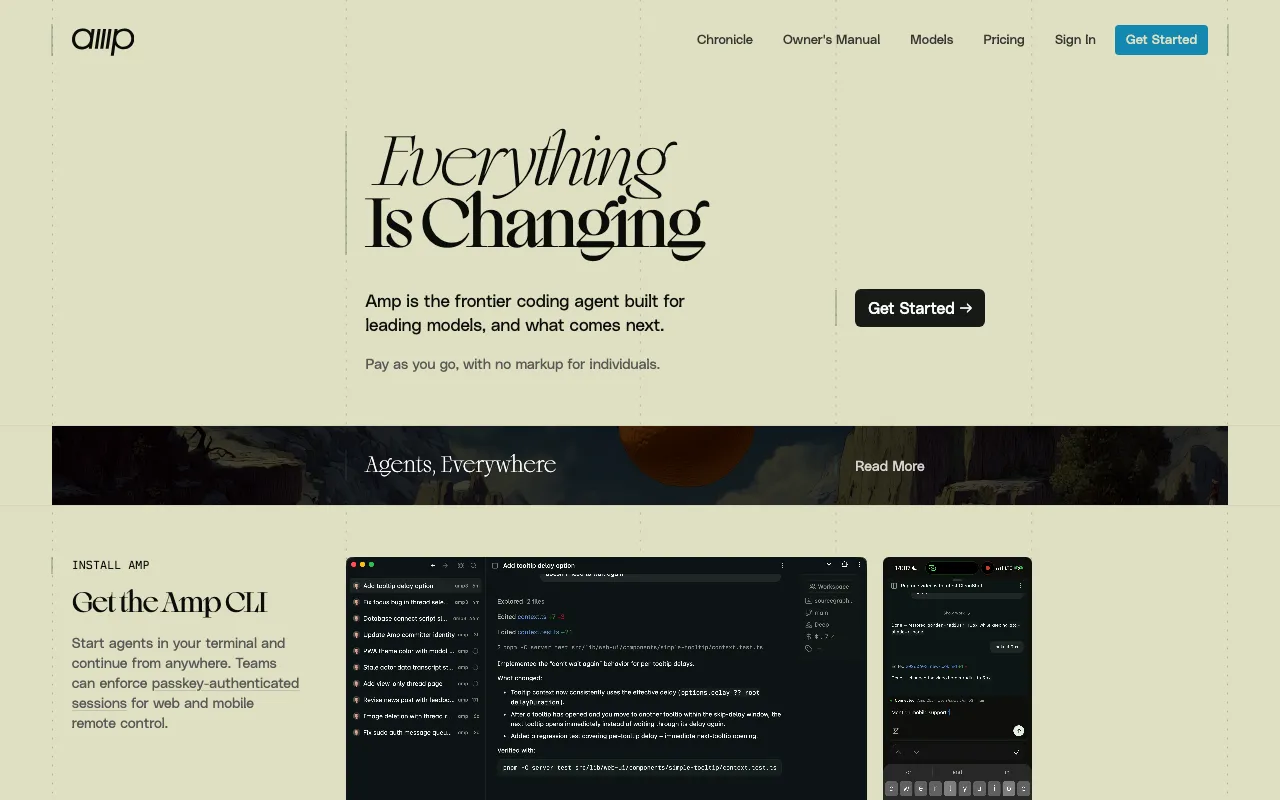
Amp is an agentic coding tool from Sourcegraph that runs autonomous agents on top of frontier models. You give it a task and it plans the work, edits across multiple files, runs commands, and checks its own output, operating from a terminal CLI, inside editors, or from the web. It offers different agent modes — Smart runs top-tier models such as Claude Opus 4.8, Deep uses extended reasoning, and Rush is tuned for fast, low-token work — and it can spawn parallel subagents to handle independent parts of a task at once. Two notable subagents are the Oracle, a high-reasoning second opinion for hard debugging and analysis, and the Librarian, which searches public and private GitHub repositories for context.
Amp’s billing is unusual: it is purely usage-based with no subscription. You buy credits from a $5 minimum, and for individuals and teams Amp passes through the raw model token cost at zero markup — a task that consumes $2.50 of provider API spend deducts $2.50 from your balance. Teams share a pooled credit balance with passkey enforcement and workspace plugin deployment, while Enterprise is a one-time $1,000 purchase that prices usage 50% higher in exchange for an analytics API and admin controls. A free daily allowance, Amp Free, exists but is currently capacity-gated and being trimmed, so it is not a reliable always-on path.
Who is it for?
Amp suits developers who want frontier-model agents driving real changes across a codebase and who prefer paying for exactly what they use over a flat subscription. Because it runs models like Claude as its engine, it is best understood as a powerful agentic harness rather than a model in its own right — and Claude remains the stronger pick for direct code generation and reasoning.
- Individual developers who want an autonomous coding agent and would rather pay raw usage than a fixed monthly fee.
- Teams needing pooled credits, shared threads, and policy controls around frontier-model agentic coding.
- Power users debugging hard problems who value the Oracle second opinion and parallel subagents.
- Multi-editor developers working across CLI, VS Code, JetBrains, Neovim, and Zed who want one agent everywhere.
How much does Amp cost?
Starting price: $0 · Free tier: yes · Model: usage-based
Price history tracked from June 2026
| Plan | Price | Includes |
|---|---|---|
| Amp Free | Free | Daily free usage allowance, ad-free since 2026 · Currently capacity-gated ('full') · Allowances reduced for less-active users · Not a dependable always-on free tier |
| Individual | Usage-based | $5 minimum credit purchase; no subscription · Zero markup — pay the raw model token cost · New signups have received starter credits · Credits expire after 1 year of inactivity |
| Team | Usage-based | Pooled workspace credits shared across members · Zero markup on usage · Passkey auth enforcement · Workspace plugin deployment and thread sharing |
| Enterprise | $1,000 one-time | One-time purchase grants $1,000 of usage · Usage priced 50% above individual and team · Workspace analytics API and admin controls · Enterprise governance and support |
What are Amp's key features?
- Autonomous multi-step coding agent across CLI, editors, and web
- Oracle — a high-reasoning second-opinion subagent for debugging and analysis
- Parallel subagents that work on independent parts of a task
- Librarian subagent that searches public and private GitHub repos
- Agent modes: Smart (frontier models), Deep (extended reasoning), and Rush (fast)
- MCP server support, plugins, skills, and custom code-review checks
- Zero-markup usage billing and pooled team credits with shared threads
What people use Amp for
- 01 Delegating a multi-file change to an autonomous agent that edits, runs commands, and checks its work
- 02 Getting a second opinion on a hard bug from the Oracle reasoning subagent
- 03 Running parallel subagents to tackle independent parts of a task at once
- 04 Searching remote GitHub repositories for context with the Librarian subagent
- 05 Continuing a CLI coding thread from the web or mobile while away from your machine
Pros and cons
| Pros | Cons |
|---|---|
| Zero-markup billing — you pay the raw model API cost, not a marked-up rate | Usage-based cost is unpredictable — heavy agent runs on frontier models burn credits fast with no fixed monthly cap |
| Runs across CLI, VS Code, JetBrains, Neovim, Zed, and the web | Amp Free is unreliable: currently capacity-gated and allowances are being reduced |
| No subscription required; buy credits from a $5 minimum and pay as you go | Enterprise usage is priced 50% higher than individual or team usage |
| Oracle and subagent architecture handles complex, multi-step debugging well | Subagents run in isolation without step-by-step user guidance mid-task |
What are the best Amp alternatives?
Aider is the closest Amp alternative in our directory: it covers the same category (AI Coding), starts at $0, has a free tier.
Ranked by category overlap with Amp, then free-tier availability, then lowest verified starting price — computed from our verified data, never from sponsorships.
| Alternative | What it is | Starting price | Free tier | Price verified |
|---|---|---|---|---|
| Aider | Open-source AI pair programming in your terminal — bring your own LLM key and edit your git repo | $0 | yes | Jun 22, 2026 |
| Cline | Open-source autonomous coding agent for VS Code that edits files, runs commands, and brings your own model | $0 | yes | Oct 23, 2026 |
| Claude | Anthropic's AI assistant built for long-context analysis, coding, and safe reasoning | $20/mo | yes | Jul 3, 2026 |
| Cursor | AI-native code editor that runs autonomous agents to build, test, and review code | $20/mo | yes | Jul 3, 2026 |
How people make money with Amp
- Freelance agentic development — use Amp's autonomous agents to ship features faster for clients, billing the saved time at your normal project or hourly rate while paying only raw model usage
Frequently asked questions
Is Amp free?
Amp has a free daily usage allowance called Amp Free, which went ad-free in 2026. However, it is currently capacity-gated and being reduced for less-active users, so it is not a dependable always-on free tier. Reliable use means buying credits, starting from a $5 minimum.
How does Amp's pricing work?
Amp is usage-based with no subscription. You buy credits from a $5 minimum, and for individuals and teams Amp passes through the raw model token cost at zero markup. For example, a task using $2 of one provider and $0.50 of another deducts $2.50 from your balance.
What is the Amp Oracle?
The Oracle is a high-reasoning subagent Amp can call for a second opinion on hard problems — complex debugging, architecture questions, or analysis. It complements the main coding agent, which plans and edits code, by bringing a more deliberate reasoning model to bear when needed.
Which editors does Amp support?
Amp runs as a terminal CLI and as extensions for VS Code (including Cursor and Windsurf), JetBrains IDEs from 2025.1, Neovim, and Zed. You can also use it from the web and continue CLI threads from the web or mobile.
Is Amp better than Claude for coding?
Amp is an agentic harness that runs frontier models — including Claude Opus 4.8 — as its engines, so it is not a replacement for Claude but a way to drive it autonomously across your codebase. Claude remains the stronger choice for direct code generation and reasoning.
How much does Amp Enterprise cost?
Amp Enterprise starts as a one-time $1,000 purchase that grants $1,000 of Enterprise usage, with usage priced 50% higher than individual or team rates. It adds admin controls and an analytics API, with larger arrangements available by contacting the Amp team.