Augment Code
Agentic coding platform with a context engine that indexes large codebases, plus expert agents for review, testing, and PR authoring
Augment Code is an agentic coding platform built around a context engine that indexes large, enterprise-scale codebases. In late 2026 it replaced message-based plans with credit-based pricing: there is no permanent free tier (trial only), Indie is $20/month for 40,000 credits, Standard is $60/month per developer for 130,000 credits per seat, and Max is $200/month for 450,000 credits. Best for engineers working in big, complex repositories who want model-agnostic agents.
What is Augment Code?
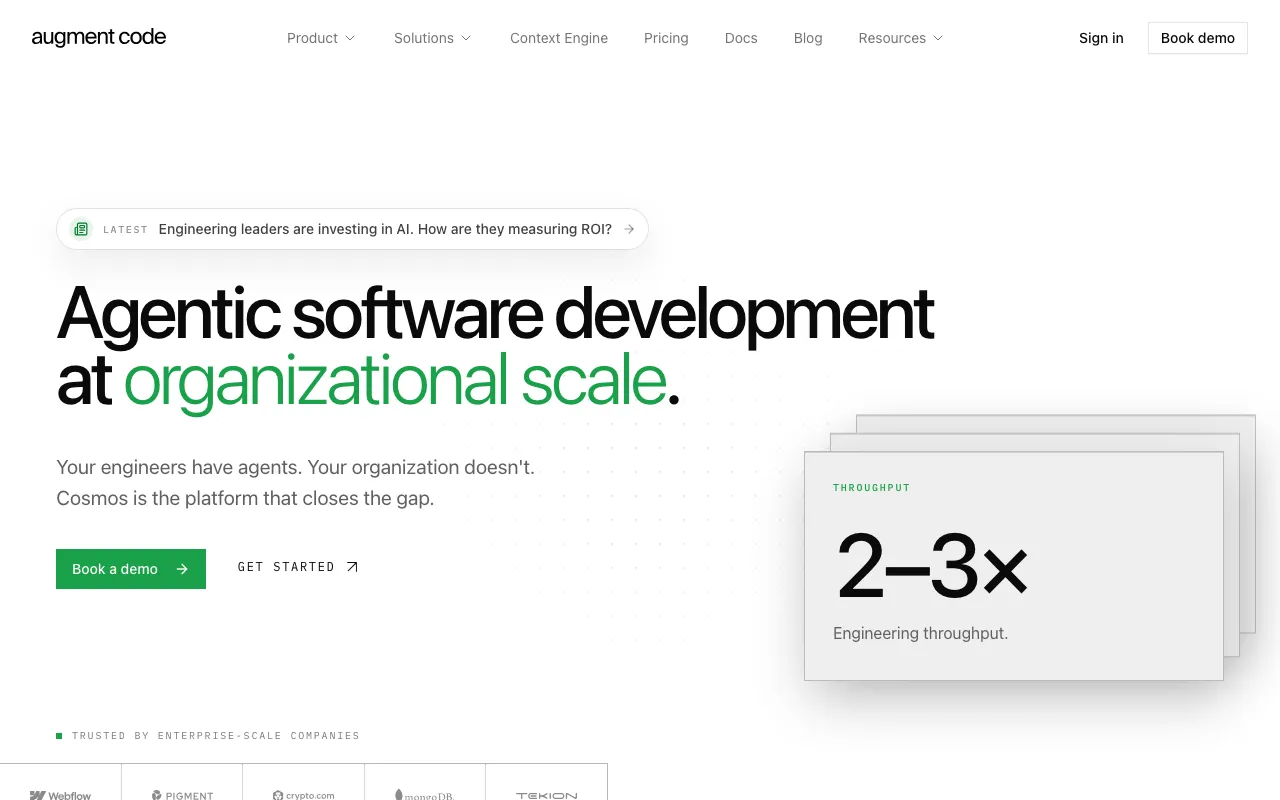
Augment Code is an agentic coding platform, branded Cosmos, built around a context engine that indexes large and enterprise-scale codebases so its agents can retrieve the right files and symbols before they edit. Instead of a single autocomplete model, it ships a set of prebuilt expert agents — PR Author, Code Review, Tester, and PR Risk Analysis — that operate across the development lifecycle inside IDEs, from a CLI, and through integrations with GitHub, Slack, Jira, and CI systems. It is model-agnostic: a router called Prism sends each task to a chosen frontier or open-weight model, and teams can bring their own keys.
In late 2026, Augment moved from message-based plans to credit-based pricing. There is no permanent free tier — only a trial with community support — and paid plans start at Indie for $20/month with 40,000 credits, then Standard at $60/month per developer for 130,000 credits per seat, and Max at $200/month per developer for 450,000 credits. Credits reset monthly without rollover, and heavy users top up at $15 per 24,000 credits. A flat $100/month Business plan pools usage across up to 50 seats with SOC 2 Type II, while Enterprise adds private deployments, SSO/SCIM, and an SLA.
Who is it for?
Augment Code targets engineers and teams whose main constraint is codebase scale: large monorepos and complex enterprise repositories where the hard part is finding the relevant context, not just generating tokens. The credit model and pooled-seat plans make it most economical for teams rather than occasional solo users.
- Engineers working in large or unfamiliar codebases who want retrieval-aware agents that pull the right context before editing.
- Engineering teams needing pooled credits, prebuilt review and test agents, and SOC 2 / ISO 42001 governance.
- Regulated or security-conscious organizations that require on-premises, VPC, or customer-cloud deployment with SSO, SCIM, and CMEK.
- Developers who want to avoid model lock-in and route tasks across frontier and open-weight models, including their own keys.
How much does Augment Code cost?
Starting price: $20/mo · Free tier: no · Model: usage-based
Price history tracked from June 2026
| Plan | Price | Includes |
|---|---|---|
| Trial | Free | Time-limited trial access, no permanent free tier · Community support only · No SLA |
| Indie | $20/mo | 40,000 credits per month for a single user · Auto top-up at $15 per 24,000 extra credits · Credits reset monthly with no rollover · Entry tier for solo developers |
| Standard | $60/dev/mo | 130,000 credits per seat · Up to 20 users with pooled team credits · No per-user caps on the shared pool · Context engine across large repositories |
| Max | $200/dev/mo | 450,000 credits per seat · Up to 20 users with pooled credits · Larger compute headroom for heavy agentic work |
| Business | $100/mo | $100 of pooled usage across models, context engine, and compute · Up to 50 seats with no per-seat charge · SOC 2 Type II, 50 concurrent sessions · CLI, MCP, and native tool support |
| Enterprise | Custom | Unlimited users and sessions · Multi-region compute and private deployments · SSO/OIDC/SCIM, CMEK, ISO 42001, SIEM · Dedicated support and SLA |
What are Augment Code's key features?
- Context engine that indexes large codebases for retrieval-aware edits
- Cosmos agent platform with prebuilt experts: PR Author, Code Review, Tester, and PR Risk Analysis
- Prism model routing that sends each turn to a chosen model
- Model-agnostic support for frontier and open-weight models, including bring-your-own-keys
- Reusable, self-learning shared team memory and experts
- CLI access plus MCP and native tool support
- Integrations with GitHub, Slack, Jira, and CI systems
- Deployment options spanning managed cloud, customer cloud, VPC, and on-premises
What people use Augment Code for
- 01 Working productively in a large, unfamiliar codebase by letting the context engine retrieve the right files before editing
- 02 Delegating routine pull-request authoring, code review, and test writing to prebuilt expert agents
- 03 Routing each task to a chosen frontier or open-weight model rather than being locked to one provider
- 04 Running agentic changes inside an existing IDE via the extension, or headless via the CLI
- 05 Standing up a shared, governed agent setup across a team with pooled credits and SOC 2 controls
Pros and cons
| Pros | Cons |
|---|---|
| Context engine is built for genuinely large, enterprise-scale repositories where flat-file context tools struggle | No permanent free tier — only a trial with community support and no SLA, so the lowest ongoing entry is $20/month |
| Model-agnostic routing avoids lock-in to a single LLM provider | Credits do not roll over; heavy use forces paid top-ups at $15 per 24,000 credits, so real cost can exceed the headline price |
| Pooled team credits and SOC 2 Type II / ISO 42001 controls suit regulated organizations | Standalone code completions were sunset, narrowing the product toward agentic workflows rather than lightweight autocomplete |
| Prebuilt expert agents cover review, testing, and PR authoring out of the box | Per-developer pricing on Standard and Max climbs quickly for larger teams |
What are the best Augment Code alternatives?
Cline is the closest Augment Code alternative in our directory: it covers the same category (AI Coding), starts at $0, has a free tier.
Ranked by category overlap with Augment Code, then free-tier availability, then lowest verified starting price — computed from our verified data, never from sponsorships.
| Alternative | What it is | Starting price | Free tier | Price verified |
|---|---|---|---|---|
| Cline | Open-source autonomous coding agent for VS Code that edits files, runs commands, and brings your own model | $0 | yes | Jun 20, 2026 |
| GitHub Copilot | AI coding assistant with inline completions, chat, and autonomous agent mode across major IDEs | $10/mo | yes | Jul 3, 2026 |
| Windsurf | Agentic AI IDE with Cascade that writes, edits and runs code autonomously inside your editor | $15/mo | yes | Jun 11, 2026 |
| Claude | Anthropic's AI assistant built for long-context analysis, coding, and safe reasoning | $20/mo | yes | Jul 3, 2026 |
| Cursor | AI-native code editor that runs autonomous agents to build, test, and review code | $20/mo | yes | Jul 3, 2026 |
How people make money with Augment Code
- Freelance large-codebase feature work — Augment's context engine and prebuilt expert agents help you ship across an unfamiliar enterprise repo faster, letting you bill the saved time at your normal project or hourly rate
- Offer Augment setup and agent-workflow onboarding for engineering teams as a consulting service; the per-seat Standard plan gives a natural upsell for small dev shops
Frequently asked questions
Is Augment Code free?
No. Augment Code offers a time-limited trial but no permanent free tier. The lowest ongoing plan is Indie at $20/month, which includes 40,000 credits for a single user. The trial comes with community support only and no SLA.
How does Augment Code pricing work?
Pricing is credit-based as of late 2026, replacing the older message-based model. Indie is $20/month for 40,000 credits, Standard is $60/month per developer for 130,000 credits per seat, and Max is $200/month per developer for 450,000 credits. Credits reset monthly with no rollover, and you can auto top-up at $15 per 24,000 extra credits.
What is the Augment context engine?
It is a retrieval system that indexes large codebases so the agent can pull the most relevant files and symbols into context before making edits. It is the main reason Augment targets enterprise-scale repositories where simpler context windows fall short.
Which models does Augment Code support?
Augment is model-agnostic. Its Prism router sends each task to a chosen frontier or open-weight model, and you can bring your own keys. This avoids locking your workflow to a single provider.
Is Augment Code better than Claude for coding?
Augment is an agentic harness that runs frontier models — including Claude — as its engines, so it is not a replacement for Claude but a way to drive it across a large codebase with retrieval and prebuilt experts. For direct code generation and reasoning, Claude remains the stronger choice.
Can Augment Code be deployed on-premises?
Yes. Alongside managed cloud, Augment offers customer-cloud, VPC, and on-premises deployment, and the Enterprise tier adds SSO/OIDC/SCIM, CMEK, ISO 42001, and SIEM integration for regulated organizations.