Daytona
Pay-as-you-go cloud sandboxes where AI agents run generated code in isolated Linux, Windows, and GPU environments
Daytona is sandbox infrastructure for AI agents: an SDK call creates an isolated Linux container in under 90ms, with VM, Windows, and GPU sandboxes available for heavier work. There is no subscription. Usage bills per second at $0.0504 per vCPU-hour and $0.0162 per GiB-hour of memory, new accounts get $200 in free compute, and GPU sandboxes run from $2.27/hour for a preemptible H100. Best for teams that want agent sandboxes without a monthly base fee and are comfortable with limits that unlock only through prepaid top-ups.
What is Daytona?
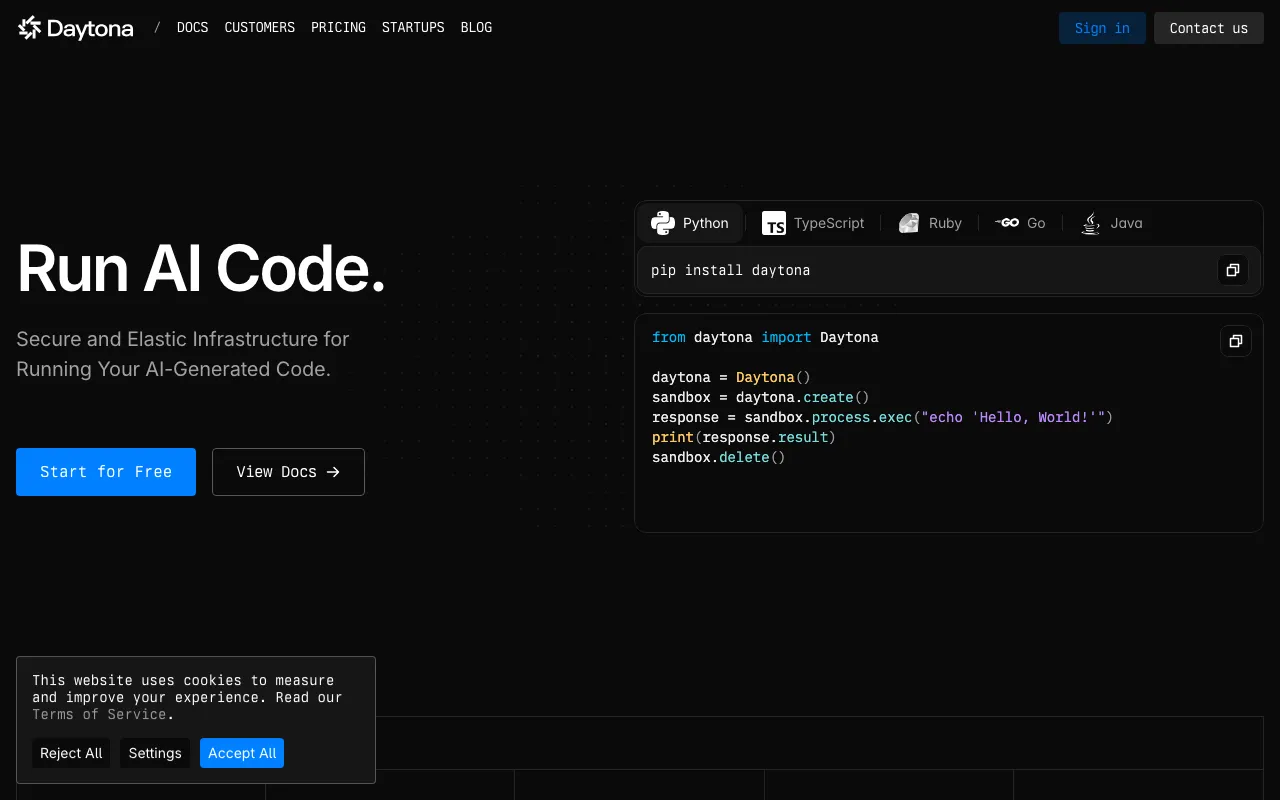
Daytona is a cloud platform that gives AI agents somewhere safe to run code. An agent asks for a sandbox through the Python, TypeScript, Ruby, or Go SDK, and gets an isolated environment with its own filesystem, network stack, and allocated CPU, memory, and disk in under 90ms. Inside it the agent can run processes, use git, open a pseudo-terminal, and query a language server, so a coding agent can edit a repository, run its tests, and retry on failure without that code ever touching your own servers. Sandboxes are Linux containers by default. Daytona also offers Linux VM and Windows sandboxes for computer-use agents, and GPU sandboxes with up to 8 NVIDIA or AMD GPUs for model serving and fine-tuning.
Pricing has no subscription layer. Everything bills per second: $0.0504 per vCPU-hour, $0.0162 per GiB-hour of memory, and storage past the first 5 GiB free. New accounts get $200 in compute. Those CPU and memory rates match E2B, but E2B adds a $150 monthly base fee on its Pro plan and Daytona does not. Instead, Daytona controls capacity through verification tiers: an email address unlocks 10 vCPUs, and larger pools need prepaid top-ups of $25, $500, or $2,000 every 30 days. Daytona’s original codebase was published under AGPL-3.0, but that repository was archived in July 2026 when core development moved to a private codebase, so today it is a hosted service.
Who is it for?
Daytona fits engineering teams whose product runs code a model wrote: code interpreters, coding agents, computer-use agents, and evaluation pipelines. Because there is no base fee, the cost tracks real usage, which suits workloads that are spiky or still small. The trade-off is the tier system. Teams that need hundreds of vCPUs at once must keep a prepaid balance topped up, and anyone who needs a self-hosted deployment has to negotiate Enterprise BYOC rather than run the archived open-source code.
- Teams building coding agents that need a persistent workspace with git, a shell, and a language server, with the reasoning supplied by a model like Claude.
- Product teams adding a code-interpreter feature who want generated code to run in a throwaway sandbox instead of on their application servers.
- Computer-use and desktop-automation builders who need Windows or Linux VM sandboxes they can watch over VNC.
- ML engineers who want short-lived GPU sandboxes for model serving or fine-tuning on the same API as their CPU workloads instead of renting separate pods on RunPod.
- Eval and RL teams running many parallel isolated environments, where per-second billing beats keeping a fleet warm.
How much does Daytona cost?
Starting price: $0.0504/vCPU-hr · Free tier: yes · Model: usage-based
Price history tracked from June 2026
| Plan | Price | Includes |
|---|---|---|
| Pay as you go | $0.0504/vCPU-hr | $200 in free compute for new accounts, no credit card required · Memory $0.0162 per GiB-hour · Storage $0.000108 per GiB-hour after the first 5 GiB free · Windows sandboxes $0.0858 per vCPU-hour · All usage billed per second, with no monthly base fee |
| GPU sandboxes | From $0.57/hr | Preemptible: RTX 4090 $0.57/hr, H100 $2.27/hr, H200 $2.61/hr, B300 $4.08/hr · On-demand: RTX 4090 $0.99/hr, H100 $3.95/hr, H200 $4.54/hr, B200 and B300 $6.25/hr · AMD MI355X $3.44/hr preemptible, $5.99/hr on-demand · Up to 8 GPUs per sandbox; free credits cannot be spent on GPUs |
| Startups | Credits | Up to $50k in free credits for qualifying startups · Same pay-as-you-go rates once credits run out |
| Enterprise | Custom | Larger resource and rate limits · SSO and audit logs · Bring your own cloud (BYOC) · Volume discounts |
What are Daytona's key features?
- Sandbox creation in under 90ms from code to execution
- Container sandboxes by default, plus Linux VM, Windows, and NVIDIA or AMD GPU sandboxes
- SDKs for Python, TypeScript, Ruby, and Go, plus a REST API, CLI, and MCP server
- Filesystem, git, process execution, pseudo-terminal, and Language Server Protocol APIs inside each sandbox
- Snapshots, volumes, and archiving to persist agent state between sessions
- Auto-stop after 15 idle minutes by default, with configurable auto-pause and auto-delete
- SSH, VNC, web terminal, and preview URLs for watching or debugging a running sandbox
- Network firewall rules and US or EU region targeting
What people use Daytona for
- 01 Running LLM-generated Python, TypeScript, or JavaScript without exposing your own servers to untrusted code
- 02 Giving a coding agent a persistent workspace with git, a shell, and a language server so it can edit, test, and retry
- 03 Running Windows or desktop sandboxes for computer-use agents that drive a GUI over VNC
- 04 Serving or fine-tuning open models on short-lived GPU sandboxes billed by the second
- 05 Fanning out large numbers of parallel isolated environments for agent evaluations and RL rollouts
Pros and cons
| Pros | Cons |
|---|---|
| No subscription: the per-second rates are the whole bill, so a low-volume or spiky workload costs only what it uses | Capacity is gated by prepaid top-ups: the free tier caps an organization at 10 vCPUs, 10GiB RAM, and 30GiB disk, and the largest self-serve pool needs a $2,000 top-up every 30 days |
| $200 in free compute with no credit card is enough to build and validate a real prototype | A single sandbox is capped at 4 vCPUs, 8GB RAM, and 10GB disk unless you move to a GPU sandbox or negotiate Enterprise limits |
| GPU and Windows sandboxes sit on the same API as CPU containers, so one integration covers code execution, computer use, and model serving | The open-source repository was archived in July 2026 after core development moved to a private codebase, so there is no maintained self-host path |
| Container sandboxes can be archived to object storage, which stops all billing while keeping the filesystem | Free credits do not apply to GPU sandboxes, and GPU sandboxes are ephemeral, deleted as soon as they stop |
| Official SDKs in four languages (Python, TypeScript, Ruby, Go), against two at E2B | Stopped container sandboxes still bill for reserved disk until you archive or delete them |
What are the best Daytona alternatives?
Modal is the closest Daytona alternative in our directory: it covers the same category (AI Agents & Automation), starts at Free + usage, has a free tier.
Ranked by category overlap with Daytona, then free-tier availability, then lowest verified starting price — computed from our verified data, never from sponsorships.
| Alternative | What it is | Starting price | Free tier | Price verified |
|---|---|---|---|---|
| Modal | Python-first serverless platform for running, deploying, and fine-tuning AI models on GPUs, billed per second with scale-to-zero and no idle charges | Free + usage | yes | Oct 19, 2026 |
| OpenHands | Open-source autonomous AI software-engineering agent that writes code, runs commands, and fixes issues | $0 | yes | Jun 24, 2026 |
| E2B | Open-source cloud sandboxes that let AI agents run untrusted code in isolated Firecracker microVMs | $150/mo | yes | Oct 18, 2026 |
| Steel | Open-source cloud browser API for AI agents: start real browser sessions in under a second, with profiles, proxies and CAPTCHA solving | $250/mo | yes | Oct 12, 2026 |
| RunPod | GPU cloud for renting Nvidia GPUs by the second — Pods for persistent workloads, Serverless for autoscaling inference | $0.27/hr | no | Jul 11, 2026 |
How people make money with Daytona
- Build a hosted code-interpreter or AI data-analyst feature for a SaaS product, running each customer's generated code in its own sandbox and passing the per-second compute cost through in a usage-priced plan
- Sell evaluation and benchmarking runs for coding-agent teams: spin up hundreds of parallel sandboxes per test suite, bill per run, and keep the margin between the per-second compute cost and a flat per-benchmark fee
Frequently asked questions
Is Daytona free?
New accounts get $200 in free compute with no credit card required, and there is no subscription fee. After the credit runs out you pay per-second usage rates. The free tier is limited to 10 vCPUs, 10GiB of RAM, and 30GiB of disk across all sandboxes, and the free credit cannot be spent on GPU sandboxes.
How much does Daytona cost?
Daytona is pay-as-you-go, billed per second. CPU costs $0.0504 per vCPU-hour, memory $0.0162 per GiB-hour, and storage $0.000108 per GiB-hour after the first 5 GiB. Windows sandboxes cost $0.0858 per vCPU-hour. GPU sandboxes run from $0.57 per hour for a preemptible RTX 4090 to $6.25 per hour for an on-demand B300.
How is Daytona priced compared with E2B?
The per-second CPU and memory rates are the same: $0.0504 per vCPU-hour and $0.0162 per GiB-hour. The difference is the base fee. E2B charges $150 per month for its Pro plan before any usage, while Daytona has no subscription and unlocks higher limits through prepaid credit top-ups instead.
Is Daytona open source?
Not anymore. The original repository was AGPL-3.0 and remains public, but it was archived in July 2026 after Daytona moved core development to a private codebase. The old code can still be forked under its license, but it receives no updates, fixes, or releases. The SDKs and hosted platform are maintained.
What are Daytona's usage limits?
Limits depend on a verification tier. Tier 1 needs only a verified email and allows 10 vCPUs, 10GiB RAM, and 30GiB disk. Tier 2 needs a linked card and a $25 top-up for 100 vCPUs. Tier 3 needs a $500 top-up, and Tier 4 needs a $2,000 top-up every 30 days for 500 vCPUs.
Does Daytona support GPUs?
Yes. GPU sandboxes offer NVIDIA RTX 4090, RTX 5090, RTX PRO 6000, H100, H200, B200, and B300, plus AMD MI355X, with up to 8 GPUs per sandbox. Each type has a cheaper preemptible rate and an on-demand rate. GPU sandboxes are ephemeral and are deleted when they stop.
How long can a Daytona sandbox run?
There is no fixed session cap. By default a sandbox stops after 15 minutes of inactivity, but you can raise that interval or set it to zero so the sandbox runs indefinitely. Stopped containers keep billing for disk until archived, and archiving moves the filesystem to object storage with no charge.
Is Daytona a coding assistant?
No. Daytona is infrastructure that gives an agent a safe place to run code. The reasoning comes from a model such as Claude, Codex, or Gemini, and Daytona publishes guides for running Claude Code, OpenCode, and other coding agents inside its sandboxes.