OpenHands
Open-source autonomous AI software-engineering agent that writes code, runs commands, and fixes issues
OpenHands (formerly OpenDevin) is an open-source autonomous coding agent that edits code, runs shell commands, browses the web, and opens pull requests. The MIT-licensed core is free to self-host; OpenHands Cloud adds a hosted version with $20 in free credits, then at-cost LLM usage with no markup. With ~78k GitHub stars and around 53% on SWE-bench Verified, it is a leading open alternative for delegating real engineering tasks.
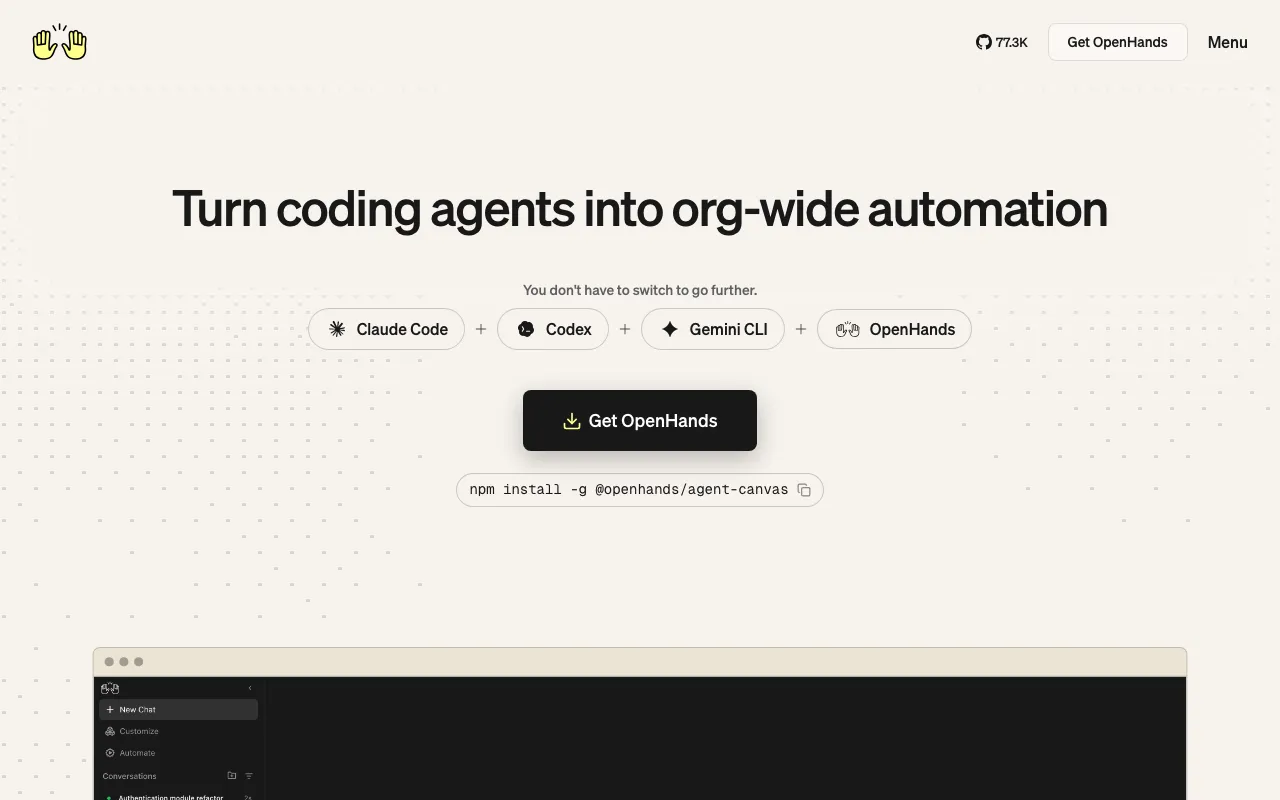
What is OpenHands?
OpenHands, formerly OpenDevin, is an open-source autonomous AI agent for software engineering. Rather than suggesting snippets, it acts: it edits files, runs shell commands, browses the web, executes tests, and opens pull requests, working toward a goal you describe much like a junior engineer would. It is model-agnostic — you connect Claude, Gemini, GPT, or another provider — and it ships with a web GUI, a terminal UI, and a CLI. Developed by All Hands AI, the project has gathered roughly 78,000 GitHub stars and scores around 53% on SWE-bench Verified, a benchmark of resolving real GitHub issues.
There are two ways to run it. The MIT-licensed core is free to self-host, giving full control over data and model choice at the cost of your own infrastructure and LLM usage. OpenHands Cloud is the managed layer: new users get $20 in free credits, after which you pay only at-cost LLM usage with no platform markup on the free Individual tier, which caps at about 10 conversations per day for a single user. Cloud sandboxes keep agents running while your machine is offline, and Jira, Slack, and MCP integrations connect it to existing workflows. Team and enterprise needs move to custom pricing with SSO, audit logs, and private deployment.
Who is it for?
OpenHands fits developers and teams who want an autonomous coding agent they can control, inspect, and run on their own terms — and who are comfortable supplying their own model and, for self-hosting, some setup. It is especially attractive where open-source licensing and no vendor lock-in matter.
- Developers who want to delegate real tasks — fixing issues, writing PRs, running tests — to an agent they can self-host.
- Open-source maintainers and small teams automating backlog triage and routine bug fixes.
- Engineering orgs with data-control requirements that prefer private deployment over a closed cloud product.
- Cost-conscious builders who want bring-your-own-model flexibility and at-cost usage rather than bundled per-seat fees.
How much does OpenHands cost?
Starting price: $0 · Free tier: yes · Model: open-source
Price history tracked from June 2026
| Plan | Price | Includes |
|---|---|---|
| Open Source (self-host) | Free | MIT-licensed core, free to self-host · Web GUI, terminal UI, and CLI · Model-agnostic (Claude, Gemini, GPT, others) · Git integrations |
| Individual (Cloud) | Free | Hosted cloud with $20 free starting credits · Bring-your-own-key or at-cost providers, no markup · Jira and Slack integrations · Caps at ~10 conversations/day, 1 user |
| Enterprise | Custom | Private VPC or self-hosted deployment · SAML/SSO and audit logs · Unlimited concurrent conversations · Named support engineer — contact sales |
What are OpenHands's key features?
- Autonomous agent that edits code, runs shell commands, and browses the web
- Opens and reviews pull requests with quality and security checks
- Cloud sandboxes keep agents running when your local machine is offline
- Jira and Slack integrations plus MCP support
- Vulnerability scanning with reviewable fixes
- Model-agnostic — bring your own key or use at-cost provider credits
What people use OpenHands for
- 01 Resolving real GitHub issues and bug tickets end-to-end
- 02 Automating code review and pull-request creation
- 03 Migrating and modernizing legacy codebases with built-in testing
- 04 Triaging incidents and debugging production errors
Pros and cons
| Pros | Cons |
|---|---|
| Fully open-source (MIT core) and self-hostable at no platform cost | Cloud LLM usage is pay-as-you-go on top of free credits — real model costs apply |
| Strong SWE-bench results and broad model choice with no vendor lock-in | The free Individual cloud tier caps at ~10 conversations/day and 1 user |
| Free cloud starting credits plus at-cost LLM usage with no markup | Self-hosting requires setup; team features jump to custom Enterprise pricing |
What are the best OpenHands alternatives?
Devin is the closest OpenHands alternative in our directory: it covers the same category (AI Coding), starts at $20/mo + $2.25/ACU, has no free tier.
Ranked by category overlap with OpenHands, then free-tier availability, then lowest verified starting price — computed from our verified data, never from sponsorships.
| Alternative | What it is | Starting price | Free tier | Price verified |
|---|---|---|---|---|
| Devin | Autonomous AI software engineer from Cognition that takes whole engineering tasks from ticket to pull request | $20/mo + $2.25/ACU | no | Jun 20, 2026 |
| Factory AI | Agentic software-development platform whose Droids autonomously triage, code, validate, and ship software across the SDLC from the desktop, CLI, or cloud | $20/mo | no | Oct 12, 2026 |
| Aider vs OpenHands → | Open-source AI pair programming in your terminal — bring your own LLM key and edit your git repo | $0 | yes | Jun 22, 2026 |
| Cline | Open-source autonomous coding agent for VS Code that edits files, runs commands, and brings your own model | $0 | yes | Oct 23, 2026 |
Head-to-head comparisons
How people make money with OpenHands
- Offer a bug-fix and issue-resolution service for open-source maintainers and small SaaS teams, self-hosting OpenHands to triage and resolve backlog tickets and billing per resolved issue or per sprint
- Run legacy-code modernization projects for agencies — use OpenHands to migrate and refactor older codebases with built-in testing, charging a fixed project fee while paying only at-cost LLM usage
Frequently asked questions
Is OpenHands free?
Yes. The OpenHands core is open-source under the MIT license and free to self-host. OpenHands Cloud is the hosted option, giving new users $20 in free credits and then charging at-cost LLM usage with no platform markup on the free Individual tier.
What was OpenHands called before?
OpenHands was previously named OpenDevin. It was renamed but remains the same open-source project, developed by All Hands AI, focused on an autonomous agent that can carry out real software-engineering tasks rather than just suggesting code.
How good is OpenHands at coding tasks?
OpenHands scores around 53% on SWE-bench Verified using CodeAct with Claude 3.5 Sonnet, with higher pass@3 results on newer models. SWE-bench measures resolving real GitHub issues, so this reflects genuine task completion rather than snippet quality.
Can I self-host OpenHands?
Yes. The MIT-licensed core is designed to be self-hosted, giving you full control over data and model choice. Self-hosting is free aside from your own infrastructure and the LLM costs of whatever provider and model you connect.
Which AI models does OpenHands support?
OpenHands is model-agnostic and works with providers such as Anthropic Claude, Google Gemini, and OpenAI GPT, among others. You bring your own API key or use at-cost provider credits in the cloud, so you can pick the model that fits your budget and task.
What is the difference between OpenHands and Devin?
Both are autonomous coding agents, but OpenHands is open-source and self-hostable with bring-your-own-model flexibility, while Devin is a closed commercial product. OpenHands appeals to teams wanting control and no lock-in; Devin offers a fully managed experience.