E2B
Open-source cloud sandboxes that let AI agents run untrusted code in isolated Firecracker microVMs
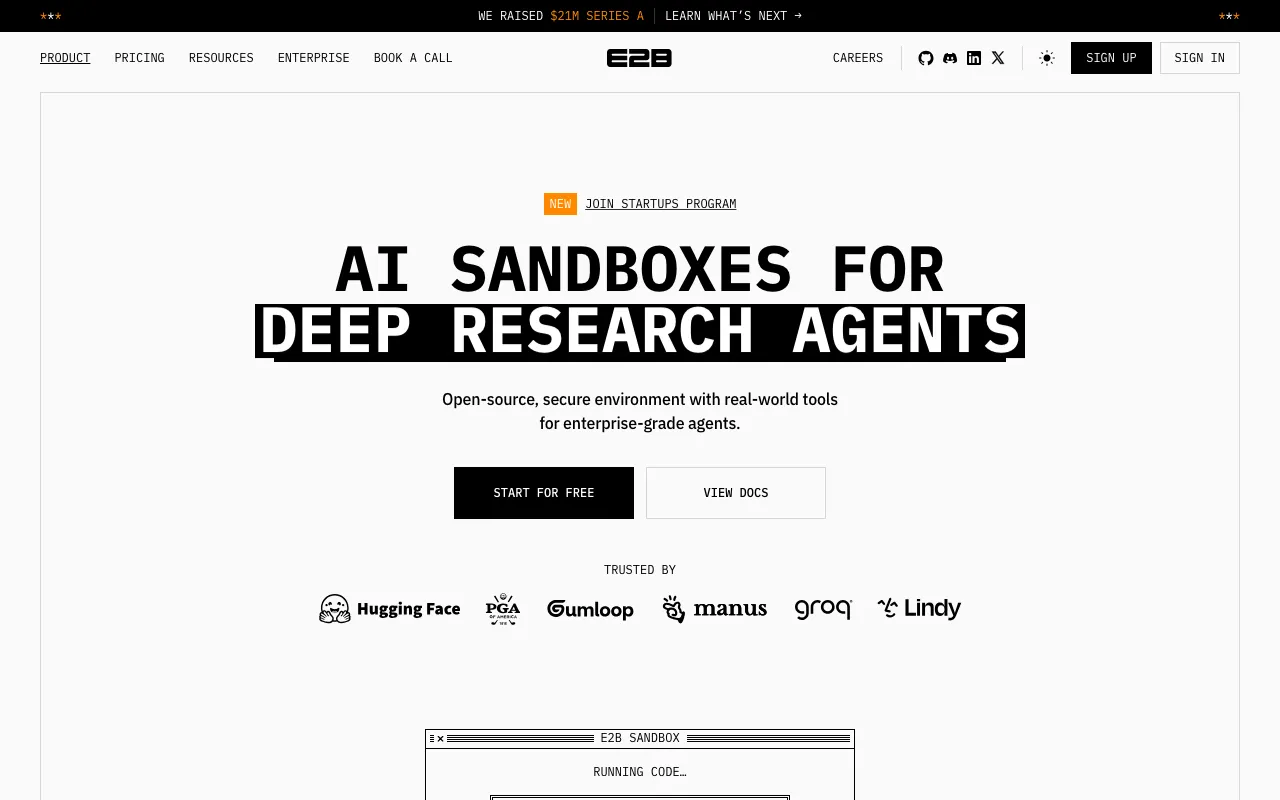
E2B is a code-execution runtime that gives AI agents a real Linux box — terminal, filesystem, internet, package installs — inside a Firecracker microVM that boots in under 200ms. The Hobby tier is free with a one-time $100 credit, 1-hour sessions, and 20 concurrent sandboxes; Pro costs $150/month for 24-hour sessions and 100 concurrent sandboxes. Compute bills per second on top: $0.000014/vCPU/second (about $0.0504 per vCPU-hour). The SDK and infrastructure are Apache-2.0 and self-hostable. Best for teams shipping agents that execute LLM-generated code and cannot run it on their own servers.
What is E2B?
E2B is a cloud runtime that gives an AI agent somewhere safe to run code. When a language model writes a Python script, something has to execute it, and executing model-written code on your own servers is a security problem you do not want. E2B’s answer is a sandbox built on Firecracker microVMs — the same isolation technology AWS Lambda uses — that boots in under 200ms and hands the agent a full Linux environment: a terminal, a filesystem, internet access, and the ability to install whatever packages it needs. The isolation is at the virtualization layer rather than a shared kernel, which is the distinction that matters when the code arrived from a model rather than a reviewer.
The product is model-agnostic infrastructure, not an assistant. You drive it from a Python or Node.js SDK, and it plugs in behind Anthropic, OpenAI, Mistral, Llama, LangChain, or LlamaIndex without caring which one you picked. Sandboxes run up to 1 hour on the free tier and 24 hours on Pro, can be paused and resumed from a filesystem snapshot, and can be pre-baked as custom templates so agents start with your dependencies already installed. Compute bills per second — $0.000014 per vCPU-second, roughly $0.0504 per vCPU-hour — so idle agents cost nothing. The SDK and the infrastructure are both Apache-2.0, and E2B publishes Terraform scripts for teams that want to run the whole stack in their own cloud account. That self-host path is genuine, but it is an infrastructure project: you end up operating a Nomad and Consul scheduling cluster, not flipping a billing toggle.
Who is it for?
E2B is for engineering teams building products where a model writes code that then has to actually run — code interpreters, data analysts, autonomous coding agents, computer-use agents. The free Hobby tier and its one-time $100 credit comfortably cover prototyping, but the 1-hour session cap means anything long-running jumps straight to the $150/month Pro plan. That base fee is the real decision point: per-second compute is cheap, so E2B makes sense when sandbox usage is steady rather than occasional, and looks expensive when it is spiky.
- Teams shipping code-interpreter or AI data-analyst features who need to execute generated pandas against customer files without that code touching their own infrastructure.
- Builders of autonomous coding agents that need a real shell to install packages, run tests, and iterate on failures — where the agent’s reasoning comes from a model like Claude and E2B supplies the box it works in.
- AI infrastructure engineers evaluating whether to buy sandboxing or build it, who want an Apache-2.0 exit ramp rather than a permanent dependency.
- Enterprises with data-residency constraints that need BYOC, on-premises, or fully self-hosted deployment and are willing to negotiate custom pricing for it.
- RL and eval teams spinning up large numbers of parallel isolated environments, where per-second billing beats keeping a fleet warm.
How much does E2B cost?
Starting price: $150/mo · Free tier: yes · Model: freemium
Price history tracked from June 2026
| Plan | Price | Includes |
|---|---|---|
| Hobby | Free | One-time $100 usage credit, no credit card required · Sandbox sessions up to 1 hour · Up to 20 concurrent sandboxes · 10 GiB free storage · Community support only |
| Pro | $150/mo | Sandbox sessions up to 24 hours · Up to 100 concurrent sandboxes, purchasable up to 1,100 · Customizable sandbox CPU and RAM · 20 GiB free storage · Per-second compute billed on top of the base fee |
| Enterprise | Custom | BYOC (bring your own cloud), on-premises, or self-hosted deployment · Custom session length and concurrency limits · Dedicated support and account management |
| Self-hosted (open source) | Free | Apache-2.0 SDK and infrastructure · Terraform deploy to your own cloud account (GCP; AWS in progress) · You pay your own cloud bill and operate the cluster |
What are E2B's key features?
- Firecracker microVM isolation — hardware-level separation, not shared-kernel containers
- Sub-200ms sandbox start with no cold start for same-region clients
- Python and Node.js/TypeScript SDKs, plus a CLI for building custom sandbox templates
- Full Linux environment: terminal, file I/O, internet access, and arbitrary package installation
- Sessions up to 24 hours on Pro, with pause and resume via filesystem snapshots
- Custom templates so agents boot with your dependencies preinstalled
- Per-second billing — you pay only while the sandbox is actually running
- Apache-2.0 licensed SDK and infrastructure with Terraform-based self-hosting
- Model-agnostic: works with Anthropic, OpenAI, Mistral, Llama, LangChain, and LlamaIndex
What people use E2B for
- 01 Running LLM-generated Python or JavaScript from a chat product without exposing your own infrastructure to untrusted code
- 02 Powering a code-interpreter feature — upload a CSV, let the model write and execute pandas, return the chart
- 03 Giving a coding agent a real shell to install packages, run the test suite, and iterate on failures
- 04 Long-running deep-research or computer-use agents that need up to 24 hours of persistent session state
- 05 Generating reinforcement-learning rollouts where thousands of isolated environments run in parallel
Pros and cons
| Pros | Cons |
|---|---|
| Free Hobby tier includes a one-time $100 credit and needs no credit card — enough to build and validate a real prototype | The $150/month Pro base fee is a hard floor that lands before any usage, which punishes low-volume or spiky workloads — per-second compute is cheap, the subscription is not |
| Firecracker isolation is a genuine security boundary, which matters when the code you run was written by a model | No GPU offering on any tier, so agents that need inference or CUDA workloads inside the sandbox have to look elsewhere |
| Apache-2.0 licensing and a documented self-host path mean the exit ramp is real, not theoretical | Hobby caps sessions at 1 hour, so any agent that needs to run longer forces the jump straight to $150/month |
| Per-second billing at $0.0504 per vCPU-hour means idle agents cost nothing | Paused sandboxes keep their snapshots until you explicitly delete them, and that storage accrues quietly past the 10–20 GiB free allowance |
| Model-agnostic runtime — swapping the LLM behind your agent does not touch the execution layer | Self-hosting is a full infrastructure project — a Nomad and Consul scheduling cluster you operate — not a configuration toggle, and Terraform support currently targets GCP with AWS still in progress |
| SDKs cover Python and JavaScript only; other languages have to drive the sandbox over HTTP |
What are the best E2B alternatives?
Modal is the closest E2B alternative in our directory: it covers the same category (AI Agents & Automation), starts at Free + usage, has a free tier.
Ranked by category overlap with E2B, then free-tier availability, then lowest verified starting price — computed from our verified data, never from sponsorships.
| Alternative | What it is | Starting price | Free tier | Price verified |
|---|---|---|---|---|
| Modal | Python-first serverless platform for running, deploying, and fine-tuning AI models on GPUs, billed per second with scale-to-zero and no idle charges | Free + usage | yes | Oct 19, 2026 |
| OpenHands | Open-source autonomous AI software-engineering agent that writes code, runs commands, and fixes issues | $0 | yes | Jun 24, 2026 |
| Browserbase | Cloud browser infrastructure for AI agents — run and scale headless browser sessions via API; maker of the open-source Stagehand framework | $20/mo | yes | Oct 11, 2026 |
| Replit | Browser-based platform where the Replit Agent turns plain-English prompts into deployed full-stack web and mobile apps, with built-in database and hosting | $25/mo | yes | Jun 18, 2026 |
| RunPod | GPU cloud for renting Nvidia GPUs by the second — Pods for persistent workloads, Serverless for autoscaling inference | $0.27/hr | no | Jul 11, 2026 |
How people make money with E2B
- Build and sell a vertical AI data-analyst product — E2B runs the generated Python against customer CSVs so you never execute untrusted code on your own servers; the free Hobby credit covers the entire prototype phase before the Pro base fee starts
- Offer agent-infrastructure consulting: migrating teams off homegrown Docker execution onto sandboxed runtimes, with the Enterprise BYOC and self-host tiers as the natural upsell for regulated clients
Frequently asked questions
Is E2B free?
There is a free Hobby tier with a one-time $100 usage credit and no credit card required. It allows sandbox sessions up to 1 hour, 20 concurrent sandboxes, and 10 GiB of storage. Once the credit is exhausted you pay per-second compute rates, and moving past the 1-hour session cap requires the $150/month Pro plan.
How much does E2B cost?
Pro is $150/month as a base fee, plus per-second compute. The published rates are $0.000014 per vCPU-second (about $0.0504 per vCPU-hour) and $0.0000045 per GiB-second of RAM (about $0.0162 per GiB-hour). The default sandbox runs 2 vCPUs. Enterprise pricing is custom.
Is E2B open source?
Yes. The SDK and the underlying infrastructure are Apache-2.0 licensed, and E2B publishes Terraform scripts to deploy the stack into your own cloud account. In practice self-hosting means running a Nomad and Consul cluster yourself, and Terraform support currently targets GCP with AWS in progress.
How is E2B different from just running Docker?
E2B sandboxes are Firecracker microVMs rather than containers, so isolation is at the virtualization layer instead of a shared kernel — the relevant difference when the code came from a language model. E2B also handles orchestration, snapshotting, and sub-200ms starts, which is the part most teams underestimate when they build execution in-house.
How long can an E2B sandbox run?
Up to 1 hour on the free Hobby tier and up to 24 hours on Pro. Enterprise limits are custom. Sandboxes can also be paused and resumed from a filesystem snapshot, though those snapshots keep consuming storage until deleted.
Does E2B support GPUs?
No. There is no GPU offering on any E2B tier as of July 2026. Workloads needing GPU compute inside the sandbox need a different runtime.
What languages and models does E2B work with?
The SDKs are Python and Node.js/TypeScript, and the sandbox itself is a full Linux environment that can run Python, JavaScript, Ruby, C++, or anything else you install. It is model-agnostic and integrates with Anthropic, OpenAI, Mistral, Llama, LangChain, and LlamaIndex.
Is E2B a coding assistant?
No. E2B is infrastructure, not an assistant — it gives an agent somewhere safe to execute code. If you want an AI that actually writes the code, use Claude for agentic coding work and E2B as the runtime underneath it.