Devin
Autonomous AI software engineer from Cognition that takes whole engineering tasks from ticket to pull request
Devin is Cognition's autonomous AI software engineer that takes a ticket and works end-to-end — planning, writing code, running tests, and opening a pull request — with minimal supervision. Pricing moved to a usage model: the Core plan is $20/month base plus $2.25 per ACU (one ACU is ~15 minutes of work, so roughly $9/hour); the Team plan is $500/month with 250 ACUs at $2.00 each. Best for delegating bounded, well-scoped engineering chores, but supervised agents like Claude Code often outperform it on reliability for nuanced work.
What is Devin?
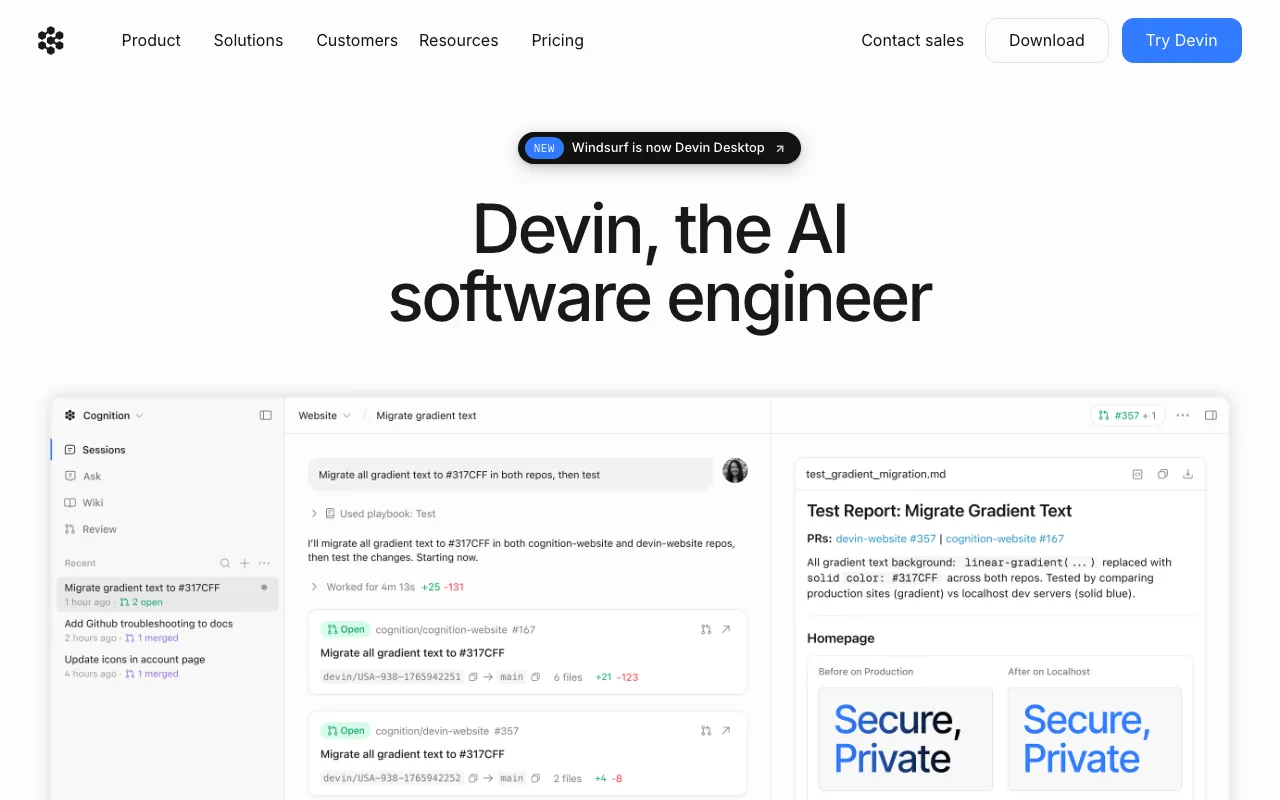
Devin is an autonomous AI software engineer built by Cognition. Instead of producing code snippets inside an editor, it takes an entire engineering task — a ticket, a migration, a backlog item — and works it end to end: it plans an approach, writes code across files, runs the tests, fixes failures, and opens a pull request for a human to review. It operates through a web app (Devin Cloud), a Slack integration where you can tag it in a conversation, an IDE extension, a command-line interface, and a documented API for scripting recurring automations. It connects to hundreds of tools, including GitHub, Linear, Notion, Datadog, AWS, and Snowflake.
What distinguishes Devin from assistant-style tools is the degree of autonomy: you can spin up multiple Devins to work in parallel on large, multi-week projects, and it learns from past work to build its own helper tools over time. Cognition positions it for repetitive, complex engineering — large code migrations, dependency upgrades, test backfilling, CI failure resolution, and routine bug triage. The trade-off for that autonomy is supervision: on ambiguous or large open-ended tasks, Devin can take wrong paths, so careful pull-request review before merging is not optional. For reliability on nuanced work, supervised agents such as Claude (via Claude Code) often produce steadier results because a human stays in the loop to catch mistakes early.
Who is it for?
Devin suits engineering teams and developers who have a steady stream of bounded, well-scoped work they would rather delegate than do by hand — and who are set up to review the output rather than trusting it blindly. The usage-based ACU billing means cost scales with actual work, which rewards teams that batch the right kind of tasks and watch their spend; at roughly $9 per hour of Devin time on the Core plan, an unsupervised month of heavy use can run into the hundreds of dollars beyond the $20 base.
- Engineering teams running migrations — legacy framework upgrades, language ports, or dependency bumps spread across many repos, where Devin’s parallel agents handle the repetitive bulk.
- Teams with backlog debt who want routine bug triage, CI fixes, and test backfilling cleared while engineers focus on feature work.
- Developers comfortable reviewing PRs rather than writing every line, who treat Devin as a junior engineer whose work always gets checked.
- Automation builders who want to trigger scheduled coding chores via the Devin API, and who would otherwise compare it against in-editor agents like Cursor or Windsurf and supervised CLI agents like Cline or Factory AI.
How much does Devin cost?
Starting price: $20/mo + $2.25/ACU · Free tier: no · Model: usage-based
Price history tracked from June 2026
| Plan | Price | Includes |
|---|---|---|
| Core | $20/mo + $2.25/ACU | $20/month base, then pay-as-you-go ACU billing · $2.25 per ACU (one ACU is approximately 15 minutes of active work) · Roughly 9 ACUs (~2.25 hours) covered by the base fee · Unlimited seats; extra usage billed on demand · Web app (Devin Cloud), Slack, IDE extension, CLI, and API access |
| Team | $500/mo | $500/month, includes 250 ACUs · Additional ACUs at $2.00 each (vs $2.25 on Core) · Centralized billing, admin dashboard, and usage analytics · Collaboration and sharing features across the team · Priority support |
| Enterprise | Custom | Everything in Team plus dedicated account management · SAML/OIDC SSO and centralized admin controls · Dedicated deployment options · Volume discounts on annual and multi-year commitments · Highest-priority support |
What are Devin's key features?
- Autonomous end-to-end task execution — plans, writes code, runs tests, and opens a pull request
- Parallel agents — spin up multiple Devins to work on large multi-week projects at once
- PR review and visual QA using browser and desktop interaction
- Hundreds of integrations including GitHub, Slack, Linear, Notion, Datadog, AWS, and Snowflake
- Devin CLI and a documented API for scripting and recurring automations
- ACU-based usage billing so cost scales with actual work rather than per-seat licenses
- Learns from past work to build custom tools and improve over time
What people use Devin for
- 01 Delegating bounded, well-scoped tickets — dependency upgrades, framework migrations, or repetitive refactors — and reviewing the resulting pull request
- 02 Backfilling unit and end-to-end tests across a codebase that lacks coverage
- 03 Resolving CI failures and triaging routine bugs while engineers focus on feature work
- 04 Large-scale code migrations (legacy frameworks, language ports) run in parallel across many repos
- 05 Scheduled chores and automations triggered via the Devin API on a recurring basis
Pros and cons
| Pros | Cons |
|---|---|
| Genuinely autonomous on bounded tasks — hands back a reviewable pull request rather than code snippets | ACU costs can spike fast — at $2.25/ACU a single complex task can run several dollars, and a busy month easily reaches hundreds of dollars beyond the $20 base |
| Usage-based ACU billing means you pay for actual work; unlimited seats avoid per-developer license creep | Still needs human supervision; autonomous runs can go down wrong paths on ambiguous or large open-ended tasks |
| Strong integration surface (GitHub, Slack, Linear, plus hundreds of tools) and a real API for automation | No free tier — the Core plan's $20 base only covers about 2.25 hours of work before metered billing kicks in |
| Runs many agents in parallel, which suits large migrations spread across repos | Reliability on nuanced engineering lags supervised agents; output quality is uneven enough that careful PR review is mandatory |
What are the best Devin alternatives?
Factory AI is the closest Devin alternative in our directory: it covers the same category (AI Coding), starts at $20/mo, has no free tier.
Ranked by category overlap with Devin, then free-tier availability, then lowest verified starting price — computed from our verified data, never from sponsorships.
| Alternative | What it is | Starting price | Free tier | Price verified |
|---|---|---|---|---|
| Factory AI | Agentic software-development platform whose Droids autonomously triage, code, validate, and ship software across the SDLC from the desktop, CLI, or cloud | $20/mo | no | Jun 18, 2026 |
| Cline | Open-source autonomous coding agent for VS Code that edits files, runs commands, and brings your own model | $0 | yes | Jun 20, 2026 |
| GitHub Copilot | AI coding assistant with inline completions, chat, and autonomous agent mode across major IDEs | $10/mo | yes | Jul 3, 2026 |
| Windsurf | Agentic AI IDE with Cascade that writes, edits and runs code autonomously inside your editor | $15/mo | yes | Jun 11, 2026 |
| Claude | Anthropic's AI assistant built for long-context analysis, coding, and safe reasoning | $20/mo | yes | Jul 3, 2026 |
| Cursor | AI-native code editor that runs autonomous agents to build, test, and review code | $20/mo | yes | Jul 3, 2026 |
How people make money with Devin
- Offer fixed-scope migration and modernization projects (legacy framework upgrades, dependency bumps, test backfills) on Upwork or Toptal — Devin handles the repetitive bulk while you scope, review, and warranty the output
- Run a small agency that triages and clears engineering backlogs for startups on a retainer; bill clients monthly and keep the spread over your Devin ACU usage costs
Frequently asked questions
How much does Devin cost?
Devin's Core plan is $20/month base plus pay-as-you-go usage at $2.25 per ACU. One ACU is roughly 15 minutes of active work, so an hour of Devin costs about $9. The Team plan is $500/month and includes 250 ACUs, with additional ACUs at $2.00 each. Enterprise pricing is custom.
What is an ACU in Devin?
An ACU (Agent Compute Unit) is Cognition's normalized measure of the resources Devin uses while actively working — virtual machine time, model inference, and networking. One ACU represents approximately 15 minutes of autonomous work. You are billed per ACU rather than per seat.
Does Devin have a free tier?
No. There is no permanent free tier. The Core plan starts at $20/month, which covers roughly 9 ACUs (about 2.25 hours of work); beyond that you pay $2.25 per additional ACU.
Is Devin better than Claude Code for coding?
For reliability on nuanced, multi-step engineering work, supervised agents like Claude Code generally outperform Devin: keeping a human in the loop catches wrong turns earlier and produces steadier output. Devin's strength is full autonomy on bounded, well-scoped tasks where you are willing to review a pull request at the end.
What integrations does Devin support?
Devin integrates with GitHub, Slack, and Linear, plus hundreds of other tools including Notion, Confluence, Jira-style trackers, Datadog, Sentry, AWS, Azure, Snowflake, and PostgreSQL. It also exposes a CLI and an API for scripting and scheduled automations.
Can Devin work autonomously without supervision?
Devin can run end-to-end — planning, coding, testing, and opening a pull request — without step-by-step prompting. In practice it still needs human review: autonomous runs can take wrong paths on ambiguous or large open-ended tasks, so PR review before merging is strongly recommended.
How do Devin's Core and Team plans differ?
Core is $20/month plus $2.25 per ACU with unlimited seats, aimed at individuals and small teams metering usage. Team is $500/month, includes 250 ACUs at a lower $2.00 overage rate, and adds centralized billing, an admin dashboard with analytics, and priority support.