Langfuse
Open-source LLM engineering platform for tracing, observability, evals, and prompt management — self-host free or run on Langfuse Cloud
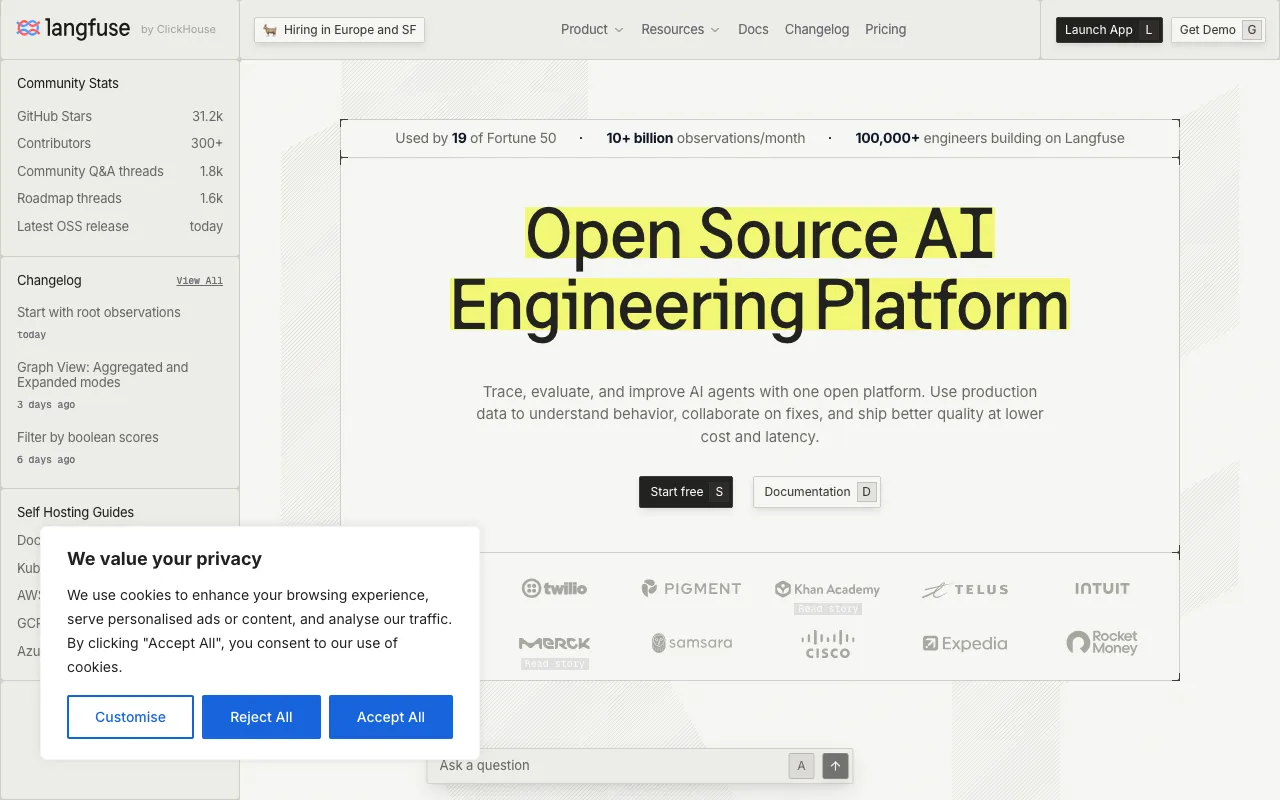
Langfuse is an open-source (MIT) LLM engineering platform for tracing, evals, prompt management, and datasets, used by 2,300+ companies. Every core feature is free when self-hosted, or you can use Langfuse Cloud: a free Hobby tier with 50k units/month, Core at $29/month, and Pro at $199/month with SOC2 reports and 3-year retention. Best for developers instrumenting and debugging LLM and agent applications.
What is Langfuse?
Langfuse is an open-source LLM engineering platform that helps teams develop, monitor, evaluate, and debug AI applications. Its core is licensed under MIT and can be self-hosted for free, or run as a managed service on Langfuse Cloud. The platform brings four capabilities together in one place: tracing and observability for LLM calls and agent steps, evaluations, prompt management, and datasets. A trace captures each request end to end — including retrieval, embedding, and tool calls — while a generation records the model name, prompt, completion, token usage, and cost, so you can inspect and debug complex logs and user sessions rather than guessing at what an app did in production. It is used by more than 2,300 companies.
Beyond observability, Langfuse handles the rest of the LLM development loop. Prompt management lets you version prompts centrally and deploy them to any environment via labels without code changes. Evaluations support LLM-as-a-judge, code-based evaluators, user feedback, and manual annotation, and datasets plus experiments give you repeatable benchmarks for pre-deployment testing. Instrumentation is framework-agnostic: native Python and JavaScript/TypeScript SDKs and an OpenTelemetry-compatible ingestion path connect to LangChain, LlamaIndex, the OpenAI SDK, and LiteLLM, so most teams can add tracing without rewriting their stack.
Who is it for?
Langfuse is built for engineers, not end users. The value shows up once you are shipping real LLM or agent features and need to see what is happening inside them — which requires instrumenting your code with an SDK. The free self-hosted version suits teams comfortable running their own infrastructure, while Langfuse Cloud removes the operational overhead for those who would rather pay per usage. Some compliance and admin features (SCIM, audit logs, project-level RBAC, SLAs) sit behind the commercial license or the Teams add-on, which matters mainly to larger organizations.
- LLM and AI application developers who need to trace, debug, and reduce the cost of multi-step agent and RAG pipelines.
- ML and platform engineers standing up shared observability and eval infrastructure for a team, either self-hosted or on Cloud.
- Startups building LLM products who want a free, open-source starting point that scales into paid Cloud tiers with unlimited users.
- Teams already using LangChain, LlamaIndex, or the OpenAI SDK who want drop-in tracing and prompt versioning without re-architecting their app.
How much does Langfuse cost?
Starting price: Free · Free tier: yes · Model: open-source
Price history tracked from June 2026
| Plan | Price | Includes |
|---|---|---|
| Open Source (self-host) | Free | MIT license — all core platform features and APIs · Observability, evals, prompt management, datasets · Unlimited usage and users · Deploy via Docker, Kubernetes, AWS, Azure, GCP · Org-level RBAC and enterprise SSO included |
| Hobby (Cloud) | Free | 50k units / month included · 2 users, 30 days data access · All platform features with limits · No credit card required, community support |
| Core (Cloud) | $29/mo | 100k units / month included · Unlimited users, 90 days data access · In-app support with 48h response SLO · Additional units at $8 per 100k |
| Pro (Cloud) | $199/mo | 100k units / month, 3 years data access · Data retention management, unlimited annotation queues · High rate limits, SOC2 & ISO27001 reports, HIPAA support · Optional Teams add-on ($300/mo) for SSO, RBAC, dedicated Slack |
| Enterprise (Cloud) | $2,499/mo | Yearly commitment, unlimited users, 3 years data access · Audit logs and SCIM API · Custom rate limits and uptime SLA · Dedicated support engineer |
| Self-Hosted Enterprise | Custom | Management APIs and project-level access controls · Data retention policies, audit logs, server-side masking · Bundled ClickHouse (Cloud, BYOC, or Private) · SOC2 Type II & ISO27001 reports, support SLA, SCIM |
What are Langfuse's key features?
- LLM tracing and observability — spans, generations, and grouped user sessions with model, prompt, completion, token, and cost data
- Prompt management with version control and label-based deployment to any environment
- Evaluations: LLM-as-a-judge, code evaluators, user feedback collection, and manual labeling
- Datasets and experiments for structured, repeatable benchmarking of LLM apps
- OpenTelemetry-compatible ingestion with native Python and JavaScript/TypeScript SDKs
- Framework integrations — LangChain, LlamaIndex, OpenAI SDK, and LiteLLM
- Metrics and dashboards for cost, latency, and quality tracking
- Self-hostable via Docker, Kubernetes, AWS, Azure, and GCP deployment templates
What people use Langfuse for
- 01 Debugging multi-step agent and RAG traces by inspecting spans, generations, retrieval steps, and token usage per request
- 02 Centrally versioning prompts and deploying them to production via labels without shipping code changes
- 03 Running LLM-as-a-judge, code-based, and human-annotation evaluations on production traces
- 04 Building datasets and experiments for pre-deployment regression testing against benchmarks
- 05 Tracking cost and latency per model, user, and session across an LLM application
Pros and cons
| Pros | Cons |
|---|---|
| Fully open source under MIT — all core observability, eval, prompt, and dataset features are free when self-hosted, with no functional gating on the OSS core | Self-hosting carries real operational burden: production deployments need Postgres, ClickHouse, and Redis/S3, so it is not a trivial single-container setup at scale |
| Framework-agnostic via OpenTelemetry; integrates natively with LangChain, LlamaIndex, OpenAI SDK, and LiteLLM through Python and JS SDKs | Cloud billing is unit-based, so high-volume tracing can trigger overage charges at $8 per 100k units beyond the included quota |
| Cloud paid tiers include unlimited users, avoiding the per-seat scaling that competing observability platforms charge | Some enterprise features — SCIM, audit logs, project-level RBAC, server-side masking, and SLAs — are gated behind the commercial license or the $300/mo Teams add-on even though the core is MIT |
| Covers the full development loop — tracing, evals, prompt management, and datasets — in a single platform | Developer- and infrastructure-focused: it requires instrumenting your code with SDKs and is not a no-code product for non-engineers |
What are the best Langfuse alternatives?
CrewAI is the closest Langfuse alternative in our directory: it covers the same category (AI Agents & Automation), starts at $0, has a free tier.
Ranked by category overlap with Langfuse, then free-tier availability, then lowest verified starting price — computed from our verified data, never from sponsorships.
| Alternative | What it is | Starting price | Free tier | Price verified |
|---|---|---|---|---|
| CrewAI | Open-source multi-agent framework for orchestrating collaborative AI agent teams | $0 | yes | Jul 3, 2026 |
| Dify | Open-source LLM app platform for building agentic workflows, RAG pipelines, and AI agents with a visual no-code builder | $0 | yes | Jun 24, 2026 |
| Flowise | Open-source low-code platform to build LLM apps and AI agents with a drag-and-drop visual flow builder | $0 | yes | Jun 24, 2026 |
| LangChain | Open-source frameworks for building LLM agents, plus the commercial LangSmith platform for tracing, evaluation, and deployment | $39/seat/mo | yes | Jul 12, 2026 |
Head-to-head comparisons
How people make money with Langfuse
- Offer LLMOps setup consulting — instrumenting a client's LLM or agent app with Langfuse tracing, building LLM-as-a-judge eval pipelines, and standing up a self-hosted instance on their cloud for teams that lack in-house observability expertise
Frequently asked questions
Is Langfuse free and open source?
Yes. The Langfuse core is open source under the MIT license and can be self-hosted for free with unlimited usage and users, including all core observability, evaluation, prompt management, and dataset features. Langfuse Cloud also offers a permanently free Hobby tier with 50k units per month.
What is the difference between Langfuse Cloud and self-hosting?
Langfuse Cloud is the fully managed SaaS — you sign up and start sending traces with no infrastructure to run, billed by monthly unit quotas from Hobby (free) through Enterprise ($2,499/mo). Self-hosting runs the MIT-licensed open-source version on your own infrastructure for free, with an optional Self-Hosted Enterprise tier for compliance, admin APIs, and support.
How much does Langfuse Cloud cost?
Langfuse Cloud has four tiers: Hobby is free with 50k units/month and 2 users; Core is $29/month with 100k units/month and unlimited users; Pro is $199/month with SOC2/ISO27001 reports and 3-year retention; Enterprise is $2,499/month on a yearly commitment with audit logs, SCIM, and an uptime SLA.
What is a 'unit' in Langfuse pricing?
Cloud plans are metered in units per month rather than per seat. Paid plans include 100k units/month, and usage beyond the included quota is billed at $8 per 100k units. Because billing scales with ingested volume, high-traffic applications should estimate their trace volume before committing to a tier.
Which frameworks and SDKs does Langfuse support?
Langfuse offers native Python and JavaScript/TypeScript SDKs and an OpenTelemetry-compatible ingestion path. It integrates directly with popular frameworks and providers including LangChain, LlamaIndex, the OpenAI SDK, and LiteLLM, so you can add tracing without rewriting your application.
Does Langfuse support evaluations?
Yes. Langfuse supports LLM-as-a-judge evaluators, code-based evaluators, user feedback collection, and manual human annotation. Combined with datasets and experiments, this lets teams benchmark prompt and model changes before deploying to production.
What features are gated behind Langfuse's commercial license?
The MIT-licensed core is fully functional, but some enterprise capabilities require the commercial or Self-Hosted Enterprise license — SCIM provisioning, audit logs, project-level RBAC, server-side data masking, data retention policies, and support SLAs. On Cloud, SSO and RBAC come via the $300/mo Teams add-on on the Pro plan.