Parallel
Web search, extraction, deep-research, and monitoring APIs built for AI agents, priced per request rather than per token
Parallel is a web infrastructure API for AI agents: one platform covers fast search, page extraction, asynchronous deep research, cited answers, web monitoring, and entity discovery, all served from its own web index. Every call is priced per request, from $1 per 1,000 searches to $2,400 per 1,000 of its heaviest research runs, and $5 of free credits each month covers up to 5,000 requests. Best for developers who want the cost of a query fixed before they run it.
What is Parallel?
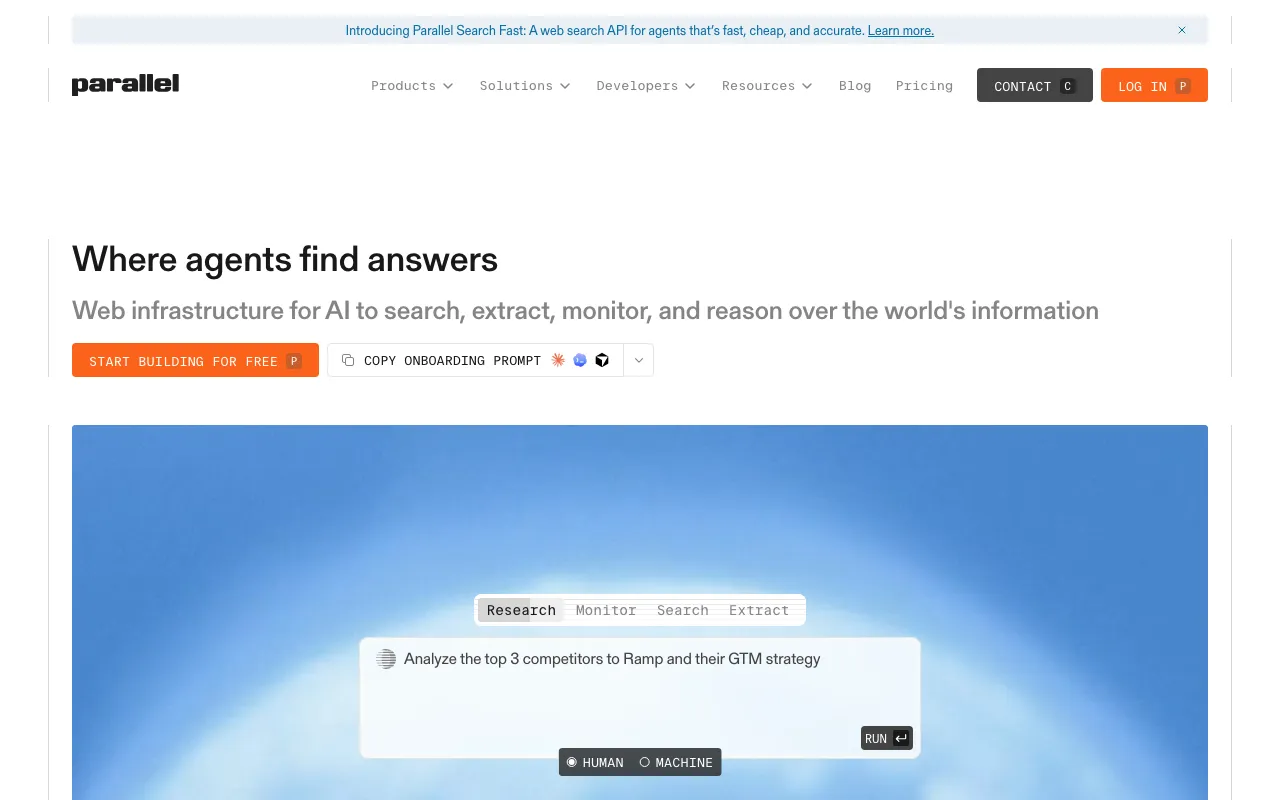
Parallel, from Parallel Web Systems, is a set of web APIs built for AI agents rather than people. Instead of a page of links, its Search API returns ranked URLs with compressed excerpts sized for a model’s context window, and its Extract API pulls full or excerpted contents from a given URL, including PDFs and JavaScript-heavy pages. Heavier jobs go to the Task API, which takes an objective, researches it asynchronously for anywhere from 5 seconds to 30 minutes, and returns structured fields. A Basis layer attaches citations, reasoning, and a calibrated confidence score to each of them. The Responses API gives cited answers in seconds in an OpenAI-compatible format, Monitor watches the web for changes and alerts by webhook, and FindAll builds lists of entities that match a description. All of it runs on Parallel’s own web index.
Pricing is per request, not per token. Search costs $1 per 1,000 requests on the Turbo and Fast processors and $5 on Basic and Advanced; Extract is $1 per 1,000 results; Task runs scale across nine processors from $5 to $2,400 per 1,000 requests. Every account gets $5 of free credits a month, which the vendor says covers up to 5,000 requests. There is no monthly subscription: past the free credits, usage is metered, and an Enterprise agreement adds zero data retention, SSO, and custom rate limits.
Who is it for?
Parallel suits developers who need agents to read the live web and want a predictable bill per query. Its closest catalog rivals are /tools/exa and /tools/tavily for agent search, and /tools/firecrawl for page extraction. Parallel’s distinguishing pieces are the asynchronous research tiers and the per-field confidence scores.
- Agent and copilot builders who need a fast search tool call that returns compact, model-ready excerpts instead of raw HTML.
- Sales and revenue-operations teams enriching account lists with cited headcount, funding, and contact fields.
- Finance, legal, and life-sciences analysts who batch deep-research reports or monitor filings, trial registries, and competitors for change.
- Teams already on MCP-capable assistants who want web search inside Cursor, VS Code, or Claude Desktop without building a scraper.
How much does Parallel cost?
Starting price: $0 · Free tier: yes · Model: usage-based
Price history tracked from June 2026
| Plan | Price | Includes |
|---|---|---|
| Free credits | Free | $5 in free credits every month, enough for up to 5,000 requests · Up to $80 in credits earned at signup · Qualified startups can apply for up to $250 in credits · Same APIs and rate limits as paid usage |
| Search API | $1 per 1K requests | Turbo (~200ms) and Fast (~700ms) at $1 per 1,000 requests with 10 results · Basic and Advanced processors at $5 per 1,000 requests · $1 per 1,000 additional results beyond 10 · 600 requests per minute default rate limit |
| Extract API | $1 per 1K results | Full page contents or compressed excerpts from a URL · Handles PDFs and JavaScript-heavy pages · 1-3s from cache, 60-90s for a live fetch |
| Task API | $5–$2,400 per 1K requests | Nine processors from Lite ($5 per 1K) to Ultra8x ($2,400 per 1K) · Core at $25 per 1K and Pro at $100 per 1K for complex research · Asynchronous runs from 5 seconds to 30 minutes · Citations, reasoning, and confidence scores on each output field |
| Responses, Monitor and FindAll APIs | $3–$250 per 1K requests | Responses API (OpenAI-compatible cited answers): $10, $50, or $250 per 1,000 · Monitor API (web change alerts): $3 or $10 per 1,000 · FindAll API: fixed cost per query plus $0.03-$1.00 per match |
| Enterprise | Custom | Zero data retention and data protection agreements · Single sign-on and custom rate limits · Dedicated onboarding and technical support · Early access to new products |
What are Parallel's key features?
- Search API with four processors trading latency (~200ms to ~3s) against excerpt depth
- Task API for asynchronous deep research and structured enrichment, with nine compute tiers
- Basis framework that attaches citations, reasoning, and calibrated confidence to each output field
- Responses API compatible with the OpenAI Responses wire format
- Monitor API that pushes structured alerts by webhook on hourly, daily, or weekly schedules
- FindAll API that builds lists of entities matching natural-language criteria
- Search and Task MCP servers for Cursor, VS Code, and Claude Desktop, plus Python and TypeScript SDKs and a CLI
What people use Parallel for
- 01 Giving a coding agent or chatbot a web search tool call that returns compressed, LLM-ready excerpts
- 02 Enriching a list of companies or people with structured, cited fields for a CRM
- 03 Running batches of deep-research reports such as account briefs or market landscapes
- 04 Watching websites for material changes like competitor pricing, funding news, or regulatory updates
- 05 Building a dataset of every entity matching a description, such as all startups in a niche
Pros and cons
| Pros | Cons |
|---|---|
| Per-request pricing means the cost of a query is known before it runs, unlike per-token billing | Deep-research costs climb steeply: the top Task processor is $2,400 per 1,000 runs, 480 times the Lite tier |
| Search starts at $1 per 1,000 requests, and $5 of monthly free credits covers real prototyping | There is no flat monthly plan, so heavy usage is pure metered spend with no volume bundle below Enterprise |
| One API key spans search, extraction, deep research, monitoring, and entity discovery | Zero data retention, SSO, and custom rate limits are Enterprise-only and need a sales call |
| Confidence scores and per-field citations make outputs auditable in production pipelines | It is developer infrastructure with no consumer search app, so non-programmers get little from it |
What are the best Parallel alternatives?
Firecrawl is the closest Parallel alternative in our directory: it covers the same category (AI Search & Research), starts at $19/mo, has a free tier.
Ranked by category overlap with Parallel, then free-tier availability, then lowest verified starting price — computed from our verified data, never from sponsorships.
| Alternative | What it is | Starting price | Free tier | Price verified |
|---|---|---|---|---|
| Firecrawl | Web scraping and crawling API that turns any site into clean markdown or structured data for AI agents | $19/mo | yes | Jul 30, 2026 |
| Tavily | Search, extract, and crawl API purpose-built for AI agents and LLM applications | $30/mo | yes | Oct 12, 2026 |
| Exa | AI-native web search engine and API built for agents, with semantic search and content extraction | $0 | yes | Oct 12, 2026 |
| You.com | Real-time web search and research APIs for AI agents and LLM pipelines | $5 per 1,000 calls | yes | Jun 11, 2026 |
| Perplexity | AI-powered answer engine that searches the live web and cites every source | $20/mo | yes | Jun 11, 2026 |
How people make money with Parallel
- Sell account-research briefs to sales teams, with each brief produced by one deep-research run whose cost is known before it starts
- Run a competitor-monitoring service for small businesses that alerts clients when a rival changes pricing, priced as a monthly retainer per tracked company
- Offer CRM enrichment as a fixed-price project, filling headcount and funding fields with cited values a client can audit
Frequently asked questions
Is Parallel free to use?
Partly. Parallel gives every account $5 in free credits each month, which the vendor says covers up to 5,000 requests, and up to $80 in credits can be earned at signup. Qualified startups can apply for up to $250 more. Beyond the free credits, every API call is billed per request.
How much does the Parallel Search API cost?
The Turbo and Fast search processors cost $1 per 1,000 requests returning 10 results each. The Basic and Advanced processors, which return longer excerpts or handle multi-hop research, cost $5 per 1,000 requests. Each additional 1,000 results beyond the first 10 per request costs $1.
What is the Parallel Task API?
The Task API runs asynchronous web research or data enrichment from an objective you describe. You choose one of nine processors, from Lite at $5 per 1,000 requests to Ultra8x at $2,400 per 1,000, trading cost against depth. Runs take from 5 seconds to 30 minutes and return cited, confidence-scored fields.
Why does Parallel price per request instead of per token?
Parallel bills each call at a fixed rate set by the API and processor you pick, so the cost of a query is known before it runs. Token-based billing varies with how much text a model reads and writes, which makes agent workloads harder to budget.
Does Parallel work with Claude, Cursor, or OpenAI tools?
Yes. Parallel publishes Search and Task MCP servers for assistants such as Cursor, VS Code, and Claude Desktop, along with Python and TypeScript SDKs and a command-line tool. Its Responses API follows the OpenAI Responses wire format, and its docs cover OpenAI function calling and LiteLLM.
What does Parallel Enterprise add?
Enterprise adds zero data retention, data protection agreements, single sign-on, custom rate limits, early access to new products, and dedicated onboarding and technical support. Pricing is not published; it starts with a demo request through the sales team.