Tavily
Search, extract, and crawl API purpose-built for AI agents and LLM applications
Tavily is a search API designed for AI agents rather than humans — it returns ranked, LLM-ready content instead of a page of blue links. The free Researcher plan includes 1,000 API credits a month with no credit card; pay-as-you-go is $0.008 per credit, and the Project plan starts at $30/month for 4,000 credits with a slider for more. Students get it free. Best for developers adding web grounding to agents.
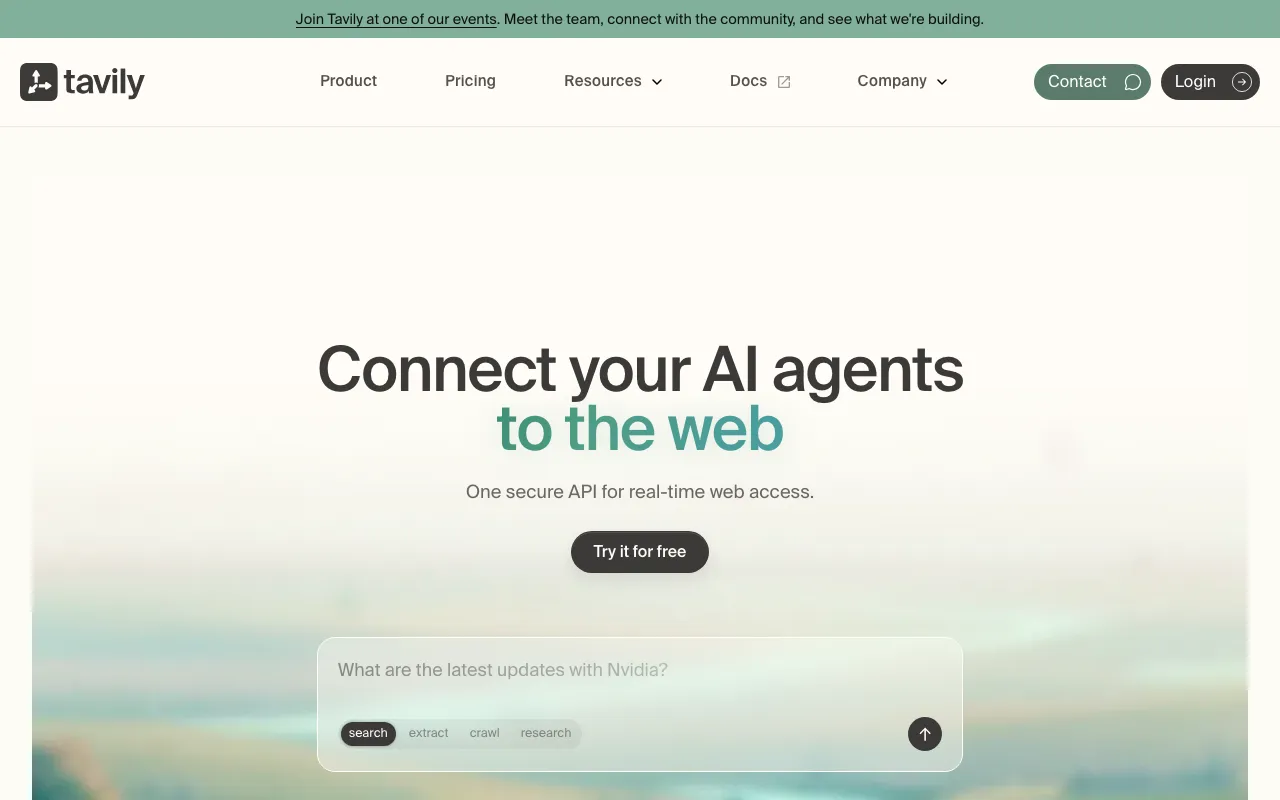
What is Tavily?
Tavily is a web search API built for machine consumers. Where a traditional search API hands back a list of links and snippets for a person to click, Tavily returns cleaned, ranked page content that a language model can read directly — which removes the fetch-and-parse step an agent would otherwise have to perform on every result. Alongside search it offers extract for pulling the readable text out of a specific URL, plus crawl and map capabilities for walking a site programmatically.
Pricing is credit-based with three self-serve routes: a permanently free Researcher tier at 1,000 credits per month, pay-as-you-go at $0.008 per credit for projects that would rather not hold a subscription, and a Project plan starting at $30/month for 4,000 credits with a slider that scales credits and price together. Credit consumption varies by request type, so a plain search costs less than a heavier crawl. Credits reset on the first of each calendar month regardless of when you started billing.
Who is it for?
Tavily suits developers who need their model’s answers grounded in current web content and who would rather call one API than maintain a search-plus-scraper stack. The free tier is genuinely enough to build and demo an agent; production traffic pushes you onto the slider or pay-as-you-go fairly quickly.
- Agent developers wiring a search tool into a framework so the model can look things up mid-task rather than relying on training data.
- Teams building research assistants that need to cite sources, where returning readable page content matters more than returning ranking positions.
- Students and academic researchers, who can access the service free — a rare concession among commercial infrastructure APIs.
- Low-volume side projects that benefit from the pay-as-you-go rate instead of committing to a monthly plan they would not fully consume.
How much does Tavily cost?
Starting price: $30/mo · Free tier: yes · Model: freemium
Price history tracked from June 2026
| Plan | Price | Includes |
|---|---|---|
| Researcher | Free | 1,000 API credits per month · No credit card required · Email support · Credits reset on the first of each month |
| Pay As You Go | $0.008/credit | Pay only for what you use · Cancel anytime · Email support |
| Project | $30/mo | 4,000 API credits per month at the base price · Slider adjusts credits and price together · Higher rate limits · Email support |
| Enterprise | Custom | Custom API call volumes · Custom rate limits · Enterprise-grade support and SLAs · Enterprise-grade security and privacy |
| Students | Free | Free access for students · Requires verification through the vendor |
What are Tavily's key features?
- Search endpoint tuned for LLM consumption, returning content rather than link lists
- Extract endpoint that pulls clean readable text from a given URL
- Crawl and map capabilities for walking a site programmatically
- Python and JavaScript SDKs with drop-in API key authentication
- Credit costs that vary by request type, so cheap searches stay cheap
- Integrations with common agent frameworks for tool-calling setups
What people use Tavily for
- 01 Grounding an LLM answer in current web sources to reduce hallucination
- 02 Giving an autonomous agent a search tool it can call mid-task
- 03 Extracting the readable content of a specific URL for summarisation
- 04 Running competitive or market research sweeps across many queries programmatically
- 05 Powering a research assistant that cites the pages it drew from
Pros and cons
| Pros | Cons |
|---|---|
| Free tier is a permanent 1,000 credits per month with no card required | The Project plan's $30 headline only covers 4,000 credits — the real price moves with a slider, so the advertised figure understates most teams' bills |
| Pay-as-you-go at $0.008 per credit means low-volume projects avoid a subscription entirely | At 4,000 credits for $30 the entry tier works out near $0.0075 per credit, barely cheaper than the $0.008 pay-as-you-go rate |
| Students get free access, which is unusual for a paid infrastructure API | Requests simply stop when monthly credits run out unless you upgrade, rather than degrading gracefully |
| Credits reset on the first of the month regardless of billing date, which simplifies forecasting | Exact credit costs per endpoint are not published on the pricing page — only 'more advanced requests use more credits' |
| SLAs, custom rate limits, and enterprise security all require a sales conversation |
What are the best Tavily alternatives?
Firecrawl is the closest Tavily alternative in our directory: it covers the same category (AI Search & Research), starts at $19/mo, has a free tier.
Ranked by category overlap with Tavily, then free-tier availability, then lowest verified starting price — computed from our verified data, never from sponsorships.
| Alternative | What it is | Starting price | Free tier | Price verified |
|---|---|---|---|---|
| Firecrawl | Web scraping and crawling API that turns any site into clean markdown or structured data for AI agents | $19/mo | yes | Jul 30, 2026 |
| Exa | AI-native web search engine and API built for agents, with semantic search and content extraction | $0 | yes | Jun 22, 2026 |
| You.com | Real-time web search and research APIs for AI agents and LLM pipelines | $5 per 1,000 calls | yes | Jun 11, 2026 |
| Perplexity | AI-powered answer engine that searches the live web and cites every source | $20/mo | yes | Jun 11, 2026 |
| Kagi | Paid, ad-free search engine with an AI assistant, universal summarizer, and translator layered on top of independent search results | $5/mo | no | Jul 11, 2026 |
How people make money with Tavily
- Build research-brief automations for consultancies that need sourced summaries on demand, priced per report with credits as the main variable cost
- Offer web-grounded chatbot integration as a retainer service for agencies, where the search layer keeps client answers current without retraining a model
Frequently asked questions
Is Tavily free to use?
Yes. The Researcher plan is permanently free with 1,000 API credits per month and no credit card required. Credits reset on the first day of each month. Students can also apply for free access. Beyond that, pay-as-you-go costs $0.008 per credit and the Project plan starts at $30/month.
How much does the Tavily Project plan cost?
The Project plan starts at $30/month, which includes 4,000 API credits and higher rate limits. The pricing card uses a slider, so both the credit allowance and the monthly price increase together as you drag it up. The advertised $30 is the base position, not a ceiling.
What is a Tavily API credit?
A credit is the unit consumed by each API request. The amount depends on the request type — search, extract, or crawl — and on how advanced or high-volume the call is. Tavily directs users to its documentation for exact per-endpoint costs rather than listing them on the pricing page.
What happens when I run out of credits?
Requests stop until your credits reset at the start of the next month or you move to a paid plan. There is no automatic overage billing on the free tier, which prevents surprise charges but also means an agent in production will fail its search calls if it hits the ceiling.
How is Tavily different from a normal search API?
Conventional search APIs return ranked links and snippets meant for a person to click. Tavily returns cleaned page content shaped for a language model to read directly, which removes the separate fetch-and-parse step agents would otherwise need before they can reason over a result.
Does Tavily offer an enterprise plan?
Yes. The Enterprise tier is custom-priced and adds negotiated API call volumes, custom rate limits, enterprise-grade support with SLAs, and enterprise security and privacy commitments. Pricing is not published — it requires contacting the sales team through the site.