Firecrawl
Web scraping and crawling API that turns any site into clean markdown or structured data for AI agents
Firecrawl is a hosted API that converts web pages into LLM-ready markdown or structured JSON, handling JavaScript rendering, proxies, and anti-bot blocks. The free tier gives 1,000 credits a month with no card; Hobby is $19/month for 5,000 credits, Standard $99/month for 100,000, and Growth $399/month for 500,000. The AGPL-3.0 core is self-hostable. Best for developers feeding live web data into agents and RAG pipelines.
What is Firecrawl?
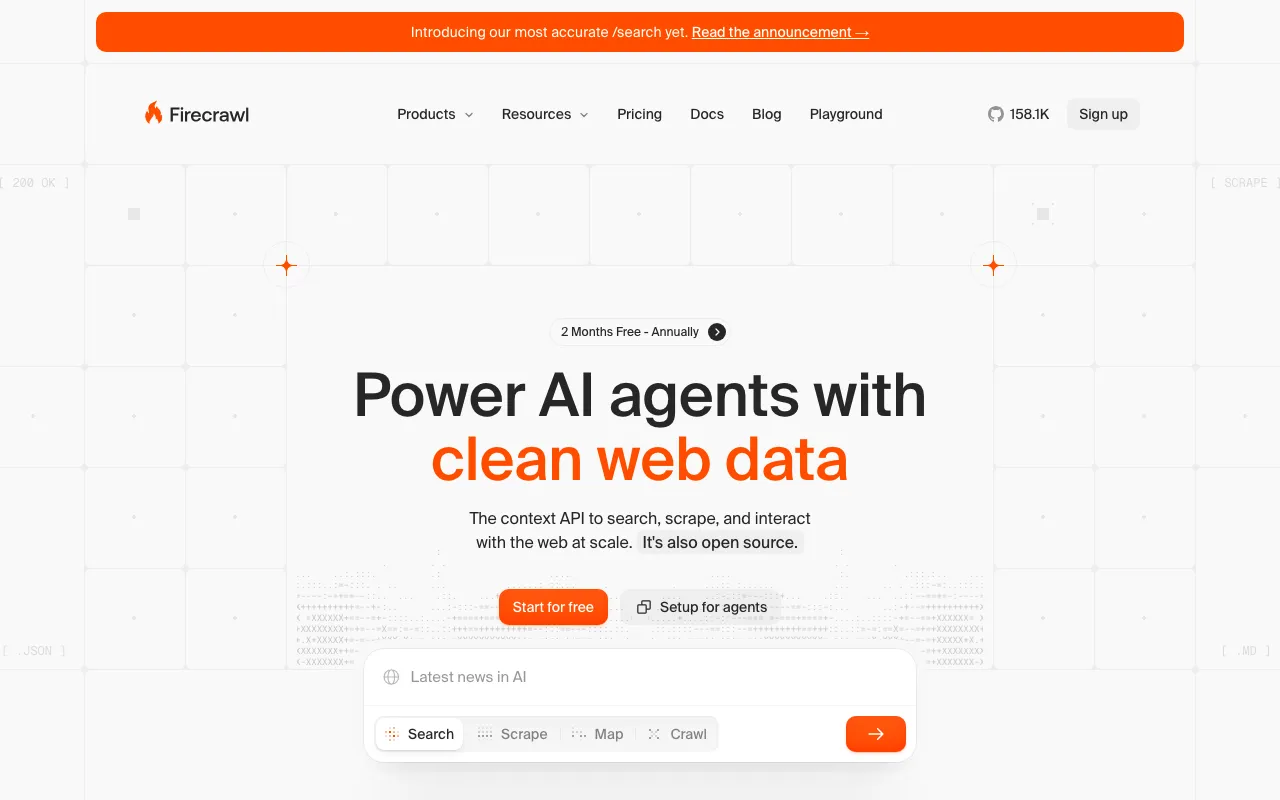
Firecrawl is a web data API built for AI applications. You send it a URL and it returns clean markdown, HTML, a screenshot, or JSON shaped to a schema you define — handling the parts that usually break scrapers, including JavaScript rendering, proxy rotation, and anti-bot challenges. Beyond single-page scraping it exposes a crawl endpoint that walks an entire site, a map endpoint that lists every URL on a domain, a search endpoint that returns page content instead of just links, and a monitor endpoint that re-checks pages on a schedule.
The pricing is credit-based and unusually legible: scraping, crawling, mapping, and each monitor check all cost 1 credit per page, search costs 2 credits per 10 results, and the Interact endpoint costs 2 credits per browser minute. The core is AGPL-3.0 licensed and self-hostable, so the hosted tiers buy managed infrastructure and concurrency rather than exclusive access to the technology. An agent-oriented onboarding path and an MCP server make it straightforward to hand the API to a coding agent as a tool.
Who is it for?
Firecrawl fits developers who need live web content inside an LLM application and do not want to maintain per-site parsers. The free 1,000 credits per month are enough to prototype, but sustained ingestion moves quickly into the $99/month Standard tier once page counts pass a few thousand.
- Agent and RAG developers who need documentation sites, competitor pages, or news sources converted into markdown their model can actually read.
- Data teams building monitoring pipelines for pricing, job listings, or compliance changes, where the monitor endpoint’s 1 credit per page per check makes cost predictable.
- Small teams replacing in-house scrapers that keep breaking on JavaScript rendering and bot detection, and who would rather pay per page than maintain proxy infrastructure.
- Engineers who need an escape hatch — the AGPL-3.0 self-hosted option means a pricing change does not strand the project, provided the copyleft terms fit the product.
How much does Firecrawl cost?
Starting price: $19/mo · Free tier: yes · Model: freemium
Price history tracked from June 2026
| Plan | Price | Includes |
|---|---|---|
| Free | Free | 1,000 credits per month · No credit card required · 2 concurrent requests · Low rate limits |
| Hobby | $19/mo | 5,000 credits per month · 5 concurrent requests · $16/mo billed annually ($190/year) · Basic support |
| Standard | $99/mo | 100,000 credits per month · 50 concurrent requests · $83/mo billed annually ($990/year) · Standard support |
| Growth | $399/mo | 500,000 credits per month · 100 concurrent requests · $333/mo billed annually ($3,990/year) · Priority support |
| Scale | $749/mo | 1,000,000 credits per month · 150 concurrent requests · $599/mo billed annually ($7,190/year) · Priority support |
| Enterprise | Custom | Custom credits and concurrency · Unlimited page scraping · Zero-data retention · SSO and advanced security · Bulk discounts, dedicated support and SLA |
What are Firecrawl's key features?
- Scrape endpoint returning markdown, HTML, screenshots, or schema-defined JSON
- Crawl endpoint that follows links across a whole site and respects depth limits
- Map endpoint for fast discovery of every URL on a domain
- Search endpoint that returns full page content alongside results
- Interact endpoint for clicking, typing, and scrolling through JavaScript-heavy pages
- Monitor endpoint that re-checks pages on a schedule for change detection
- Managed proxies and anti-bot handling so blocked pages still return content
- SDKs plus an MCP server for wiring the API into agent frameworks
What people use Firecrawl for
- 01 Feeding live web pages into a RAG pipeline as clean markdown instead of raw HTML
- 02 Crawling an entire documentation site with one call to build a searchable knowledge base
- 03 Extracting structured JSON fields from listing pages without writing per-site parsers
- 04 Giving an AI agent a search tool that returns page content, not just result links
- 05 Monitoring specific pages for changes on a schedule and re-ingesting only what moved
Pros and cons
| Pros | Cons |
|---|---|
| Free tier is a permanent 1,000 credits per month and needs no credit card | Credits reset monthly and do not roll over, so bursty workloads either overpay or hit the ceiling |
| AGPL-3.0 core can be self-hosted, so the hosted plans are a convenience rather than a lock-in | There is no pay-per-use plan — the vendor's own FAQ confirms you must sit on a monthly tier |
| Credit costs are published per endpoint — scraping, crawling, and mapping are all 1 credit per page | AGPL-3.0 copyleft makes the self-hosted path awkward for closed-source commercial products |
| Annual billing cuts roughly 16% off every paid tier | The gap between Growth at $399/month and Scale at $749/month is steep for teams needing just over 500,000 credits |
What are the best Firecrawl alternatives?
Tavily is the closest Firecrawl alternative in our directory: it covers the same category (AI Agents & Automation), starts at $30/mo, has a free tier.
Ranked by category overlap with Firecrawl, then free-tier availability, then lowest verified starting price — computed from our verified data, never from sponsorships.
| Alternative | What it is | Starting price | Free tier | Price verified |
|---|---|---|---|---|
| Tavily | Search, extract, and crawl API purpose-built for AI agents and LLM applications | $30/mo | yes | Jul 30, 2026 |
| Browser Use | Open-source library that lets AI agents control a real browser to automate and extract from any site | $0 | yes | Jul 1, 2026 |
| Exa | AI-native web search engine and API built for agents, with semantic search and content extraction | $0 | yes | Jun 22, 2026 |
| Browserbase | Cloud browser infrastructure for AI agents — run and scale headless browser sessions via API; maker of the open-source Stagehand framework | $20/mo | yes | Jul 10, 2026 |
| Apify | Cloud platform for web scraping and automation with a marketplace of 54,000+ ready-to-run Actors | $29/mo | yes | Jul 30, 2026 |
How people make money with Firecrawl
- Build price-monitoring or lead-enrichment data feeds for niche B2B clients, charging a monthly retainer that scales with the number of pages tracked per check
- Sell RAG chatbot builds over a company's own documentation as a fixed-fee project, using the crawl endpoint to ingest an entire site in one pass
Frequently asked questions
Is Firecrawl free?
Yes. The free plan includes 1,000 credits per month with no credit card required, which covers roughly 1,000 scraped pages. It allows 2 concurrent requests and low rate limits. Paid plans start at $19/month for Hobby, which raises the allowance to 5,000 credits and 5 concurrent requests.
How do Firecrawl credits work?
Most endpoints cost 1 credit per page: scraping, crawling, mapping, and each monitor check. Search costs 2 credits per 10 results, and the Interact endpoint costs 2 credits per browser minute. Credits reset at the start of each billing period and unused credits do not carry over.
How much does Firecrawl cost per month?
Hobby is $19/month for 5,000 credits, Standard $99/month for 100,000, Growth $399/month for 500,000, and Scale $749/month for 1,000,000. Annual billing lowers those to $16, $83, $333, and $599 per month respectively. Enterprise pricing is custom.
Can I self-host Firecrawl?
Yes. The core is published under the AGPL-3.0 licence and can be run on your own infrastructure. The copyleft terms matter if you plan to embed it in a closed-source product, so review the licence before shipping it inside a commercial application.
Does Firecrawl handle JavaScript-heavy sites?
Yes. Pages are rendered before extraction, and managed proxies plus anti-bot handling are included on all plans. The Interact endpoint goes further, letting you click, type, and scroll through a page before capturing content, billed at 2 credits per browser minute.
Is there a pay-as-you-go option instead of a subscription?
No. Firecrawl states in its own billing FAQ that it does not currently offer a pay-per-use plan. Higher usage means moving up to Hobby, Standard, Growth, or Scale, or negotiating an Enterprise agreement with custom credit volumes and bulk discounts.