Qdrant
Open-source vector database in Rust for RAG, agent memory, and semantic search — self-host free or run on Qdrant Cloud
Qdrant is an open-source vector database written in Rust and licensed under a plain Apache 2.0 — no branding clause, no source-available carve-out. Self-hosting is free, uncapped, and unmetered by the vendor. Qdrant Cloud adds a free-forever tier (0.5 vCPU, 1GB RAM, 4GB disk — roughly 1M vectors at 768 dimensions), then usage-based Standard billing charged hourly on compute, memory, and storage. Best for teams building retrieval who want an exit from vendor lock-in.
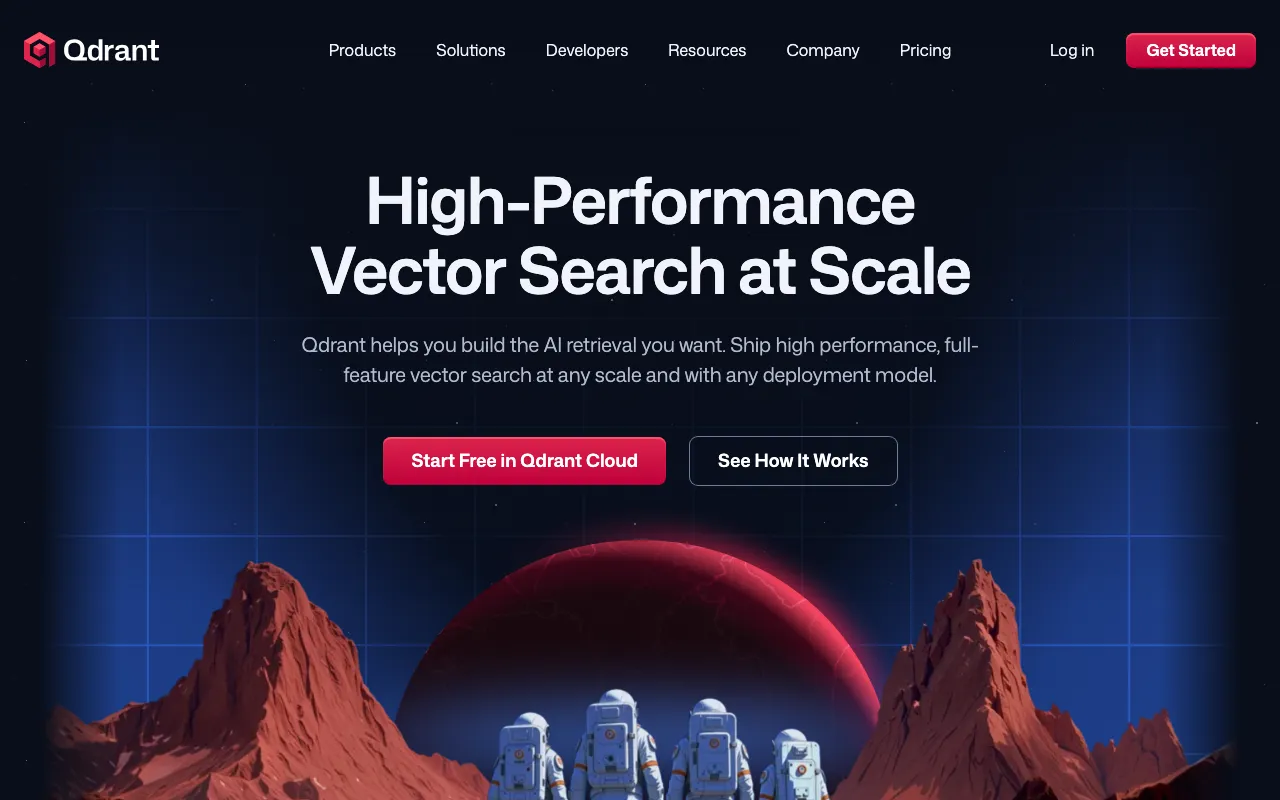
What is Qdrant?
Qdrant is a vector database — a store that keeps text, images, or audio as numeric embeddings and answers “what is most similar to this?” instead of “what contains this word?”. That question is the foundation of retrieval-augmented generation, where an AI application looks up the handful of passages from your own documents that actually relate to a user’s question and feeds them to a language model, so the answer is grounded in your content rather than invented. The same lookup powers semantic search, agent memory, and recommendations. Qdrant is written in Rust, indexes with HNSW, and applies metadata filters during index traversal rather than after retrieval — which avoids the common failure where a restrictive filter leaves a query with almost nothing to return.
The engine is open source under an unmodified Apache 2.0 license and can be self-hosted for free with no usage caps or license keys; sharding, replication, hybrid search, and quantization all ship in the free release rather than being held back for a paid edition. Qdrant Cloud is the managed alternative, running clusters on AWS, Azure, or GCP with a free-forever starter cluster and usage-based billing above it, while Hybrid Cloud runs managed clusters on infrastructure you own. The proprietary part is the operational layer — provisioning, scaling, multi-AZ topology, SSO, private networking — not the search engine itself. The project passed 33,000 GitHub stars, shipped version 1.18.3 in July 2026, and the company raised a 50 million dollar Series B in March 2026.
Who is it for?
Qdrant suits engineering teams building retrieval features who care about where their data sits and what happens if pricing changes. Because the engine is the same whether you run it yourself or buy the managed service, you can prototype on the free cloud tier, move to Standard when traffic justifies it, and still keep self-hosting as a real fallback rather than a theoretical one. It is developer infrastructure: you will be writing code against an API, not clicking through a builder.
- AI application developers building RAG pipelines who want filtered, hybrid retrieval and are comfortable choosing an embedding model and managing a collection schema.
- Teams with data-residency or compliance constraints who need the database inside their own network or an air-gapped environment, via self-hosting, Hybrid Cloud, or Private Cloud.
- Cost-sensitive startups whose query volume makes per-query managed pricing painful, and who would rather pay for a server than a metered retrieval API — see Pinecone for the fully managed contrast.
- Platform and infrastructure engineers standing up shared retrieval for several internal applications, who need sharding, replication, and quantization to control memory cost at scale.
- Agent builders who need durable semantic memory and want to query it through the official MCP server or the Python, JavaScript, Rust, Go, Java, and .NET clients.
How much does Qdrant cost?
Starting price: Free · Free tier: yes · Model: open-source
Price history tracked from June 2026
| Plan | Price | Includes |
|---|---|---|
| Open Source (self-hosted) | Free | Apache 2.0 license — no usage caps, seats, or license keys · Full engine: filtering, hybrid search, quantization, distributed sharding · Deploy via Docker, Kubernetes, or the official Helm chart · Built-in web dashboard and REST plus gRPC APIs · Community support via Discord and GitHub |
| Free Tier (Cloud) | Free | Free forever, single-node managed cluster · 0.5 vCPU / 1GB RAM / 4GB disk · Serves roughly 1M vectors at 768 dimensions · Free Cloud Inference with selected models · Limited choice of cloud providers and regions |
| Standard Tier (Cloud) | Usage-based | Billed hourly on vCPU, RAM, storage, backups, and paid inference tokens · Dedicated resources with vertical and horizontal scaling · Highly available multi-node setups, backup and disaster recovery · 99.5% uptime SLA, 10x5 support · AWS, Azure, or GCP; payable by card or cloud marketplace subscription |
| Premium Tier (Cloud) | Minimum spend | Enterprise SSO and private VPC links · 99.9% uptime SLA (99.95% multi-AZ) · 24/7 support with a 1-hour severity-1 response SLA · Disk encryption with customer-supplied keys (AWS and GCP) · Architecture reviews and performance consulting |
| Hybrid Cloud | Custom | Managed Qdrant clusters on your own compute, network, and storage · Data stays inside your network for residency and regulated workloads · Operated through the Qdrant Cloud management plane · Quoted by sales |
| Private Cloud | Custom | Dedicated, fully isolated deployment · Supports air-gapped setups · Custom SLAs · Quoted by sales |
What are Qdrant's key features?
- Rust-based search engine with HNSW indexing and no garbage-collection pauses
- Filterable vector search — metadata conditions applied during traversal rather than as a post-filter
- Hybrid search combining dense vectors, sparse vectors, and full-text matching in one query
- Scalar, product, and binary quantization to cut memory footprint on large collections
- Distributed deployment with sharding, replication, and multi-node clusters
- Built-in web dashboard plus REST and gRPC APIs, with official Python, JavaScript, Rust, Go, Java, and .NET clients
- Official MCP (Model Context Protocol) server so agents can query collections directly
- Qdrant Cloud Inference for generating embeddings without running a separate model service
What people use Qdrant for
- 01 Powering retrieval-augmented generation (RAG) so an LLM answers from your own documents rather than inventing facts
- 02 Long-term memory for AI agents, storing and recalling past interactions by semantic similarity
- 03 Semantic search over product catalogs, support tickets, or internal documentation where keyword matching misses paraphrases
- 04 Recommendation systems that surface similar items, articles, or users from embedding proximity
- 05 Anomaly detection and deduplication by finding records that sit unusually far from or close to their neighbours in vector space
Pros and cons
| Pros | Cons |
|---|---|
| Genuinely open source under an unmodified Apache 2.0 license — the core engine carries no branding clause, no seat limits, and no vendor telemetry gate | Qdrant Cloud publishes no rate card — the only public per-unit figure is the $0.01 marketplace resource-usage unit, so estimating a real cluster bill means using the calculator or contacting sales |
| Self-hosting is a credible production path, not a crippled demo: sharding, replication, quantization, and hybrid search all ship in the free engine | The free cloud tier's 1GB RAM ceiling holds roughly 1M vectors at 768 dimensions, which makes it a prototyping tier rather than a small-production one |
| Written in Rust with predictable latency under load, and quantization can shrink memory use enough to keep large collections affordable | Operational features that enterprises actually ask for — SSO, private VPC links, multi-AZ topology, custom-key disk encryption — live in the proprietary Cloud control plane, not in the Apache 2.0 engine |
| Free managed cloud tier needs no credit card, and paid usage can be billed through an existing AWS, GCP, or Azure marketplace subscription | Self-hosting a distributed cluster is real infrastructure work: shard rebalancing, replication, backups, and memory sizing all become your responsibility |
| Premium Tier requires a minimum spend commitment that is not disclosed publicly |
What are the best Qdrant alternatives?
Dify is the closest Qdrant alternative in our directory: it covers the same category (AI Agents & Automation), starts at $0, has a free tier.
Ranked by category overlap with Qdrant, then free-tier availability, then lowest verified starting price — computed from our verified data, never from sponsorships.
| Alternative | What it is | Starting price | Free tier | Price verified |
|---|---|---|---|---|
| Dify | Open-source LLM app platform for building agentic workflows, RAG pipelines, and AI agents with a visual no-code builder | $0 | yes | Jun 24, 2026 |
| Flowise | Open-source low-code platform to build LLM apps and AI agents with a drag-and-drop visual flow builder | $0 | yes | Jun 24, 2026 |
| Cohere | Enterprise AI platform for private, secure LLM deployment with search and agentic models | $0.30/1M tokens | yes | Jul 3, 2026 |
| Pinecone | Managed serverless vector database for semantic search, RAG, and recommendation systems | $20/mo | yes | Jul 12, 2026 |
| LangChain | Open-source frameworks for building LLM agents, plus the commercial LangSmith platform for tracing, evaluation, and deployment | $39/seat/mo | yes | Jul 12, 2026 |
| LlamaIndex | Open-source data framework for LLM apps, plus the commercial LlamaCloud platform for parsing, extracting, and indexing complex documents | $50/mo | yes | Jul 16, 2026 |
How people make money with Qdrant
- Offer RAG and vector-search implementation consulting — prototype on the free cloud tier or a self-hosted Docker instance at zero licence cost, then bill the client's managed cluster as an hourly usage pass-through once the workload reaches production
- Run a self-hosted cluster as the retrieval backend for a subscription semantic-search or document-Q&A product; because the Apache 2.0 engine is unmetered, the only marginal cost is the underlying server, so gross margin improves as query volume grows
- Sell migration engagements moving teams off proprietary managed vector databases onto self-hosted Qdrant, charging a fixed project fee justified by the recurring per-query licence spend the client stops paying
Frequently asked questions
Is Qdrant free and open source?
Yes. The Qdrant engine is released under a plain, unmodified Apache 2.0 license, verified against the canonical Apache text in July 2026. You can self-host it for free with no usage caps, seat limits, or license keys, and the repository contains a single LICENSE file with no additional branding or commercial clauses.
What is a vector database used for?
A vector database stores text, images, or audio as numeric embeddings and finds the items closest in meaning to a query rather than matching exact keywords. That powers retrieval-augmented generation, where an LLM pulls relevant passages from your documents before answering, plus semantic search, agent memory, and recommendation systems.
How much does Qdrant Cloud cost?
Qdrant Cloud has a free-forever tier with 0.5 vCPU, 1GB RAM, and 4GB disk. The Standard Tier is usage-based, billed hourly on vCPU, memory, storage, backups, and paid inference tokens, with no published rate card. Premium Tier requires a minimum spend and is quoted by sales, as are Hybrid Cloud and Private Cloud.
How does Qdrant Cloud billing work through a cloud marketplace?
You can pay by credit card or subscribe through the AWS, GCP, or Azure marketplace at no price difference. Marketplace usage appears on your cloud bill as resource-usage units priced at one cent each, so a cluster costing eighty-five dollars in a month adds 8,500 units. Marketplace payment restricts cluster creation to that provider's regions.
What is the difference between self-hosted Qdrant and Qdrant Cloud?
The search engine is identical and fully featured in both. Cloud adds the operational layer: managed provisioning, vertical and horizontal scaling, backups, multi-AZ topology, uptime SLAs, enterprise SSO, and private VPC links. Those control-plane capabilities are proprietary and are not part of the Apache 2.0 release, so self-hosters build that tooling themselves.
How many vectors fit in the Qdrant Cloud free tier?
Qdrant's documentation states the free single-node cluster, with 1GB RAM and 4GB disk, serves roughly 1 million vectors at 768 dimensions. That is enough to build and demonstrate a working RAG or semantic-search prototype. Larger collections need a Standard Tier cluster with dedicated resources, or quantization to shrink the memory footprint.
Does Qdrant support hybrid search and metadata filtering?
Yes. Qdrant combines dense vector similarity, sparse vectors, and full-text matching within a single query. Its filtering is applied during index traversal rather than after retrieval, which avoids the common failure where a restrictive metadata filter leaves too few results. Both capabilities ship in the free open-source engine.
Is Qdrant actively maintained?
Yes. Version 1.18.3 was released on 17 July 2026, with commits landing on the master branch through 20 July 2026. The GitHub repository has passed 33,000 stars. The company remains independent and raised a 50 million dollar Series B in March 2026, bringing total funding to roughly 88 million dollars.