Qoder
Alibaba's agentic coding IDE with Quest autonomous task mode and repo-wide context, billed on a monthly credit system
Qoder is Alibaba's agentic coding IDE that pairs repo-wide context with Quest, an autonomous mode that runs long tasks — some sessions run for hours. It uses credit-based billing: a free Community Edition, then Pro at $20/month for 2,000 credits, Pro+ at $60 for 6,000, and Ultra at $200 for 20,000. Strong for whole-repo work, but monthly credits can run dry.
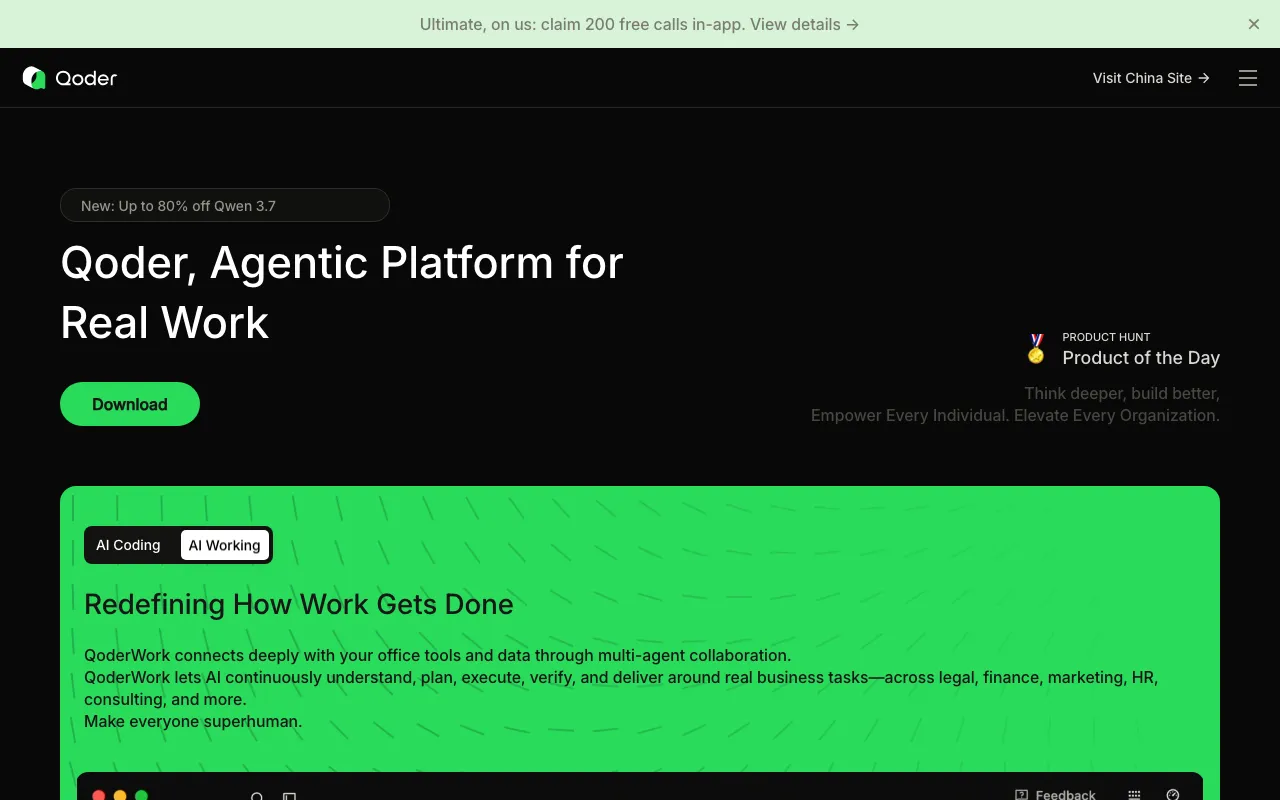
What is Qoder?
Qoder is a desktop-first agentic coding IDE, widely reported as an Alibaba product, that treats the whole repository as context rather than the single file in front of you. Its headline feature is Quest, an autonomous mode you hand a goal to — Quest then plans and executes long, multi-step work with minimal supervision, running for hours if needed, before returning changes for you to review. Alongside Quest, Repo Wiki automatically “Wikilizes” a codebase into a browsable map of its architecture and design, which is aimed squarely at onboarding onto large or unfamiliar projects.
Qoder is generally available rather than a preview, with the vendor citing over a million users and a launched subscription program. It is billed on credits: a free Community Edition covers basic models and limited messages, and paid tiers add larger monthly credit quotas — Pro at $20/month for 2,000 credits, Pro+ at $60/month for 6,000, and Ultra at $200/month for 20,000. Credits do not roll over, and add-on credit packs are available when a plan runs dry. The product spans a desktop IDE, a JetBrains plugin, and a terminal CLI, so it competes directly with editors like Cursor and ByteDance’s Trae.
Who is it for?
Qoder fits developers working in large or unfamiliar codebases who want repo-wide understanding and the option to offload long, self-contained tasks to an autonomous agent. The free Community Edition and 2-week Pro trial make it low-risk to evaluate, but the value shows up on Pro and above, where the monthly credit budget is large enough to run Quest and Repo Wiki on real work. As with any agentic tool, it rewards users who review diffs carefully rather than merging autonomous output unread — and for peak coding quality many pair it with a frontier model like Claude.
- Developers inheriting large or legacy codebases who want Repo Wiki to map architecture before making changes.
- Engineers with long, well-scoped tasks — migrations, refactors, batch fixes — that suit Quest’s hours-long autonomous runs.
- JetBrains and terminal users who want agentic coding inside their existing IDE or CLI rather than a browser chat.
- Teams evaluating credit-based tools who need a free tier and a clear per-credit add-on cost, but should first confirm data-handling policies for proprietary code.
How much does Qoder cost?
Starting price: $20/mo · Free tier: yes · Model: freemium
Price history tracked from June 2026
| Plan | Price | Includes |
|---|---|---|
| Community Edition | Free | Basic models with limited user messages · 2-week Pro trial with starter credits on first sign-in · Access to core IDE, CLI, and JetBrains plugin |
| Pro | $20/mo | 2,000 monthly credits for chat and agent requests · Quest autonomous task mode · Repo Wiki and Knowledge Card · Add-on credit packs available if you run out |
| Pro+ | $60/mo | 6,000 monthly credits (3x Pro) · Same Quest, Repo Wiki, and Knowledge Card features · For heavy users of autonomous coding |
| Ultra | $200/mo | 20,000 monthly credits (10x Pro) · Recommended for frequent long-running Quest tasks · Highest usage ceiling before falling back to basic models |
What are Qoder's key features?
- Quest mode — an autonomous agent that runs long, multi-step tasks with minimal supervision (sessions can run for hours)
- Repo Wiki — automatically 'Wikilizes' a codebase into a browsable architecture and design wiki
- Comprehensive repo-wide context that ingests code, directories, and images across large repositories
- Credit-based usage metering with monthly quotas plus optional add-on credit packs
- Multiple surfaces: Qoder Desktop IDE, JetBrains plugin, and Qoder CLI
- Memory and Rules that learn user preferences and coding patterns
- Knowledge Card for reusable, shareable context
What people use Qoder for
- 01 Delegating long-running, multi-step tasks to Quest mode and reviewing the result rather than supervising every step
- 02 Generating a browsable architecture wiki with Repo Wiki before touching an unfamiliar or legacy codebase
- 03 Whole-repository context queries across very large projects (up to roughly 100k files) to map dependencies before editing
- 04 Everyday code completion and light agent assistance inside the desktop IDE or JetBrains plugin
- 05 Terminal-native coding through the Qoder CLI
Pros and cons
| Pros | Cons |
|---|---|
| Genuine free Community Edition plus a 2-week Pro trial — no payment needed to evaluate | Monthly credits (2,000 on Pro) do not roll over and can run out mid-month on heavy Quest use, pushing you to add-on credit packs or a pricier tier |
| Repo Wiki and whole-repo context are strong for understanding large or unfamiliar codebases | The public pricing page is JavaScript-rendered, so figures here were verified via the official docs pricing page rather than the marketing page; trial credit amounts are reported inconsistently across sources |
| Quest handles long-running autonomous tasks that stall shorter-turn assistants | Corporate ownership is opaque — the product is widely reported as Alibaba's but the site's copyright lists Bright Zenith Private Limited (Singapore); review data-handling policies before using it on proprietary code |
| Pro starts at $20/month, matching the mainstream tier of rivals like Cursor | Autonomous Quest runs still need human review — hours-long agent sessions can drift and require careful diff inspection |
| Primarily a desktop, CLI, and plugin IDE; there is no full browser-based editor |
What are the best Qoder alternatives?
Trae is the closest Qoder alternative in our directory: it covers the same category (AI Coding), starts at $3/mo, has a free tier.
Ranked by category overlap with Qoder, then free-tier availability, then lowest verified starting price — computed from our verified data, never from sponsorships.
| Alternative | What it is | Starting price | Free tier | Price verified |
|---|---|---|---|---|
| Trae | ByteDance's free, VS Code-based AI code editor with an autonomous SOLO mode that scaffolds and builds full-stack projects from a prompt | $3/mo | yes | Jun 30, 2026 |
| GitHub Copilot | AI coding assistant with inline completions, chat, and autonomous agent mode across major IDEs | $10/mo | yes | Jul 3, 2026 |
| Windsurf | Agentic AI IDE with Cascade that writes, edits and runs code autonomously inside your editor | $15/mo | yes | Jun 11, 2026 |
| Claude | Anthropic's AI assistant built for long-context analysis, coding, and safe reasoning | $20/mo | yes | Jul 3, 2026 |
| Cursor | AI-native code editor that runs autonomous agents to build, test, and review code | $20/mo | yes | Jul 3, 2026 |
How people make money with Qoder
- Offer whole-repo documentation and onboarding as a fixed-scope consulting deliverable — use Repo Wiki to generate architecture wikis for legacy codebases clients cannot afford to reverse-engineer by hand
- Increase freelance development throughput by delegating long, multi-step tickets to Quest mode and reviewing the diffs, shipping more client work per week without raising your rate
Frequently asked questions
Who makes Qoder?
Qoder is widely reported by independent tech reviewers as an Alibaba agentic coding platform, operated internationally under the entity Bright Zenith Private Limited (Singapore). It is not a ByteDance product — ByteDance's comparable AI IDE is Trae.
Is Qoder free?
Yes. There is a free Community Edition with basic models and limited messages, plus a 2-week Pro trial with starter credits granted on first sign-in. No payment is required to try it.
How much does Qoder cost?
Paid plans are credit-based: Pro is $20/month for 2,000 credits, Pro+ is $60/month for 6,000 credits, and Ultra is $200/month for 20,000 credits. All paid tiers include Quest, Repo Wiki, and Knowledge Card; the difference is the monthly credit allowance.
What is Quest mode?
Quest is Qoder's autonomous agent mode for long, multi-step tasks. You delegate a goal and Quest works through it with minimal supervision — sessions can run for hours — then hands back changes for review. The Ultra plan is recommended for people who run Quest frequently.
What is Repo Wiki?
Repo Wiki automatically analyzes your repository and generates a browsable wiki of its architecture and design, which Qoder calls 'Wikilizing' the codebase. It is useful for onboarding onto unfamiliar or legacy projects before making changes.
Do Qoder credits roll over?
No. Monthly credits refresh at the start of each billing cycle and unused credits expire — they do not carry over. If you run out, you can buy add-on credit packs, which are valid for one month from purchase.
Is Qoder better than Claude for coding?
Not necessarily. Qoder is strong at repo-wide, in-IDE workflows and long autonomous Quest runs, but Claude and Claude Code remain a benchmark for general coding quality and agentic multi-file work. Many developers use Qoder for its IDE tooling alongside frontier models rather than as a replacement for them.