Qodo
AI code-review and governance platform that automates pull-request review and enforces standards
Qodo (formerly CodiumAI) is an AI code-review and governance platform that automates pull-request review, enforces coding standards, and flags issues in your IDE. There is a 14-day free trial (no card); the Pro Team plan is $30/month for up to 30 users on a pooled credit model at $0.012/credit, and Enterprise adds SSO, on-prem, and bring-your-own LLM keys. Best for teams shipping AI-generated code that needs consistent review. For general coding, Claude remains stronger.
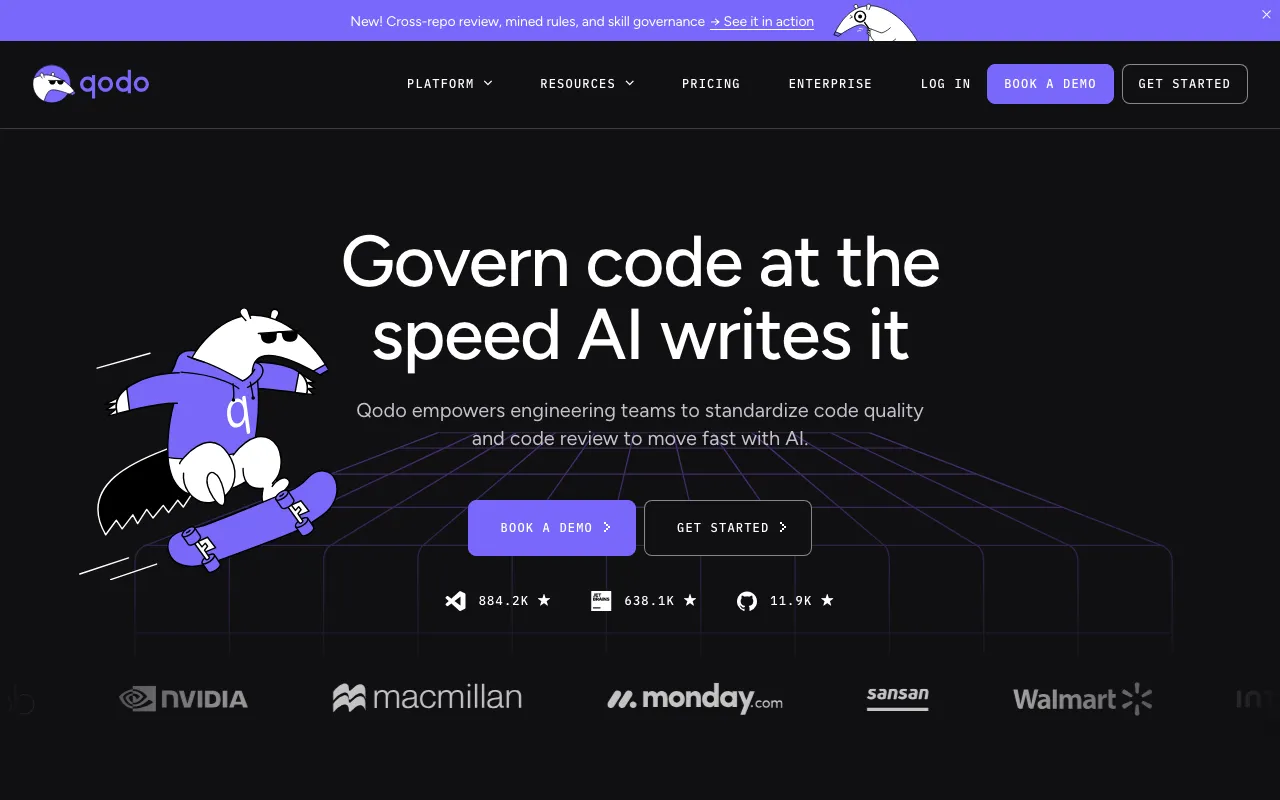
What is Qodo?
Qodo, formerly CodiumAI, is an AI platform for code review and governance. Where general coding assistants focus on writing code, Qodo focuses on checking it: its flagship Qodo Merge runs agentic review on every pull request across GitHub, GitLab, and Bitbucket, catching bugs, style violations, and breaches of your team’s conventions before a human reviewer weighs in. An in-IDE extension for VS Code and the JetBrains editors surfaces the same feedback while you code, so issues are caught before a PR is even opened.
The broader pitch is governance. Qodo’s standards system encodes coding conventions as machine-readable rules that apply organization-wide, a governance portal tracks risk and quality metrics across repositories, and a context engine builds cross-repository understanding so reviews reflect how your codebase actually works. The company frames this as closing the gap between how fast AI now writes code and how slowly review and governance have kept up. Pricing is a pooled credit model — a team shares one balance rather than paying strictly per seat.
Who is it for?
Qodo is aimed at engineering teams, not solo hobbyists — the pooled-credit Pro Team plan covers up to 30 users, and the governance features matter most when many developers (and AI agents) touch a shared codebase. Teams that already trust general assistants like Cursor or GitHub Copilot for writing code use Qodo as the review-and-standards layer on top. For open-ended coding help and reasoning, Claude remains the stronger general-purpose choice; Qodo’s edge is disciplined, repeatable review.
- Mid-to-large engineering teams managing multi-repository codebases who want consistent, automated first-pass review on every PR.
- Engineering leaders who need to enforce standards and produce audit trails as AI-generated code becomes a larger share of commits.
- Teams on GitHub, GitLab, or Bitbucket that want review integrated into their existing git and IDE workflow rather than a separate tool.
- Regulated or enterprise organizations needing SSO/SAML, on-premises deployment, or bring-your-own LLM keys on the Enterprise plan.
How much does Qodo cost?
Starting price: $30/mo · Free tier: no · Model: paid
Price history tracked from June 2026
| Plan | Price | Includes |
|---|---|---|
| Free Trial | $0 | 14 days, no credit card · Unlimited reviews and credits during trial · Agentic PR review and rules system · Git and IDE integrations |
| Pro Team | $30/mo | Up to 30 users, no commitment · Pooled credits at ~$0.012 each · Credit packs: 2,500 / 5,000 / 20,000 · Unlimited repositories and reviews |
| Enterprise | Custom | 30+ users, SSO/SAML, audit logs · Bring-your-own LLM keys · Single-tenant SaaS or on-premises · Priority support and dedicated account manager |
What are Qodo's key features?
- Qodo Merge — agentic PR review on GitHub, GitLab, and Bitbucket
- In-IDE review and suggestions for VS Code and JetBrains editors
- Machine-readable standards system to enforce conventions org-wide
- Governance portal with risk, quality, and compliance metrics across repos
- Context engine for cross-repository understanding
- Pooled credit model shared across the whole team
What people use Qodo for
- 01 Automating pull-request review so every PR gets a consistent first-pass check before a human reviews
- 02 Enforcing organization-wide coding standards across multiple repositories
- 03 Catching bugs and issues in the IDE while writing code, before opening a PR
- 04 Governing AI-generated code with audit trails and quality metrics
Pros and cons
| Pros | Cons |
|---|---|
| Focused specifically on code review and governance rather than general autocomplete | No permanent free tier — after the 14-day trial you must pay, unlike some autocomplete competitors |
| 14-day trial needs no credit card, and open-source projects can qualify for free access | Credits expire monthly with no rollover, and heavy review volume can exhaust a pack quickly |
| Pooled credits (about $0.012 each) let a team of up to 30 share one $30/month plan | Enterprise controls (SSO/SAML, on-prem, BYO LLM keys) require the custom 30+ user plan |
| Works across GitHub, GitLab, and Bitbucket plus VS Code and JetBrains |
What are the best Qodo alternatives?
CodeRabbit is the closest Qodo alternative in our directory: it covers the same category (AI Coding), starts at $0, has a free tier.
Ranked by category overlap with Qodo, then free-tier availability, then lowest verified starting price — computed from our verified data, never from sponsorships.
| Alternative | What it is | Starting price | Free tier | Price verified |
|---|---|---|---|---|
| CodeRabbit | AI code-review bot that posts line-by-line PR feedback, summaries, and fixes on GitHub, GitLab, Azure DevOps, and Bitbucket, plus a free IDE and CLI reviewer | $0 | yes | Jun 23, 2026 |
| GitHub Copilot | AI coding assistant with inline completions, chat, and autonomous agent mode across major IDEs | $10/mo | yes | Jul 3, 2026 |
| Claude | Anthropic's AI assistant built for long-context analysis, coding, and safe reasoning | $20/mo | yes | Jul 3, 2026 |
| Cursor | AI-native code editor that runs autonomous agents to build, test, and review code | $20/mo | yes | Jul 3, 2026 |
How people make money with Qodo
- Offer AI code-review and governance rollout as a consulting service for engineering teams — configure Qodo Merge rules, the standards system, and CI gates, billed as a fixed-scope onboarding engagement
Frequently asked questions
Is Qodo free?
Qodo offers a 14-day free trial with no credit card and unlimited reviews, but there is no permanent free tier. After the trial, the Pro Team plan costs $30 per month. Open-source projects can apply for free access through a separate program.
How much does Qodo cost?
Qodo's Pro Team plan is $30 per month for up to 30 users, billed with no long-term commitment. It uses a pooled credit model at about $0.012 per credit, with packs of 2,500, 5,000, or 20,000 credits. Enterprise pricing is custom.
What is the difference between Qodo and CodiumAI?
They are the same company. CodiumAI rebranded to Qodo, expanding from AI test generation into a broader code-review and governance platform that now includes Qodo Merge for pull-request review and an in-IDE review extension.
Which IDEs and git platforms does Qodo support?
Qodo works in VS Code and the JetBrains editors, including IntelliJ, PyCharm, WebStorm, and GoLand. For pull-request review, Qodo Merge integrates with GitHub, GitLab, and Bitbucket across all major programming languages.
How many code reviews does a Qodo plan include?
Reviews draw from a pooled credit balance. Qodo estimates roughly 18 reviews per month from a 2,500-credit pack, 36 from 5,000 credits, and 144 from 20,000 credits. Unused credits expire monthly with no rollover.
Does Qodo replace human code review?
No. Qodo automates a consistent first-pass review — catching bugs, style violations, and standards breaches — but it is designed to speed up human reviewers, not replace their judgment on architecture and design decisions.
Public signals
- "Qodo CLI agent scores 71.2% on SWE-bench Verified" — 139 points on Hacker News, Aug 12, 2025