SciSpace
AI research assistant (formerly Typeset) to chat with PDFs, run literature reviews across 280M+ papers, and synthesize findings
SciSpace (formerly Typeset) is an AI research assistant that lets you chat with PDFs, run literature reviews across 280M+ papers, and synthesize findings with its Deep Review feature, plus an AI writer and paraphraser. There is a free tier; Premium is $12/month billed annually (about $20 monthly), with Advanced and Max tiers adding larger credit pools. Best for researchers and graduate students processing large volumes of academic literature.
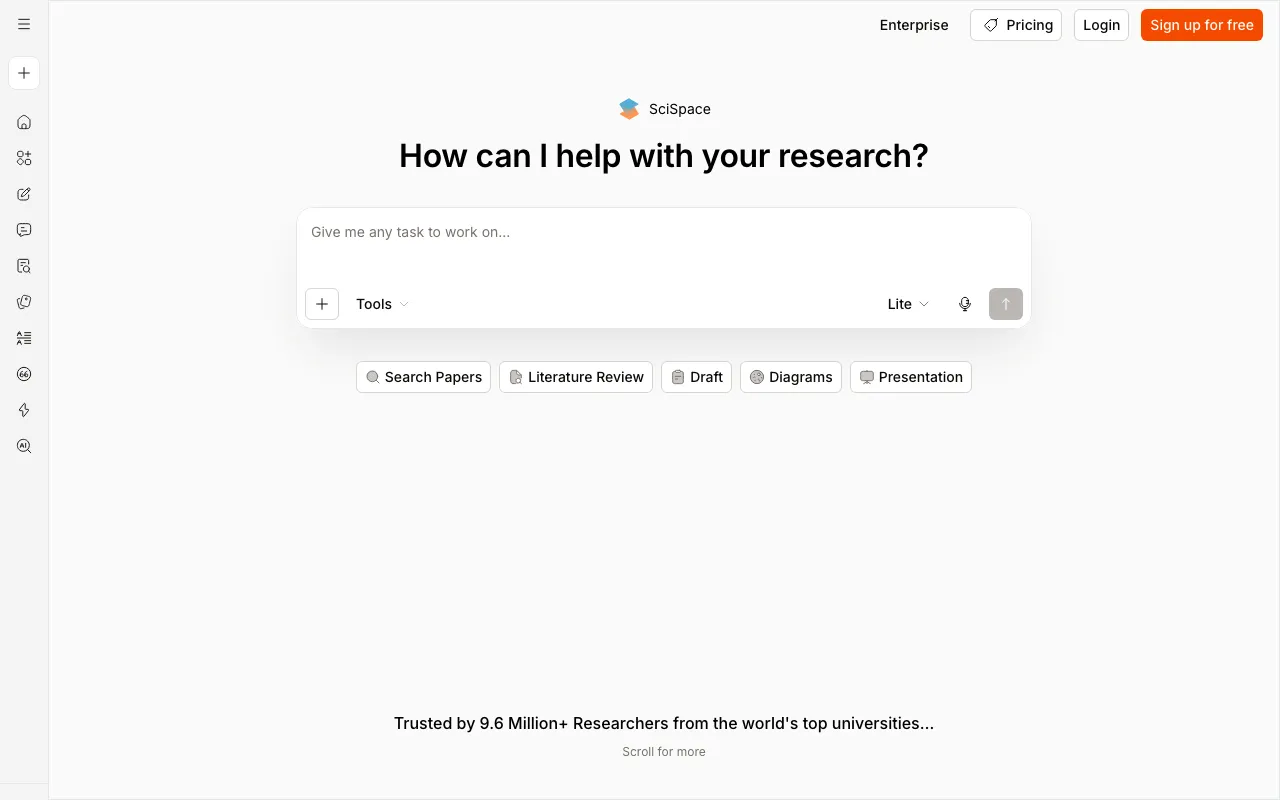
What is SciSpace?
SciSpace, formerly known as Typeset, is an AI-powered platform that tries to cover the whole academic research workflow in one place. Its best-known feature is “chat with PDF”: upload a paper and ask plain-language questions about its methods, results, figures, or conclusions, and SciSpace answers with reference to the text. From there it scales up to systematic literature review across a corpus of more than 280 million papers, extracting key data into comparison tables, and a Deep Review mode that synthesizes a curated set of high-quality papers into themes, trends, gaps, and methodologies with a cited source list.
Around that research core, SciSpace bundles writing tools: an AI Writer that drafts academic text and inserts citations from the corpus, a Paraphraser that rewrites text in more than 75 languages while keeping citations intact, an AI content detector, and a citation generator carrying over 40,000 journal formatting templates from its Typeset days. A SciSpace Copilot browser extension extends the explanations to journal sites, arXiv, and the wider web. As with any AI research tool, its outputs can be wrong or overstated, so findings still need verification.
Who is it for?
SciSpace is aimed at people who regularly wade through large volumes of scientific literature and want to move faster without losing the citation trail. The free tier is enough to try the core features, while the credit-metered paid tiers suit heavier, ongoing research.
- Researchers and academics running literature reviews and synthesizing findings across many papers.
- Graduate and PhD students reading dense papers and drafting their own work with proper citations.
- Authors preparing for submission who need journal-specific formatting and reference management.
- Undergraduates and analysts who want quick, plain-language explanations of technical papers via chat or the browser extension.
How much does SciSpace cost?
Starting price: $12/mo · Free tier: yes · Model: freemium
Price history tracked from June 2026
| Plan | Price | Includes |
|---|---|---|
| Free | Free | Limited AI Copilot queries · Basic literature review and citation extraction · PDF highlighting · Limited paraphrasing |
| Premium | $12/mo | $12/mo billed annually; about $20/mo monthly · Around 1,200 monthly credits · Unlimited AI Copilot queries and paper summaries · 40,000+ journal formatting templates |
| Advanced | $70/mo | $70/mo annual; about $90/mo monthly · Around 10,000 monthly credits · Higher-quality model access · Everything in Premium |
| Max | $160/mo | $160/mo annual; about $200/mo monthly · Around 40,000 monthly credits · Priority support · Priority access to new features |
| Enterprise | Custom | For institutional research needs · Role management and admin tools · Dedicated account manager · Priority support |
What are SciSpace's key features?
- Chat with PDF — natural-language questions and answers on uploaded papers
- Literature review across 280M+ academic papers
- Deep Review for multi-paper synthesis from curated, high-quality sources
- AI Writer that inserts citations from the corpus
- Paraphraser supporting 75+ languages that preserves citations
- Citation generator with 40,000+ journal formatting templates
- SciSpace Copilot Chrome extension that explains papers anywhere on the web
What people use SciSpace for
- 01 Uploading a paper and asking natural-language questions about its methods and results
- 02 Running a systematic literature review across millions of papers and extracting data into tables
- 03 Synthesizing themes, gaps, and methodologies from a set of papers with Deep Review
- 04 Drafting academic text with citations auto-inserted from the paper corpus
- 05 Paraphrasing academic writing while keeping citations intact
Pros and cons
| Pros | Cons |
|---|---|
| Massive 280M+ paper corpus underpins search and citation features | Like any AI research tool, it can hallucinate or over-interpret findings — claims need checking |
| Free tier is usable for trying chat-with-PDF and basic reviews | The advertised $12/month requires annual prepay; monthly billing is about $20 |
| Chrome extension brings explanations to journal sites, arXiv, and more | Higher credit tiers (Advanced, Max) jump steeply to $70 and $160 per month |
| Premium is inexpensive at $12/month on annual billing | No confirmed dedicated mobile app, and API access is not a clearly documented public offering |
What are the best SciSpace alternatives?
NotebookLM is the closest SciSpace alternative in our directory: it covers the same category (AI Search & Research), starts at $7.99/mo, has a free tier.
Ranked by category overlap with SciSpace, then free-tier availability, then lowest verified starting price — computed from our verified data, never from sponsorships.
| Alternative | What it is | Starting price | Free tier | Price verified |
|---|---|---|---|---|
| NotebookLM | Google's AI research assistant that answers questions grounded in your own uploaded sources | $7.99/mo | yes | Jun 11, 2026 |
| Consensus | AI search engine for peer-reviewed research across 200M+ scientific papers | $10/mo | yes | Jun 11, 2026 |
| Perplexity | AI-powered answer engine that searches the live web and cites every source | $20/mo | yes | Jun 11, 2026 |
| Elicit | AI research assistant that searches, summarizes and extracts data from 138 million academic papers | $49/mo | yes | Jul 3, 2026 |
How people make money with SciSpace
- Academic research-support service — offer literature reviews and reference formatting for grad students and authors using SciSpace, billed per project or per chapter
Frequently asked questions
Is SciSpace free?
Yes. SciSpace has a free tier with limited AI Copilot queries, basic literature review, citation extraction, and PDF highlighting. Heavier use — unlimited Copilot queries and larger credit pools — requires the Premium ($12/month annually), Advanced, or Max plan.
How much does SciSpace cost?
SciSpace Premium is about $12 per month billed annually, or roughly $20 per month month-to-month. Advanced is around $70 per month with 10,000 monthly credits, and Max is about $160 per month with 40,000 credits. Enterprise pricing is custom.
What is SciSpace Deep Review?
Deep Review is SciSpace's multi-paper synthesis feature. It draws from a curated set of high-quality papers and organizes findings into themes, trends, gaps, and methodologies with a cited source list, helping researchers summarize a body of literature more quickly.
How many papers does SciSpace search?
SciSpace searches a corpus of more than 280 million academic papers. It uses that corpus for literature review, citation extraction, and its AI Writer, which can insert relevant citations into your draft automatically.
Was SciSpace formerly called Typeset?
Yes. SciSpace was previously known as Typeset, at typeset.io. It kept its journal-formatting roots — offering more than 40,000 journal templates — while expanding into AI-powered literature review, chat-with-PDF, paraphrasing, and academic writing tools.
Can SciSpace write and paraphrase academic text?
Yes. SciSpace includes an AI Writer that drafts academic text and auto-inserts citations, plus a Paraphraser that rewrites text in more than 75 languages while preserving citations. Outputs should still be reviewed, since AI tools can introduce errors.