Vecbase
Multi-agent workspace where specialised AI agents share files, tools, and sandboxed computers to finish real work
Vecbase runs a team of specialised AI agents — researcher, coder, writer, operator — in one workspace with shared files, OAuth-connected apps, and a fresh sandboxed computer for every task. There are only two plans: Plus at $20/month and Pro at $50/month, each including that same dollar amount in usage credits, with overages billed off a published rate card at provider cost multiplied by 1.15. It launched in July 2026, so it is very early.
What is Vecbase?
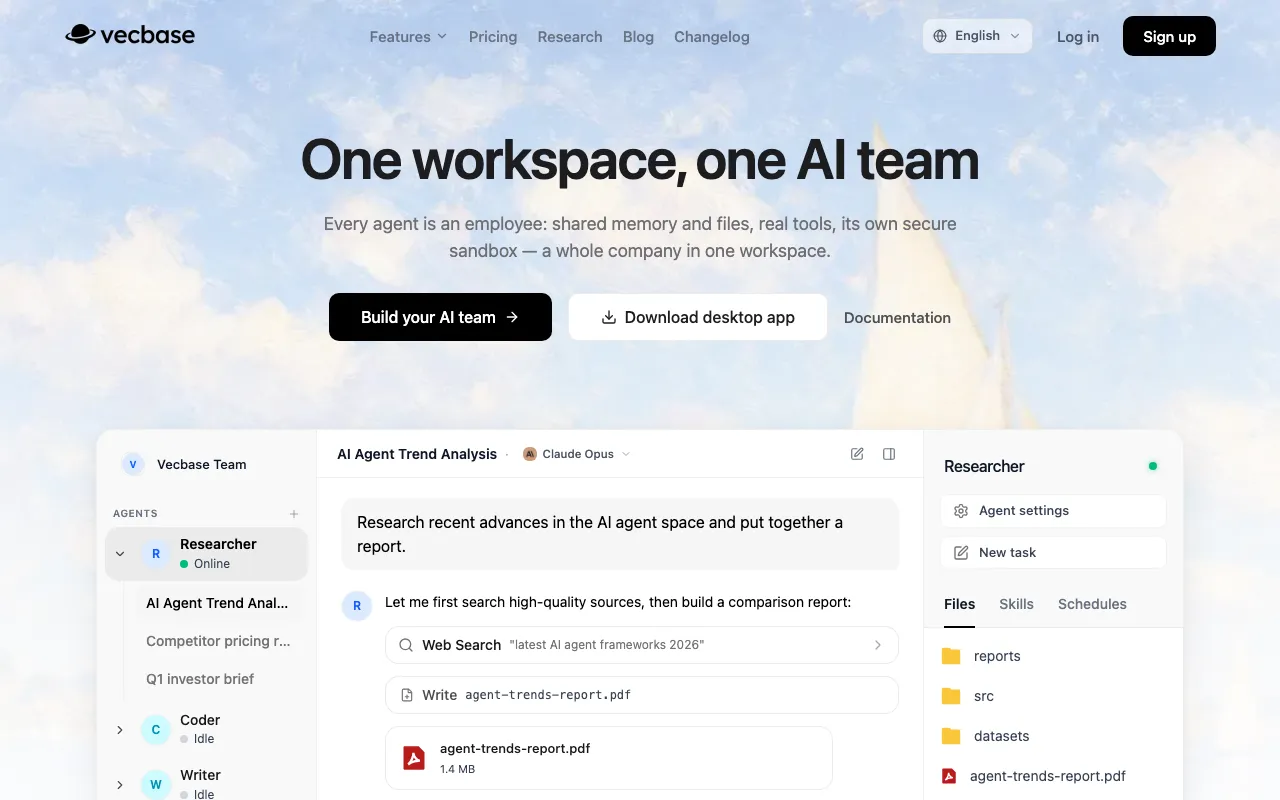
Vecbase is a workspace that treats AI agents as staff rather than as chat windows. You create agents with distinct jobs — a researcher, a coder, a writer, an operator — and each one gets a role, a model, a set of tools, and its own sandboxed computer that is created fresh for every task. They all read and write the same shared Drive, so the output of the research agent is a file the writer agent can open, not a message someone has to copy across. Work arrives as finished artefacts: reports, slide decks, spreadsheets, images, code, published sites.
The part that separates it from most agent platforms is the billing surface. The subscription is a credit balance, not a seat fee: $20/month on Plus and $50/month on Pro each deposit the same dollar amount as usage credits, and everything an agent does — tokens, sandbox hours, storage, egress, web search, document parsing, transcription, speech synthesis — is drawn down against that balance at rates published in full on the pricing page. Vecbase states the formula openly: exact provider cost multiplied by 1.15. Agents connect outward to Gmail, Notion, GitHub, Slack, Calendar, Drive, HubSpot, Salesforce, Linear, Jira, and Figma through OAuth, and every step an agent takes streams into the chat where it stays replayable afterwards.
Who is it for?
Vecbase suits small teams that already have repeatable knowledge work — weekly competitor sweeps, inbox triage, recurring reports, data cleanup — and want it produced as files on a schedule rather than assembled by hand each time. It is a very new product, released on 9 July 2026, so it fits people who are comfortable evaluating something before a track record exists.
- Operators at small companies and agencies who want a standing set of agents handling research, drafting, and CRM upkeep across client workspaces, priced per organisation rather than per seat.
- Analysts and researchers who need scheduled multi-step briefs — search, read, compare, write — delivered as documents with the working steps visible and replayable.
- Cost-sensitive teams who would rather read a full rate card and pay provider cost plus a stated 15 percent than guess what an opaque “credit” is worth, as at manus or genspark.
- Anyone who has outgrown single-agent chat and wants parallel agents with separate memory, tools, and permissions — the same territory as dust, crewai, and relevance-ai.
How much does Vecbase cost?
Starting price: $20/mo · Free tier: no · Model: paid
Price history tracked from June 2026
| Plan | Price | Includes |
|---|---|---|
| Plus | $20/mo | One subscription per organisation · Includes $20 of usage credits each month · Overages billed at the same published rates · Models, tools, and connected apps · Schedules and multi-agent workflows · A fresh sandboxed computer is created for every task |
| Pro | $50/mo | Everything in Plus · Includes $50 of usage credits each month · More included credits at the same usage rates · Persistent cloud computers for agents that run 24/7 |
| Usage rates (both plans) | Provider cost x 1.15 | Model inference priced per million tokens, per model · Compute from $0.06/hour (2 vCPU / 1 GB) to $0.60/hour (4 vCPU / 16 GB) · Persistent volume $0.28/GB-month, object storage $0.04/GB-month · Internet egress $0.12/GB · Web search from $5.75 per 1,000 Perplexity requests · Document parsing from $0.0345 per page |
What are Vecbase's key features?
- Separate agents with distinct roles that run in parallel in the same workspace
- A fresh isolated sandbox computer per task, or persistent cloud computers on the Pro plan
- Shared Drive so agents and people read and write the same files with per-agent access control
- Skills — reusable routines written once and callable by any agent
- Scheduled tasks that deliver results to Drive or an inbox on a fixed cadence
- Model choice per agent across Claude, GPT, Gemini, Kimi, DeepSeek, MiniMax, and Vecbase's own models
- Managed capabilities billed in one place: speech-to-text, TTS, document parsing, image generation, crawling, translation
- Live step-by-step execution view — every search, file read, and shell command streams into the chat and stays replayable
- Desktop app alongside the web workspace, with an interface localised into 12 languages
What people use Vecbase for
- 01 Handing a multi-step brief to a research agent that searches, reads sources, and returns a written report with citations
- 02 Running scheduled agents that produce a Monday brief or a six-hourly check without anyone re-prompting them
- 03 Letting an agent act inside Gmail, Notion, GitHub, Slack, Linear, or Jira through OAuth rather than copy-pasting between tools
- 04 Packaging a repeated internal routine as a Skill once, then letting every agent in the workspace run it
- 05 Producing deliverables that are files — slide decks, spreadsheets, images, code, published sites — instead of chat replies
Pros and cons
| Pros | Cons |
|---|---|
| The published rate card is unusually complete — per-model token rates, per-hour compute, storage, egress, search, and parsing are all listed with the markup formula stated openly | Launched 9 July 2026 with one blog post and one changelog entry — there is no third-party review, benchmark, or user base to check the marketing claims against |
| Only two plans to choose between, and the subscription fee is credit you actually spend rather than a seat-access charge | No free tier is offered on the pricing page, so evaluating it costs at least a month of Plus |
| Per-task sandboxing means an agent running shell commands cannot reach the rest of the workspace | The published OpenAPI file at docs.vecbase.com is still the unmodified documentation-template sample (a plant store), so there is no usable public API despite the docs implying one |
| Model choice is per agent, so cheap models can handle routine steps while a frontier model handles the hard one | Credits are consumed by real infrastructure — long-running agents on persistent computers can burn a Pro allowance well before month-end, and overage is uncapped by default |
| The in-house Vecbase 1.0 models are undocumented, so it is not possible to judge them against the third-party models on the same rate card |
What are the best Vecbase alternatives?
Manus is the closest Vecbase alternative in our directory: it covers the same category (AI Agents & Automation), starts at $20/mo, has a free tier.
Ranked by category overlap with Vecbase, then free-tier availability, then lowest verified starting price — computed from our verified data, never from sponsorships.
| Alternative | What it is | Starting price | Free tier | Price verified |
|---|---|---|---|---|
| Manus | Autonomous general AI agent that plans and executes multi-step tasks end-to-end in the cloud | $20/mo | yes | Jun 20, 2026 |
| Lindy | No-code AI agents that handle email, calendar, meetings, and 100+ app integrations | $49.99/mo | no | Jun 21, 2026 |
| CrewAI | Open-source multi-agent framework for orchestrating collaborative AI agent teams | $0 | yes | Jul 3, 2026 |
| Genspark | All-in-one AI Super Agent that runs research, slides, sheets, browsing, and real phone calls | $0 | yes | Jun 22, 2026 |
| Relevance AI | No-code platform for building and deploying autonomous AI agents for business workflows | $19/mo | yes | Jun 11, 2026 |
| Dust | Enterprise platform for building and deploying AI agents connected to company data, tools, and workflows | $30/seat/mo | yes | Jul 18, 2026 |
How people make money with Vecbase
- Sell recurring research or competitor-tracking reports: a scheduled agent runs the same brief every week and drops the finished deck or spreadsheet into Drive, so a retainer covers review time instead of production time
- Run per-client agency workspaces where one agent triages the shared inbox through the Gmail connection and another maintains records through the HubSpot or Salesforce connection, billed as a monthly operations retainer
Frequently asked questions
How much does Vecbase cost?
Vecbase has two plans. Plus is $20 per month and Pro is $50 per month, each billed as one subscription per organisation. The monthly fee arrives as usage credits of the same value, and anything beyond that is billed at the same published rates rather than at a penalty rate.
Does Vecbase have a free tier?
No. The pricing page lists only the Plus and Pro plans, with no permanent free plan and no free credit allowance stated. Evaluating Vecbase means paying for at least one month of Plus at $20.
How is usage billed on top of the subscription?
Every action draws down the monthly credit balance. Model inference is charged per million tokens, compute per hour, storage per gigabyte-month, and search per thousand requests. Vecbase states that billing applies the exact provider cost multiplied by 1.15, so the markup is 15 percent.
Which AI models can Vecbase agents use?
Each agent picks its own model. The published rate card covers Claude, OpenAI GPT-5.5, Gemini, Kimi, DeepSeek V4 Pro and Flash, MiniMax M2.7, and three in-house Vecbase 1.0 variants. Cheaper models can handle routine steps while a frontier model handles harder work.
Does Vecbase have a public API?
Not a usable one. The documentation site links an OpenAPI specification, but the file served is still the unedited sample that ships with the documentation template. Integration today happens the other way round: agents connect outward to Gmail, Notion, GitHub, Slack, HubSpot, Salesforce, Linear, Jira, and Figma via OAuth.
What is a Vecbase Skill?
A Skill is a routine written once and stored in the workspace so any agent can run it without being re-taught. It is Vecbase's answer to pasting the same long instructions into every new conversation.
Is Vecbase safe to give access to my accounts?
Each task runs in its own isolated computer, and agents hold per-agent access rather than blanket workspace access. That said, OAuth connections act through your own account, so an agent's mistakes appear as your actions in Gmail, GitHub, or a CRM. Approval steps matter.