Weaviate
Open-source vector database for AI-native search, RAG, and semantic retrieval — self-host free or run it managed on Weaviate Cloud
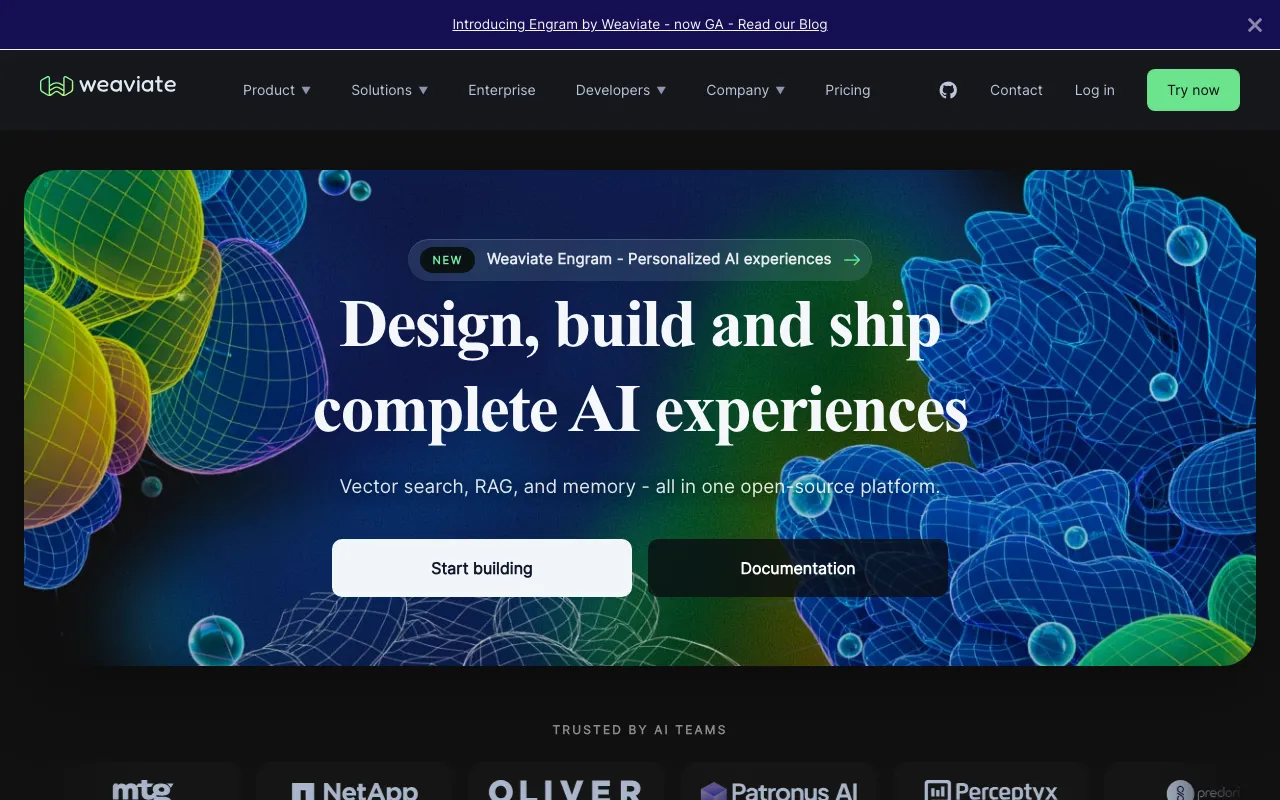
Weaviate is an open-source (BSD-3-Clause) vector database for AI-native search, RAG, and semantic retrieval. The core engine is free to self-host with no object cap. Weaviate Cloud adds a managed offering: a free tier capped at 100,000 objects, pay-as-you-go Flex from $45/month, Plus from $280/month, and custom-priced Premium for BYOC and compliance. Best for teams building production RAG and hybrid search.
What is Weaviate?
Weaviate is an open-source vector database built for AI-native search, retrieval-augmented generation (RAG), and semantic retrieval. Instead of matching on exact keywords, it stores data as high-dimensional embeddings and finds results by meaning, making it a common backend for LLM applications that need to ground answers in private documents. The core engine is licensed under BSD-3-Clause and can be self-hosted via Docker, Kubernetes, or an embedded runtime with no cap on the number of objects you store.
Beyond raw vector storage, Weaviate ships hybrid search that blends dense vector similarity with BM25 keyword ranking, built-in vectorization modules and Weaviate Embeddings for generating vectors from text and images, and a Query Agent that translates natural-language intent into optimized database queries. It exposes GraphQL, REST, and gRPC APIs alongside SDKs for Python, Go, TypeScript, and JavaScript. For teams that prefer not to run infrastructure, Weaviate Cloud provides the same engine as a managed service with a free tier and metered paid plans.
Who is it for?
Weaviate suits engineering teams building production RAG, semantic search, or AI agents that need durable memory, and it fits both self-hosted and managed deployment paths. The open-source core is a strong fit when data residency, cost control, or air-gapped operation matter; Weaviate Cloud makes sense when a team would rather pay for uptime and support than manage clusters themselves.
- AI/ML engineers building RAG pipelines who need hybrid retrieval and built-in embeddings in one database.
- Startups and solo builders who want a free, uncapped self-hosted vector store to keep early infrastructure cost near zero.
- Platform teams running large-scale semantic search that need replication, multi-tenancy, and quantization to control memory cost.
- Enterprises with compliance needs that require BYOC deployment, HIPAA controls, and dedicated support through the Premium plan.
How much does Weaviate cost?
Starting price: $0 · Free tier: yes · Model: open-source
Price history tracked from June 2026
| Plan | Price | Includes |
|---|---|---|
| Open Source (Self-Hosted) | Free | BSD-3-Clause licensed, fully self-hostable · No object or collection cap · Deploy via Docker, Kubernetes, or embedded · All core vector, hybrid, and keyword search features |
| Cloud Free | Free | 100,000 objects, 1 GB memory, 10 GB disk · 1 collection, no credit card required · Built-in embeddings (2,000 requests/day) · Query Agent (1,000 requests/month) |
| Flex | $45/mo | Pay-as-you-go, no long-term commitment · Unlimited objects, up to 1,000 collections · 99.5% uptime SLA, RBAC · Priced on vector dimensions, storage, and backups |
| Plus | $280/mo | Annual commitment with discounted rates · Higher uptime SLA and faster support response · Choice of shared or dedicated deployment · Available across shared and dedicated clusters |
| Premium | Custom | Bring Your Own Cloud (BYOC) deployment · HIPAA and compliance controls · Dedicated infrastructure on AWS, GCP, or Azure · Enterprise support with 1-hour Sev 1 response |
What are Weaviate's key features?
- BSD-3-Clause open-source core, self-hostable via Docker or Kubernetes
- Hybrid search combining dense vector similarity with BM25 keyword ranking
- Built-in vectorization modules and Weaviate Embeddings for text and images
- Query Agent that translates natural-language intent into optimized database queries
- GraphQL, REST, and gRPC APIs with Python, Go, TypeScript, and JavaScript SDKs
- Horizontal scaling, replication, and multi-tenancy for production workloads
- Compression (product/binary quantization) to cut memory cost of large vector sets
What people use Weaviate for
- 01 Powering retrieval-augmented generation (RAG) pipelines that ground LLM answers in your own documents
- 02 Semantic and hybrid (vector + keyword) search over large product catalogs or knowledge bases
- 03 Self-hosting a vector store with no per-object cost for privacy-sensitive or air-gapped deployments
- 04 Adding long-term memory and personalization to AI agents and chat applications
- 05 Multimodal search across text, images, and other embedding types in one database
Pros and cons
| Pros | Cons |
|---|---|
| Core database is fully open source with no object cap when self-hosted | Cloud pricing is metered on vector dimensions, storage, and backups, so costs are harder to predict than flat per-object plans |
| Managed cloud starts free (100,000 objects) and scales pay-as-you-go from $45/month | Self-hosting at scale requires managing memory, replication, and quantization tuning yourself |
| Native hybrid search and built-in embeddings reduce the need for extra services | Enterprise BYOC and compliance features sit behind custom-priced Premium contracts |
| Broad SDK and API coverage (GraphQL, REST, gRPC) fits most stacks |
What are the best Weaviate alternatives?
LlamaIndex is the closest Weaviate alternative in our directory: it covers the same category (AI Search & Research), starts at $50/mo, has a free tier.
Ranked by category overlap with Weaviate, then free-tier availability, then lowest verified starting price — computed from our verified data, never from sponsorships.
| Alternative | What it is | Starting price | Free tier | Price verified |
|---|---|---|---|---|
| LlamaIndex | Open-source data framework for LLM apps, plus the commercial LlamaCloud platform for parsing, extracting, and indexing complex documents | $50/mo | yes | Jul 16, 2026 |
| Qdrant | Open-source vector database in Rust for RAG, agent memory, and semantic search — self-host free or run on Qdrant Cloud | Free | yes | Jul 20, 2026 |
| Mem0 | Memory layer for AI agents that stores and retrieves user context across sessions, open source with a hosted platform | $19/mo | yes | Jul 18, 2026 |
| Pinecone | Managed serverless vector database for semantic search, RAG, and recommendation systems | $20/mo | yes | Jul 12, 2026 |
| LangChain | Open-source frameworks for building LLM agents, plus the commercial LangSmith platform for tracing, evaluation, and deployment | $39/seat/mo | yes | Jul 12, 2026 |
How people make money with Weaviate
- Offer managed RAG-backend setup as a service: deploy the free self-hosted core on client infrastructure, then upsell migration to Weaviate Cloud Flex or Plus once teams outgrow the ops overhead
- Build and sell vertical semantic-search products (legal, e-commerce, support docs) on the free self-hosted engine, keeping infrastructure cost near zero until customer volume justifies the Plus plan
Frequently asked questions
Is Weaviate free?
Yes. The core Weaviate database is open source under the BSD-3-Clause license and free to self-host with no object cap. Weaviate Cloud also offers a free managed tier capped at 100,000 objects, 1 GB memory, and one collection, with no credit card required.
What license is Weaviate released under?
The core Weaviate database is licensed under BSD-3-Clause, a permissive open-source license held by Weaviate B.V. That means you can self-host, modify, and redistribute it, including in commercial products, subject to the license's attribution and endorsement clauses.
How much does Weaviate Cloud cost?
Weaviate Cloud has a free tier for up to 100,000 objects. Paid managed plans start with Flex at $45/month (pay-as-you-go), Plus from $280/month with annual commitment, and custom-priced Premium for BYOC and compliance needs. Usage is metered on vector dimensions, storage, and backups.
Does Weaviate have an API?
Yes. Weaviate exposes GraphQL, REST, and gRPC APIs, plus official SDKs for Python, Go, TypeScript, and JavaScript. Applications connect to a self-hosted instance or a Weaviate Cloud cluster through the same client libraries.
How is Weaviate different from Pinecone?
Weaviate is open source and can be self-hosted for free with no object cap, while Pinecone is a fully managed, closed-source service. Weaviate also ships native hybrid search and built-in vectorization modules; Pinecone focuses on a simpler managed vector API without a self-host option.
Can Weaviate be used for RAG?
Yes. RAG is a primary use case. Weaviate stores document embeddings, supports hybrid vector-plus-keyword retrieval, and includes a Query Agent that turns natural-language intent into optimized queries, making it a common retrieval backend for LLM applications.