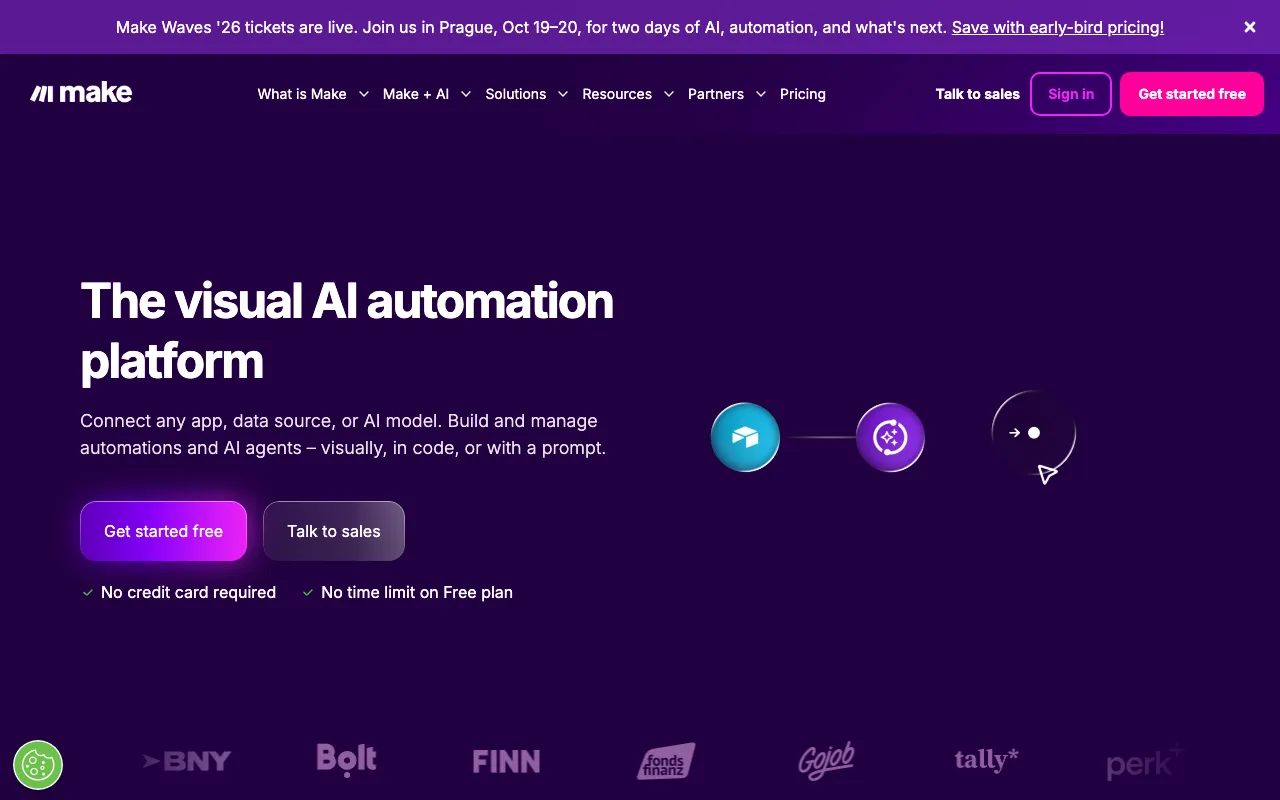
Make
Visual automation platform connecting 3,000+ apps with no-code workflows and AI agents
FREEMIUM Verified JUL 3, 2026
7 tools ranked · last updated Jun 28, 2026 · how we picked
The best AI automation tool in 2026 is Make, whose Core plan runs just $9/mo for unlimited scenarios, 3,000+ app connectors, and the branching logic simpler tools can't match. The most generous free option is Gumloop, with 5,000 credits per month at $0, while the strongest developer pick is n8n — free to self-host with full code-level control, or €20/mo in the cloud. Below we rank 7 tools by capability, verified-price value, and free-tier generosity for the job you actually need done.
Prices last verified Jul 3, 2026 against official pricing pages.
Make is a visual workflow automation platform that connects 3,000+ apps and AI services without code, building each workflow as a “scenario” on a node canvas. Its routers, filters, and iterators handle branching, looping, and conditional logic that linear builders struggle with, which is why it suits multi-path processes rather than simple A-to-B handoffs. The free tier includes 1,000 operations per month and 2 active scenarios; the Core plan is $9/mo for 10,000 operations, unlimited active scenarios, 1-minute scheduling, and Make API access. That price makes it the strongest value in this list for technical and semi-technical operators. The honest caveat: Make bills per operation, so a single data-heavy scenario that touches many records can burn your monthly allowance fast, and the flexible canvas carries a steeper learning curve than Zapier’s step-by-step editor. Best for ops teams building intricate, high-fan-out automations on a budget.
n8n is a workflow automation platform built for technical teams, pairing a visual canvas with inline JavaScript and Python so you can drop to code whenever a node isn’t enough. It ships a dedicated AI agent layer — multi-agent pipelines, RAG sources, multiple LLM providers, and human-in-the-loop approval gates, all on the same canvas. The Community Edition is free to self-host under a FairCode licence with unlimited workflows and no execution cap; the managed Cloud Starter plan is €20/mo for 2,500 executions and 5 concurrent runs, scaling to Pro at €50/mo for 10,000. Self-hosting gives you full data control at zero software cost, which is rare in this category. The caveat: self-hosting requires real DevOps effort to deploy, secure, and maintain, and the FairCode licence restricts commercial redistribution, so reselling n8n-as-a-service needs an enterprise agreement. Best for engineers and IT teams who want ownership over their automation stack.
Zapier is the broadest no-code automation platform in 2026, connecting 7,000+ apps through trigger-action “Zaps” — more integrations than any rival here, so it covers almost any SaaS combination without API work. It adds an AI Copilot that drafts Zaps from a plain-language description plus free Chatbots and Agents on every plan. The free tier includes 100 tasks per month but is limited to two-step Zaps; the Professional plan is $19.99/mo for 750 scalable tasks, multi-step Zaps with filters, delays, and branching paths, full premium-app access, and 2-minute polling. For non-technical teams that value reach and reliability over deep logic, it is the safest default. The caveat: task-based pricing climbs quickly at volume, and the free tier’s two-step ceiling means anything beyond a single trigger plus action forces an upgrade. Best for non-engineering teams automating repetitive cross-app tasks at scale.
Gumloop is a no-code canvas for building AI agents and multi-step automations from nodes, run against a monthly credit pool rather than per-seat pricing. Its free tier is the most generous AI-agent offer in this list: 5,000 credits per month, 1 seat, 1 scheduled trigger, and unlimited agents and flows, which is enough to ship real recurring workflows before paying anything. The Pro plan is $37/mo for 20,000+ credits, unlimited seats, REST API access, and a hosted MCP server; bringing your own model key drops each AI node to 1 credit, cutting cost on AI-heavy flows. Best for ops and growth teams that want AI agents without hiring engineers. The caveat: credit consumption is hard to forecast because different nodes cost different amounts, and even Pro caps you at 5 concurrent runs, which can bottleneck high-throughput batch jobs. A strong, low-commitment entry point into agentic automation.
Relevance AI is a no-code platform for building autonomous AI agents that run business processes end-to-end, with a visual builder and 2,000+ connectors aimed at go-to-market and operations teams. It is built around multi-agent “teams” that hand work between specialists — research, qualification, drafting — for judgment-heavy tasks that simple triggers can’t cover. The free tier includes 200 actions per month plus a one-time 1,000 vendor-credit allocation; the Pro plan is $19/mo (billed annually) for 2,500 actions, 2 build users, bring-your-own-key support, and scheduled tasks. At that price it is the cheapest dedicated agent platform here with a real free tier. The caveat: usage is metered in actions, so high-volume outbound or enrichment runs scale cost meaningfully, and analytics, A/B testing, and end-user seats require the Team plan at $234/mo. Best for revenue and ops teams automating complex prospecting and content pipelines without engineering.
Lindy builds no-code AI agents that handle the recurring desk work most people never automate — triaging email, scheduling meetings, taking notes, and acting across 100+ integrations from a plain-language setup. Pro-tier agents add computer use (browser automation), letting a Lindy operate web apps that lack a clean API. There is no free tier: you get a 7-day trial, then Plus at $49.99/mo for up to 2 connected inboxes, Pro at $99.99/mo for 3x the usage plus browser automation and 3 inboxes, and Max at $199.99/mo for 7x usage and up to 5 inboxes. Best for operators and founders who want to delegate repetitive knowledge work rather than build flowcharts. The caveat: it is the priciest entry point in this list and the only one with no free tier, and each plan’s usage allowance caps how much heavy, always-on automation you can run before upgrading. Strong on real-world execution, weak on try-before-you-buy.
Manus is an autonomous general-purpose AI agent: instead of answering one prompt, it takes a goal, breaks it into steps, and runs them to completion in the cloud using a built-in browser operator and tools. It produces concrete deliverables — research reports, slide decks, simple sites — and tasks can run unattended on a schedule. The Free plan gives 300 daily refresh credits plus a one-time 1,000-credit starter pack and 1 concurrent task; paid Pro tiers are $20/mo for 4,000 credits, $40/mo for 8,000, and $200/mo for 40,000, all with up to 20 concurrent tasks. Best for users who want to hand off entire multi-step jobs rather than chat turn by turn. The honest caveat: for open-ended chat, writing, and reasoning, Claude is the stronger choice — Manus’s edge is autonomous end-to-end execution, not conversation — and long browser sessions deplete credits quickly, so heavy use trends toward the higher tiers.
We selected these seven because each owns a distinct slice of the AI automation market: complex branching (Make), developer control (n8n), widest app coverage (Zapier), generous free agentic builds (Gumloop), low-cost sales/ops agents (Relevance AI), hands-off knowledge work (Lindy), and autonomous whole-job delegation (Manus). We ranked by capability, verified-price value, free-tier generosity, and fit for the job — never popularity or payment. We dropped framework- and SDK-led entries (CrewAI, Dify, Flowise) and adjacent app and workspace platforms (Airtable, Bardeen, Taskade) that aren’t what most people pick first for cross-app automation. Where a tool overlaps with Claude on chat, writing, or reasoning, we say plainly that Claude wins that dimension; these tools earn their place on automation, not conversation. Pricing was verified on 2026-06-28 against each product’s official pricing page; no tool paid to appear.
Visual automation platform connecting 3,000+ apps with no-code workflows and AI agents
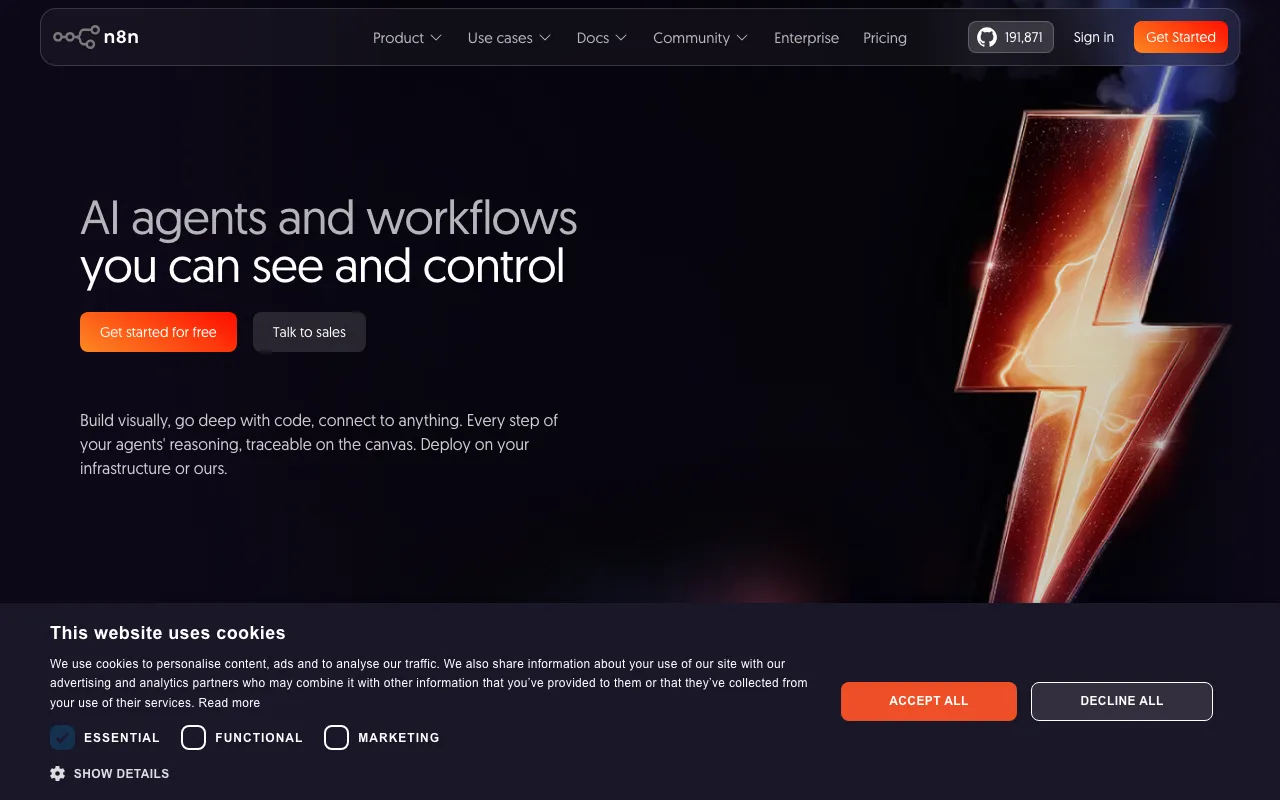
Open-source workflow automation platform for building AI agents and multi-app integrations
★ 195.2k as of Jul 5, 2026
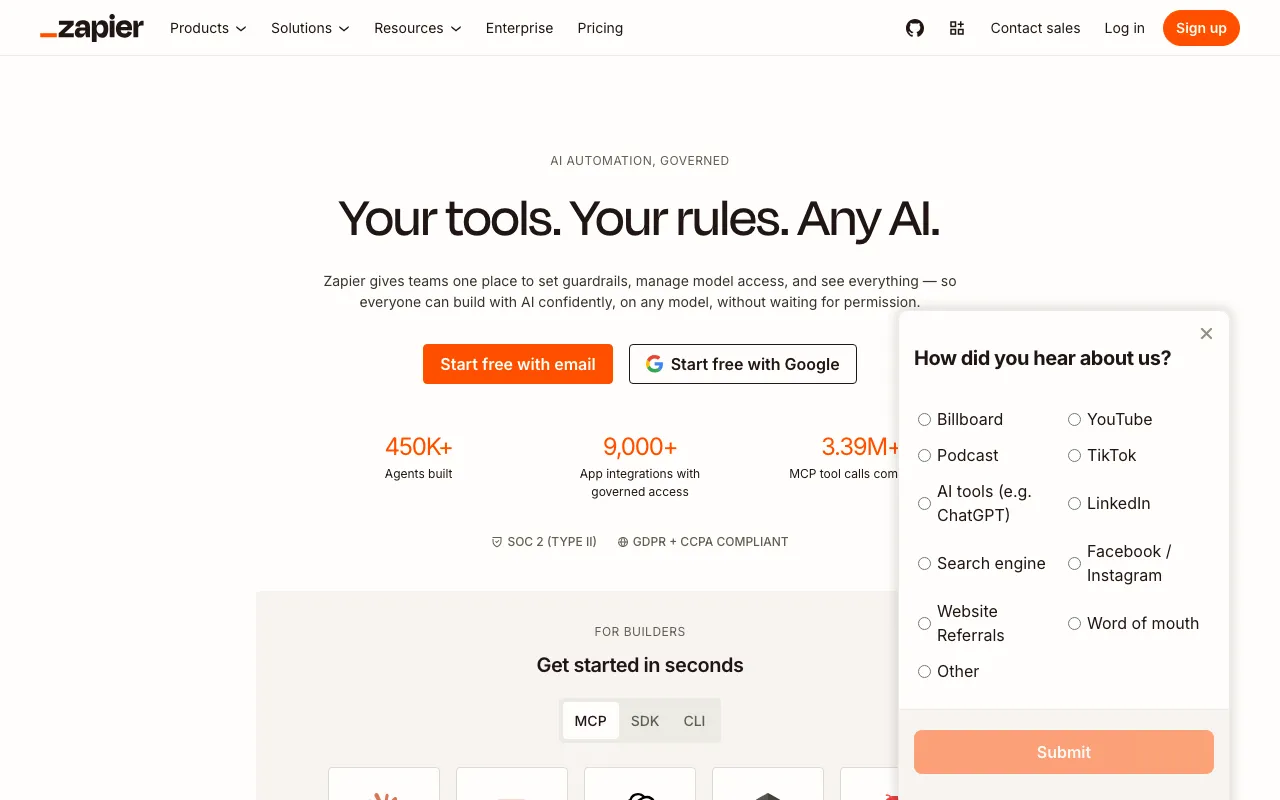
No-code automation platform that connects 7,000+ apps to build multi-step workflows without writing code
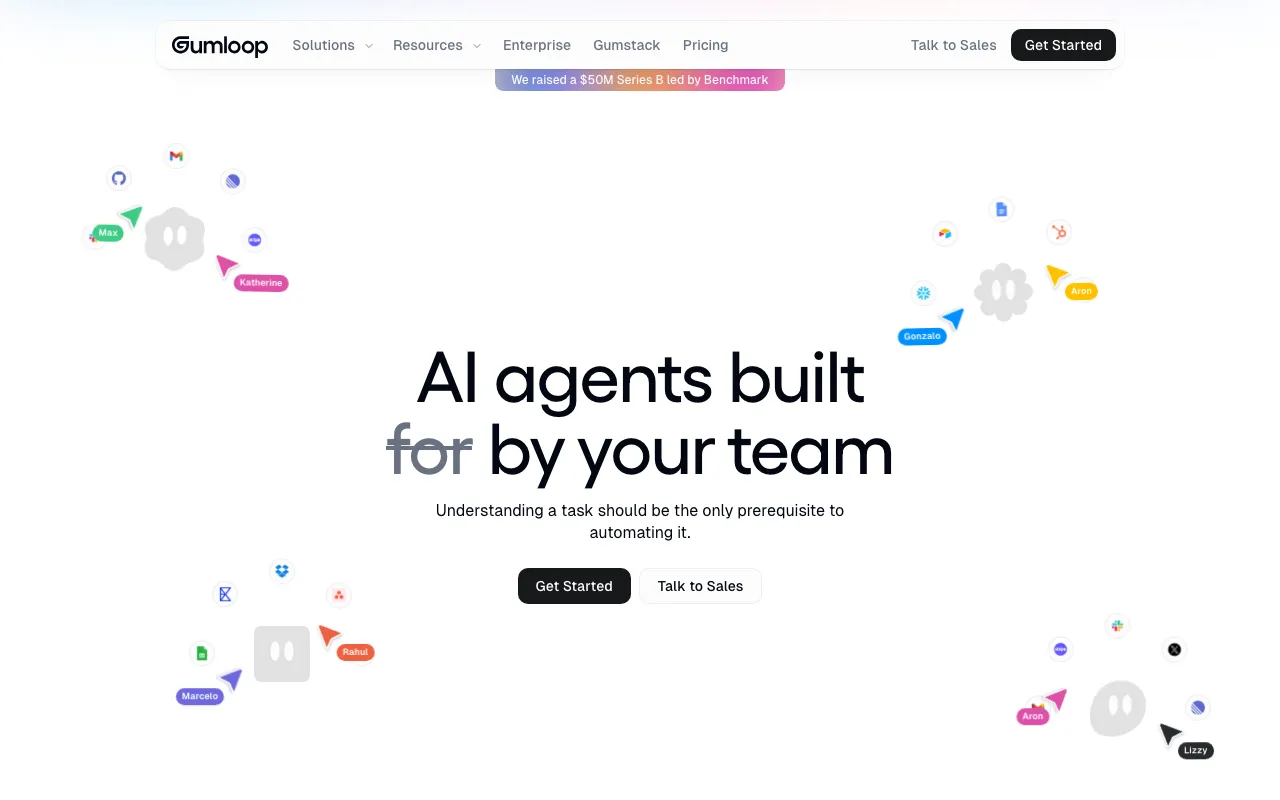
No-code visual builder for AI agents and multi-step automations, priced on a monthly credit pool
No-code platform for building and deploying autonomous AI agents for business workflows
No-code AI agents that handle email, calendar, meetings, and 100+ app integrations
Autonomous general AI agent that plans and executes multi-step tasks end-to-end in the cloud
Every tool in this list has a full profile in our directory with pricing verified against its official pricing page on the date shown on its stamp. Ranking reflects verified pricing, free-tier generosity, platform coverage, and documented capabilities — not sponsorships. Nobody can pay to appear here. Read the full methodology.
Yes — 6 of the 7 tools here have a free tier: Make, n8n, Zapier, Gumloop, Relevance AI, Manus. Pricing verified Jun 28, 2026.
Make has the lowest verified monthly starting price in this list at $9/mo, checked against its official pricing page on Jul 3, 2026.
6 of the 7 tools list an API: Make, n8n, Zapier, Gumloop, Relevance AI, Manus.