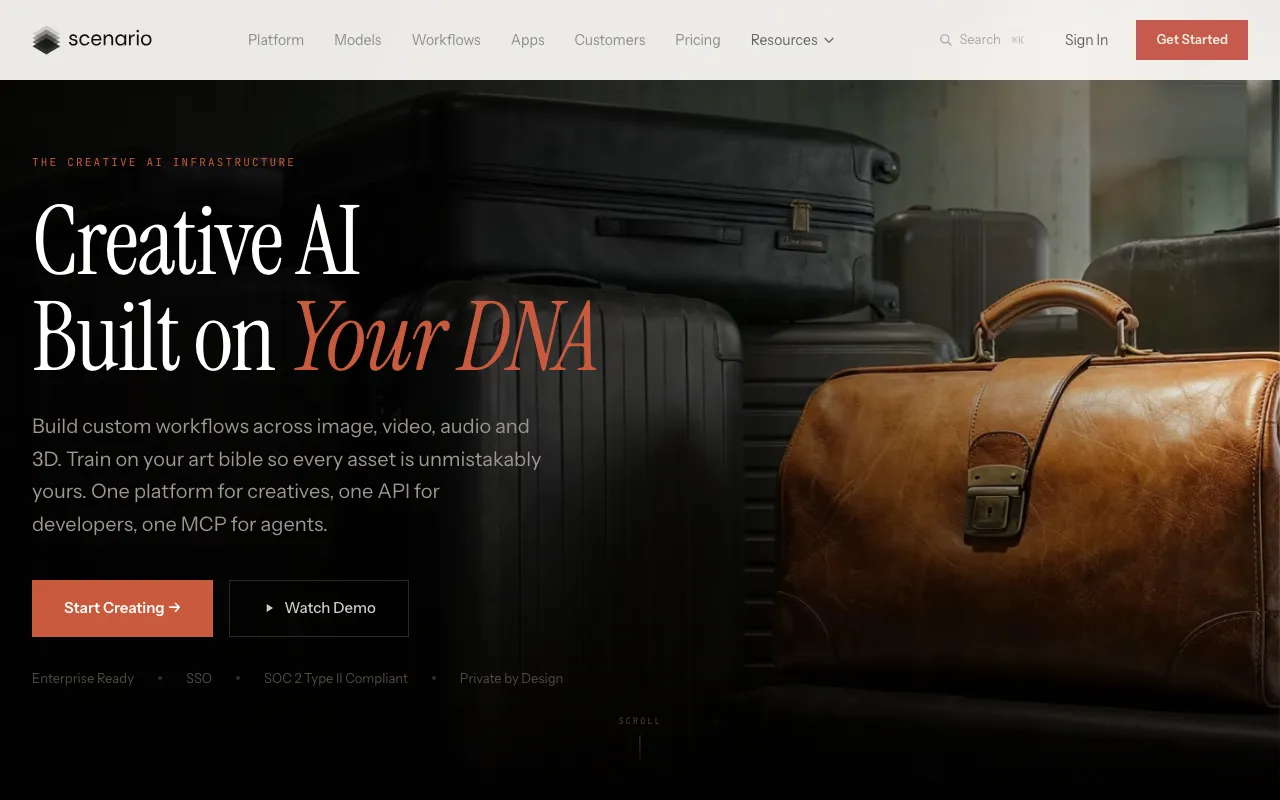
Scenario
Trains custom AI models on your own art so generated images, video, and 3D assets match your studio's established style
FREEMIUM Verified JUL 16, 2026
6 tools ranked · last updated Jul 16, 2026 · how we picked
The best AI tool for game developers in 2026 is Scenario ($15/month), which trains a model on your art bible so hundreds of assets stay on-model. That is the real indie bottleneck — not one good image, but coherence across an entire asset library — though custom training is Pro at $45/month and Starter only generates. The best free pick is Meshy, whose $0 tier gives 100 credits a month under a CC BY 4.0 commercial licence with plugins for Unity, Unreal, Godot, and Blender.
Prices last verified Jul 16, 2026 against official pricing pages.
Scenario trains a custom model on your existing art so new sprites, item icons, tiles, card frames, and character variants come out on-model, and it ranks first because that is the problem indie studios actually have. A general image generator gives you one nice picture; a game needs 300 that look like they belong in the same world, and style drift is what forces a hand-redraw of the lot. It ships a REST API for pipeline integration and names Unity and Ubisoft among its customers. The free tier gives 50 credits per day with no credit card, for evaluation and personal use — commercial licensing starts on paid tiers. The caveat is important to the price: Starter at $15/month ($10 annually) is generation only, and the custom model training that justifies the top spot is Pro at $45/month ($30 annually) for 5,000 credits.
Meshy generates 3D models from text or images and then carries them through the rest of the pipeline: AI texturing, remeshing to a target polygon count, and auto-rigging, with plugins for Blender, Unity, Unreal Engine, Maya, Godot, and Roblox Studio. It is the best free entry in this list by a distance — the $0 tier gives 100 credits per month under a CC BY 4.0 licence that permits commercial use with attribution, with one task at a time and lower queue priority. For prototyping a level before committing to hand-modelled assets, that costs nothing but attribution. The caveat is topology, and it is the one every honest 3D generation entry shares: AI-generated meshes are often not production-clean and usually need manual retopology before you animate or ship them. Treat the output as a fast first draft, not a finished asset.
Tripo generates 3D models from text, images, or sketches, and it is the sharpest mesh-per-dollar option here: one-click 4K PBR-ready textures, auto-rigging with clean skeletons and skin weights, part segmentation for editing pieces independently, and plugins for Blender, Unity, Unreal, Godot, and ComfyUI, plus a REST API for batch work. At $19.90/month it costs roughly twice Meshy’s entry, which buys better texture output and rigging quality — worth it when the asset is going in the game rather than in a greybox. It ranks third rather than second on free-tier terms: the free plan gives 200 credits per month (about 8 models) but is explicitly non-commercial and caps downloads. That is the caveat — commercial rights require Pro or above, so anything you intend to ship needs a paid plan from the start.
ElevenLabs covers the leg no other tool on this page touches: audio. It generates character voices, NPC barks, narration, and sound effects from $6/month, with voice cloning if you have a performer to work from, and it is the highest-confidence pricing in this list. For a solo dev, it replaces booking voice talent for a prototype entirely, and the sound effects generation rides on the same subscription rather than a second one. The free tier gives 10,000 credits per month across text-to-speech, sound effects, and music with 3 Studio projects. The caveat is exactly where it bites hardest for games: the free tier excludes commercial use, so a jam prototype is fine but anything you sell needs a paid plan, and credit costs for long-form audio escalate quickly on lower tiers if your game is dialogue-heavy.
Leonardo.Ai is a general image generator with cheap LoRA training, which makes it the budget alternative to Scenario for style-locked 2D: train on your in-house reference art and generate consistent characters, environments, and texture sheets inside an established visual language. At $12/month it undercuts Scenario’s entry, and it is the pick when your consistency needs are real but modest. The free tier gives 150 tokens per day, roughly 30 to 50 images, with commercial use permitted and access to Phoenix and other base models. The caveat is unusual and worth reading twice: free-tier generations are public and can be remixed by other users, so anything you would rather not show competitors needs the paid plan from $12/month for private mode. Its pricing is also the stalest in this ranking, so confirm current tiers before subscribing.
Stable Diffusion is the technical option: open-weight models you can fine-tune on your own art style and run locally with no per-seat cost and no vendor lock-in, generating textures, concept art, and environment sketches. For a studio with a GPU and an engineer, it is the only entry here that scales without a subscription curve, and the fine-tuning is genuinely yours rather than a hosted feature you rent. There is a first-party Platform API if you would rather not self-host, at roughly $0.065 per image on SD 3.5 Large, and a $20/month credit membership. It ranks last because it is infrastructure rather than a workflow: everything above it hands you a finished asset pipeline, while this hands you the parts. The caveat is evaluation friction — the API free tier is only 25 credits on signup, too limited to judge the models before committing.
We ranked these six as a game-asset pipeline rather than a set of generators: the criteria were style consistency across a library, whether output actually reaches an engine (plugins, export formats, rigging), commercial licensing at the free tier, and cost at the volume a real project needs. That is why the order inverts what a pure 3D ranking would produce — a 2D style-consistency tool leads, because coherence across hundreds of assets is the indie bottleneck, not the quality of any single mesh. We excluded tools with no genuine game-asset evidence: a community model library with no engine path, a real-time generation canvas with no public API, a web-embed 3D tool that ships to websites rather than to Unity, and an industrial design tool built for automotive and footwear concepting. Pricing was verified against each product’s official pricing page between June 11 and July 16 2026; no tool paid or provided incentives to appear, and nobody can buy a ranking here.
Trains custom AI models on your own art so generated images, video, and 3D assets match your studio's established style
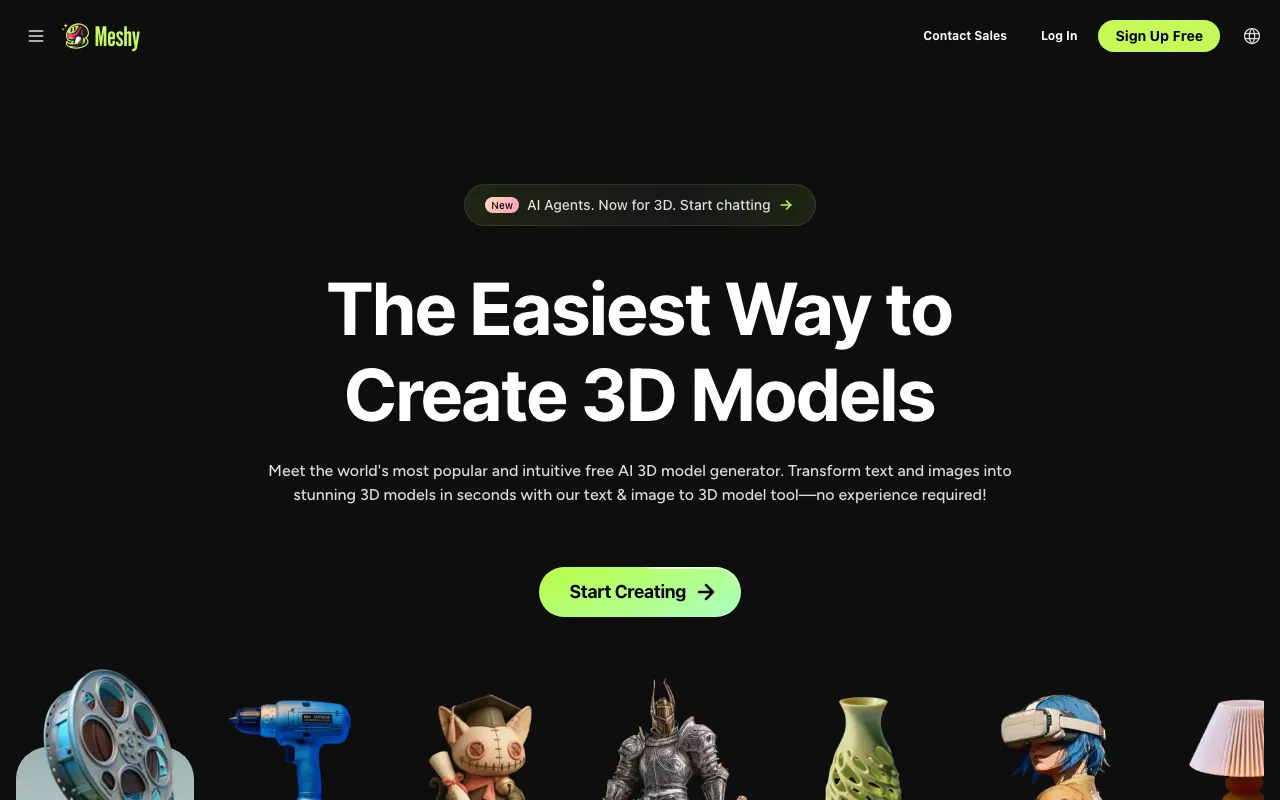
AI 3D model generator that turns text or images into textured, riggable 3D models in seconds, with exports for game, film, AR/VR, and 3D-printing pipelines
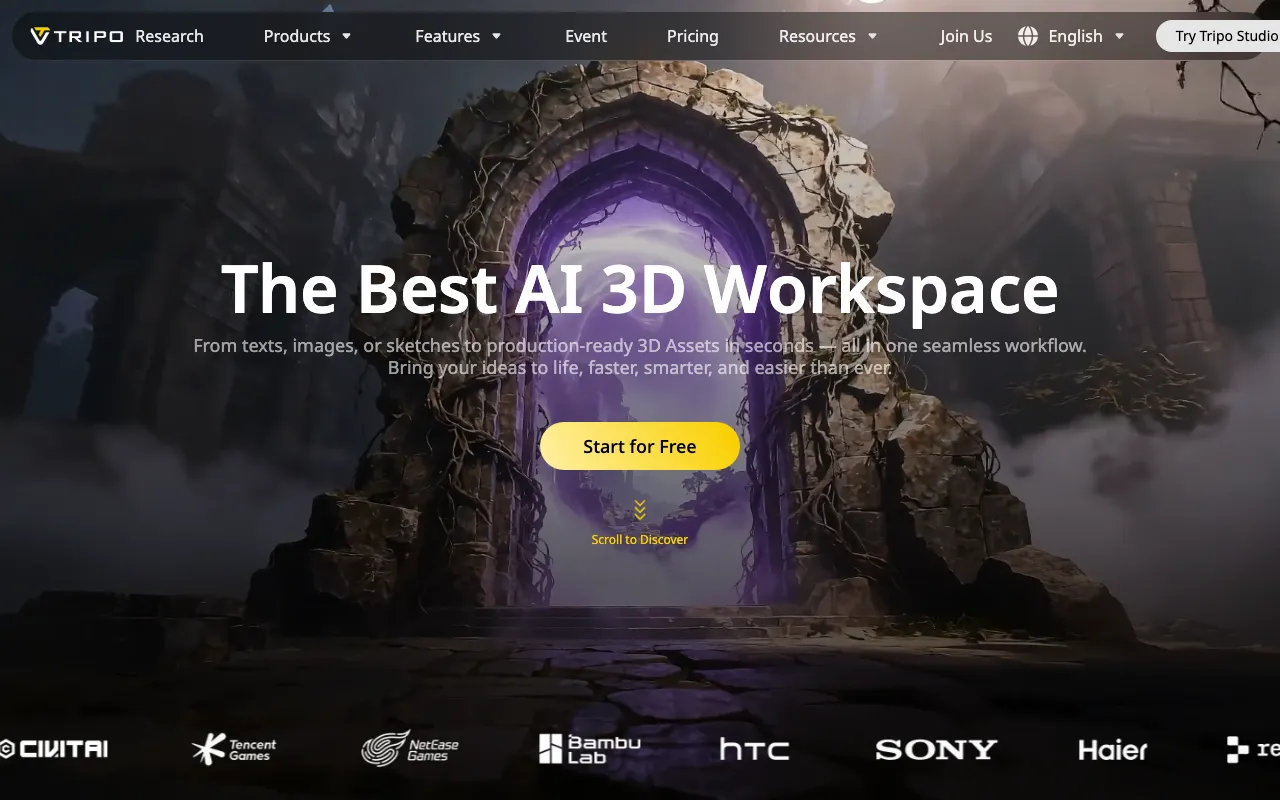
AI 3D model generator that turns text, images, or sketches into rigged, PBR-textured meshes for games, AR/VR, and 3D printing
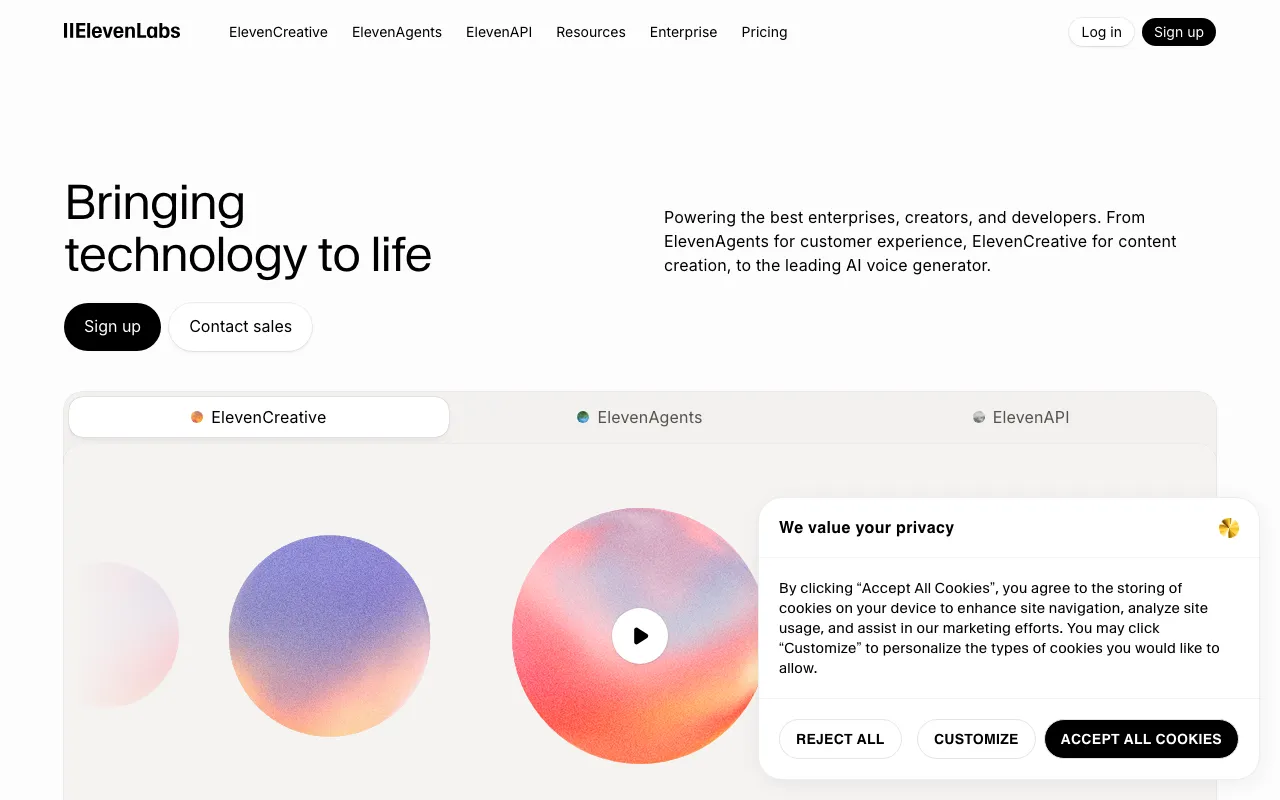
AI voice platform for text-to-speech, voice cloning, and conversational agents in 70+ languages
AI image generator with custom model training, canvas editor, and token-based generation
Open-weight AI image generation model by Stability AI with API and self-hosted deployment options
★ 27.2k as of Jul 5, 2026
Every tool in this list has a full profile in our directory with pricing verified against its official pricing page on the date shown on its stamp. Ranking reflects verified pricing, free-tier generosity, platform coverage, and documented capabilities — not sponsorships. Nobody can pay to appear here. Read the full methodology.
Yes — 6 of the 6 tools here have a free tier: Scenario, Meshy, Tripo, ElevenLabs, Leonardo.Ai, Stable Diffusion. Pricing verified Jul 16, 2026.
ElevenLabs has the lowest verified monthly starting price in this list at $6/mo, checked against its official pricing page on Jul 3, 2026.
6 of the 6 tools list an API: Scenario, Meshy, Tripo, ElevenLabs, Leonardo.Ai, Stable Diffusion.