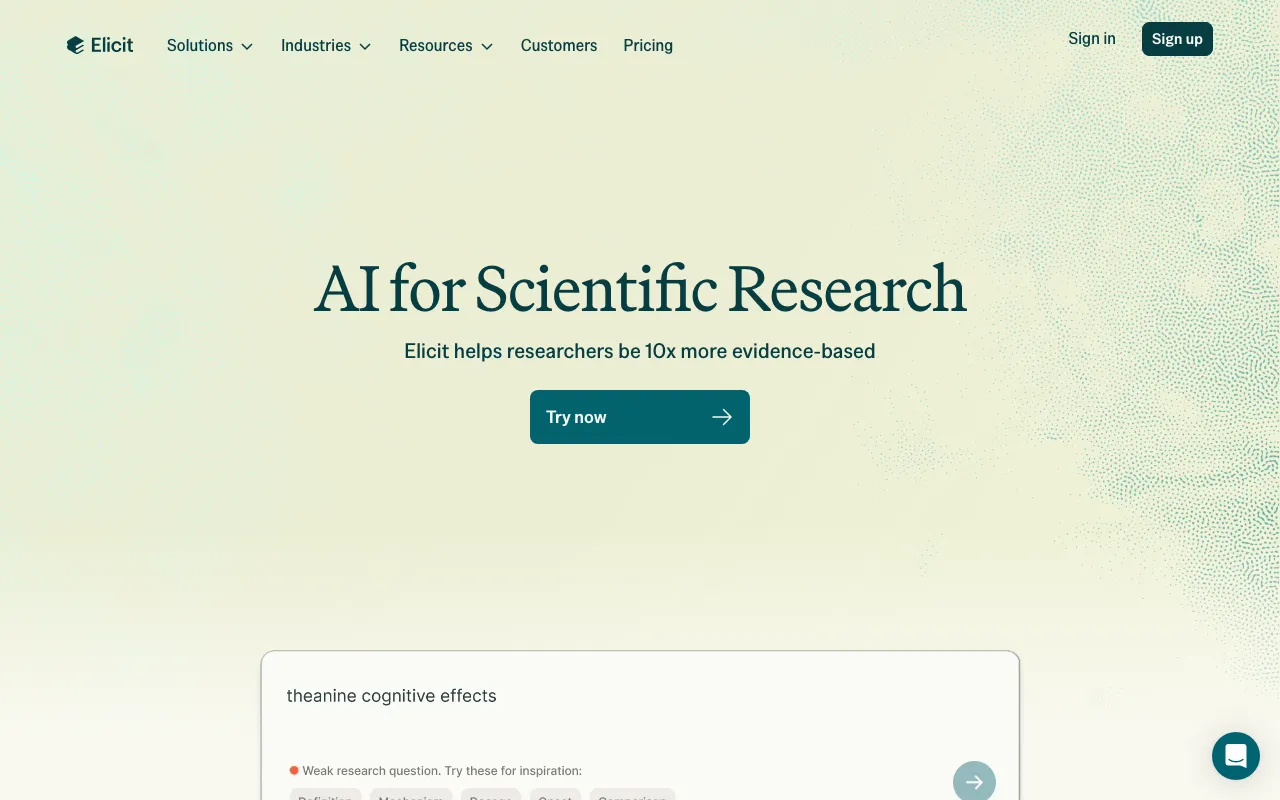
Elicit
AI research assistant that searches, summarizes and extracts data from 138 million academic papers
FREEMIUM Verified JUL 3, 2026
5 tools ranked · last updated Jul 19, 2026 · how we picked
The best AI tool for literature reviews in 2026 is Elicit at $49/month, the only one here with a structured systematic-review workflow that screens up to 5,000 papers. Consensus is the cheapest credible option at $10/month billed annually, and Undermind is the one to reach for on narrow questions where recall matters more than speed. Every pick has a free tier except Scite, which starts at $20/month. We ranked on screening depth and citation evidence rather than answer speed.
Prices last verified Jul 19, 2026 against official pricing pages.
Elicit searches 138 million academic papers and turns the results into structured, cited reports, but the reason it leads a literature-review list specifically is its systematic review workflow: Pro screens up to 5,000 papers in a structured pass, extracts fields into tables of up to 20 columns, and pulls from up to 135 data sources. Sentence-level citations make every claim checkable rather than requiring you to re-derive it. The free Basic tier gives unlimited search plus 2 automated reports a month and 2 table columns; Pro is $49/month ($588/year) with 144 reports a year and API access, Scale is $169/month, and Enterprise screens up to 40,000 papers. Two caveats: coverage is limited to indexed academic papers, so grey literature and books are excluded, and the tool does not flag gaps in the literature — an empty result can mean nobody has published rather than nothing exists.
Undermind is a deep-search agent that spends three to six minutes per query reading, ranking, and citation-chasing across a 200M+ article index instead of returning instant results. That design choice makes it the strongest recall tool here for narrow topics where keyword search and one-shot retrieval quietly miss the relevant papers. Pricing splits by who you are: academic Pro is $20/month ($16 billed annually), while industry and commercial users pay $75/month ($60 annually), and academic Team plans start at $15 per person per month on annual billing with a three-seat minimum. The free tier runs real deep searches rather than a crippled demo. Two caveats: those three-to-six-minute searches make it unusable for quick lookups or iterative back-and-forth, and it cannot read paywalled full texts — deep analysis is limited to open access and preprint articles.
Consensus queries 200M+ peer-reviewed papers and synthesises them through a Consensus Meter that shows yes, no, or possibly across the studies it analysed, which makes it the fastest way to get oriented on a question before committing to a full review. Its free tier is the most generous starting point in this list: unlimited paper searches with no hard cap, plus 3 Deep Searches and 10 Study Snapshots a month. Pro is $10/month billed annually ($120/year) or $15 month-to-month, raising Deep Searches to 15 and Study Snapshots to unlimited; a 40% student discount brings the annual rate to roughly $6/month. Deep is $65/month ($45 annually) for 200 Deep Searches plus Medical Mode. Two caveats: there is no API at all, which rules out programmatic research pipelines, and Deep Search credits reset monthly with no rollover.
Scite answers a question raw citation counts cannot: whether the papers citing a finding actually agreed with it. Its index classifies 1.6B+ citation statements as supporting, contrasting, or mentioning across 280M+ articles and 32M+ full-text sources, reaching inside paywalled papers through direct agreements with 30+ publishers including Wiley and SAGE. Reference Check audits an entire bibliography for retractions and contrasting findings from a single PDF upload. Basic is $20/month with unlimited Assistant queries, 250 MCP credits, and 1,000-paper Collections; Pro is $50/month with 2,500 credits and 10,000-paper Collections; Team is $50 per seat up to 15 seats. Two caveats: there is no permanent free tier — the only free access is a 7-day trial that auto-converts into the plan you selected at signup unless you cancel first — and API access is listed only on Enterprise.
SciSpace is the pick for the stage after discovery: chatting with the PDFs themselves, extracting citations, and running a Deep Review across a corpus of 280M+ papers. It bundles an AI writer, a paraphraser covering 75+ languages that preserves citations, and a citation generator with 40,000+ journal formatting templates, and its Chrome extension brings explanations onto journal sites and arXiv rather than requiring you to upload everything first. The free tier is usable for trying chat-with-PDF and basic reviews; Premium is $12/month billed annually with around 1,200 monthly credits, Advanced is around $70/month for 10,000 credits, and Max is around $160/month for 40,000. Two caveats: that advertised $12 requires annual prepay and monthly billing runs about $20, and like any AI research tool it can over-interpret findings, so claims still need checking against the source.
We ranked these on the things that decide whether a literature review holds up: how many papers a tool can screen in a structured pass, whether it shows the evidence behind a claim at sentence or citation level, how much of the corpus it can actually read (abstracts versus full text), and what the entry price is for an academic rather than an enterprise buyer. That is a different test from general AI research tools, which we rank separately — speed and breadth win there, while depth and traceability win here, and it is why a slow tool (Undermind) and a tool with no free tier (Scite) both outrank cheaper, faster options. Every price quoted is the tier that actually unlocks the reviewing feature, not the lowest number on the pricing page. Pricing was verified on July 19 2026 against each product’s official pricing page; no tool paid or provided incentives to appear in this list.
AI research assistant that searches, summarizes and extracts data from 138 million academic papers
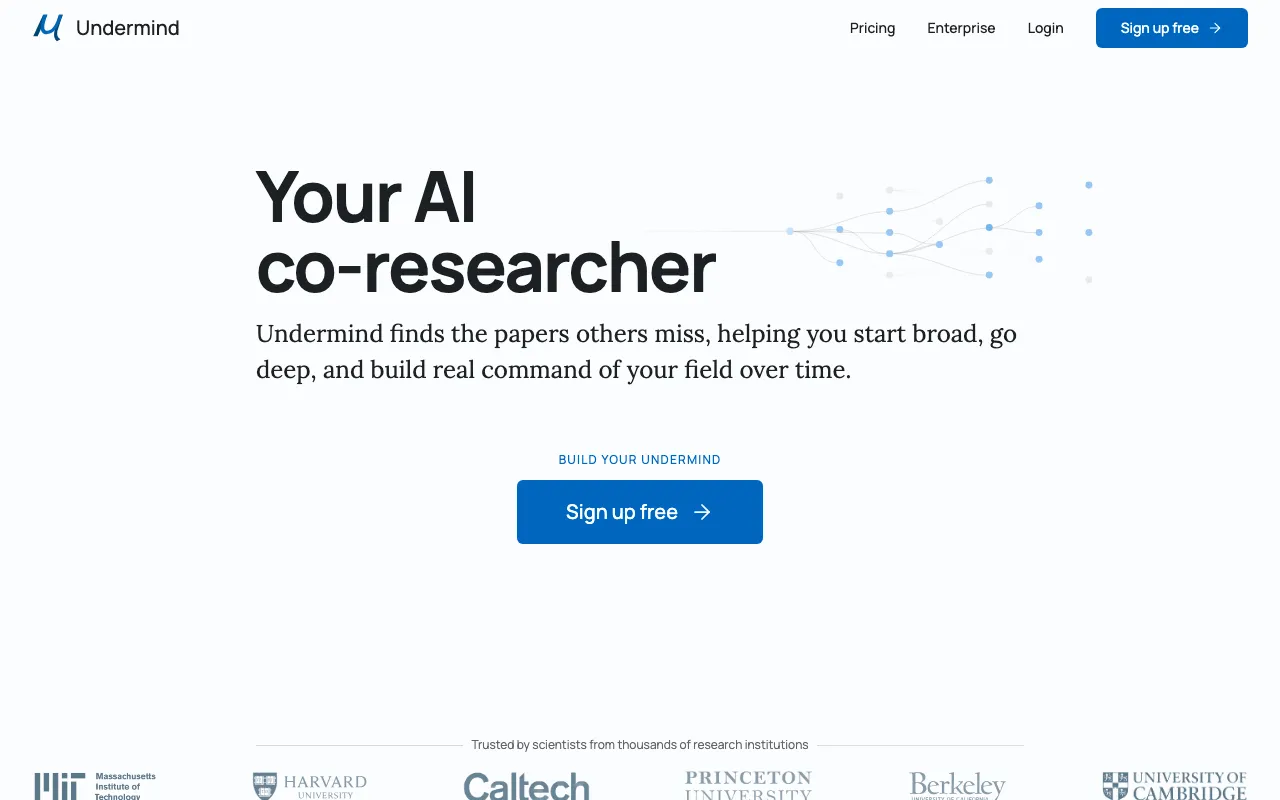
AI deep-search agent that reads hundreds of scientific papers per query to surface literature keyword search misses
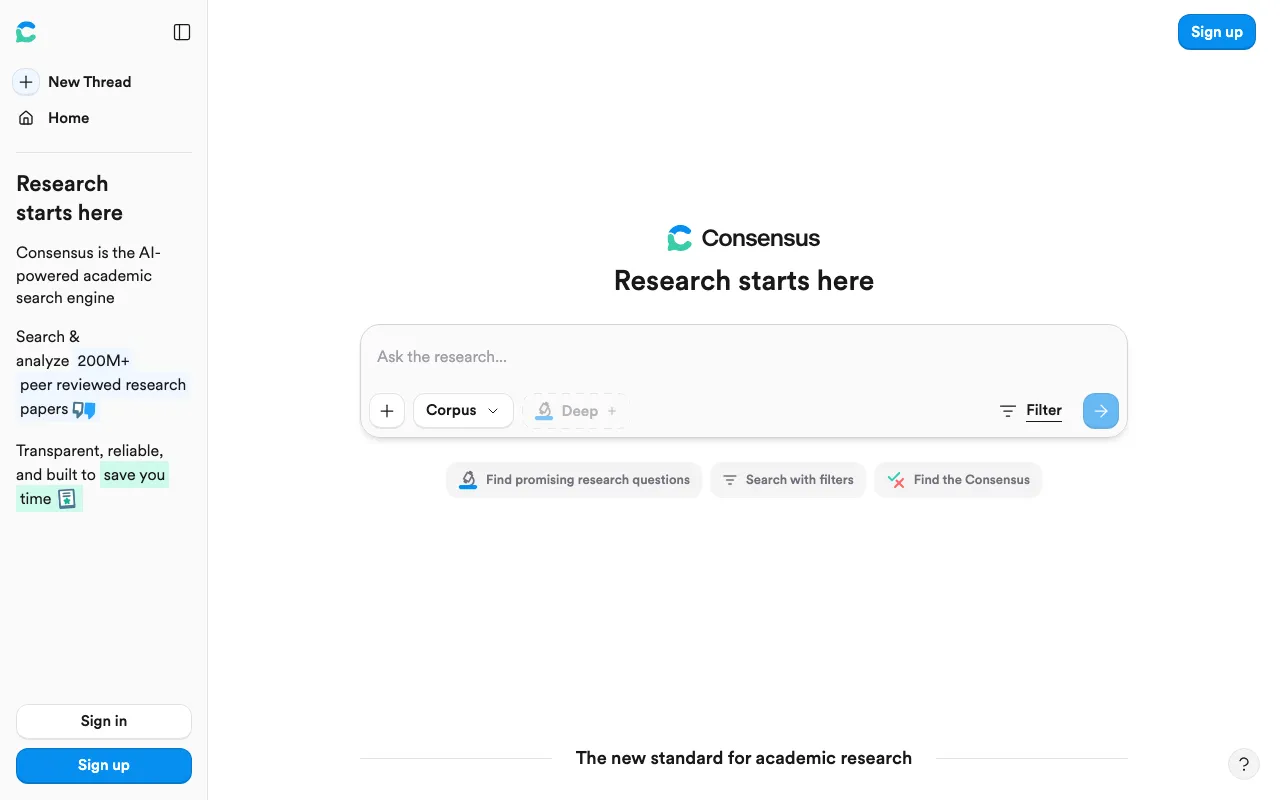
AI search engine for peer-reviewed research across 200M+ scientific papers
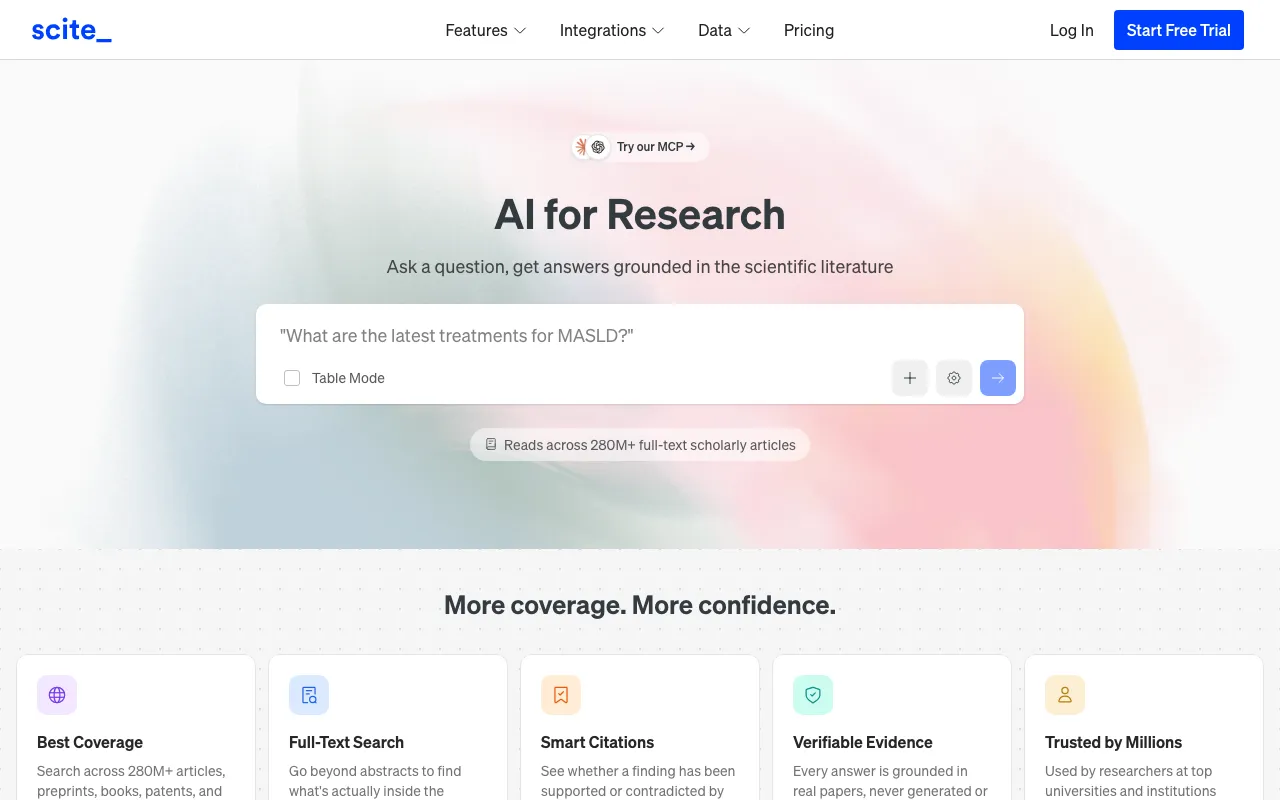
Smart Citations show whether later papers support or contrast a finding, with an AI Assistant grounded in full-text literature
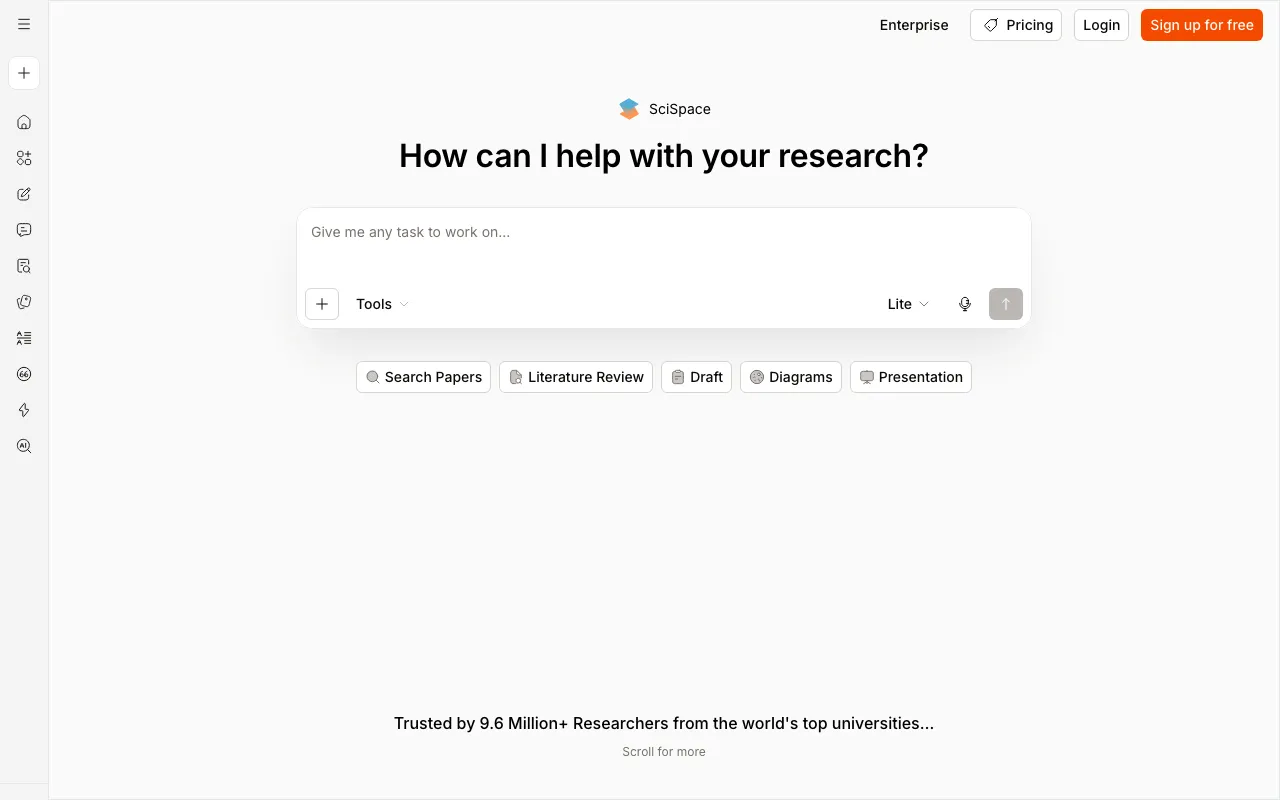
AI research assistant (formerly Typeset) to chat with PDFs, run literature reviews across 280M+ papers, and synthesize findings
Every tool in this list has a full profile in our directory with pricing verified against its official pricing page on the date shown on its stamp. Ranking reflects verified pricing, free-tier generosity, platform coverage, and documented capabilities — not sponsorships. Nobody can pay to appear here. Read the full methodology.
Yes — 4 of the 5 tools here have a free tier: Elicit, Undermind, Consensus, SciSpace. Pricing verified Jul 19, 2026.
Consensus has the lowest verified monthly starting price in this list at $10/mo, checked against its official pricing page on Jun 11, 2026.
3 of the 5 tools list an API: Elicit, Undermind, Scite.