Undermind
AI deep-search agent that reads hundreds of scientific papers per query to surface literature keyword search misses
Undermind is a deep-search agent for scientific literature that spends 3–6 minutes per query reading, ranking, and citation-chasing across a 200M+ article index rather than returning instant results. Pricing splits by user type: academic Pro is $20/month ($16/month billed annually), while industry and commercial users pay $75/month ($60/month annually). The free tier searches abstracts and metadata only; Pro adds full-text analysis of open access and preprint articles. Best for hard, narrow literature questions where recall matters more than speed.
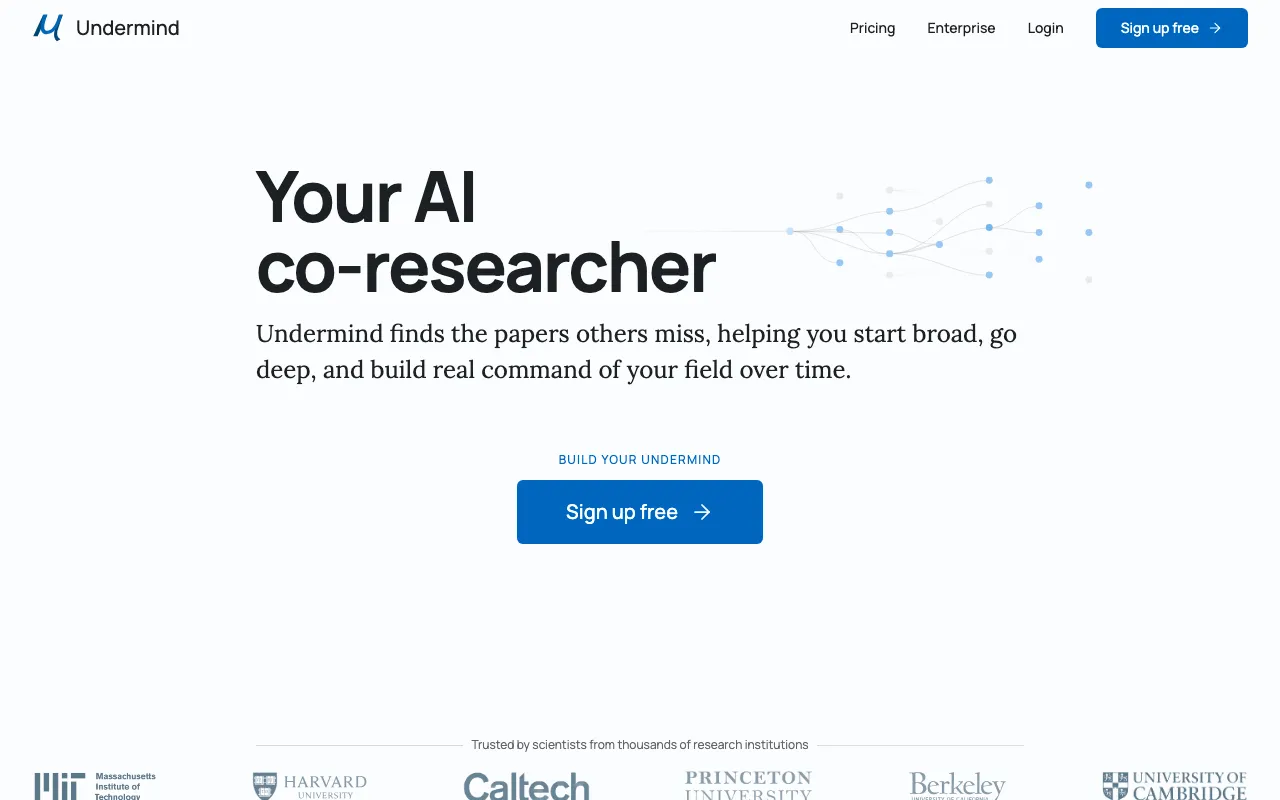
What is Undermind?
Undermind is a search agent for scientific literature that inverts the usual speed trade-off. Instead of returning results in under a second, it spends three to six minutes on a single query: asking clarifying follow-up questions to pin down what you actually mean, then scanning hundreds of papers, classifying each candidate as highly relevant, closely related, or ignorable, following citation trails outward, and adapting its strategy as it learns the shape of the topic. The underlying corpus is a Semantic Scholar index of over 200 million articles spanning PubMed, arXiv, and commercial publishers, so coverage is genuinely cross-disciplinary rather than confined to one field.
The design target is recall on hard questions rather than convenience on easy ones. Undermind’s own whitepaper — a vendor-run benchmark on its own product, not an independent evaluation — compared its v1 engine against Google Scholar across roughly 300 user queries and reported ten times more relevant results for the median query. That framing is worth taking at face value only as far as vendor benchmarks go, but it does describe the intended use case accurately: the tool earns its keep when you suspect relevant work exists and conventional keyword search is not surfacing it. On the free tier the agent reads abstracts and metadata; paid tiers allocate more compute to also read the full texts of nearly all open access and preprint articles, which is where the relevance classification gets meaningfully sharper.
Who is it for?
Undermind fits researchers whose cost of missing a paper is high — a failed grant application, a duplicated experiment, a patent filed over existing prior art. It is a poor fit for anyone wanting quick answers, general web research, or writing assistance, since it does only literature discovery and does it slowly. The pricing split matters when choosing: the widely quoted $16/month figure is the academic annual rate, and commercial users pay roughly four times that. Anyone evaluating it should also compare against Elicit and Consensus for faster extraction across papers, SciSpace for reading and explaining individual PDFs, and Perplexity for general research that spans beyond academic sources.
- Academic researchers and PhD students running systematic literature reviews or entering an unfamiliar subfield where they do not yet know the correct search vocabulary.
- Industry R&D and biotech teams doing novelty assessment and prior-art scanning, who need the recall but should budget for the $75/month industry rate rather than the academic one.
- Grant writers and principal investigators who need defensible evidence that a proposed direction has not already been covered in the published record.
- Research librarians and evidence-synthesis specialists who can absorb the three-to-six-minute search latency into a batch workflow and value the citation-trail following over instant results.
- Not a fit for casual users or students wanting fast answers — Perplexity or Consensus return usable results in seconds for straightforward questions.
How much does Undermind cost?
Starting price: $20/mo · Free tier: yes · Model: freemium
Price history tracked from June 2026
| Plan | Price | Includes |
|---|---|---|
| Free | Free | Deep searches, chat, and reports with strong AI models · Searches abstracts and metadata only (no full texts) · Collaborate on shared projects · Standard rate limits on chats and searches |
| Pro (Academic) | $20/mo | $16/mo billed annually ($192/year, 20% saving) · Latest, most powerful AI models · Deepest analysis of full texts on open access and preprints · 10x higher usage limits than Free · Unlimited projects, files, and paper libraries |
| Pro (Industry) | $75/mo | $60/mo billed annually ($720/year, 20% saving) · Same feature set as academic Pro · Applies to commercial and non-academic users |
| Team (Academic) | $18.70/user/mo | $15/user/mo billed annually at 3–10 seats · 3-seat minimum; volume breaks at 11, 30, and 60 seats · Falls to $15.60/user/mo monthly at 60+ seats · Team member management and centralized billing · Priority customer support |
| Team (Industry) | $75/user/mo | Commercial equivalent of the academic Team plan · Same management, support, and billing features |
| Enterprise | Custom | Programmatic API queries and batch processing · Custom integrations into internal research platforms · Increased compute and sitewide organizational login · Admin dashboard and onboarding seminars · Custom terms, SLA, and security review · No customer data used for model training |
What are Undermind's key features?
- Multi-minute agentic search that reads and ranks hundreds of papers per query
- Citation-trail following until the agent judges the topic exhausted
- Relevance classification of each candidate paper into highly relevant, closely related, or ignorable
- Coverage of a 200M+ article index spanning PubMed, arXiv, and commercial publishers
- Clarifying follow-up questions before the search runs, to pin down intent
- Full-text analysis of open access and preprint articles on Pro tiers
- Alerts for newly published work in saved areas of interest
- Shared projects and paper libraries for team collaboration
What people use Undermind for
- 01 Running a systematic literature review where missing a relevant paper is costly
- 02 Novelty assessment before a grant application or patent filing
- 03 Finding methodological workarounds for a specific experimental bottleneck
- 04 Mapping an unfamiliar subfield when you do not yet know the right keywords
- 05 Monitoring newly published papers in a defined research area via alerts
Pros and cons
| Pros | Cons |
|---|---|
| Recall-oriented design finds papers that keyword search and one-shot retrieval tools miss on narrow topics | Industry and commercial pricing at $75/month is nearly 4x the $20 academic rate, and the $16 headline figure on the pricing page is the academic annual price — easy to misread as universal |
| Academic pricing at $16/month annually is cheap relative to a single journal article purchase | Each deep search takes 3–6 minutes, so it is unusable for quick lookups or iterative back-and-forth questioning |
| Free tier runs real deep searches rather than a crippled demo, making evaluation genuine | Free tier searches abstracts and metadata only; full-text analysis requires a paid plan |
| Vendor publishes a whitepaper with its benchmark methodology instead of only marketing claims | Cannot read paywalled full texts — deep analysis is limited to open access and preprint articles |
| Explicit no-training data policy and enterprise security review options | Narrow scope: scientific and academic literature only, with no general web, news, or business research |
| Small independent startup with a very small team, which carries continuity risk for anyone building workflows on it | |
| No self-serve API — programmatic access is gated behind Enterprise contact-us pricing |
What are the best Undermind alternatives?
Exa is the closest Undermind alternative in our directory: it covers the same category (AI Search & Research), starts at $0, has a free tier.
Ranked by category overlap with Undermind, then free-tier availability, then lowest verified starting price — computed from our verified data, never from sponsorships.
| Alternative | What it is | Starting price | Free tier | Price verified |
|---|---|---|---|---|
| Exa | AI-native web search engine and API built for agents, with semantic search and content extraction | $0 | yes | Jun 22, 2026 |
| Consensus | AI search engine for peer-reviewed research across 200M+ scientific papers | $10/mo | yes | Jun 11, 2026 |
| SciSpace | AI research assistant (formerly Typeset) to chat with PDFs, run literature reviews across 280M+ papers, and synthesize findings | $12/mo | yes | Jun 28, 2026 |
| Perplexity | AI-powered answer engine that searches the live web and cites every source | $20/mo | yes | Jun 11, 2026 |
| Elicit | AI research assistant that searches, summarizes and extracts data from 138 million academic papers | $49/mo | yes | Jul 3, 2026 |
| Scite vs Undermind → | Smart Citations show whether later papers support or contrast a finding, with an AI Assistant grounded in full-text literature | $20/mo | no | Jul 18, 2026 |
Head-to-head comparisons
How people make money with Undermind
- Offer systematic literature reviews and prior-art scans to biotech or hardware startups as fixed-fee research deliverables; the flat per-seat subscription keeps input cost predictable per project, though commercial work falls under the higher industry rate
- Sell recurring literature-monitoring retainers to R&D teams using the alerts feature — bill monthly per research area rather than per report, since the plan is flat-rate rather than metered per search
Frequently asked questions
How much does Undermind cost?
Undermind prices Pro by user type. Academic users pay $20 per month billed monthly, or $16 per month billed annually. Industry and commercial users pay $75 per month billed monthly, or $60 per month billed annually. Team plans start at $15 per person per month on academic annual billing with a three-seat minimum, and Enterprise is custom priced.
Is there a free version of Undermind?
Yes. The free tier costs nothing and includes deep searches, chat, and reports using strong AI models, plus collaboration on shared projects. It applies standard rate limits on chats and searches. The main functional limit is depth: the free tier searches abstracts and metadata only, while Pro adds full-text analysis of open access and preprint articles.
How long does an Undermind search take?
Undermind states that a typical deep search takes three to six minutes. That time is spent scanning hundreds of papers, cross-comparing and ranking sources, and adapting the search strategy as the agent learns about the topic. It is a deliberate trade-off against instant keyword search, which makes it suited to literature reviews rather than quick factual lookups.
What database does Undermind search?
Undermind draws on a Semantic Scholar corpus of over 200 million articles covering all fields of science, including PubMed, arXiv, and many commercial publishers. Because coverage depends on that index, a highly specific or very recently posted paper occasionally will not be present, and paywalled full texts stay outside what the agent can read directly.
How is Undermind different from Elicit or Consensus?
Undermind runs a multi-minute agentic search that reads and ranks hundreds of papers and follows citation trails before returning a report. Elicit and Consensus lean toward faster one-shot retrieval with extracted answers across papers. Undermind trades speed for recall on hard, narrow topics, while the alternatives are quicker for broad questions and for screening large result sets.
Does Undermind have an API?
Yes, but not on self-serve plans. Undermind offers programmatic queries, batch processing for high-volume work, and custom integrations as part of its Enterprise offering, alongside the web app and custom research platform builds. Access requires contacting the company directly, and pricing is not published. Individual Pro and Team subscribers use the browser application only.
Is the claim of 10x better results than Google Scholar independently verified?
No. That figure comes from Undermind's own whitepaper, which compared its v1 search engine against Google Scholar across roughly 300 queries and reported ten times more relevant results for the median query. The company publishes its methodology, but this remains a vendor-run benchmark on its own product rather than an independent third-party evaluation.