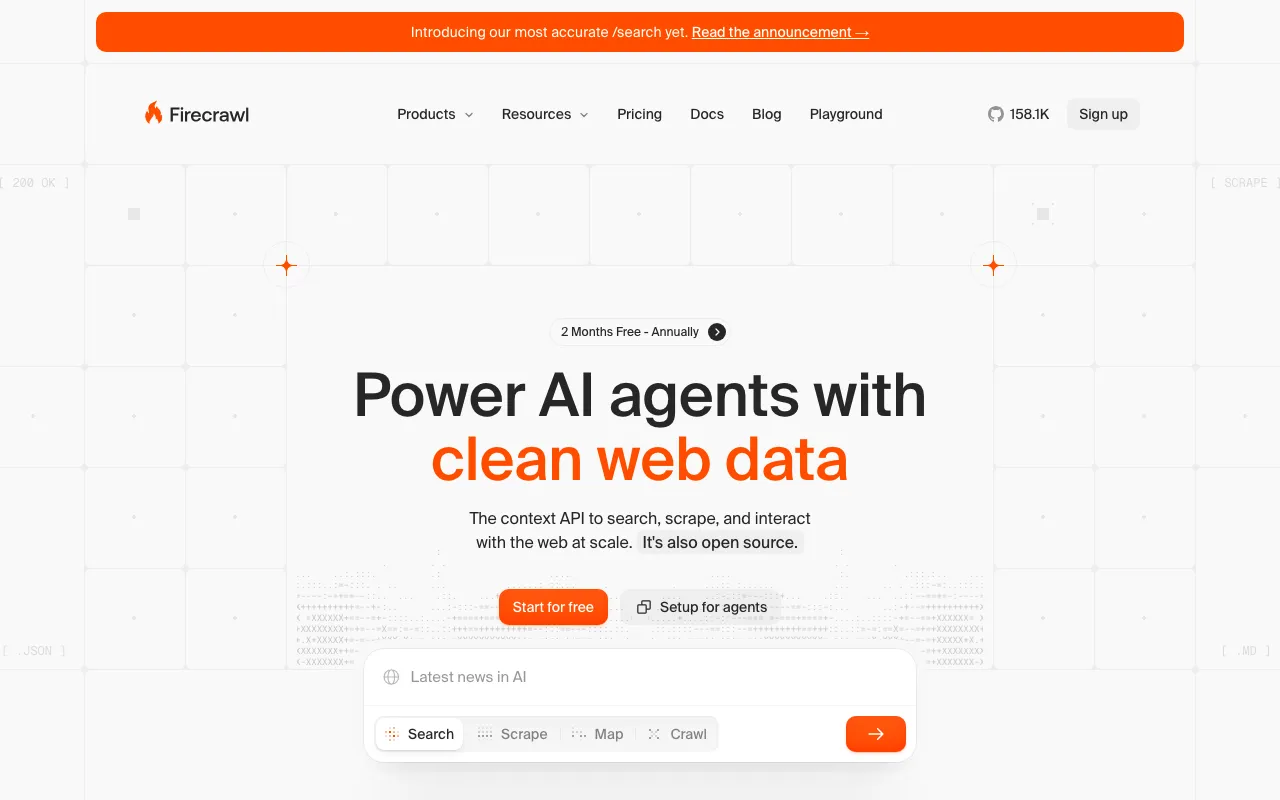
Firecrawl
Web scraping and crawling API that turns any site into clean markdown or structured data for AI agents
FREEMIUM Verified JUL 30, 2026
5 tools ranked · last updated Jul 30, 2026 · how we picked
The best AI web scraping tool in 2026 is Firecrawl, which turns any URL into clean markdown or schema-shaped JSON and handles JavaScript, proxies and anti-bot blocks for you — 1,000 free credits a month, then $19/month. The best no-code option is Apify, whose store carries 54,000+ ready-made scrapers from $29/month, and the best free pick is Browser Use, an open-source library that lets an agent drive a real browser at no cost.
Prices last verified Jul 30, 2026 against official pricing pages.
Firecrawl is a hosted API that takes a URL and returns clean markdown, HTML, a screenshot, or JSON shaped to a schema you define, handling the parts that usually break a scraper: JavaScript rendering, proxy rotation, and anti-bot challenges. Beyond single pages it exposes crawl, map, search, and monitor endpoints, so one call can walk an entire documentation site. Pricing is unusually legible — scraping, crawling, and mapping all cost 1 credit per page — with 1,000 free credits a month and no card, then $19/month for 5,000 credits, $99 for 100,000, and $399 for 500,000. The AGPL-3.0 core is self-hostable. It suits developers feeding live web data into agents and RAG pipelines. The honest caveat: there is no pay-per-use plan, and credits reset monthly without rolling over, so bursty workloads either overpay or hit the ceiling mid-month.
Apify is a serverless cloud for scraping and browser automation wrapped around a marketplace of more than 54,000 prebuilt “Actors” — ready-to-run scrapers for common marketplace, search, and social targets. The free plan gives $5 of platform credit at $0.20 per compute unit; Starter is $29/month, Scale $199, and Business $999, each granting matching credit and a lower compute rate down to $0.13. Because the subscription converts into an equal amount of usage credit, the monthly fee is largely prepaid consumption rather than an access charge. It also ships an MCP server so an assistant can call Actors as tools, plus managed proxies and Crawlee, its open-source crawling library. The caveat is cost predictability: compute units depend on memory and runtime, and many store Actors charge their own rental or per-result fees on top of your compute spend.
Browser Use is an open-source Python library that lets an AI agent control a real browser — clicking, typing, and extracting structured data from any site through natural-language tasks. That makes it the right tool when the data sits behind a login, a multi-step form, or an interface no HTTP scraper can reach. The library itself is free and model-agnostic, so you supply your own LLM key and run it on your own machine at no platform cost. Browser Use Cloud adds managed stealth browsers with a free tier of 3 concurrent sessions, Dev at $29/month for 25 concurrent sessions, Business at $299/month, and usage billing at $0.02 per browser-hour. It fits developers building web-automation agents at scale. The caveat is reliability: browser automation is inherently brittle, and a target-site redesign can break a working flow overnight.
Browserbase is the infrastructure layer underneath browser-driven scraping: headless Chrome sessions you start and scale over an API, with proxies and stealth handled for you, plus the open-source Stagehand framework. You bring the automation logic — Playwright, Puppeteer, Selenium, or Stagehand — and it runs the browser fleet. The Free plan includes 1 browser hour and 3 concurrent browsers; Developer is $20/month for 25 concurrent browsers and 100 browser hours, then $0.12 per browser-hour; Startup is $99/month for 100 concurrent browsers and 500 hours at $0.10 per hour beyond that. It is the pick for teams whose scraping job is already written and now needs concurrency they don’t want to operate. The caveat is that consumption stacks: heavy runs add per-browser-hour and per-GB proxy charges on top of the flat monthly fee.
Unstructured handles the other half of the data problem — the PDFs, scans, slides, spreadsheets, and email that a web crawl leaves you holding. It converts more than 20 source types into clean structured output for retrieval and fine-tuning, which is the step most RAG pipelines get wrong when they feed raw text at a model. The free tier processes 15,000 pages every month with no credit card and resets monthly, then billing is $0.03 per page — and unusually the monthly bill stops at $3,000, after which pages are free up to 1 million a month. The core library is Apache-2.0. It suits teams building retrieval over real-world files rather than tidy web pages. The caveat is volume cost before that cap: a 100,000-page backlog runs roughly $2,550 after the free allowance.
We ranked these five on how reliably they get usable data out of a source and what that costs at real volume, weighing free-tier generosity, published per-unit pricing, and whether the tool handles JavaScript, logins, and anti-bot defences rather than assuming clean HTML. Firecrawl leads because one call returns model-ready output with per-endpoint credit costs published up front; Apify ranks second because 54,000 prebuilt Actors mean most common jobs need no code at all. This list covers extraction — pulling content out of a site or a file. Finding pages across the open web is a different job, handled by search APIs, which we rank separately. Prices were verified in July 2026 against each product’s official pricing page; no tool paid or was paid to appear.
Web scraping and crawling API that turns any site into clean markdown or structured data for AI agents
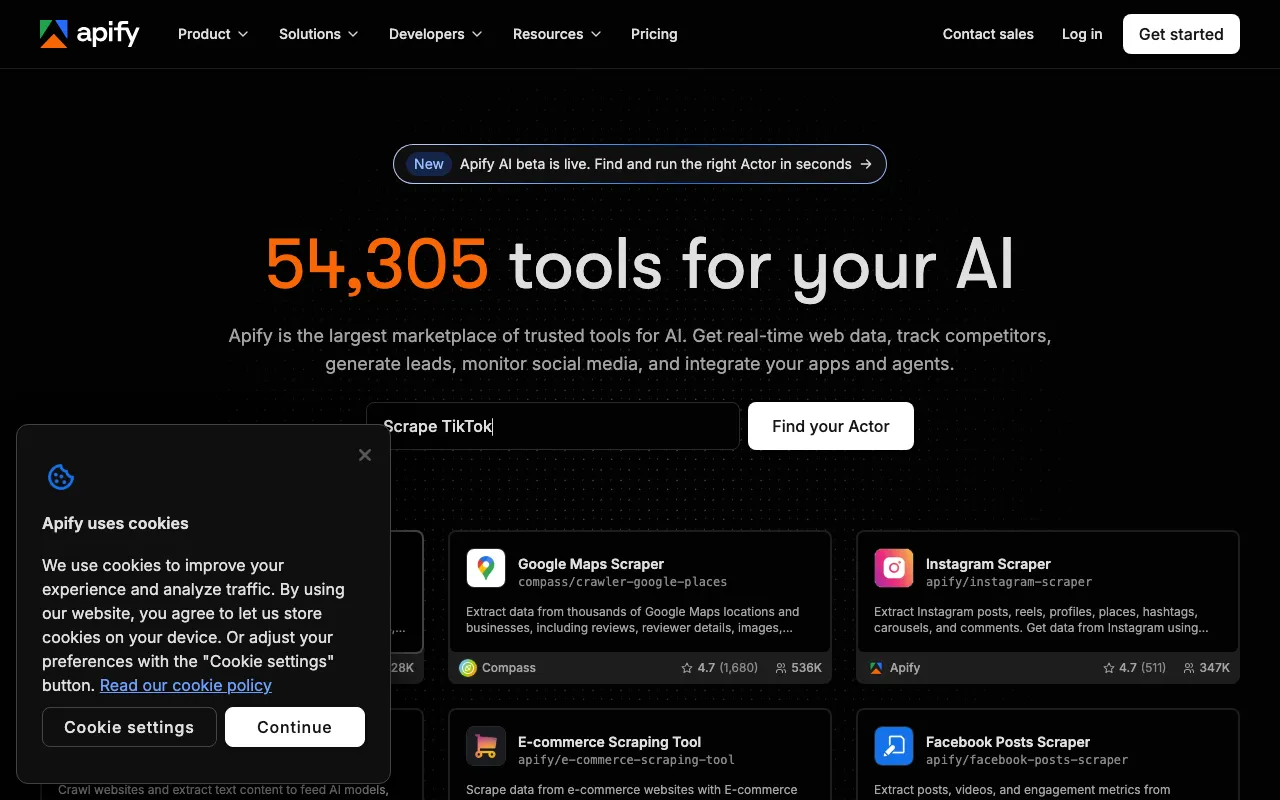
Cloud platform for web scraping and automation with a marketplace of 54,000+ ready-to-run Actors
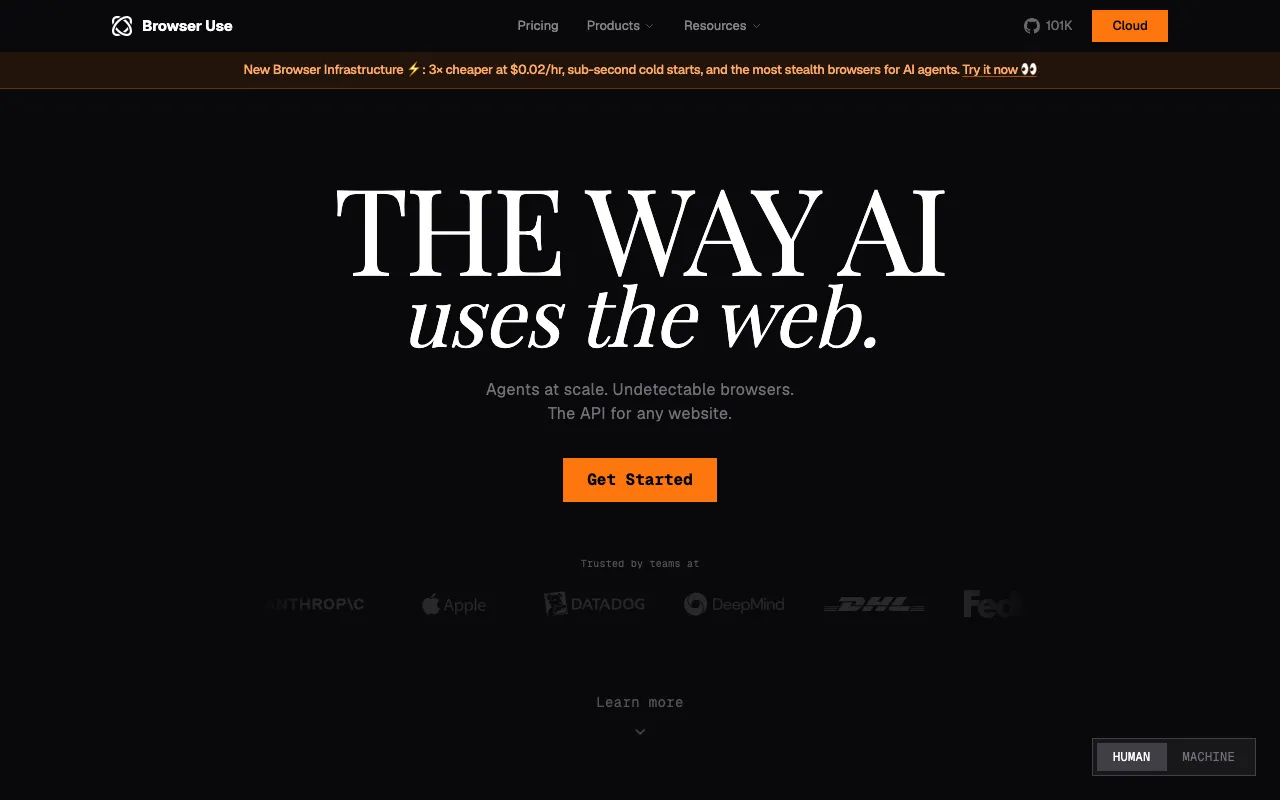
Open-source library that lets AI agents control a real browser to automate and extract from any site
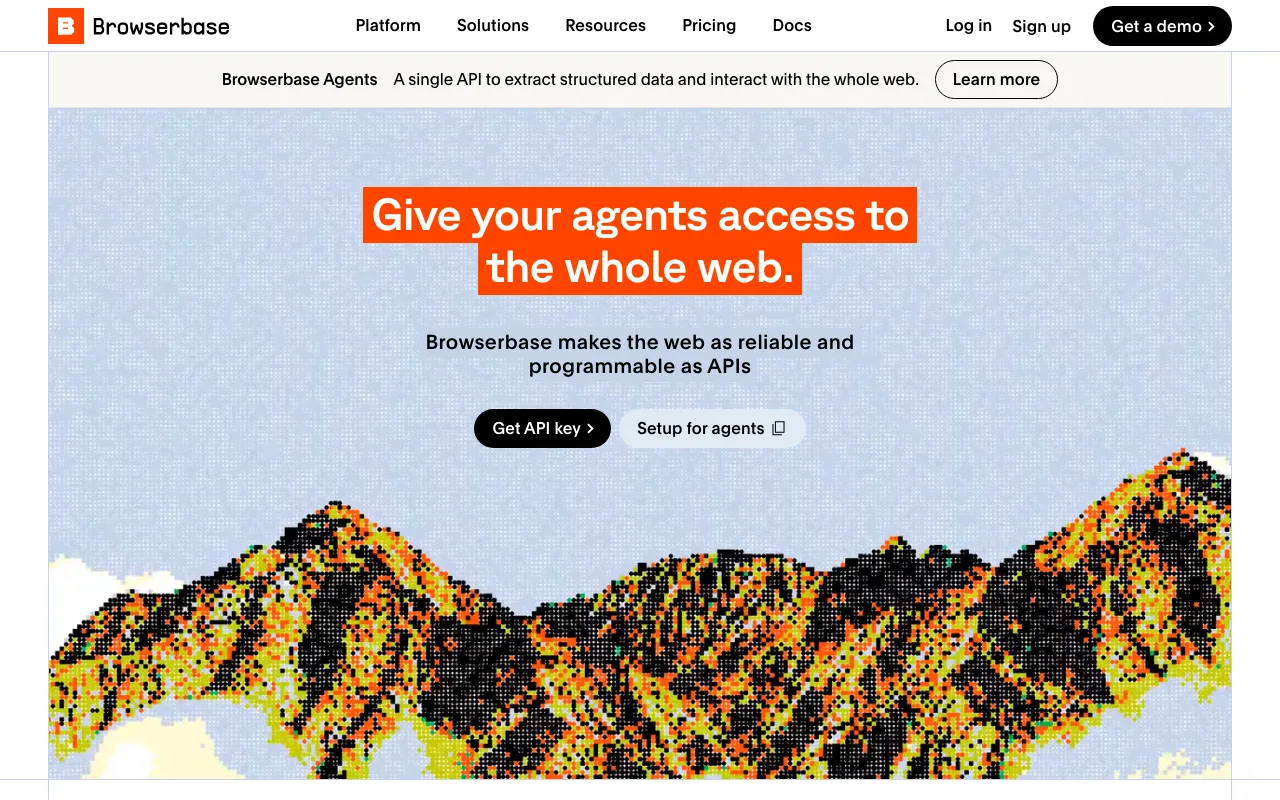
Cloud browser infrastructure for AI agents — run and scale headless browser sessions via API; maker of the open-source Stagehand framework
Document processing platform that converts PDFs, slides, and 20+ other sources into LLM-ready structured data
Every tool in this list has a full profile in our directory with pricing verified against its official pricing page on the date shown on its stamp. Ranking reflects verified pricing, free-tier generosity, platform coverage, and documented capabilities — not sponsorships. Nobody can pay to appear here. Read the full methodology.
Yes — 5 of the 5 tools here have a free tier: Firecrawl, Apify, Browser Use, Browserbase, Unstructured. Pricing verified Jul 30, 2026.
Firecrawl has the lowest verified monthly starting price in this list at $19/mo, checked against its official pricing page on Jul 30, 2026.
5 of the 5 tools list an API: Firecrawl, Apify, Browser Use, Browserbase, Unstructured.