Unstructured
Document processing platform that converts PDFs, slides, and 20+ other sources into LLM-ready structured data
Unstructured turns messy documents — PDFs, scans, slides, email, spreadsheets — into clean structured output for RAG and fine-tuning. The free tier processes 15,000 pages every month with no credit card. Beyond that it is $0.03 per page, and unusually the bill stops at $3,000/month, after which pages are free up to 1 million a month. Business plans add VPC and on-premise deployment. Best for teams building retrieval pipelines over real-world files.
What is Unstructured?
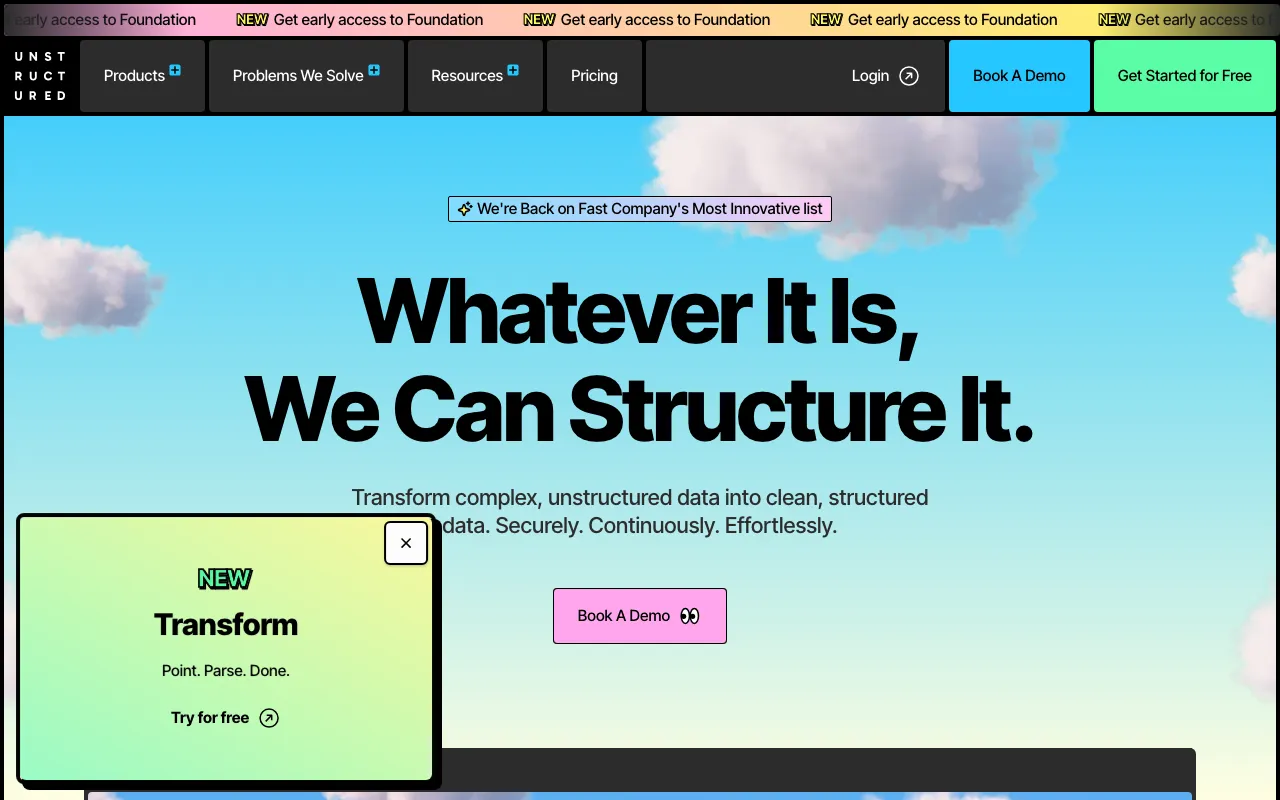
Unstructured is an ingestion platform for the documents that break ordinary parsers. It takes PDFs, scans, presentations, spreadsheets, email, and HTML and emits clean, chunked, structured output that a vector database or fine-tuning job can consume. More than 10 vision language models handle layout and table understanding, so tables and figures survive extraction instead of collapsing into a wall of text. Around that sit 40+ connectors — over 20 sources and over 20 destinations — plus change detection, incremental processing, and event-driven updates so unchanged files are not paid for twice.
The commercial model is straightforward metering with a genuinely unusual ceiling. Every account gets 15,000 pages a month free, resetting monthly rather than expiring as a trial credit. Past that, pages cost $0.03 each — but the monthly bill stops at $3,000, and every page after that is free up to 1 million pages a month. Feature access does not vary by plan; what the Business tier buys is deployment control, including a dedicated instance, in-VPC installation on AWS, Azure, or GCP, or bare metal, with multi-user accounts and data isolation. The core parsing library is Apache-2.0 and can be run independently of the hosted service.
Who is it for?
Unstructured is aimed at teams whose retrieval quality is limited by document ingestion rather than by their model. The recurring free allowance makes it practical to evaluate against a real corpus before committing budget, which is the main reason to start here rather than writing parsers.
- RAG and search engineers who need consistent chunking and table extraction across a mixed archive of file formats.
- Regulated teams — legal, financial, healthcare — that need processing inside their own VPC or on-premise, which the Business plan provides at custom pricing.
- Data platform teams running scheduled syncs from internal sources into a vector store, where incremental processing keeps the per-page bill from rising on every run.
- High-volume digitisation projects that benefit specifically from the $3,000 monthly cap, since a million-page month would otherwise be unaffordable at a per-page rate.
How much does Unstructured cost?
Starting price: $0.03/page · Free tier: yes · Model: usage-based
Price history tracked from June 2026
| Plan | Price | Includes |
|---|---|---|
| Free | Free | 15,000 pages every month · Allowance resets monthly · No credit card required · All features included |
| Pay-As-You-Go | $0.03/page | Applies after the first 15,000 free pages · Monthly bill stops at $3,000 · Every page beyond that is free, up to 1 million pages a month · All features included |
| Business | Custom | Dedicated instance, in-VPC, or bare metal deployment · Multi-user accounts with full data isolation · Dedicated technical support · Batch data processing and opinionated writing · Pricing tailored to volume |
What are Unstructured's key features?
- 40+ connectors spanning 20+ sources and 20+ destinations
- Support for 10+ vision language models for layout and table understanding
- Change detection with event-driven and incremental processing so unchanged files are not reprocessed
- Apache-2.0 open-source library alongside the hosted platform
- Deployment as SaaS, dedicated instance, in-VPC on AWS/Azure/GCP, or bare metal
- Available through the AWS and Azure marketplaces
- 24/7 connector maintenance handled by the vendor
What people use Unstructured for
- 01 Converting a backlog of scanned PDFs into chunked text for a retrieval system
- 02 Normalising documents from many file types into one consistent schema
- 03 Pulling tables and figures out of reports so a model can reason over the numbers
- 04 Syncing a document source to a vector store on a schedule with incremental processing
- 05 Preparing a labelled corpus for fine-tuning from mixed internal file formats
Pros and cons
| Pros | Cons |
|---|---|
| The free allowance is 15,000 pages every month and resets — far more generous than a one-off trial credit | At $0.03 per page, a 100,000-page backlog costs roughly $2,550 after the free allowance — document volume drives the bill fast |
| The $3,000 monthly cap means very high volume workloads get up to 1 million pages without an unbounded bill | VPC, bare metal, and on-premise deployment are Business-only and require a sales conversation with no published price |
| Core library is Apache-2.0, so the parsing logic can be run yourself without a licence negotiation | Several connectors are marked 'enabled on request' rather than being available immediately on self-serve plans |
| All features are included on every plan — deployment options, not capabilities, are what changes | Business tier pricing is entirely custom, so budgeting for a private deployment needs a quote first |
What are the best Unstructured alternatives?
Firecrawl is the closest Unstructured alternative in our directory: it covers the same category (AI Agents & Automation), starts at $19/mo, has a free tier.
Ranked by category overlap with Unstructured, then free-tier availability, then lowest verified starting price — computed from our verified data, never from sponsorships.
| Alternative | What it is | Starting price | Free tier | Price verified |
|---|---|---|---|---|
| Firecrawl | Web scraping and crawling API that turns any site into clean markdown or structured data for AI agents | $19/mo | yes | Jul 30, 2026 |
| LlamaIndex | Open-source data framework for LLM apps, plus the commercial LlamaCloud platform for parsing, extracting, and indexing complex documents | $50/mo | yes | Jul 16, 2026 |
| Chroma | Open-source Apache-2.0 vector database for building RAG and semantic search into LLM apps, with a serverless usage-based Chroma Cloud | Free | yes | Jul 23, 2026 |
| Qdrant | Open-source vector database in Rust for RAG, agent memory, and semantic search — self-host free or run on Qdrant Cloud | Free | yes | Jul 20, 2026 |
| LangChain | Open-source frameworks for building LLM agents, plus the commercial LangSmith platform for tracing, evaluation, and deployment | $39/seat/mo | yes | Jul 12, 2026 |
How people make money with Unstructured
- Offer document-ingestion setup for law firms or accountancies as a fixed-fee project, since the free monthly page allowance covers most pilots before any spend starts
- Build and maintain retrieval pipelines over client archives on a monthly retainer, where per-page metering makes the cost line predictable to quote
Frequently asked questions
Is Unstructured free?
Yes, up to a point. The free plan processes 15,000 pages every month with no credit card required, and the allowance resets monthly rather than being a one-time trial. All platform features are included. Beyond 15,000 pages you pay $0.03 per page on the pay-as-you-go plan.
How much does Unstructured cost per page?
Pages cost $0.03 each after your first 15,000 free pages in a month. The unusual part is the ceiling: once your monthly bill reaches $3,000, every additional page is free up to 1 million pages per month. That caps the worst-case spend for high-volume ingestion.
What file types can Unstructured handle?
It targets the messy end of document processing — PDFs, scanned images, presentations, spreadsheets, email, and HTML among others. More than 10 vision language models are used for layout and table understanding, which is what allows tables and figures to survive extraction rather than collapsing into unstructured text.
Can I run Unstructured on my own infrastructure?
Two ways. The core library is Apache-2.0 licensed and can be self-hosted freely. For the managed platform, private deployment as a dedicated instance, inside your own VPC on AWS, Azure, or GCP, or on bare metal is available on the Business plan at custom pricing.
Does Unstructured reprocess documents that have not changed?
No. The platform includes change detection with incremental and event-driven processing, so only new or modified files are pushed through the pipeline again. That matters directly for cost, because per-page billing would otherwise charge you for re-ingesting an unchanged archive.
What is Unstructured used for in RAG pipelines?
It sits at the ingestion step, turning raw files into clean, chunked, structured output that a vector database or index can store. Connectors move data from sources such as cloud storage and wikis into destinations including vector stores, which removes most custom parsing code from a retrieval project.