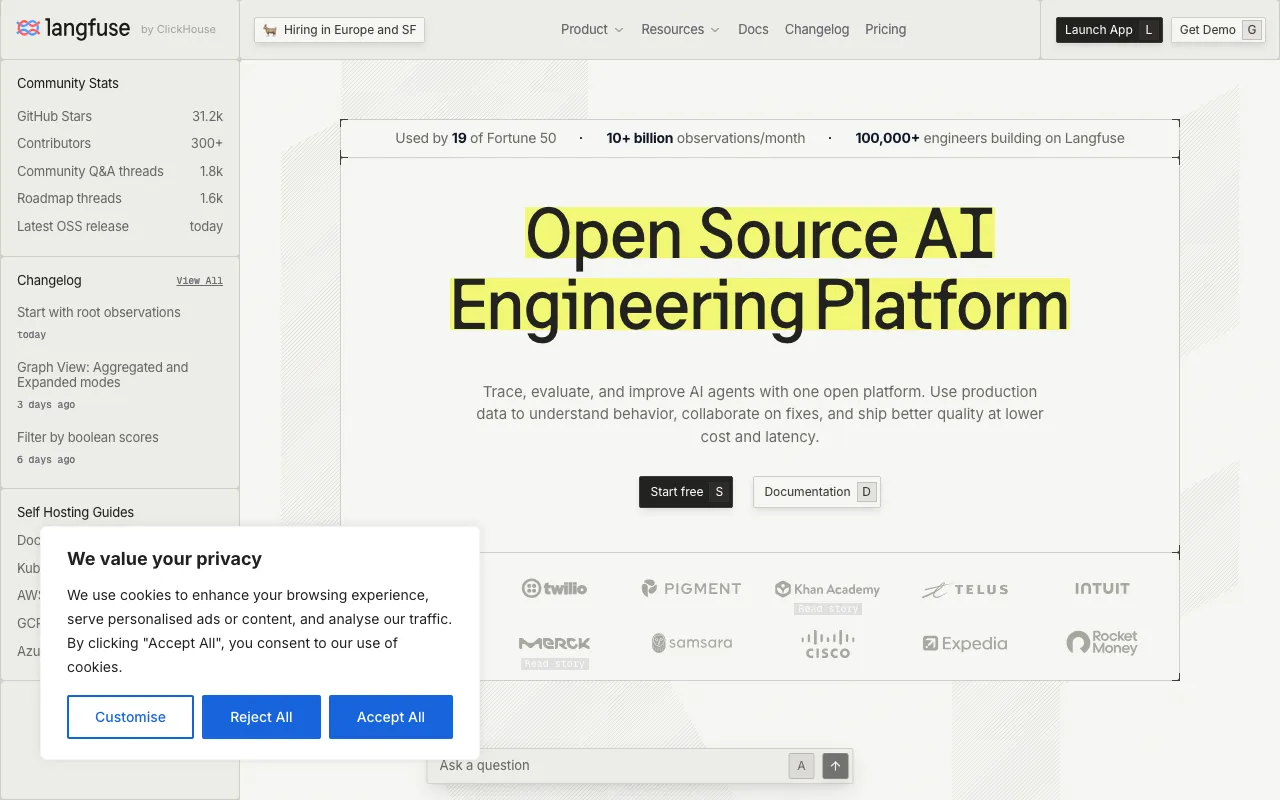
Langfuse
Open-source LLM engineering platform for tracing, observability, evals, and prompt management — self-host free or run on Langfuse Cloud
OPEN-SOURCE Verified JUL 15, 2026
5 tools ranked · last updated Jul 20, 2026 · how we picked
The best LLM observability tool in 2026 is Langfuse — free to self-host under an MIT licence, or $29/month on Langfuse Cloud's Core tier. Braintrust is the runner-up when evaluation matters more than logging: its free Starter plan covers 1 GB of processed data and 10k scores a month before a flat $249/month Pro fee. LiteLLM is the pick if the problem is cost rather than quality — an MIT gateway listed at $0 that tracks spend across 100+ providers. All 5 picks meter by volume, not per seat, with one exception.
Prices last verified Jul 20, 2026 against official pricing pages.
Langfuse covers the whole job rather than one slice of it: traces that record each span, generation, model name, token count and cost per request; LLM-as-a-judge, code-based and human-annotation evaluators; versioned prompts deployed by label without a code change; and datasets for pre-deployment regression runs. Ingestion is OpenTelemetry-compatible with native Python and JS/TS SDKs, so it attaches to LangChain, LlamaIndex, the OpenAI SDK or LiteLLM without an app rewrite. The MIT core is free to self-host with unlimited usage and users. Cloud runs a free Hobby tier at 50k units/month and 2 users, Core at $29/mo for 100k units and unlimited users, Pro at $199/mo with SOC2 and ISO27001 reports, and Enterprise at $2,499/mo. Two caveats: a production self-host means running Postgres, ClickHouse and Redis/S3, and Cloud overage bills $8 per 100k units, so heavy trace volume is where the bill appears.
Braintrust is the pick when the question is “did this prompt change make things worse,” not “what happened last night.” You store a golden dataset, run a prompt or model against it as an experiment, and diff the scores between runs — with scorers from LLM-as-a-judge, ordinary code, the open-source autoevals library, or human reviewers. Production traces land in Brainstore, its purpose-built trace database, and any interesting one becomes an eval case in a click, while Topics clusters logs into recurring failure patterns. Starter is free with 1 GB processed data, 10k scores and 14-day retention; Pro is a flat $249/mo with 5 GB, 50k scores and 30-day retention, and no per-seat charge on any plan. Caveats: the platform is closed-source with no free self-host, and the jump from free to $249/mo has nothing in between.
The commercial half of LangChain is LangSmith, which traces every step, token and tool call in an agent run and pairs automated scorers with human review to catch output regressions. It is framework-agnostic — it instruments raw SDK calls, not just LangChain — but the practical reason to choose it is that the frameworks, the prompt hub, dataset management and LangGraph Platform deployment sit in one account with the tracing. The Developer tier is free at 1 seat and up to 5k base traces/month; Plus is $39/seat/mo with unlimited seats and 10k base traces, plus one free dev-sized LangGraph deployment; Enterprise is custom with VPC or self-hosted deployment. Two caveats: this is the only pick here that charges per seat, so a team of six starts at $234/mo before trace overage at $2.50 per 1,000, and the layered stack has a genuinely steep learning curve.
LiteLLM answers the monitoring question the eval platforms do not: who spent what, on which model, and what happens when a provider goes down. It is a gateway you run in front of your own provider accounts, exposing 100+ providers behind one OpenAI-compatible endpoint, with virtual keys carrying per-key, per-user, per-team and per-org budgets and RPM/TPM limits, spend tracked per request and tag, plus fallbacks, Prometheus metrics and log callbacks into Langfuse, Langsmith, Arize, OpenTelemetry, S3 or GCS. The self-hosted core is MIT and listed at $0, unmetered and uncapped in users, sending no telemetry back. Enterprise is quote-only with a 30-day trial. Two caveats: SSO is free only up to 5 users — beyond that SSO, SCIM, JWT auth and audit logs all need the paid licence — and there is no first-party managed cloud, so you own Postgres, the proxy and regular upgrades.
OpenRouter is the managed counterpart to a self-hosted gateway: one OpenAI-compatible endpoint reaching 400+ models from 70+ providers, with automatic failover when a provider is down or rate-limited, provider routing rules by price or latency, and a single credit balance that centralises spend tracking across every model you call. That last part is the observability value here — it is per-request cost and routing visibility rather than trace inspection or scoring, so it complements the four picks above instead of replacing them. Token usage passes through at each provider’s posted rate with no markup; OpenRouter charges 5.5% on card credit purchases with an $0.80 minimum, or a flat 5% for crypto. A free tier covers 25+ models at 50 requests/day. Caveats: the $0.80 minimum makes small top-ups cost an effective 10-20%, and it adds a routing layer plus a dependency on OpenRouter’s own uptime.
We ranked these on how much of the shipping loop each one closes — trace inspection, scored evaluation against a dataset, prompt versioning, and per-request cost and latency attribution — and on what it costs to keep a real production app instrumented rather than a demo. Licensing and billing shape mattered heavily: an MIT core you can self-host for free beats a proprietary platform when trace volume is unpredictable, and volume-metered billing beats per-seat billing for a team that wants product managers and domain experts looking at traces without buying them each a licence. We separated the jobs on purpose instead of ranking five near-identical trace viewers — debugging what happened, proving a change did not regress, and knowing what it all cost are three different problems, and the gateway picks solve the third without pretending to solve the first two. Pricing was verified on July 20 2026 against each product’s official pricing page; no tool paid or provided incentives to appear.
Open-source LLM engineering platform for tracing, observability, evals, and prompt management — self-host free or run on Langfuse Cloud
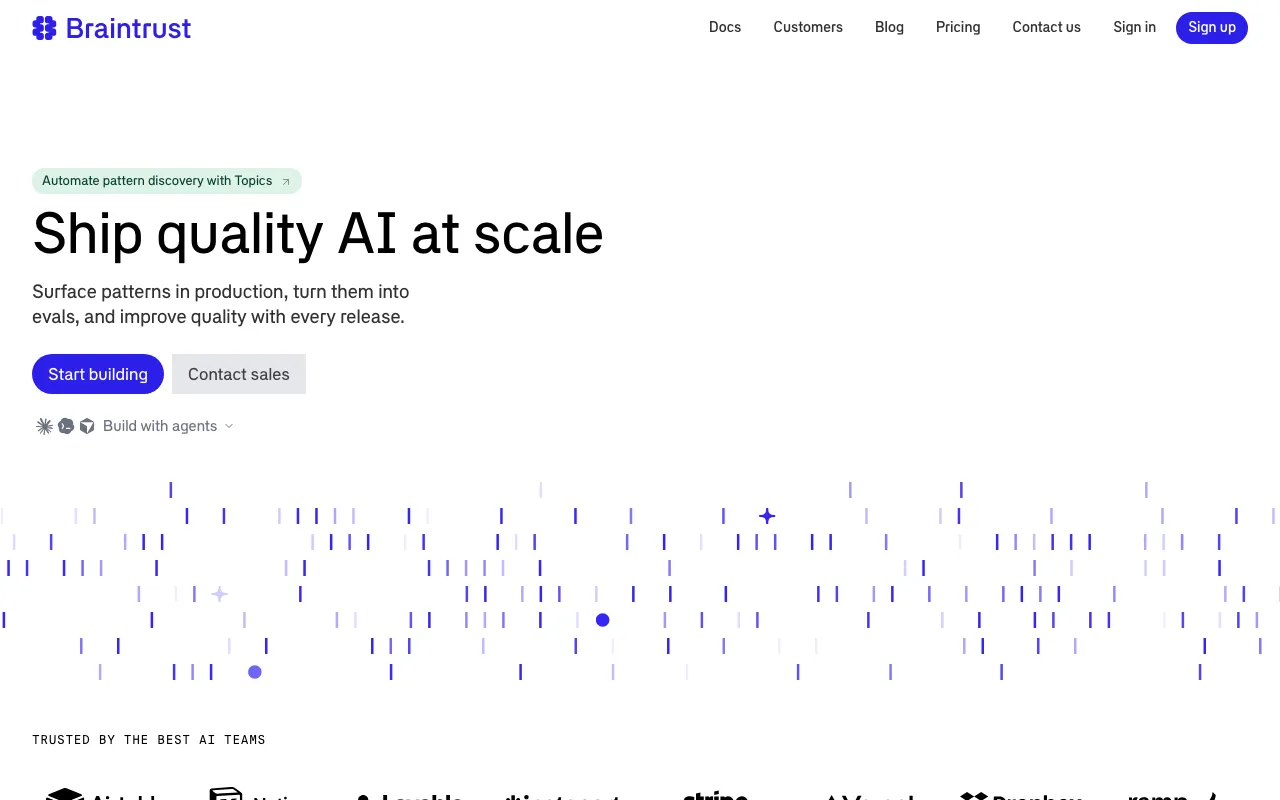
AI evaluation and observability platform for LLM apps — tracing, experiments, playgrounds, scorers, and the Loop agent
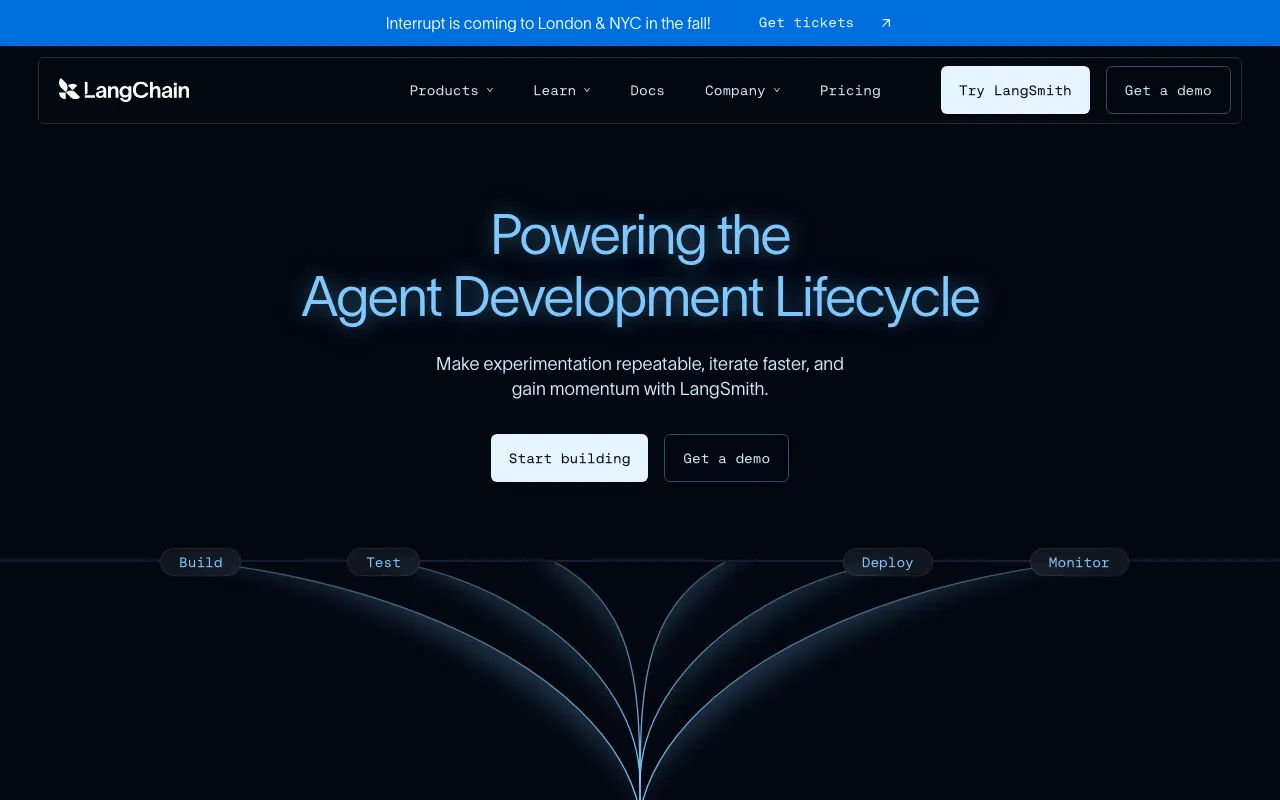
Open-source frameworks for building LLM agents, plus the commercial LangSmith platform for tracing, evaluation, and deployment
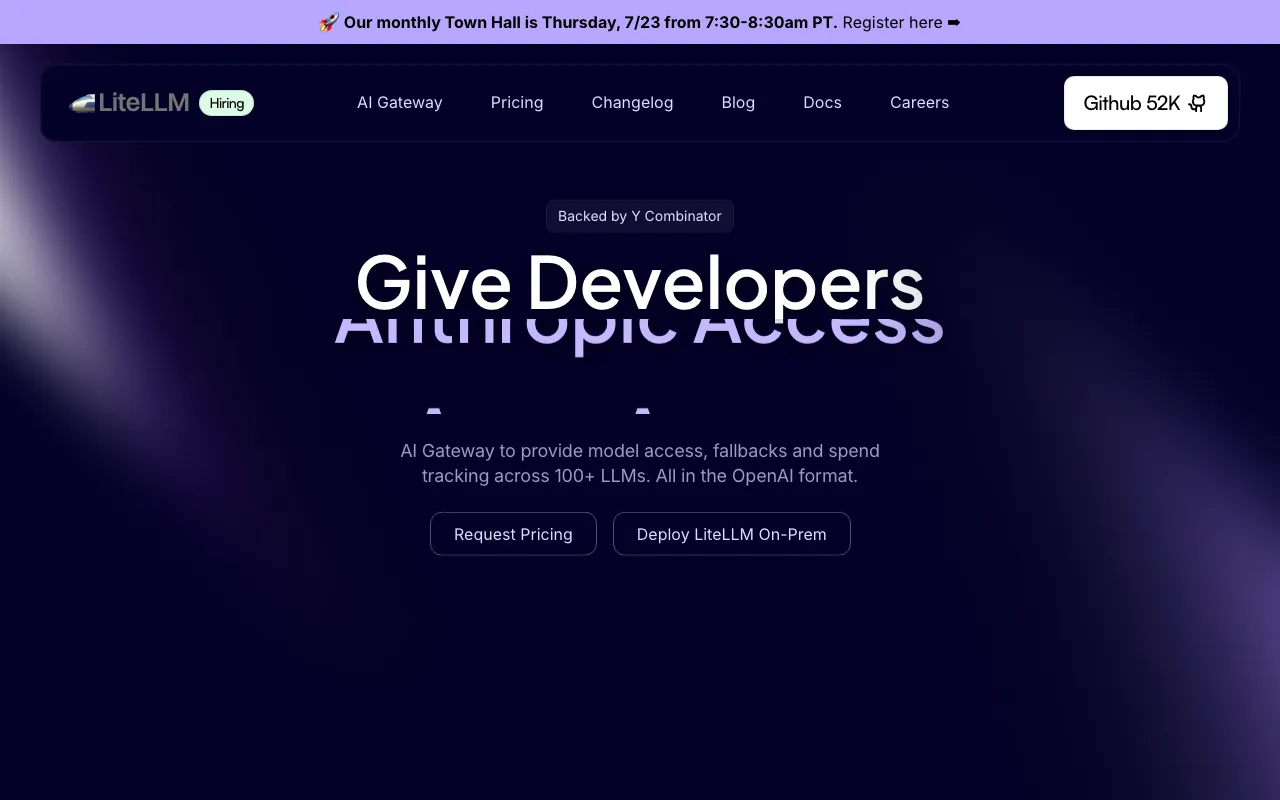
Open-source LLM gateway that puts one OpenAI-compatible API in front of 100+ model providers, with virtual keys, budgets, spend tracking and fallbacks
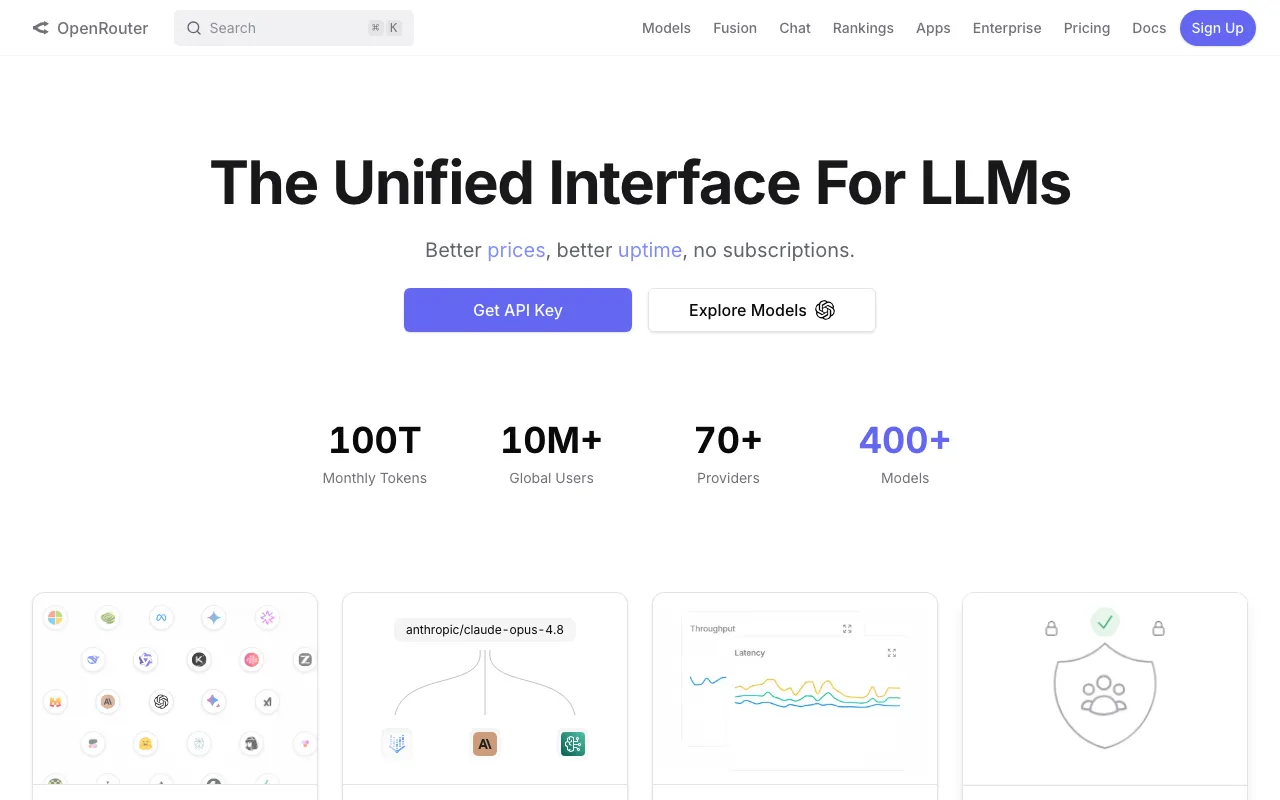
Unified API to 400+ LLMs from 70+ providers through one OpenAI-compatible endpoint, with automatic failover and pass-through token pricing
Every tool in this list has a full profile in our directory with pricing verified against its official pricing page on the date shown on its stamp. Ranking reflects verified pricing, free-tier generosity, platform coverage, and documented capabilities — not sponsorships. Nobody can pay to appear here. Read the full methodology.
Yes — 5 of the 5 tools here have a free tier: Langfuse, Braintrust, LangChain, LiteLLM, OpenRouter. Pricing verified Jul 20, 2026.
LangChain has the lowest verified monthly starting price in this list at $39/seat/mo, checked against its official pricing page on Jul 12, 2026.
5 of the 5 tools list an API: Langfuse, Braintrust, LangChain, LiteLLM, OpenRouter.