Braintrust
AI evaluation and observability platform for LLM apps — tracing, experiments, playgrounds, scorers, and the Loop agent
Braintrust is a closed-source LLM evaluation and observability platform from Braintrust Data, Inc., covering tracing, experiments, playgrounds, scorers, and the Loop agent. Starter is free with 1 GB processed data and 10k scores per month; Pro is a flat $249/month platform fee with 5 GB and 50k scores, then metered overage. Best for teams shipping LLM features who need regression testing, not just logs.
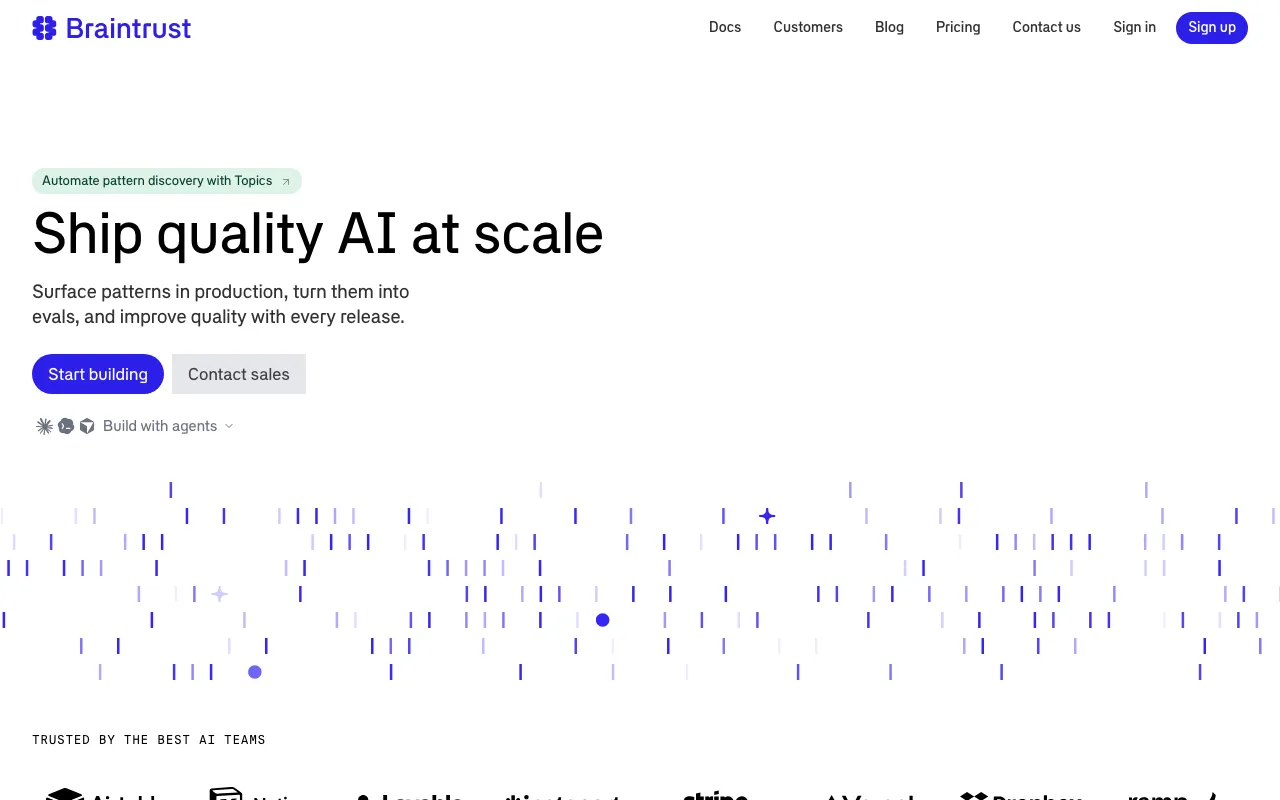
What is Braintrust?
Braintrust is a platform for measuring whether an AI feature actually works. When software is deterministic you write a test that passes or fails; when a feature is powered by a language model the same input can produce a different answer every time, and “worse” is a matter of degree rather than a crash. An eval is the answer to that problem: you assemble a dataset of representative inputs with known-good expectations, run your prompt or agent against all of them, and have each output scored — by another model acting as a judge, by ordinary code, or by a human reviewer. Braintrust stores those datasets, runs the experiments, records the scores, and shows you the diff between two runs, so you can tell whether swapping a model or editing a prompt made things better or quietly broke a case that used to work.
The other half of the product is production observability. Braintrust ingests traces from live traffic — the prompt, the response, every tool call, retrieval step, token count, latency, and cost — and stores them in Brainstore, a database the company built specifically for the large nested documents that AI traces produce. Topics clusters those logs automatically into recurring patterns of task, issue, and sentiment so failure modes surface without anyone reading logs by hand, and any interesting trace can be promoted into an eval dataset in one click. Loop, the built-in agent, works on the evals themselves: it drafts test cases, suggests better scorers, and iterates on prompts. Instrumentation is framework-agnostic through SDKs for Python, TypeScript, Go, Ruby, Java, C#, and Rust, and an MCP server lets a coding agent query logs and update prompts from inside an IDE. The company raised an $80M Series B in February 2026 and ships continuously — the changelog and public SDK repositories were both updated in July 2026.
Who is it for?
Braintrust is developer infrastructure, not an end-user tool: the value only appears once you are shipping a real LLM or agent feature and have instrumented your code with an SDK. Billing is unusual for this category in that it charges nothing per seat — unlimited users on every plan, including the free one — but meters processed data, scores, and Topics tokens on top of the plan fee, so the invoice depends on trace volume rather than headcount. That makes the free Starter tier viable for a small production app and Pro reasonable for a team, but it also means anyone with high-volume traffic should estimate GB ingested and scores recorded before committing. Teams that want an open-source core they can self-host for free should look at Langfuse instead, since Braintrust’s platform is proprietary and its self-hosted option is Enterprise-only.
- AI application engineers who need to debug a multi-step agent or RAG pipeline by reading the actual trace rather than guessing from application logs.
- Teams putting quality gates in CI who want a prompt or model change blocked automatically when scores regress against a golden dataset.
- Product managers and domain experts doing structured human review on sampled production traces, using custom annotation views built for their specific task.
- Early-stage startups that qualify for the 6-12 month free Pro program and want production-grade eval infrastructure without paying for it during the seed stage.
- Regulated or privacy-sensitive organisations needing BYOC or a self-hosted data plane so traces containing customer data stay in their own cloud account.
How much does Braintrust cost?
Starting price: $0 · Free tier: yes · Model: freemium
Price history tracked from June 2026
| Plan | Price | Includes |
|---|---|---|
| Starter | Free | 1 GB processed data / month, then $4 per GB · 10k scores / month, then $2.50 per 1,000 · 14-day data retention · Unlimited users, projects, datasets, playgrounds, and experiments · Monthly Topics credit of $10; no credit card required |
| Pro | $249/mo | 5 GB processed data / month, then $3 per GB · 50k scores / month, then $1.50 per 1,000 · 30-day retention, extendable to 180 days at $0.50 per GB per month · Custom charts, environments, sandbox evals, dataset snapshots · Basic role-based access control and priority email support · Topics credit of $249/month as a launch promotion, dropping to $100/month after 1 September 2026 |
| Enterprise | Custom | Custom usage limits, retention policies, and S3 export automations · SAML/OIDC SSO, custom RBAC, audit logging, domain mappings · SOC 2 attestation, DPA, and BAA for HIPAA workloads · BYOC and self-hosted data plane deployment options · Shared Slack channel, guaranteed SLAs, annual invoicing |
| Startup program | Free | 6-12 months of free Pro access for qualifying startups · Must be a new customer at Series A or earlier · Requires at least 100K in raised funding |
What are Braintrust's key features?
- Trace ingestion and log search over prompts, responses, tool calls, latency, and cost, backed by Brainstore, a purpose-built database for nested AI traces
- Experiments — run a prompt or model against a versioned dataset and diff scores across runs
- Scorers: LLM-as-a-judge, code-based, and the open-source autoevals library, plus configurable human review scores
- Playgrounds for side-by-side prompt and model comparison, with annotations on paid plans
- Loop agent — a built-in agent that generates test cases, proposes better prompts and scorers, and iterates on evals
- Topics — automatic clustering of production logs into task, issue, and sentiment patterns, metered separately from data and scores
- MCP server so a coding agent in your IDE can query logs, run evals, and update prompts
- Native SDKs for Python, TypeScript, Go, Ruby, Java, C#, and Rust, plus an open-source AI gateway proxy
- Online scoring, quality gates, alerts, and custom trace views for team-specific annotation workflows
What people use Braintrust for
- 01 Catching quality regressions before release by re-running a saved dataset against a new prompt or model and comparing scores side by side
- 02 Debugging production AI failures by inspecting the full trace — prompts, tool calls, retrieval steps, latency, and cost — for a single user request
- 03 Turning real production traces into eval datasets with one click, so regression tests are built from actual failures rather than synthetic examples
- 04 Running online scoring continuously against live traffic to detect silent drift after a model provider updates a model
- 05 Collecting structured human review scores from product managers and domain experts on sampled traces
Pros and cons
| Pros | Cons |
|---|---|
| No per-seat pricing at any tier — users, projects, datasets, playgrounds, and experiments are unlimited even on the free Starter plan | The platform itself is closed-source, unlike Langfuse's MIT core — there is no free self-hosted option, and even the self-hosted deployment only puts the data plane in your cloud while the control plane stays managed by Braintrust |
| The free tier is genuinely usable for a small production app: 1 GB of processed data and 10k scores per month with no credit card required | Billing stacks a flat platform fee on top of metered processed data, scores, and Topics tokens, so the real monthly bill is not the headline price and is hard to predict before you know your trace volume |
| Overage rates get cheaper on Pro rather than more expensive, so scaling volume improves unit economics instead of penalising it | The jump from free to $249/month is steep with nothing in between, which is awkward for a solo developer or side project that outgrows the Starter limits |
| SDKs, the autoevals scorer library, and the gateway proxy are published under MIT or Apache-2.0, so instrumentation code is not locked to a proprietary client | Compliance essentials — SOC 2 attestation, audit logging, SAML/OIDC SSO, BAA, and custom retention policies — are all Enterprise-only; Starter and Pro get Google sign-in only |
| Qualifying early-stage startups can get 6-12 months of Pro for free, which covers most of a seed-stage runway | The Pro Topics credit is a launch promotion that falls from $249 to $100 per month after 1 September 2026, quietly reducing the included value of the plan |
| The name collides with an unrelated freelance talent marketplace of the same name, which makes searching for documentation, tutorials, and hiring signal noticeably harder |
What are the best Braintrust alternatives?
CrewAI is the closest Braintrust alternative in our directory: it covers the same category (AI Agents & Automation), starts at $0, has a free tier.
Ranked by category overlap with Braintrust, then free-tier availability, then lowest verified starting price — computed from our verified data, never from sponsorships.
| Alternative | What it is | Starting price | Free tier | Price verified |
|---|---|---|---|---|
| CrewAI | Open-source multi-agent framework for orchestrating collaborative AI agent teams | $0 | yes | Jul 3, 2026 |
| Dify | Open-source LLM app platform for building agentic workflows, RAG pipelines, and AI agents with a visual no-code builder | $0 | yes | Jun 24, 2026 |
| Langfuse vs Braintrust → | Open-source LLM engineering platform for tracing, observability, evals, and prompt management — self-host free or run on Langfuse Cloud | Free | yes | Jul 15, 2026 |
| LangChain | Open-source frameworks for building LLM agents, plus the commercial LangSmith platform for tracing, evaluation, and deployment | $39/seat/mo | yes | Jul 12, 2026 |
Head-to-head comparisons
How people make money with Braintrust
- Offer LLM evaluation consulting — instrument a client's AI product with Braintrust tracing, build golden datasets from their real production traces, and stand up LLM-as-a-judge scorers as CI release gates; bill as a fixed-scope engagement plus a monthly retainer
- Build and sell domain-specific scorer libraries for regulated verticals such as healthcare intake or financial summarisation, where generic correctness scorers miss compliance failures; price per scorer pack with an annual maintenance fee
Frequently asked questions
Is Braintrust the same company as the freelance talent network?
No. Braintrust Data, Inc. at braintrust.dev is an AI evaluation and observability platform founded in 2023 and led by Ankur Goyal. The similarly named freelancer marketplace with the BTRST token is a completely separate, unrelated company. Funding figures, reviews, and pricing found under the plain name Braintrust often refer to the talent network instead.
How much does Braintrust cost?
Starter is free with no credit card, including 1 GB of processed data and 10k scores per month at 14-day retention. Pro is a flat $249 per month platform fee with 5 GB, 50k scores, and 30-day retention. Enterprise is custom priced on an annual invoice. There is no per-seat charge on any plan.
What counts as processed data and scores?
Processed data is the volume ingested when you send traces to Braintrust, measured cumulatively per calendar month; deleting data afterwards does not reduce the count. A score is one recorded output from an LLM-as-a-judge, autoevals, or custom code scorer. Both meter independently, and overage bills per GB and per 1,000 scores respectively.
Is Braintrust open source?
Only partly. The client SDKs, the autoevals scorer library, and the AI gateway proxy are published on GitHub under MIT or Apache-2.0 licences. The platform itself — the UI, ingestion pipeline, and the Brainstore database — is proprietary. There is no free self-hosted edition, so the free tier is the only zero-cost way to use it.
Can Braintrust be self-hosted?
Partially, and only on Enterprise. The self-hosted option deploys the data plane into your own cloud account so sensitive traces never leave your infrastructure, while Braintrust continues to operate the managed UI, authentication, and platform updates. A BYOC option exists where Braintrust runs that deployment for you instead.
What is the Loop agent?
Loop is Braintrust's built-in AI agent for improving evals rather than for building your app. You describe what you want to optimise and it generates test cases, proposes improved prompts and scorers, and iterates on datasets autonomously. It is available on all plans, including the free Starter tier.
How does Braintrust compare to Langfuse?
Both cover tracing, evals, prompt work, and datasets. The core difference is licensing: Langfuse ships an MIT-licensed core you can self-host for free, while Braintrust is proprietary SaaS. Braintrust counters with a purpose-built trace database, the Loop agent, and no per-seat pricing, but its paid entry point is considerably higher.
Does Braintrust have a free plan?
Yes. The Starter plan is permanently free and needs no credit card. It includes 1 GB of processed data, 10k scores, and a monthly Topics credit, with unlimited users, projects, datasets, playgrounds, and experiments. Retention is capped at 14 days, and advanced features like custom charts and environments require Pro.