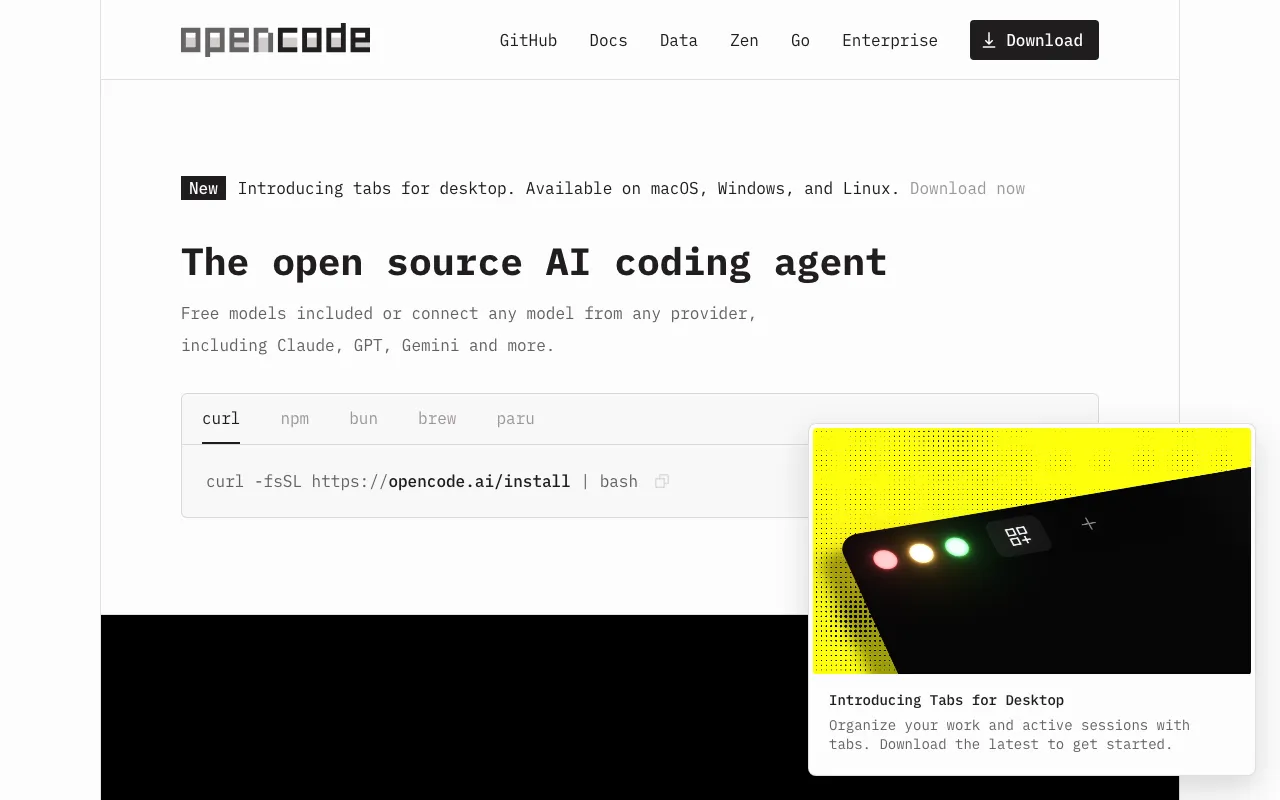
OpenCode
Open-source terminal AI coding agent that works with 75+ model providers, plus an optional Zen gateway and Go subscription
OPEN-SOURCE Verified JUL 18, 2026
5 tools ranked · last updated Jul 19, 2026 · how we picked
The best open-source AI coding agent in 2026 is OpenCode — MIT-licensed, free at $0, and wired to 75+ model providers on your own API key. Cline is the strongest pick inside VS Code with 8M+ installs under Apache-2.0, and OpenHands scores around 53% on SWE-bench Verified if you want to self-host the whole thing. All 5 tools are free to run: you pay your model provider, not the tool, which makes the real monthly cost a function of how much you use it.
Prices last verified Jul 18, 2026 against official pricing pages.
OpenCode is an MIT-licensed terminal coding agent from Anomaly, the company formerly called SST, with more than 187,000 GitHub stars and roughly 900 contributors. The CLI is free and runs against 75+ providers through Models.dev including locally hosted models, and it will accept an existing GitHub Copilot or ChatGPT Plus/Pro login instead of a separate key — a practical detail that removes the usual first-run friction. It stores no code or context data; processing is local or direct to your chosen provider. Optional paid extras exist but are genuinely optional: Go is $10/month ($5 for the first month) for 15 open models with spend caps of $12 per 5 hours and $60 per month, and Zen is pay-as-you-go. Two caveats: bring-your-own-key billing is unpredictable, since a long session on a frontier model escalates with no built-in per-session cap, and the project is young and fast-moving with over 4,700 open issues and pull requests.
Cline is an Apache-2.0 agent shipping as a VS Code extension, CLI, and SDK, with 8M+ installs — the widest real-world deployment in this list. It plans and executes multi-file changes through separate Plan and Act modes, runs terminal commands, supports checkpoints, and extends through an MCP Marketplace and .clinerules files. Its architecture is client-side with bring-your-own key, so your code and prompts go straight to Anthropic, OpenAI, Google, or Bedrock rather than through a vendor middleman, and existing extensions and keybindings stay intact. Solo use needs no subscription; a Teams plan adds central billing at $20/user/month with the first 10 seats permanently free. Two caveats: token costs are real, with typical individual usage running roughly $5–50/month in provider fees and heavy agentic work exceeding $100, and Cline is an agent rather than a Tab-completion tool, so you may still want a separate completion extension.
Aider is MIT-licensed, installs via pip with no account, and does one thing better than anything else here: it edits files directly in your local git repo and auto-commits each change, so every AI edit is reviewable and reversible through tools you already use rather than a proprietary checkpoint system. It is model-agnostic across Claude, GPT, DeepSeek, and others, supports 100+ programming languages, and runs free end to end against a local model via Ollama. Its public polyglot leaderboard, where top models score around 88%, makes model-choice guidance transparent instead of marketing. Two caveats: it is not free in practice, since you pay real API costs that add up quickly on large frontier models, and it is terminal-only with no GUI, which is a steeper learning curve than editor-integrated tools for anyone not already comfortable there.
OpenHands, formerly OpenDevin, is an MIT-licensed autonomous agent that edits code, runs shell commands, browses the web, and opens pull requests, with roughly 78,000 GitHub stars and around 53% on SWE-bench Verified — the clearest published capability figure among these five. It ships a web GUI, a terminal UI, and a CLI, and the core is free to self-host at no platform cost, which matters when the requirement is that the agent runs inside your own perimeter. An optional hosted cloud gives $20 in free starting credits then at-cost LLM usage with no markup, plus Jira and Slack integrations. Two caveats: the free Individual cloud tier caps at roughly 10 conversations a day for 1 user, and self-hosting takes real setup effort before team features jump straight to custom Enterprise pricing with no middle tier.
Zed is the odd one out here and earns its place on speed: a code editor written from scratch in Rust with GPU-accelerated rendering, open source with no feature gating, and an Agent Panel with agentic editing built in rather than bolted on. If you want an agent without leaving a native editor — and want that editor to be genuinely fast — this is the pick. The free Personal plan includes the full editor, 2,000 accepted edit predictions a month, and unlimited model use if you bring your own API key, with external agents working without any subscription. Pro is $10/month for unlimited predictions plus $5 of hosted token credits, overage at API list price plus 10%, and a default $10/month spend cap. Two caveats: AI is metered, so Pro’s $5 credit runs out fast, and Windows support is the newest and least mature of its three desktop platforms.
This list is scoped to tools whose source you can actually read, fork, and self-host — MIT, Apache-2.0, or an equivalent OSI licence — which is a narrower test than “free to use”. Several strong agents have generous free tiers while remaining proprietary, and they are ranked in our general coding roundups instead. Worth stating plainly: Claude Code remains our highest-ranked AI coding tool overall on capability, and it is not open source, so it is deliberately absent here rather than overlooked — if raw coding quality is your only criterion, that is the tool to beat. We ranked what remains on licence clarity, how much work the agent can do unattended, whether your code leaves your machine, and how predictable the real cost is once model tokens are counted. Pricing was verified on July 19 2026 against each product’s official pricing page; no tool paid or provided incentives to appear in this list.
Open-source terminal AI coding agent that works with 75+ model providers, plus an optional Zen gateway and Go subscription
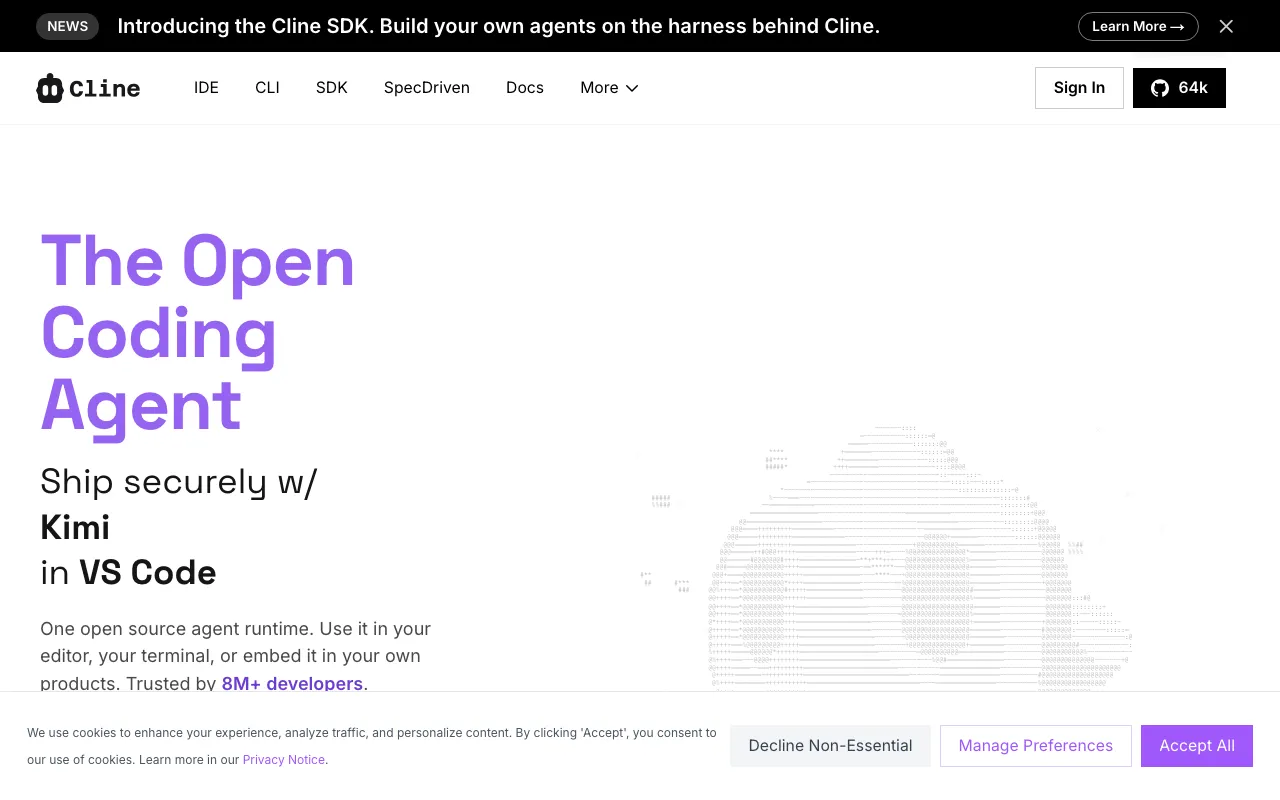
Open-source autonomous coding agent for VS Code that edits files, runs commands, and brings your own model
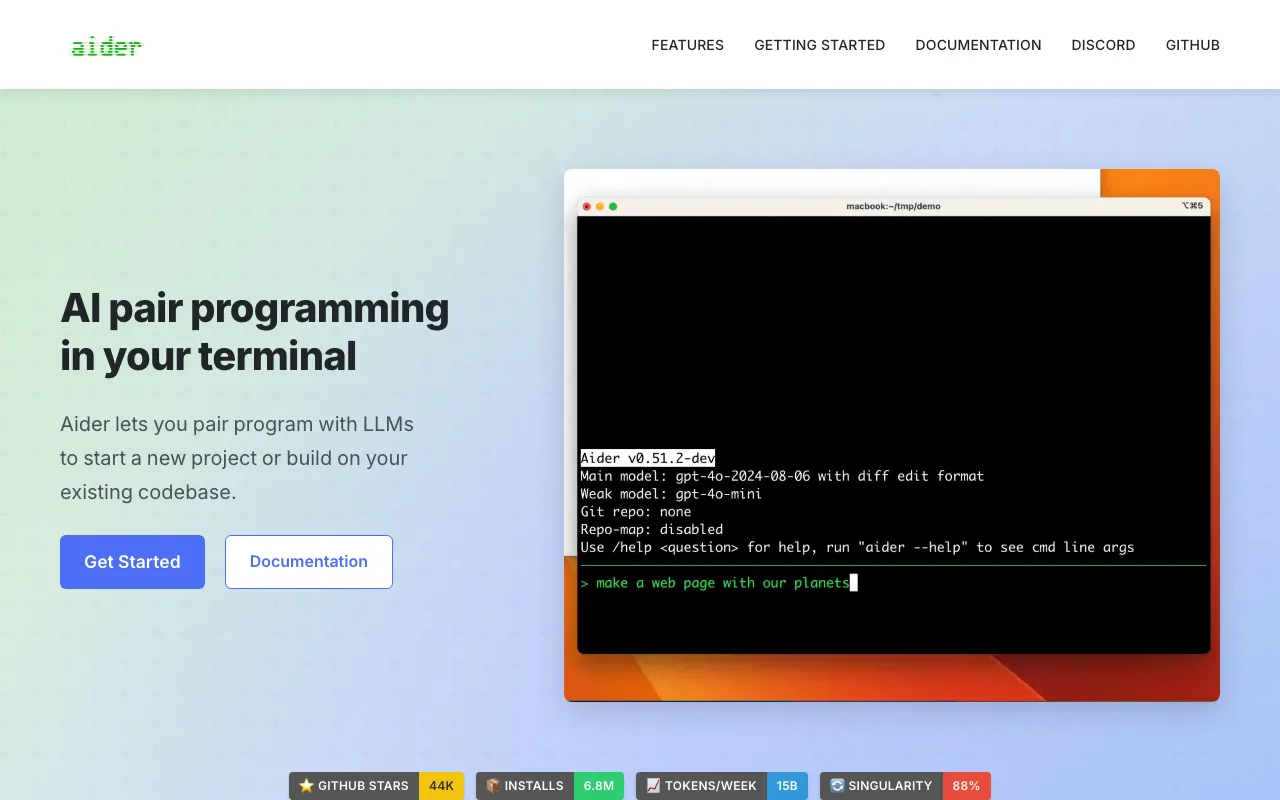
Open-source AI pair programming in your terminal — bring your own LLM key and edit your git repo
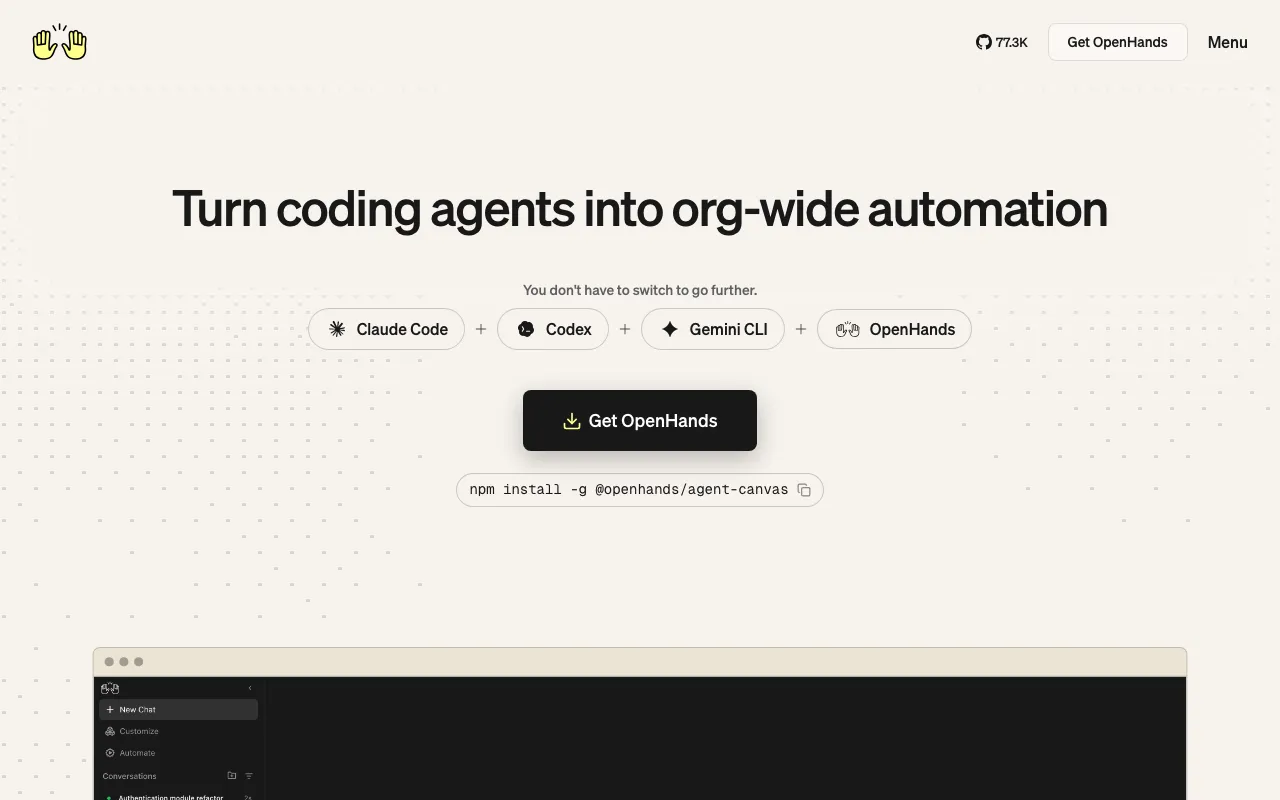
Open-source autonomous AI software-engineering agent that writes code, runs commands, and fixes issues
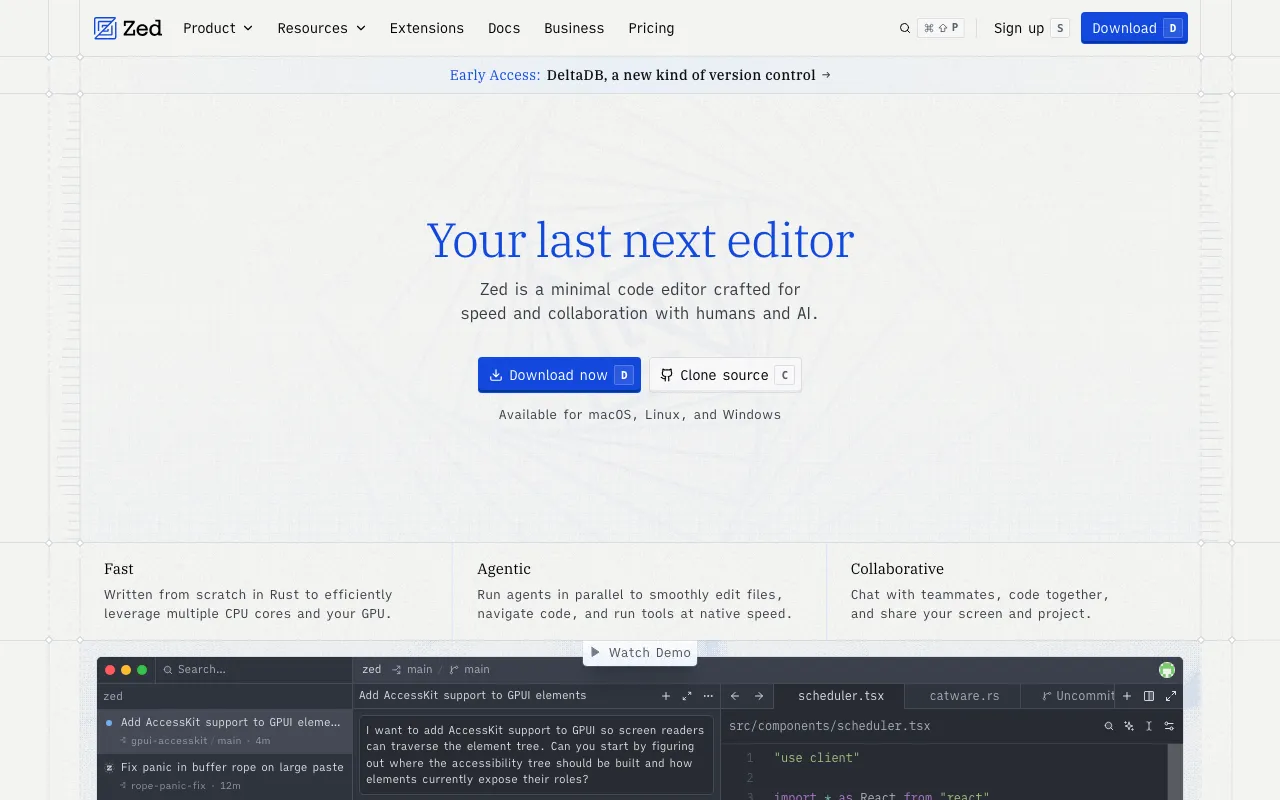
Fast, open-source code editor written in Rust with a built-in AI agent panel and agentic editing
Every tool in this list has a full profile in our directory with pricing verified against its official pricing page on the date shown on its stamp. Ranking reflects verified pricing, free-tier generosity, platform coverage, and documented capabilities — not sponsorships. Nobody can pay to appear here. Read the full methodology.
Yes — 5 of the 5 tools here have a free tier: OpenCode, Cline, Aider, OpenHands, Zed. Pricing verified Jul 19, 2026.
Zed has the lowest verified monthly starting price in this list at $10/mo, checked against its official pricing page on Jun 26, 2026.
3 of the 5 tools list an API: OpenCode, Cline, OpenHands.